
The Green Card Lottery 2026 — officially known as the U.S. Diversity Immigrant Visa (DV-2026) programme — is one of the most accessible routes to US permanent residence for people around the world. Every year, more than 22 million people apply for approximately 51,000–55,000 available visas. Winning the lottery is one route; for skilled workers, there is also the employment-based (EB) pathway — but a strict 7% per-country cap forces applicants from India and China to wait over a decade. This guide covers both routes, who qualifies, which countries are excluded, current wait times, and what to do next.
| At a Glance — Key Numbers 2025–2026 – Green Card Lottery 2026 visas: ~51,600 | Ineligible countries: 19 | Entry: Free at dvprogram.state.gov – Employment-based annual cap: ~140,000–150,000 | Per-country ceiling: 7% of combined annual total (~26,300 visas) – EB-2 India priority date (Sept 2025): Jan 1, 2013 → 12+ year wait – EB-1 India priority date (Sept 2025): Feb 15, 2022 → approx. 3-year wait – EB-2 & EB-3 Rest of World: approx. 2 years | EB-1 Rest of World: Current (no wait) |
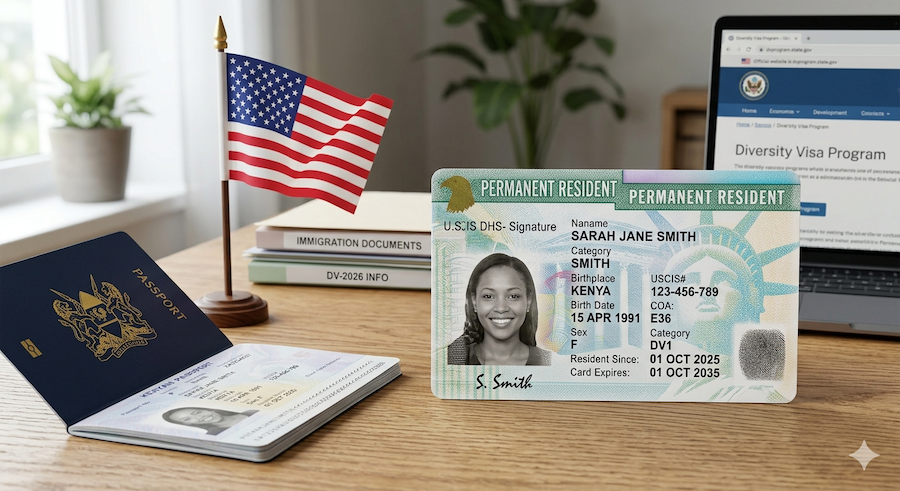
1. What Is the Green Card Lottery 2026?
The Green Card Lottery 2026 is the common name for the U.S. Diversity Immigrant Visa programme, established by the Immigration Act of 1990. Its goal is to diversify US immigration by welcoming people from countries that have historically sent fewer immigrants. It is the only US immigration programme that gives ordinary people — with no US job offer, no American relatives, and no special skills — a direct shot at permanent residence through a random computerised draw. The lottery is administered by the U.S. Department of State and is entirely free to enter.
How Many Visas Are Available?
Congress authorises up to 55,000 diversity visas per year. Mandatory deductions under NACARA (Nicaraguan Adjustment and Central American Relief Act) and the NDAA (National Defense Authorization Act) for FY 2024 reduce the effective total. For DV-2025 and DV-2026, approximately 51,600–52,000 visas were available after these deductions.
Who Is Eligible for the Green Card Lottery 2026?
Two conditions must both be met:
- Country of birth: You must be a native of a country that sent fewer than 50,000 immigrants to the US in the previous five-year period. Countries above that threshold are excluded each year.
- Education or work experience: You must hold at least a high school diploma (or its recognized equivalent), OR have two years of qualifying work experience within the past five years in an occupation requiring at least two years of training.
| Special Rule: Born in an Ineligible Country? You may still qualify through your spouse’s or parents’ country of birth. • If your spouse was born in an eligible country, claim their country as your “chargeability country” — your spouse does not need to apply. • If your parents were both born in a currently eligible country at the time of your birth, you may also claim that country. |
Which Countries Are NOT Eligible for the Green Card Lottery 2026?
The following 19 countries were ineligible for DV-2026. This list changes every year based on five-year immigration trends. Citizens of most African, Eastern European, Central Asian, and many Latin American and Oceanian countries remain eligible.
| Country | Region |
|---|---|
| Bangladesh | Asia |
| Brazil | South America |
| Canada | North America |
| China (mainland & Hong Kong) | Asia |
| Colombia | South America |
| Cuba | Caribbean |
| Dominican Republic | Caribbean |
| El Salvador | Central America |
| Haiti | Caribbean |
| Honduras | Central America |
| India | Asia |
| Jamaica | Caribbean |
| Mexico | North America |
| Nigeria | Africa |
| Pakistan | Asia |
| Philippines | Asia |
| South Korea | Asia |
| Venezuela | South America |
| Vietnam | Asia |
Note: The list changes every year. Citizens of most African, Eastern European, Central Asian, and many Latin American countries remain eligible each year. Always check the official State Department instructions for the current year’s list.
How to Apply for the Green Card Lottery 2026: Step by Step
- Go to dvprogram.state.gov during the annual registration window (typically early October to early November). This is the only official entry portal — paper submissions are not accepted.
- Complete the online form carefully. Upload a recent photograph meeting the exact State Department specifications. Errors or duplicate entries cause automatic disqualification.
- Save your unique confirmation number immediately after submitting. The government will NOT notify you by email, letter, or phone if selected. Your confirmation number is the only way to check your status.
- Check results from early May of the following year using the Entrant Status Check on the official website. Results for DV-2026 were available from 3 May 2025.
- If selected, gather documents promptly: A valid passport, birth certificate, police clearance certificates, and educational credentials. Book a medical examination with a State Department-approved physician.
- Attend your consular interview (outside the US) or file Form I-485 for Adjustment of Status (if already lawfully in the US). All processing must finish by 30 September of the relevant fiscal year — visas cannot carry over.
| Green Card Lottery 2026 — Key Dates Registration window: 2 October 2024 – 7 November 2024 (this cycle has closed) Results check online: From 3 May 2025 — dvprogram.state.gov (Entrant Status Check) Processing deadline: 30 September 2026 — no extensions, unused visas are permanently forfeited DV-2027 registration: Expected October–November 2025 · Results: May 2026 |
| ⚠ Scam Warning: Protect Yourself The US government will NEVER send an unsolicited email or letter saying you have won. Entering the Green Card Lottery is 100% free. Never pay anyone to register on your behalf. Only use the official site: dvprogram.state.gov. Dozens of copycat websites charge fees for a free process. If you receive an email claiming you were selected, go directly to dvprogram.state.gov to verify — do not click links in unsolicited messages. |
2. Employment-Based Green Cards — The 7% Country Cap Problem
For skilled workers, executives, researchers, and investors, the employment-based (EB) system provides five preference categories with a combined annual limit of approximately 140,000–150,000 visas. A single structural rule — the 7% per-country ceiling — means your country of birth determines not just whether you wait, but for how long.
| Category | Who Qualifies | Annual Limit | % of EB Total |
|---|---|---|---|
| EB-1 | Extraordinary ability, outstanding professors/researchers, multinational executives | ~40,000 | 28.60% |
| EB-2 | Advanced degree holders or exceptional ability; NIW available | ~42,900 | 28.60% |
| EB-3 | Skilled workers (2+ yrs exp), professionals, other workers | ~40,000 | 28.60% |
| EB-4 | Special immigrants (religious workers, broadcasters, etc.) | ~9,940 | 7.10% |
| EB-5 | Investors: $800K–$1.05M min. investment creating 10 jobs | ~9,940 | 7.10% |
How the 7% Per-Country Cap Works
Under the Immigration and Nationality Act, no single country may receive more than 7% of the combined total annual employment-based and family-sponsored preference visas. For FY-2025, this ceiling equals approximately 26,300 visas per country — regardless of how many qualified applicants come from that country.
The practical effect: a software engineer from Estonia and one from India, with identical qualifications and petitions filed on the same day, face vastly different waits. The Estonian may receive a green card within 1–2 years. The Indian national may wait 12+ years — solely because India generates far more employment-based applicants than the annual cap allows.
Current Backlog Data (September 2025 Visa Bulletin)
- EB-1 India: Priority date Feb 15, 2022 → approx. 3-year wait. All other countries: Current (no wait).
- EB-2 India: Priority date Jan 1, 2013 → over 12-year wait. Affects the majority of Indian H-1B holders pursuing green cards.
- EB-3 India: Priority date May 22, 2013 → over 12 years.
- EB-2 China: Priority date Dec 15, 2020 → approximately 4–5 years.
- EB-3 Philippines: Priority date Feb 8, 2023 → approximately 2 years.
- EB-2 Rest of World: Retrogressed in mid-2025 due to record demand — even countries without historical backlogs faced temporary delays.
- All FY-2025 EB-2 visas exhausted by September 2025 — processing paused until the FY-2026 quota reset on 1 October 2025.
| Why Has the Country Cap Not Been Reformed? – The ~140,000 annual employment-based cap has not changed since the Immigration Act of 1990 — over 35 years ago. – The Fairness for High-Skilled Immigrants Act (S.386) proposed phasing out the per-country ceiling. It passed the House but stalled repeatedly in the Senate. – Congressional Research Service analysis: removing the cap would cut Indian/Chinese wait times but would not reduce the overall backlog — it would only redistribute who waits. – As of April 2026, no legislation has been passed to change the 7% per-country cap. |
Cross-Chargeability: A Workaround for Couples
If you and your spouse were born in different countries and your spouse’s birth country has a shorter EB queue, both of you may be charged to your spouse’s country — even though you are the primary applicant. For example, an Indian national married to a German national could potentially receive a green card in months rather than years. Consult a licensed immigration attorney to determine whether this applies to your situation.
3. Family-Based Green Cards
US citizens and lawful permanent residents (LPRs) may sponsor certain family members for permanent residence. The family-sponsored system has an annual limit of 226,000 visas. Key points:
- Immediate Relatives of US citizens: Spouses, unmarried children under 21, and parents face no annual numerical cap and no waiting list — the fastest family-based route.
- Family Preference categories (F1–F4): Cover adult unmarried children, married children, and siblings of US citizens, plus spouses and children of LPRs. Subject to annual limits — wait times range from a few years to over 20 years depending on the category and country of birth.
- Country caps apply here too: Nationals of Mexico and the Philippines face significantly longer waits than applicants from most other countries in several family preference categories.
- Derivatives: Spouses and unmarried children under 21 of the principal applicant are included on the same petition and may travel together.
4. Practical Tips for Applicants Worldwide
- File as early as possible. Your priority date is set when USCIS receives your petition. The backlog grows every year — every month of delay adds time to your wait.
- Check the Visa Bulletin monthly at travel.state.gov. Priority dates move forward and can retrogress without notice. You need to know your eligibility window in real time.
- Explore EB-1A (Extraordinary Ability). No employer, no PERM, no job offer needed. Significantly faster for those who qualify.
- Consider EB-2 National Interest Waiver (NIW). Self-petition without employer sponsorship — requires demonstrating your work benefits the US national interest.
- Use cross-chargeability if your spouse was born in a country with a shorter queue. This alone can turn a 12-year wait into under 2 years for eligible couples.
- Keep all documents current. Medical exam results, police certificates, and passport validity all expire. An out-of-date document can pause your case precisely when your priority date becomes current.
- Never miss the DV Lottery results window. Check from early May each year. If selected and you miss the 30 September deadline, the visa is permanently lost — no exceptions.
- Do not submit duplicate DV Lottery entries. A second entry in the same year causes automatic disqualification of both entries.
- Get legal advice for employment-based cases. The rules around PERM, I-140, Adjustment of Status, and portability are complex. Mistakes are costly and sometimes irreversible.
5. All US Green Card Routes at a Glance
| Route | Key Facts (2025–2026) |
|---|---|
| DV Lottery | ~51,600 visas/yr. Free to enter. Ineligible: 19 countries incl. India, China, Mexico. Results online in May. |
| EB-1 | ~40,000/yr. No job offer needed for EB-1A. India/China backlogged ~3 years. Others: current. |
| EB-2 | ~42,900/yr. India backlog >12 years. Rest of World: ~2 years. All FY2025 visas exhausted by Sept 2025. |
| EB-3 | ~40,000/yr. India backlog ~12 years. China ~5 years. Philippines ~2 years. |
| Family-Based | 226,000/yr total. Immediate availability for spouses of US citizens. Other categories: varies. |
6. Frequently Asked Questions
Q: What is the Green Card Lottery 2026?
The Green Card Lottery 2026 is the popular name for the U.S. Diversity Immigrant Visa (DV-2026) programme, run by the U.S. Department of State. It randomly selects approximately 51,000–55,000 people from eligible countries each year and gives them the chance to apply for US permanent residence (a green card). Entry is completely free.
Q: Is the Green Card Lottery free to enter?
Yes. Registering on dvprogram.state.gov costs nothing. In 2025 the State Department added a $1 processing fee. If you are selected, normal government visa processing fees apply. Never pay a third-party website — they cannot improve your odds and the entire entry process is do-it-yourself online.
Q: Which countries cannot apply for the Green Card Lottery 2026?
19 countries were ineligible for DV-2026: Bangladesh, Brazil, Canada, China (mainland & Hong Kong), Colombia, Cuba, Dominican Republic, El Salvador, Haiti, Honduras, India, Jamaica, Mexico, Nigeria, Pakistan, Philippines, South Korea, Venezuela, and Vietnam. This list is updated every year based on five-year immigration trends.
Q: I was born in an ineligible country — can I still enter?
Possibly yes. If your spouse was born in an eligible country, you may claim their country as your “chargeability country” and still qualify — even if your spouse does not apply. The same applies if your parents were both born in an eligible country at the time of your birth.
Q: What education or work experience is required?
You need at least a high school diploma (or equivalent), OR two years of qualifying work experience within the past five years in an occupation that requires at least two years of training or experience. The U.S. Department of Labor O*Net system determines which occupations qualify.
Q: How long is the wait for an employment-based green card from India?
As of the September 2025 Visa Bulletin, EB-2 and EB-3 applicants from India face waits exceeding 12 years — priority dates are stuck around January–May 2013. EB-1 India is approximately 3 years. The root cause is the 7% per-country cap: no single country can receive more than 7% of annual employment-based visas, regardless of total demand.
Q: Can I change jobs while waiting for my green card?
Switching employers before your I-140 petition is approved risks your place in the queue. However, under the AC21 portability rule, once your I-140 is approved and your I-485 has been pending for 180+ days, you may move to a similar job without losing your priority date. Always consult a licensed immigration attorney before changing jobs during the green card process.
Q: What happens after I am selected in the DV Lottery?
Selection means you are eligible to apply for a visa — it does not guarantee a green card. You must still pass background and security checks, a medical examination, and a consular interview (or file I-485 if you are already in the US). All processing must be completed by 30 September of the relevant fiscal year. Unused DV visas cannot carry over.
| Disclaimer: This article is for general informational purposes only and does not constitute legal advice. US immigration rules change frequently — always verify current information at travel.state.gov and uscis.gov, and consult a licensed immigration attorney for advice specific to your situation. Sources: U.S. Department of State (travel.state.gov) · USCIS (uscis.gov) · FY-2025 Visa Bulletin (September 2025) · Wikipedia Diversity Immigrant Visa · Congressional Research Service Report R46291 · Fragomen Immigration Law. |
Also Read
- US Green Card Eligibility – Are You Eligible?
- What is US Green Card Lottery Program
- US green card lottery eligible countries
- H1B Visa Status: Change is in the Air and the India May Benefit
- No Modification to H1B Visa Extension Policy
- Trump’s Immigration Reform
- Applying for USA EB5 Visa Program – The A to Z
- US Immigration Through Investment – Can Investment Helps Get A Green Card?
- US Green Card Benefits – 6 Reasons Why You Should Go for It