
US green card eligibility comes down to three tests, and an applicant must pass all three: you have to fit a category Congress wrote into law, a visa number must be available in your category and country of chargeability, and you must be admissible to the United States. Most people asking whether they qualify think only about the first test. The second and third are where applications stall.
This guide sets out every US green card eligibility route as the rules stand in August 2026, the limits attached to each, and the requirements that apply whichever route you take. For what permanent residence is and how the application works, see the full US green card overview.
Key Takeaways
- US green card eligibility has three parts, not one: you must fit a statutory category, an immigrant visa number must be available to you, and you must be admissible to the United States.
- US green card eligibility runs through six routes — family, employment, investment, the diversity visa lottery, humanitarian protection, and a small group of special categories.
- The EB-5 minimum is $800,000 in a targeted employment area and $1,050,000 elsewhere. The $500,000 figure has not been law since March 2022, and both amounts adjust on 1 January 2027.
- Fiscal year 2026 limits: 226,000 family-sponsored visas, 186,317 employment-based visas, up to 55,000 diversity visas, and a 7% per-country ceiling of 28,862.
- US green card eligibility is not the same as visa availability. In the September 2026 Visa Bulletin, EB-2 India and EB-5 unreserved India were both marked “U” — unavailable.
- Most sponsored applicants need a sponsor earning at least 125% of the federal poverty guideline, and revised USCIS public charge guidance takes effect on 18 September 2026.
Table of Contents
What US Green Card Eligibility Actually Means
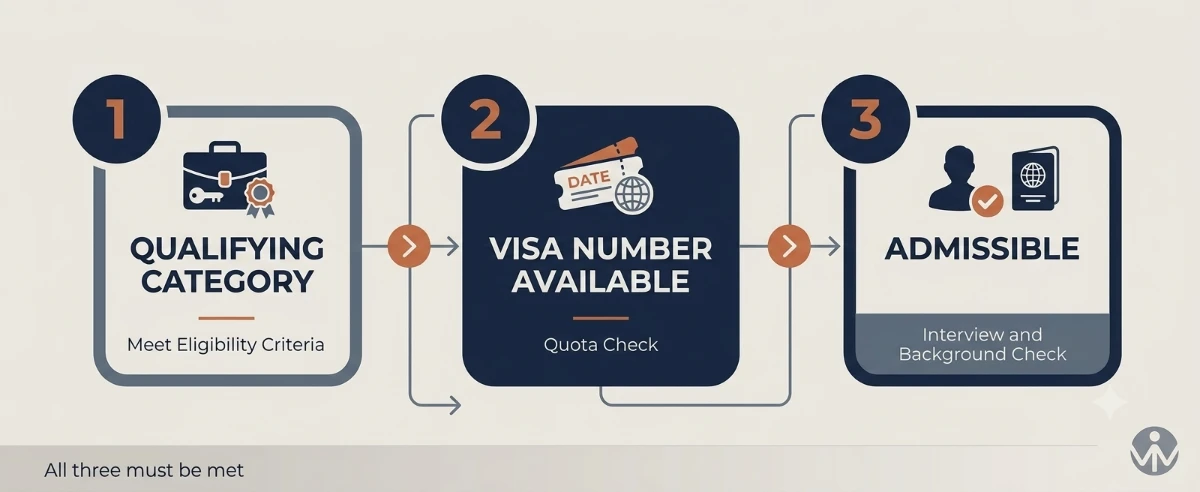
A green card confers lawful permanent residence: the right to live and work anywhere in the United States indefinitely and, after a qualifying period, to apply for naturalisation. What that status is worth is set out in our guide to the benefits of permanent residence. US green card eligibility is fixed by the Immigration and Nationality Act rather than left to official discretion, so the first question is which statutory category you fit.
The second question is numerical. Congress caps most categories annually and applies a per-country ceiling of 7% — 28,862 visas in fiscal year 2026 — so nationals of high-volume countries wait far longer than everyone else in the same category. Your place in that queue is your priority date, the day your petition was properly filed. Each month the State Department publishes a Visa Bulletin showing which priority dates have reached the front.
The third question is admissibility. Health, criminal history, security concerns, earlier immigration violations and the likelihood of becoming a public charge can each bar an otherwise qualified applicant. Assessing US green card eligibility means holding all three tests in view at once, because a strong case on one can be defeated by either of the others.
The Six US Green Card Eligibility Routes at a Glance
Family and employment account for the overwhelming majority of green cards issued each year. The remaining routes are smaller but decisive for the people who qualify under them.
Table 1: The six US green card eligibility routes compared
| Route | Who qualifies | Annual limit (FY2026) | Petitioner needed? |
|---|---|---|---|
| Family — immediate relative | Spouse, unmarried child under 21, or parent of a US citizen aged 21 or over | No numerical limit | Yes — US citizen relative |
| Family — preference (F1–F4) | Other qualifying relatives of US citizens and lawful permanent residents | 226,000 across all preferences | Yes — US citizen or permanent resident relative |
| Employment (EB-1 to EB-4) | Workers with qualifying skills, job offers or special immigrant status | 186,317 across all EB categories | Usually — most need an employer petition |
| Investment (EB-5) | Investors of $800,000 or $1,050,000 who create ten qualifying jobs | Counted within the 186,317 EB total | No — self-petition |
| Diversity visa lottery | Nationals of low-admission countries who meet the education or work test | Up to 55,000 | No — self-entry |
| Humanitarian | Refugees, asylees, VAWA self-petitioners, T and U visa holders, Special Immigrant Juveniles | No fixed green card cap | No — self-petition in most cases |
| Fiscal year 2026 limits as published in the Visa Bulletin for September 2026, US Department of State. Verified 22 August 2026. | |||
Family-Based US Green Card Eligibility
Family sponsorship splits into two tiers, and the gap between them is the single most consequential fact in family-based US green card eligibility.
Immediate relatives of US citizens are exempt from numerical limits altogether: the spouse of a US citizen, an unmarried child under 21, and the parent of a citizen aged 21 or over. No annual cap means no queue — once the petition is approved and the applicant is admissible, a visa number is available.
Everyone else falls into the family preference categories, sharing 226,000 visas in fiscal year 2026. F1 covers unmarried adult sons and daughters of US citizens; F2A the spouses and minor children of permanent residents; F2B their unmarried adult children; F3 the married children of citizens; F4 the siblings of adult citizens. Waits are long and wildly uneven: F4 for India stood at a November 2006 priority date in September 2026, while F2A was close to current everywhere.
Two limits on family-based US green card eligibility catch people out. Permanent residents can sponsor only a spouse or an unmarried child, never a parent or sibling. And a child who turns 21 while waiting can lose derivative eligibility; the Child Status Protection Act freezes their age in defined circumstances, but USCIS tightened how that age is calculated in 2025. Filing mechanics are covered in our guide to the family-based green card application.
Employment-Based US Green Card Eligibility
Employment-based US green card eligibility is divided into five preference categories, with 186,317 visas available in fiscal year 2026. That figure sits well above the 140,000 statutory floor still quoted on many sites because unused family-sponsored numbers from the previous year roll over into the employment total.
US green card eligibility across the five employment preferences
EB-1 covers extraordinary ability in the sciences, arts, education, business or athletics, outstanding professors and researchers, and certain multinational executives. EB-2 covers advanced degree holders and people of exceptional ability, and a national interest waiver can remove the job offer and labour certification requirements. EB-3 covers professionals, skilled workers with two years of experience, and other workers in unskilled positions. EB-4 is a narrow special immigrant classification. EB-5 is the investor route, below.
Most EB-2 and EB-3 applicants need an employer willing to petition and, before that, a permanent labour certification from the Department of Labor showing no qualified US worker is available. EB-1 and national interest waiver applicants self-petition. Our guide to the five employment preference categories works through each in turn, and moving from an O-1 visa to a green card sets out one common route in.
Read: The EB-2 national interest waiver route
Where the queue blocks otherwise eligible applicants
Meeting a category’s criteria is not the same as being able to use it. In the September 2026 Visa Bulletin, two lines carried a “U” for unavailable: EB-2 for India and EB-5 unreserved for India. Applicants there are eligible on the merits and simply cannot be issued a visa until numbers reset on 1 October 2026.
Table 2: US green card eligibility by employment category — final action dates, September 2026
| Category | All other countries | China | India | Mexico | Philippines |
|---|---|---|---|---|---|
| EB-1 | Current | 1 Jul 2023 | 15 Oct 2022 | Current | Current |
| EB-2 | Current | 1 Sep 2021 | Unavailable | Current | Current |
| EB-3 professionals and skilled workers | 1 Sep 2024 | 1 Jan 2022 | 1 Jan 2014 | 1 Sep 2024 | 1 Aug 2023 |
| EB-3 other workers | 1 Apr 2022 | 1 May 2019 | 1 Jan 2014 | 1 Apr 2022 | 1 Dec 2021 |
| EB-4 special immigrants | 15 Dec 2022 | 15 Dec 2022 | 15 Dec 2022 | 15 Dec 2022 | 15 Dec 2022 |
| EB-5 unreserved | Current | 1 Dec 2016 | Unavailable | Current | Current |
| Final action dates, Visa Bulletin for September 2026, US Department of State. “Unavailable” means no visa numbers remain in that category and country for the fiscal year. Dates move monthly and can move backwards. | |||||
The 7% per-country ceiling produces this distortion. Reform bills have repeatedly proposed raising or removing it, and none has become law; our article on the per-country cap traces that history.
Investment-Based US Green Card Eligibility: the EB-5 Route
EB-5 grants permanent residence to investors who invest capital in a new US commercial enterprise and create at least 10 full-time jobs for qualifying US workers within roughly 2 years.
The minimum is $800,000 for a project in a targeted employment area and $1,050,000 anywhere else. The $500,000 figure still repeated across the web has not been law since March 2022, when the EB-5 Reform and Integrity Act replaced it. Both amounts adjust for inflation every five years, the next adjustment falling due on 1 January 2027.
Capital must be lawfully sourced and genuinely at risk, and the investor must be involved in the enterprise at least at policy level. The same Act reserved a share of EB-5 numbers for specific project types, which is why rural and high-unemployment applicants often move faster than those in the unreserved queue.
Table 3: EB-5 minimum investment and reserved visa allocations
| Project type | Minimum investment | Share of EB-5 visas reserved | Next change |
|---|---|---|---|
| Targeted employment area — rural | $800,000 | 20% | Inflation adjustment, 1 January 2027 |
| Targeted employment area — high unemployment | $800,000 | 10% | Inflation adjustment, 1 January 2027 |
| Qualifying infrastructure project | $800,000 | 2% | Inflation adjustment, 1 January 2027 |
| Any other new commercial enterprise | $1,050,000 | 68% (unreserved) | Inflation adjustment, 1 January 2027 |
| Amounts set by the EB-5 Reform and Integrity Act of 2022, which requires an inflation adjustment every five years; the next takes effect 1 January 2027. The $500,000 minimum that applied before March 2022 no longer exists. Verified 22 August 2026. | |||
Beyond the money, US green card eligibility under EB-5 turns on the project itself. Our guide to the EB-5 immigrant investor programme covers project selection, regional centres and the conditional residence period following approval.
Diversity Visa Lottery: US Green Card Eligibility Without a Sponsor
The diversity visa lottery makes up to 55,000 green cards available each year to nationals of countries that have sent relatively few immigrants to the United States. Eligibility has two parts. Your country of birth must be on the eligible list for that year — broadly, countries that sent fewer than 50,000 immigrants in the preceding five years. And you must have completed secondary education, or have two years of work experience in the last five in an occupation requiring two years of training.
Applicants born in an ineligible country can sometimes qualify through a spouse’s or parent’s country of birth, a rule known as cross-chargeability. The list of eligible countries changes from year to year.
Entry is no longer free: a $1 registration fee applies and cannot be waived. The State Department announced changes to the DV-2027 entry process and has confirmed the visa application period of 1 October 2026 to 30 September 2027, but the entry and selection timetable has been unsettled, so check the official announcement before relying on any date. Our diversity visa lottery guide tracks the position.
Humanitarian US Green Card Eligibility Routes
People granted refugee status are required to apply for a green card after one year of physical presence in the United States. People granted asylum are permitted, not required, to apply after one year. Neither route needs a sponsor.
Several protective categories also confer US green card eligibility. A spouse, child or parent abused by a US citizen or permanent resident may self-petition under the Violence Against Women Act without the abuser’s knowledge. Holders of T visas, for trafficking victims, and U visas, for victims of certain crimes who assist law enforcement, can adjust status once presence requirements are met. Children who cannot be reunited with a parent because of abuse, abandonment or neglect may qualify as Special Immigrant Juveniles.
Less Common US Green Card Eligibility Categories
Narrower categories complete the picture. The Registry allows a person who has resided continuously in the United States since before 1 January 1972 to apply regardless of how they entered the United States. The EB-4 classification covers certain religious workers, Afghan and Iraqi nationals who worked for the US government, international broadcasters and some former NATO employees. Country-specific statutes, the Cuban Adjustment Act among them, create their own routes. These categories issue few green cards, but for anyone who fits one they are often the fastest available.
The US Green Card Eligibility Rules That Apply to Everyone
Whichever route you take, three further US green card eligibility requirements sit on top of it.
Admissibility: the US green card eligibility test everyone must pass
Section 212(a) of the Immigration and Nationality Act lists the grounds on which a person can be refused: communicable diseases of public health significance and missing vaccinations, a range of criminal convictions, security and terrorism grounds, fraud or misrepresentation in an earlier application, and unlawful presence — more than 180 days triggers a three-year bar on return, more than a year a ten-year bar. Waivers exist for some grounds and not others, and most require showing extreme hardship to a qualifying US relative.
Since 21 January 2026, the State Department has also paused immigrant visa issuance for nationals of around 80 countries pending public benefits screening. Applications can be filed, and interviews still take place, but visas are not being issued to affected nationals. The list changes, so check it directly.
Sponsor income: the US green card eligibility floor for family cases
Most family-based applicants need a sponsor to file Form I-864, a legally enforceable undertaking to support the immigrant. The sponsor’s household income must reach 125% of the federal poverty guideline for their household size; an active-duty service member sponsoring a spouse or child qualifies at 100%. A joint sponsor can be used where the petitioner falls short, and assets can cover a shortfall at a statutory ratio. The current poverty guidelines for the affidavit of support are published by USCIS.
Table 4: Sponsor income floors affecting US green card eligibility, 2026 (48 contiguous states)
| Household size | 125% of the poverty guideline | 100% — active-duty sponsor of a spouse or child |
|---|---|---|
| 2 | $27,050 | $21,640 |
| 3 | $34,150 | $27,320 |
| 4 | $41,250 | $33,000 |
| 5 | $48,350 | $38,680 |
| HHS poverty guidelines effective 13 January 2026 as applied on Form I-864P. Higher figures apply in Alaska and Hawaii. Household size counts the sponsor, the sponsor’s dependants and the intending immigrant. | ||
Public charge, and what changes on 18 September 2026
Public charge is a ground of inadmissibility in its own right and reaches almost every category. USCIS issued revised guidance on 18 August 2026, applying to adjustment applications filed on or after 18 September 2026, under which receipt of any means-tested public benefit may be weighed rather than only the narrower set considered since 2022. Officers assess each case in the round — age, health, family status, assets, income, education and skills — rather than applying a single threshold. The State Department separately runs a pilot allowing some applicants refused on public charge grounds to post a bond, the amount set case by case.
US Green Card Eligibility and Where You Apply
Eligibility also determines where the application is made. Someone already in the United States who entered lawfully and, in most categories, has maintained status can file Form I-485 to adjust status without leaving. Immediate relatives of US citizens have more latitude here than preference applicants. Everyone else goes through consular processing: the National Visa Center collects documents, and the interview takes place at a US embassy or consulate, which since 2025 is expected to be in the applicant’s country of nationality or residence. USCIS has also narrowed when a green card interview is waived, so plan on attending one.
How to Check Your Own US Green Card Eligibility
Work through it in order. Identify the category that fits you best, and where more than one fits, compare the queues rather than assuming the obvious one is fastest. Establish the priority date your petition would carry. Check it against the current Visa Bulletin for your country of chargeability. Review the admissibility grounds honestly, including anything in your immigration history that predates this application. Then confirm a sponsor can meet the income floor, or that a joint sponsor is available.
US green card eligibility is worth reassessing periodically rather than settling once. Categories retrogress and advance every month, the EB-5 thresholds change on 1 January 2027, and the public charge rules change next month.
Frequently Asked Questions
Can I apply for a green card without a sponsor?
Yes, in several categories. EB-1 applicants with extraordinary ability, EB-2 applicants granted a national interest waiver, EB-5 investors, diversity visa lottery entrants, refugees, asylees and VAWA self-petitioners all file on their own behalf. Most other family and employment routes require a petitioner.
Who decides my US green card eligibility?
Two agencies, depending on where you apply. USCIS decides adjustment of status applications filed inside the United States. A consular officer of the State Department decides immigrant visa applications filed abroad. Both apply the same statutory grounds, but they do not always reach the same result on discretionary questions.
Does the $500,000 EB-5 investment amount still exist?
No. It was replaced in March 2022 by the EB-5 Reform and Integrity Act. The minimum is now $800,000 in a targeted employment area and $1,050,000 elsewhere, and both figures will adjust for inflation on 1 January 2027.
What does “U” next to my category in the Visa Bulletin mean?
It means no immigrant visa numbers remain in that category and country for the current fiscal year. In the September 2026 bulletin, EB-2 India and EB-5 unreserved India were both marked “U”. Eligibility is unaffected; only issuance is paused until numbers reset on 1 October.
How long does US green card eligibility take to become an actual green card?
It depends entirely on category and country of birth. An immediate relative of a US citizen may finish inside a year. An Indian national in EB-3 faced a January 2014 final action date in September 2026, a wait measured in more than a decade.
Can a criminal record make me ineligible?
It can. Convictions involving moral turpitude, controlled substance offences, and multiple convictions carrying an aggregate sentence of five years or more are among the grounds of inadmissibility. Some are waivable, and some are not, and the analysis turns on the specific offence rather than the sentence alone.
Do I lose US green card eligibility if I have received public benefits?
Not automatically. Public charge is a forward-looking assessment of whether you are likely to become primarily dependent on government support, weighed against your age, health, income, assets, education and skills. From 18 September 2026, a wider range of means-tested benefits may be taken into account.