
| Key Takeaways |
| Foreign nationals can acquire Thailand citizenship mainly through naturalization based on permanent residency, or through marriage to a Thai citizen, which shortens the residency requirement. |
| General naturalization applicants must be at least 20 years old, hold Thai permanent residency for a minimum of 5 continuous years, and meet income, tax, and Thai language requirements. |
| Applicants married to a Thai national can apply after 3 years of continuous residence in Thailand without first obtaining permanent residency. |
| A points-based system (100 points; minimum 50 required) assesses age, income, education, and Thai language ability for naturalization applications. |
| Application fees range from approximately 1,000 THB to 10,000 THB depending on applicant age and application type; processing can take 1 to 3 years. |
| Thailand generally permits dual citizenship, though naturalized citizens may still be asked to declare an intent to renounce a prior nationality where their home country does not allow dual nationality. |
Thailand citizenship is available to foreign nationals mainly through naturalization, marriage to a Thai citizen, or descent from a Thai parent. For long-term residents, naturalization is the most common route, and it follows a defined legal process under the Nationality Act B.E. 2508 (1965), administered by the Special Branch of the Royal Thai Police and the Ministry of Interior. This guide sets out who qualifies for Thailand citizenship, how the points-based assessment works, what documents and fees are involved, and what to expect at each stage of the application.
Who Can Apply for Thailand Citizenship
There are two primary pathways for a foreign national seeking Thailand citizenship by naturalisation: through prior permanent residency, or through marriage to a Thai citizen. A separate, much smaller pathway exists for those with Thai descent, distinguished service to Thailand, or other exceptional grounds recognised under Section 11 of the Nationality Act, which are decided at the Minister’s discretion.
General Naturalization (Permanent Residency Route)
Applicants pursuing Thailand citizenship without a Thai spouse must generally have held Thai permanent residency for at least 5 continuous years before filing. Core requirements include:
- Being at least 20 years old, the age of legal majority under Thai law
- Holding the same category of permanent residency for the full 5-year period before applying
- A clean criminal record and good conduct
- A stable income, generally at least 80,000 THB per month, evidenced by tax filings
- A valid work permit maintained for at least 3 consecutive years
- Proficiency in spoken and written Thai, including the ability to sing the Thai National Anthem and the Royal Anthem
Naturalization Through Marriage to a Thai Citizen
A foreign national legally married to a Thai citizen can apply for Thailand citizenship without first holding permanent residency. This route requires 3 years of continuous residence in Thailand on a valid visa (commonly a marriage or work visa) and a lower minimum monthly income, generally 40,000 THB. Applicants must also meet the same age, conduct, and Thai-language requirements as the general route, though those applying solely on marriage grounds are typically exempted from the anthem-singing requirement.
Thailand Citizenship by Descent
A child born to at least one Thai parent, whether inside or outside Thailand, acquires Thai nationality at birth under Section 7 of the Nationality Act and does not need to apply for naturalization. Documentation requirements for registering the child and obtaining a Thai passport should be confirmed with the nearest Royal Thai Embassy or consulate.
The Points-Based Assessment System
General naturalization applications for Thailand citizenship are scored against a 100-point system, with a minimum of 50 points required to proceed. The system weighs factors including age, income, length of residence, education, and Thai language ability, alongside an assessment of the applicant’s conduct.
| Criterion | Scoring Basis | Maximum Points |
|---|---|---|
| Age | Higher scores for applicants in prime working-age brackets | 20 |
| Income and tax history | Assessed against minimum monthly income thresholds and years of tax filings | 20 |
| Length of residence in Thailand | Continuous years held on permanent residency or qualifying visa status | 20 |
| Education | Level of formal education, including Thai qualifications where applicable | 15 |
| Thai language ability | Speaking, listening, reading, and writing proficiency assessed at interview | 15 |
| Conduct and background | Criminal record, behavior, and interview assessment by Special Branch | 10 |
Documents Required for a Thailand Citizenship Application
The Special Branch office where the application is filed issues the definitive checklist, and requirements can vary from case to case. In general, applicants should expect to prepare the following.
| Document | Notes |
|---|---|
| Valid passport and copies | All pages, including entry/exit stamps |
| Certificate of Residence or Certificate of Foreigner Identity (Tor.Ror.14) | Proof of continuous domicile in Thailand |
| Work permit history | Typically 3 consecutive years of work permits, if applying on employment grounds |
| Income and tax certificates | Personal income tax filings supporting the minimum monthly income threshold |
| Bank certificate | Showing funds on deposit, per Special Branch requirements at the time of filing |
| Marriage certificate and spouse’s Thai ID | Required if applying on marriage grounds |
| Photographs | Per the specification issued by the filing Special Branch office |
| Criminal background clearance | From Thailand and, where required, the applicant’s home country |
Thailand Citizenship Application Process
Naturalization to Thailand citizenship follows a multi-stage administrative process that moves between the police, the Ministry of Interior, and the Royal Palace. Processing commonly takes between 1 and 3 years from filing to the final oath ceremony, and timelines vary significantly by case and by the Special Branch office handling the file.
1. File the application: Submit the application and supporting documents to the Special Branch of the Royal Thai Police in Bangkok, the Provincial Police (outside Bangkok), or the nearest Royal Thai Embassy or consulate if filing from abroad.
2. Document verification and interview: Special Branch reviews the submission and conducts an interview assessing Thai language ability, general knowledge of Thailand, and the applicant’s background.
3. Forwarding to the Ministry of Interior: Once Special Branch is satisfied, the file is forwarded to the Ministry of Interior, which reviews the case through its Subcommittee and Review Committee on Nationality.
4. Ministerial decision: The Minister of Interior has final discretion to approve or deny the application. There is no statutory right to a positive outcome and no fixed decision deadline.
5. Royal Assent and Government Gazette publication: Approved applications are forwarded for Royal Assent. Once granted, the applicant’s naturalization is published in the Royal Gazette.
6. Oath of Allegiance: The applicant attends a ceremony at Special Branch headquarters to take the Oath of Allegiance to Thailand.
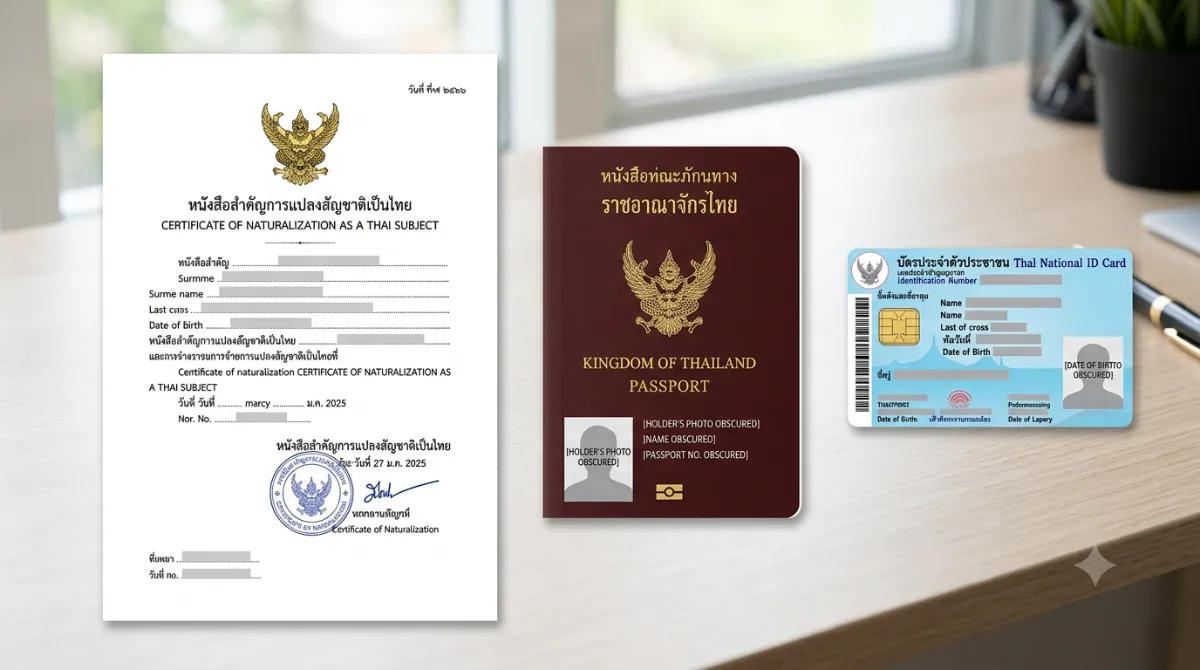
7. Certificate and civil registration: The applicant receives a Certificate of Naturalization and can then register at the local district office to obtain a Thai house registration (tabien baan) and apply for a Thai national ID card and passport.
Thailand Citizenship Application Fees
Fees for a Thailand citizenship application vary by applicant age and application type.
| Application Type | Fee (THB, approximate) |
|---|---|
| Citizenship application, applicant 18 or over | 10,000 |
| Citizenship application, applicant’s children or applicants under 18 | 5,000 |
| Recovery of Thai nationality | 2,000 |
| Certificate of Naturalization | 1,000 |
Dual Citizenship and Thailand Citizenship
Thailand has generally permitted dual citizenship since 1992, and naturalised citizens are usually not required to formally surrender a prior nationality unless their country of origin does not allow dual nationality. In practice, Thai officials may still ask applicants to sign a declaration of intent to renounce a former nationality as part of the naturalization paperwork, even where the applicant’s home country permits dual citizenship. Thai citizenship obtained by naturalisation can also be revoked in specific circumstances, including concealment of material facts during the application, prolonged residence abroad without maintaining a Thai domicile, or conduct considered harmful to Thailand’s security or public order.
Rights and Limits for Naturalized Thai Citizens
Once naturalized, a Thai citizen gains the right to live and work in Thailand permanently without a work permit, own land and property, and hold majority ownership in a Thai company. Some rights are phased in: naturalized citizens generally cannot vote until 5 years after naturalization, and certain positions, including standing for the House of Representatives or Senate, remain restricted to Thai citizens by birth.
Thailand Citizenship vs. Other Thailand Visa Routes
Citizenship is the end point of a long-term residence journey in Thailand, not a starting visa category. Most applicants arrive in Thailand on a visa such as a Thailand Tourist Visa or a work-related category, transition to longer-term status, and only become eligible for naturalization after years of continuous residence. Some professionals qualify through the Thailand Smart Visa, which can support the residence and income evidence used later in a citizenship application. For a full comparison of Thailand’s visa categories and how they connect to permanent residency and citizenship, see the Types of Thailand Visa guide.
Common Reasons Applications Are Delayed or Denied
Because the Minister of Interior retains full discretion over naturalization decisions, an application can be delayed or refused even when an applicant appears to meet the published criteria. In practice, the most frequent causes of delay or denial include:
- Gaps or inconsistencies in the residency record, such as a lapse between one visa category and another during the qualifying period
- Income or tax filings that fall short of the required threshold in one or more of the qualifying years
- Limited spoken or written Thai, particularly where the applicant relies on the general residency route rather than the marriage route
- Incomplete or inconsistent documentation between the Special Branch file and the Ministry of Interior submission
- Unresolved legal issues, including outstanding fines, pending criminal matters, or prior visa overstays
There is no formal, publicly codified appeal process for a denied naturalization application. In most cases, an applicant who is refused can reapply once the underlying issue, such as an income shortfall or a documentation gap, has been resolved. Because outcomes depend heavily on the completeness of the initial filing, many applicants choose to have their documentation reviewed by a Thailand-based immigration lawyer before submission.
Frequently Asked Questions About Thailand Citizenship
What is the minimum age to apply for Thailand citizenship?
Applicants must be at least 20 years old, the age of legal majority under Thai law.
How long does a Thailand citizenship application take?
Processing commonly takes between 1 and 3 years from filing to the final oath ceremony, though timelines vary by case and by the office handling the application.
Can I get Thailand citizenship through marriage without permanent residency?
Yes. Foreign nationals married to a Thai citizen can apply after 3 years of continuous residence in Thailand, without first holding permanent residency, subject to income and other requirements.
Does Thailand allow dual citizenship?
Generally yes. Thailand has permitted dual citizenship in most cases since 1992, though applicants may still be asked to declare an intent to renounce a prior nationality during processing.
What is the points-based system for Thailand citizenship?
It is a 100-point assessment covering age, income, education, length of residence, and Thai language ability. A minimum of 50 points is required for a general naturalization application to proceed.
Can Thailand citizenship be revoked after naturalization?
Yes, in specific circumstances such as concealment of material facts during the application, prolonged residence abroad without maintaining a Thai domicile, or conduct considered harmful to Thailand’s security or public order.