
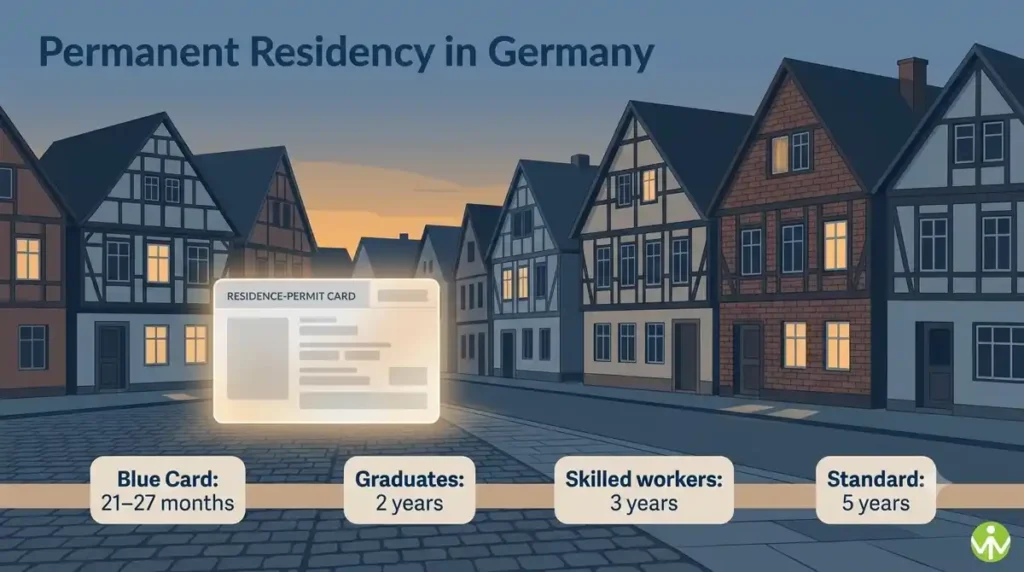
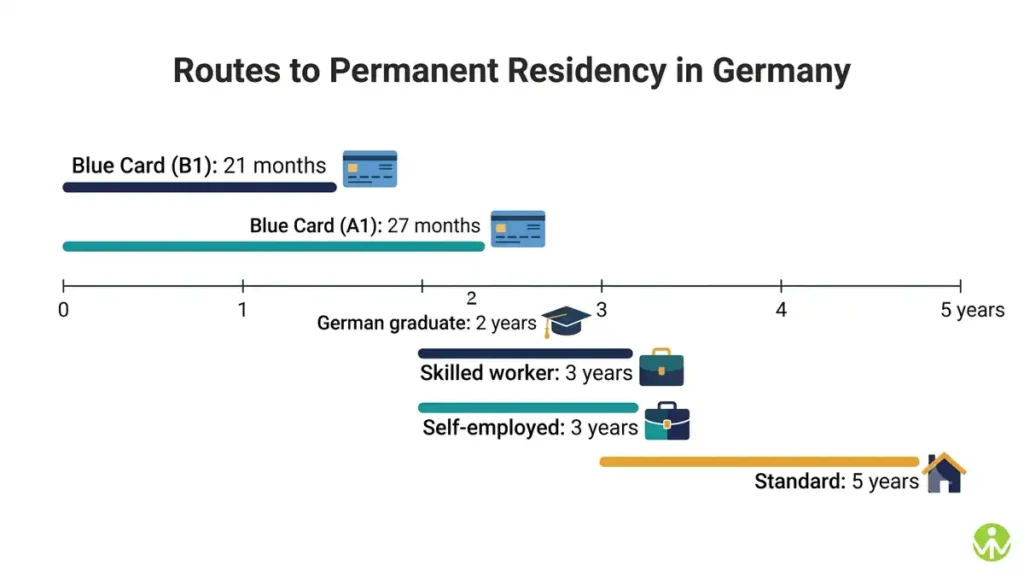
Permanent residency in Germany is granted through the settlement permit (Niederlassungserlaubnis), an unlimited residence title that lets a non-EU national live, work and run a business in Germany without renewing a permit. Most people qualify after five years, but EU Blue Card holders can apply after 21 or 27 months, graduates of German universities and training programmes after two years, and skilled workers, self-employed people and family members of German citizens after three.
This guide explains each route to permanent residency in Germany, the general requirements, the documents and fees, how the permanent EU residence permit differs, how status can be lost and how it leads to German citizenship. Rules change, so check the official Make it in Germany settlement permit page and your local foreigners authority before you apply. For the visas that lead here, see our guide to the types of Germany visa.
Key Takeaways
- Permanent residency in Germany means the settlement permit (Niederlassungserlaubnis) or the permanent EU residence permit; both are unlimited.
- The standard route needs 5 years on a residence permit, 60 months of pension contributions, B1 German and the “Living in Germany” test.
- EU Blue Card holders can apply after 27 months with A1 German, or 21 months with B1.
- Graduates of a German university or vocational training can apply after 2 years on a skilled-worker permit with 24 months of contributions.
- Skilled workers, self-employed people and family members of German citizens can generally apply after 3 years.
- Fees are €113 in most cases, €124 for self-employed people, €147 for highly qualified professionals and €109 for the permanent EU residence permit.
- You apply inside Germany at the local foreigners authority; no country-specific checks such as the APS certificate apply.
- German citizenship generally needs 5 years of residence, as the 3-year route was repealed in October 2025.
Table of contents
What is permanent residency in Germany?
Germany has two permanent residence titles. The settlement permit is a national title under Section 9 of the Residence Act (AufenthG). The permanent EU residence permit (Erlaubnis zum Daueraufenthalt – EU, Section 9a) is an EU-wide status with similar rights that also makes it easier to move to another EU country. Both are issued as an electronic residence permit card (eAT). The card is replaced from time to time, but the status itself does not expire.
With permanent residency in Germany you can take any job or become self-employed, bring family members under easier conditions and stop renewing your permit. You cannot vote in federal or state elections, because that right comes with citizenship. To compare Germany with other countries, see our global permanent residency guide.
Table 1: Settlement permit and permanent EU residence permit compared
| Feature | Settlement permit (Section 9) | Permanent EU residence permit (Section 9a) |
|---|---|---|
| Minimum residence | 5 years on the standard route; 21 months to 3 years on faster routes | 5 years |
| Pension contributions | 60 months on the standard route; 24 to 36 months on faster routes | 60 months |
| German language | B1 (A1 on the 27-month Blue Card route) | B1 |
| Moving within the EU | Valid for Germany only | Easier residence in other EU countries |
| Absence before it lapses | More than 6 months, unless the authority allows longer | 12 consecutive months outside the EU, or 6 years outside Germany |
| Fee | €113, €124 or €147 | €109 |
| Sources: Sections 9, 9a, 18c and 51 of the Residence Act (AufenthG) and Sections 44 and 44a of the Residence Ordinance (AufenthV), checked 21 October 2026. Faster routes apply only to the settlement permit. | ||
Routes to permanent residency in Germany at a glance
The route you take depends on your residence permit, your qualifications and your family situation. The table summarises the main routes; each is explained in the sections below.
Table 2: Routes to permanent residency in Germany
| Route | Minimum time | Pension contributions | German level | Legal basis |
|---|---|---|---|---|
| Standard route | 5 years on a residence permit | 60 months | B1 | Section 9 AufenthG |
| EU Blue Card | 27 months (21 with B1) | For the whole qualifying period | A1 (B1 for 21 months) | Section 18c(2) |
| Skilled worker | 3 years on a skilled-worker permit | 36 months | B1 | Section 18c(1) |
| German university or vocational graduate | 2 years on a skilled-worker permit | 24 months | B1 | Section 18c(1) |
| Highly qualified professional | Immediately, in special cases | Not set | Not set | Section 18c(3) |
| Self-employed or freelancer | 3 years of self-employment | Not set | Not set | Section 21(4) |
| Family member of a German citizen | 3 years on a residence permit | Not set | B1 | Section 28(2) |
| Spouse of a skilled worker with a settlement permit | 3 years on a residence permit | Not required | B1 | Section 9(3a) |
| All routes also need a secure livelihood and no serious public-safety concerns; most need adequate housing and the “Living in Germany” test. Source: Residence Act (AufenthG), checked 21 October 2026. | ||||
General requirements for permanent residency in Germany
If no faster route applies, permanent residency in Germany follows Section 9 of the Residence Act. The foreigners authority must issue a settlement permit if you meet all of these conditions:
- You have held a residence permit for five years.
- Your livelihood is secure without public benefits.
- You have paid at least 60 months of compulsory or voluntary contributions to the statutory pension insurance, or have equivalent pension provision. Time spent caring for children or relatives counts.
- You are allowed to work, and you hold any licence your job needs.
- You speak German at B1 level.
- You have basic knowledge of the legal and social system and way of life in Germany, usually shown by passing the “Living in Germany” (Leben in Deutschland) test.
- You have enough living space for yourself and your family.
- There are no public-safety or public-order grounds against you.
Completing an integration course proves both the language and the knowledge requirements. Married couples who live together can share the pension and employment conditions, so one spouse’s contributions can cover both. Half of any time you spent in Germany studying or in vocational training counts towards the five years.
Faster routes to permanent residency in Germany
Several groups can reach permanent residency in Germany sooner than five years. Most of these routes sit in Section 18c of the Residence Act, which covers skilled workers.
EU Blue Card holders
EU Blue Card holders have the fastest standard route to permanent residency in Germany. You can apply after 27 months of employment on the Blue Card if you have paid pension contributions for that period and speak German at A1 level. With B1 German, the period falls to 21 months. You still need a secure livelihood, adequate housing and basic knowledge of life in Germany, usually shown by the “Living in Germany” test. Our German work visa guide explains the 2026 Blue Card salary thresholds, and our general EU Blue Card guide covers the scheme across EU countries.
Skilled workers
In German law, a skilled worker is someone with a recognised vocational qualification (Section 18a), a German or recognised foreign degree (Section 18b), an EU Blue Card (Section 18g) or a researcher’s permit (Section 18d). After three years on one of those permits, you can apply for a settlement permit if you have a job your permit allows, 36 months of pension contributions, B1 German, a pass in the “Living in Germany” test and adequate housing. The Federal Employment Agency does not need to approve it.
Graduates of German universities and vocational training
Graduates of German universities and of vocational training in Germany have their own shorter route to permanent residency in Germany. The waiting period falls to two years on a skilled-worker permit under Section 18a, 18b, 18d or 18g, and the pension requirement falls to 24 months. B1 German, the “Living in Germany” test, a job your permit allows and adequate housing are still required.
The two years count from the date you hold a skilled-worker permit, so time on the 18-month job-search permit after graduation does not count towards them. Our German student visa guide explains the job-search permit that bridges study and work.
Highly qualified professionals
In special cases, highly qualified professionals with an academic background can receive a settlement permit straight away, with no waiting period. The Residence Act names scientists with special technical knowledge and teaching or research staff in senior positions, in each case with several years of professional experience. The authority must expect you to integrate and to support yourself without state help, and some federal states require approval from a state authority first.
Self-employed people and freelancers
If you hold a residence permit for self-employment under Section 21, you can apply for permanent residency in Germany after three years. Your business or freelance work must have been successful, it must be expected to continue, and it must support you and your family on a lasting basis. Make it in Germany lists no separate language requirement for this route, so confirm the details with your foreigners authority.
Family members of German citizens
Spouses, minor unmarried children and parents caring for a minor German child usually receive a settlement permit after three years on a residence permit. Family life with the German citizen must continue in Germany, you need B1 German, and there must be no interest in expelling you. Our Germany dependent visa guide covers the family reunion visa that comes first.
Spouses of skilled workers
If your spouse holds a settlement permit as a skilled worker under Section 18c, you can get your own permanent residency in Germany after three years on a residence permit. You must live together, work at least 20 hours a week and meet the general conditions, including B1 German and the “Living in Germany” test.
Does your nationality change the route?
Permanent residency in Germany follows the same rules for every non-EU nationality, and there is no country-specific pre-screening for the settlement permit. The APS certificate that applicants with qualifications from China, India or Vietnam need is part of the student visa and university admission process, not of permanent residence. A few nationality-based differences do exist, as the table shows.
Table 3: How nationality affects permanent residency in Germany
| Group | Rule that applies | Effect on permanent residence |
|---|---|---|
| EU and EEA citizens (EU countries, Iceland, Liechtenstein, Norway) | Freedom of movement | No settlement permit needed. A permanent right of residence arises automatically after 5 years of legal residence; a certificate is optional. |
| Swiss citizens | EU–Switzerland free movement agreement | Separate rules; ask the foreigners authority. |
| Australia, Canada, Israel, Japan, New Zealand, South Korea, United Kingdom, United States | Section 41(1) Residence Ordinance | May enter without a visa and apply for a residence permit in Germany within 90 days. Waiting periods for permanent residence are unchanged. |
| Andorra, Brazil, El Salvador, Honduras, Monaco, San Marino | Section 41(2) Residence Ordinance | Same privilege, but only without gainful employment, so it does not shorten work-based routes. |
| All other non-EU nationals | Standard rules | National visa from a German mission, then a residence permit, then a settlement permit after the qualifying period. |
| Sources: Section 41 of the Residence Ordinance and the Freedom of Movement Act/EU, checked 21 October 2026. British nationals living in Germany before 2021 have separate Withdrawal Agreement rights. | ||
Where nationality matters most is paperwork. Birth and marriage certificates, degrees and other foreign public documents may need an apostille or legalisation, depending on the country that issued them, plus a certified German translation. Your foreigners authority will tell you which form it accepts.
Documents for permanent residency in Germany
Each foreigners authority publishes its own checklist for permanent residency in Germany, but most ask for the following:
- A valid passport and your current residence permit card.
- The settlement permit application form from your local authority.
- A biometric photograph.
- Your employment contract and recent payslips, or business accounts if you are self-employed.
- A pension statement (Versicherungsverlauf) from the German statutory pension insurance.
- A B1 German certificate, or proof that you completed an integration course.
- Your “Living in Germany” test certificate.
- Your rental contract and proof of address registration.
- Proof of health insurance.
- Your degree or vocational certificate and recognition notice, for skilled-worker routes.
How to apply for permanent residency in Germany
You apply for permanent residency in Germany from inside the country, at the foreigners authority (Ausländerbehörde) for the place where you live. The highly qualified route is the only one that can lead to a settlement permit straight after arrival, and Make it in Germany advises having all documents ready before you enter.
- Check which route fits you and when you become eligible. Your pension statement shows how many months of contributions you have.
- Gather the documents for your route, including language and test certificates.
- Book an appointment with your foreigners authority. Many cities now accept applications online.
- Submit the application and pay the fee. The authority may ask for more documents.
- Give fingerprints for the new card if asked, then collect your electronic residence permit card when it is ready.
Apply before your current permit expires. If you apply in time, your current permit is normally treated as continuing until the authority decides.
Fees for permanent residency in Germany
The Residence Ordinance sets national fees for permanent residence titles. Most applicants pay €113. Self-employed applicants pay €124, highly qualified professionals pay €147, and the permanent EU residence permit costs €109. Make it in Germany notes that the fee is paid when you apply. The Residence Ordinance lists the amounts in full.
Table 4: Fees for permanent residency in Germany
| Residence title | Fee |
|---|---|
| Settlement permit for highly qualified professionals (Section 18c(3)) | €147 |
| Settlement permit for self-employed people (Section 21(4)) | €124 |
| Settlement permit, all other routes | €113 |
| Permanent EU residence permit (Section 9a) | €109 |
| Source: Sections 44 and 44a of the Residence Ordinance (AufenthV), checked 21 October 2026. Reductions and exemptions apply in some cases; confirm with your foreigners authority. | |
Can you lose permanent residency in Germany?
A settlement permit has no end date, but it can lapse. It ends if you leave Germany for a reason that is not temporary, or if you stay abroad for more than six months without the foreigners authority agreeing to a longer period. Ask the authority before a long absence, because it can set a longer period when your stay abroad is temporary.
There are exceptions. A settlement permit does not lapse through absence if you have lived legally in Germany for at least 15 years and your livelihood is secure, or if you are married to a German citizen, as long as there are no serious grounds for expulsion. The permanent EU residence permit is harder to lose: it lapses only after 12 consecutive months outside the EU (24 months for former Blue Card holders), six years outside Germany, or if you gain the same status in another EU country. Either title can also be withdrawn if it was obtained by deception, or ended by expulsion.
From permanent residency in Germany to citizenship
Permanent residency in Germany is often a step towards citizenship, but it is not a requirement. Under Section 10 of the Nationality Act (StAG), you can naturalise after five years of legal residence if you hold an unlimited right of residence, such as a settlement permit, or an EU Blue Card or another qualifying residence permit. Permits for study, job seeking and some humanitarian purposes do not qualify.
You also need B1 German, a secure livelihood, no relevant criminal convictions and a pass in the naturalisation test. The three-year fast track for exceptionally well-integrated applicants was repealed in October 2025, so five years is the minimum for most people. Germany has allowed dual citizenship since June 2024, and naturalisation costs €255 per adult. The Federal Ministry of the Interior explains the full requirements, and our German citizenship test guide covers the test.
Permanent residency in Germany: FAQs
How long does it take to get permanent residency in Germany?
Between 21 months and five years for most people. EU Blue Card holders can apply after 21 months with B1 German or 27 months with A1, graduates of German universities and training after two years, skilled workers, self-employed people and family members of German citizens after three years, and everyone else after five years.
Can German graduates get permanent residency after two years?
Yes. If you completed a degree or vocational training in Germany, you can apply after two years on a skilled-worker permit, with 24 months of pension contributions, B1 German and the “Living in Germany” test. Time on the post-study job-search permit does not count towards the two years.
Do I need to speak German for permanent residency in Germany?
Usually at B1 level. The Blue Card route accepts A1 if you wait 27 months instead of 21. A completed integration course counts as proof, and exceptions apply for illness or disability.
Can I apply for permanent residency in Germany from outside Germany?
No. You apply inside Germany, at the foreigners authority where you live, after holding a qualifying permit for the required time. Highly qualified professionals are the exception, as they can receive a settlement permit straight after arrival. No country-specific checks, such as the APS certificate, apply to permanent residence.
How much does permanent residency in Germany cost?
€113 for most settlement permits, €124 for self-employed people and €147 for highly qualified professionals. The permanent EU residence permit costs €109.
Can I lose my German settlement permit?
Yes. It usually lapses if you stay outside Germany for more than six months without the foreigners authority’s agreement, or if you leave for good. People with 15 years of legal residence and a secure livelihood, and spouses of German citizens, are protected from losing it through absence.
Do I need a settlement permit before I can become a German citizen?
No. You need five years of legal residence and an unlimited right of residence, an EU Blue Card or another qualifying permit. A settlement permit is the most common basis, but it is not the only one.