
A German student visa is a national (Type D) visa that lets a non-EU student enter Germany to study at a German university. In 2026, the German student visa costs €75, and you must show about €11,904 a year for living costs. After you arrive, the local foreigners authority (Ausländerbehörde) issues a residence permit for study, which lets you work 140 full days or 280 half days a year and, once you graduate, stay up to 18 months to look for a job.
This guide explains who needs a German student visa, the requirements and documents, how to apply through the Consular Services Portal, what happens after arrival, and how the work and post-study rules operate. For the other long-stay routes, see our guide to the types of Germany visa. Rules and amounts change, so check the Federal Foreign Office visa pages before you apply.
Key Takeaways
- The German student visa is a national (Type D) visa costing €75, or €37.50 for minors; holders of publicly funded scholarships pay no fee.
- You need admission to a recognised German higher education institution and proof of funds, usually a blocked account holding €11,904 for 2026 (€992 a month).
- Applications can be submitted online through the Consular Services Portal, but an in-person appointment for fingerprints is still required.
- Nationals of Australia, Canada, Israel, Japan, New Zealand, South Korea, the United Kingdom and the United States can enter without a visa and apply for the permit in Germany within 90 days.
- Applicants whose school or university qualifications come from China, India or Vietnam usually need an APS certificate verifying their documents before they apply.
- On a German student visa you may work 140 full days or 280 half days a year, or up to 20 hours a week during term.
- Graduates can stay up to 18 months to look for qualified work and may take any job while they search.
Table of Contents
Who needs a German student visa?
Citizens of EU and EEA countries and Switzerland do not need a German student visa. They can enrol and live in Germany with an identity card or passport. Most other nationals who plan to study for longer than 90 days must apply for a national visa at a German embassy or consulate before travelling. A short-stay Schengen visa covers trips of up to 90 days and is not the route for a degree programme, as our Schengen visa guide explains. The Visa Navigator on the Federal Foreign Office website shows which visa applies to your nationality and purpose.
Nationalities that can apply after arrival
Under Section 41 of the Residence Ordinance (AufenthV), nationals of a short list of countries may enter Germany without a visa, even for a long stay, and then apply for a residence permit in Germany. They must apply within 90 days of entry. A second group of countries has the same privilege only if the person does not intend to take up gainful employment, so students from those countries who plan to work alongside their studies should check with the foreigners authority first.
Table 1: Nationalities that can apply for a study residence permit after entering Germany
| Group | Countries | What it means for students |
|---|---|---|
| Group 1 | Australia, Canada, Israel, Japan, New Zealand, South Korea, United Kingdom, United States | Enter without a visa and apply for the residence permit for study at the local foreigners authority within 90 days. |
| Group 2 | Andorra, Brazil, El Salvador, Honduras, Monaco, San Marino | Same privilege, but only if you do not intend to take up gainful employment. Check with the foreigners authority before working, or apply for a visa first. |
| Source: Section 41 of the Residence Ordinance (AufenthV), checked 20 October 2026. All other non-EU nationals need a German student visa before travelling. | ||
German student visa or student applicant visa?
Germany has two visas for people coming to study. The German student visa is for people who already hold an admission letter. The student applicant visa is for people who meet the entry requirements for a German university but have not yet been admitted. The table compares the two.
Table 2: German student visa and student applicant visa compared (2026)
| Visa | Who it is for | Proof of funds | Length of stay | Work allowed |
|---|---|---|---|---|
| German student visa (Section 16b) | People admitted to a German university or a preparatory course | €992 a month (€11,904 a year) | Residence permit usually 2 years at first, renewable | 140 full or 280 half days a year, or 20 hours a week |
| Student applicant visa (Section 17) | People eligible for university who are not yet admitted | €1,091 a month | Up to 9 months, not renewable for the same purpose | Up to 20 hours a week, plus up to two weeks of trial work |
| Source: Make it in Germany and the Federal Foreign Office, checked 20 October 2026. National visa fee for both: €75 (€37.50 for minors). | ||||
A residence permit for study also covers preparatory measures before a degree, such as a language course or a preparatory course (Studienkolleg) for applicants whose school-leaving certificate is not recognised as equivalent to the German Abitur, according to Make it in Germany. If you are admitted while on a student applicant visa, you can apply for a study permit at the local foreigners authority without leaving Germany.
German student visa requirements
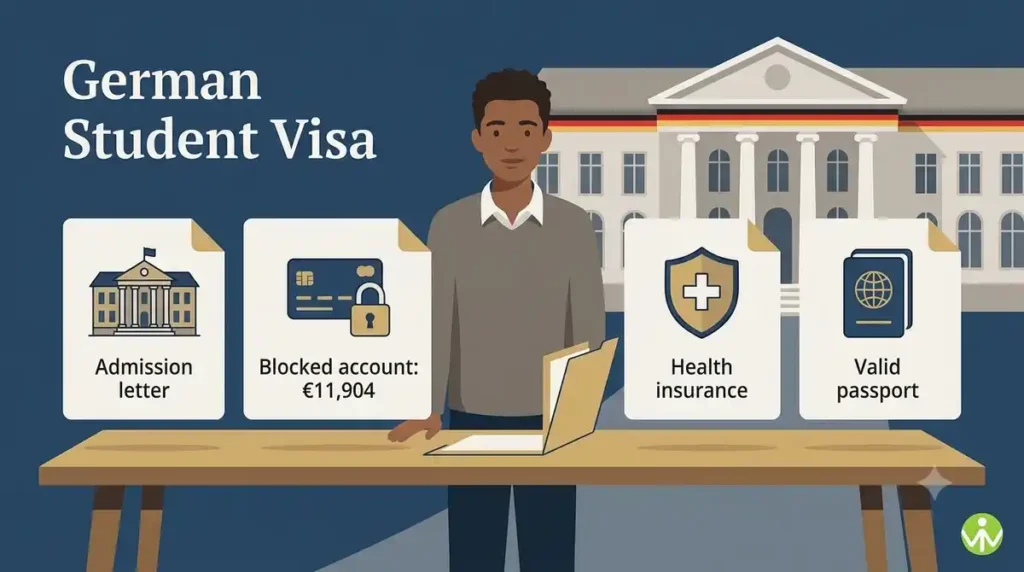
German student visa requirements fall into four areas: admission, money, health insurance and language. Applicants with qualifications from China, India or Vietnam also need an APS certificate. Each embassy or consulate publishes its own checklist, so use the one for the mission responsible for your place of residence.
Admission to a German university
You need an admission letter (Zulassungsbescheid) from a state-recognised higher education institution in Germany, or confirmation of a place on a preparatory course that leads to a degree. Mission information sheets also state that you don’t need flight reservations for the application, so book travel only after the visa is issued.
Proof of funds and the blocked account
You must show that you can cover your living costs. For 2026, the amount is €992 a month, or €11,904 for a year. Most applicants use a blocked account (Sperrkonto), which holds the full year’s funds and releases one monthly amount at a time after you arrive. Alternatives include a scholarship or a formal declaration of commitment (Verpflichtungserklärung) from someone living in Germany. The Federal Foreign Office blocked-account page explains how the account works and how to close it if your application is refused.
The required amount is linked to the maximum German student grant (BAföG). A reform before parliament in October 2026 would raise that grant from the 2027 summer semester if it is passed, so confirm the current figure with your mission when you apply. Tuition is separate: public universities charge little or nothing for most programmes, while private institutions set their own fees. Our guide to the cost to study in Germany covers living costs.
Health insurance
You need health insurance from the date your visa starts. Statutory student health insurance can only begin once you live in Germany and are enrolled, so most students buy private travel or incoming-student cover from arrival to enrolment, then switch to a statutory or recognised private student plan.
Language skills
Some programmes require a certain level of German or English, usually level B2 of the Common European Framework of Reference for Languages. You prove your language skills to the embassy or consulate, typically with the certificate your university accepted.
APS certificate for China, India and Vietnam
If your school-leaving certificate or degree comes from China, India or Vietnam, you will usually need a certificate from the Academic Evaluation Centre (Akademische Prüfstelle, APS) before you apply for a German student visa. APS is run by the German embassy in each of these countries together with the German Academic Exchange Service (DAAD), and it checks that your educational records are genuine. Universities ask for the certificate as part of admission, and APS India says it is part of the documentation generally required for the student visa. The fee is non-refundable, and the certificate does not replace the university’s admission decision or the visa decision. Some groups, such as doctoral applicants in Vietnam, are exempt, so check the rules of your APS office: APS India, APS China or the German Embassy in Vietnam.
India has added a second step for some master’s applicants. If your previous degree is in one of the fields listed by APS India and you sent your APS documents on or after 29 June 2026, you must also pass the dMAT, a subject test, before APS issues your certificate. It applies to people starting a master’s in Germany from 2027, and APS India has not yet published the full list of affected fields.
Documents for a German student visa
Typical documents for a German student visa application include the following:
- A valid passport and copies of its data pages.
- The completed national visa application, submitted online through the Consular Services Portal or printed from the online form.
- Recent biometric passport photographs that meet the mission’s requirements.
- The admission letter from your German university or preparatory course.
- An APS certificate, if your school or university qualifications come from China, India or Vietnam.
- Proof of funds, such as a blocked-account confirmation, scholarship award or declaration of commitment.
- Proof of health insurance covering the start of your stay.
- School-leaving and university certificates, and language test results.
- The visa fee, paid at the appointment.
Many missions ask for originals plus copies and require a certified German translation of documents that are not in German or English. Missing documents are the most common cause of delay, so check the list before you book your appointment.
How to apply for a German student visa
The steps to apply for a German student visa are the same for applicants of any nationality. Only the mission, the visa centre and the appointment system differ.
- Check whether you need a visa and which one applies, using the Visa Navigator.
- Accept your university place, open a blocked account or arrange another form of financial proof, and buy health insurance. If your qualifications come from China, India or Vietnam, have your APS certificate ready before you book the visa appointment.
- Register on the Consular Services Portal, complete the application and upload your documents. The portal checks your file and tells you if anything is missing.
- Book an appointment with the German embassy, consulate or external visa centre that is responsible for your place of residence.
- Attend in person to present original documents, give your fingerprints and photograph, and pay the fee.
- Wait for the decision. The visa section usually needs approval from the foreigners authority in your future university town, which adds time.
- Travel to Germany, register your address and apply for your residence permit before the visa expires.
All German visa sections have been connected to the Consular Services Portal since 1 January 2025, according to the Federal Foreign Office. If online applications for study are not yet available at the mission responsible for you, you can still book an appointment and apply on paper. Do not apply online at a different mission to get round this, because the mission responsible for your place of residence does not change.
German student visa fee and processing time
The German student visa fee is €75 for adults and €37.50 for minors. The fee is waived for people who receive a scholarship from public funds during their stay in Germany, and for their spouse or partner and minor children if the scholarship covers them. Missions that use an external visa centre may also charge a service fee, so check what your mission states before you pay.
The Federal Foreign Office says national visa applications may take several months to process, depending on the purpose of the stay. Apply as soon as you have your admission letter and financial proof.
After you arrive in Germany
A German student visa is an entry visa. Once you arrive, register your address at the local registration office, enrol at your university and activate your blocked account so the monthly payments start. Then apply to the foreigners authority for a residence permit for study, which is usually issued for two years at first and can be renewed for another two if you have not finished your degree. If you earn money while studying, our guide to tax filing in Germany for international students explains the tax side.
Working on a German student visa
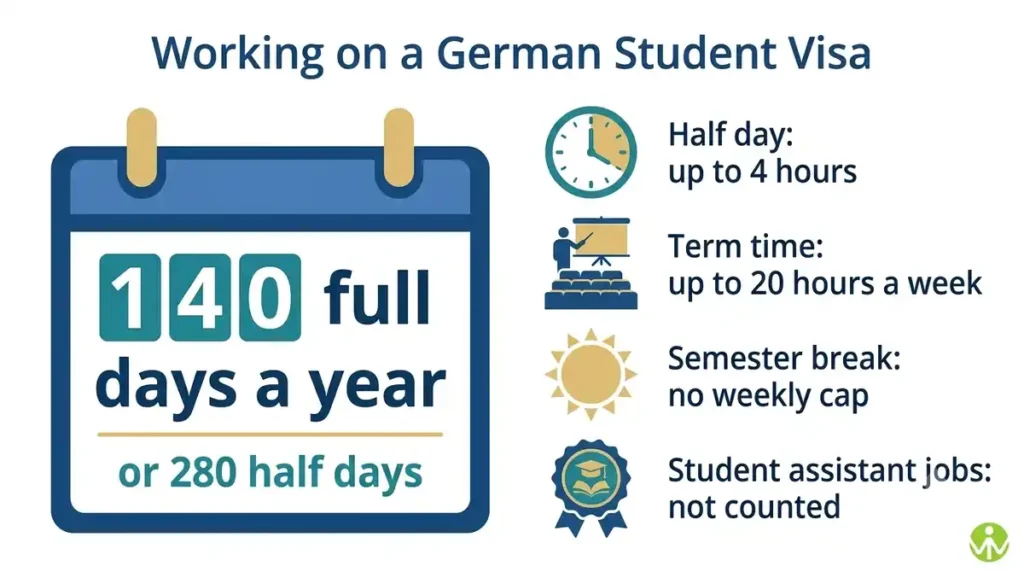
Students from outside the EU may work up to 140 full days or 280 half days a year without approval from the Federal Employment Agency, according to Make it in Germany. A working day of up to four hours counts as a half day. Alternatively, students may work up to 20 hours a week during the lecture period, and during the semester break they can work without that weekly restriction. The annual allowance increased to 120 full days in 2024.
Jobs as a student or research assistant at a university don’t count toward the limit. Self-employment requires approval from the foreigners authority, which checks that the work will not interfere with your studies. Internships are generally treated as work, so ask the foreigners authority before starting one unless it is a compulsory part of your programme. Breaking the work rules can put your residence permit at risk, so keep a record of the days you work.
Income from a student job can also help when you renew your permit. If you earn at least the monthly living-cost amount, currently €992, the foreigners authority may accept your wages as proof of funds instead of a renewed blocked account.
After graduation: the 18-month job search
After you complete your degree, you can apply for a residence permit to look for work for up to 18 months. During that time, you may take any job to support yourself while you search for a position that matches your qualifications. Once you find qualified employment, you switch to a skilled worker permit or an EU Blue Card, which our German work visa guide compares.
Graduates of German universities have a shorter path to settlement. Make it in Germany says they can apply for a settlement permit after working in Germany for more than two years, and our guide to permanent residency in Germany explains the other conditions. You can also switch to a skilled worker permit before finishing your degree if you receive a suitable permanent job offer.
German student visa FAQs
How much does a German student visa cost?
The German student visa fee is €75 for adults and €37.50 for minors. Holders of scholarships from public funds are exempt. An external visa centre may add its own service fee, and the residence permit in Germany carries a separate local fee.
How much money do I need in a blocked account?
For 2026 you need €11,904 for a year, which is €992 a month. A scholarship or a declaration of commitment from someone living in Germany can replace all or part of the blocked account.
Can I apply for a German student visa online?
Yes. The Consular Services Portal accepts German student visa applications online, and all visa sections have been connected to it since January 2025. You still attend an appointment in person to give fingerprints and pay the fee.
How many days can I work on a German student visa?
You can work 140 full days or 280 half days a year, or up to 20 hours a week during the lecture period. Jobs as a student assistant at the university do not count towards the limit.
Can I stay in Germany after graduating?
Yes. Graduates can get a residence permit for up to 18 months to look for qualified work, may take any job in the meantime, and then switch to a skilled worker permit or an EU Blue Card.
Can I get a German student visa without an admission letter?
No, but you can apply for a student applicant visa instead. It allows up to nine months in Germany to secure a place, requires €1,091 a month in funds, and permits work of up to 20 hours a week.
Do I need an APS certificate for a German student visa?
Only if your school or university qualifications come from China, India or Vietnam. In those countries the APS checks your certificates before you apply, and universities and the visa process rely on its certificate. From 2027, some Indian master’s applicants must also pass the dMAT subject test.
How long does it take to get a German student visa?
Processing times vary by mission and season. The Federal Foreign Office says national visas may take several months, so apply as early as possible once you have your admission letter and funds.