
Curricular Practical Training (CPT) is the work authorisation that lets an F-1 student take an internship, co-op or practicum while still enrolled, provided the training is an integral part of the degree. It sits alongside on-campus jobs, Optional Practical Training and the STEM extension as one of the main ways international students gain US work experience. It is also the only off-campus option authorised by the school alone, with no application to USCIS.
This guide sets out who qualifies for Curricular Practical Training, how day-one CPT works, how CPT interacts with OPT, and how the rules are being applied since the Student and Exchange Visitor Program (SEVP) tightened its guidance in August 2026. For the wider picture, start with our guide to the types of USA student visa; for the visa itself, see the F-1 student visa guide.
Key Takeaways
- Curricular Practical Training lets F-1 students work in an internship, co-op or practicum that is an integral part of their degree. The school’s DSO authorises it, so no EAD is needed.
- Most students qualify only after one full academic year. Graduate programmes that require training straight away can authorise day-one CPT.
- CPT is tied to one employer, one location and fixed dates, all shown on your updated Form I-20.
- 12 months or more of full-time CPT (over 20 hours a week) ends OPT eligibility at that degree level. Part-time CPT never does.
- SEVP’s August 2026 broadcast messages tell schools to authorise CPT only where training is required for all students in the curriculum. Neither message changes the regulation.
- Four higher-education associations sued DHS over that guidance on 5 October 2026. Until a court rules, schools are applying the stricter standard.
Table of Contents

What Is Curricular Practical Training?
The rule sits in the federal regulations at 8 CFR 214.2(f)(10)(i). It allows a Designated School Official (DSO) to authorise an F-1 student to join a Curricular Practical Training programme that is “an integral part of an established curriculum.” The regulation lists what counts: alternative work/study, internships, cooperative education, and any other required internship or practicum offered by sponsoring employers through cooperative agreements with the school.
Three features set Curricular Practical Training apart from other student work. It is authorised by your school, not by USCIS, so there is no Form I-765, no Employment Authorization Document (EAD) and no government fee. It is tied to one employer, one location and fixed dates. And the work must be directly related to your major area of study. CPT can be paid or unpaid; most schools require authorisation for unpaid internships too, because the test is training, not pay.
Curricular Practical Training Eligibility
To be eligible for Curricular Practical Training, you must normally have been lawfully enrolled full time at an SEVP-certified college, university, conservatory or seminary for one full academic year. You must be in valid F-1 status, the training must be directly related to your major, and it must be an integral part of your programme, typically because the degree requires it or because you earn academic credit for it. Students in English language training programmes are not eligible for any practical training.
Each school sets its own CPT policy on top of the regulation, so the details differ between institutions. Many require a credit-bearing internship course, a job offer letter that describes the duties, and an academic adviser’s sign-off before the DSO will act. Check your school’s international office page before you accept an offer that depends on CPT.
Day-One CPT
The one-year wait has one exception. The regulation allows CPT earlier for students enrolled in graduate studies that require immediate participation in Curricular Practical Training. Programmes built this way, such as some master’s and doctoral programmes with a practicum or co-op from the first term, can authorise what is informally called day-one CPT.
Day-one CPT is legitimate when the programme genuinely requires training from the start. It has also drawn scrutiny for years, because some schools have marketed it mainly as a way to work while enrolled. That concern is the background to SEVP’s August 2026 guidance. A student with day-one CPT on their record should expect closer questions later: when applying for OPT, at a visa interview, or when an employer files for H-1B status. Keeping the course registration, syllabus and offer letter that show why the training was required is the practical safeguard.
Part-Time vs Full-Time Curricular Practical Training and Your OPT
Curricular Practical Training can be part-time (20 hours a week or less) or full-time (more than 20 hours a week). Part-time CPT can run alongside classes; full-time CPT is common in summer breaks and in co-op terms. The DSO records which one applies on your Form I-20.
The distinction matters because of Optional Practical Training. Under the regulation, a student who has received one year or more of full-time Curricular Practical Training is not eligible for OPT at that degree level. Part-time CPT does not count towards that limit, however long it lasts. Because the limit applies per education level, it resets when you move to a higher degree.
The OPT side of that trade-off may soon become more expensive. On 8 October 2026, DHS published a proposed rule that would charge USD 70,000 per student for an initial OPT authorisation and USD 30,000 for each later period, including the STEM extension, according to SEVP Broadcast Message 2610-02. It is a proposal only, open for public comment until 9 November 2026, and it does not cover Curricular Practical Training. Our guides to Optional Practical Training and the STEM OPT extension explain how OPT works today.
| Feature | Curricular Practical Training (CPT) | Optional Practical Training (OPT) |
|---|---|---|
| Purpose | Training that is an integral, required part of the curriculum | Optional training directly related to the field of study |
| When | During the programme | During the programme or after completion |
| Who authorises | The school’s DSO, in SEVIS | USCIS, after a DSO recommendation |
| Application to USCIS | None | Form I-765 |
| EAD required | No | Yes |
| Employer | Named employer, location and dates on the I-20 | Any job related to the field of study |
| Time limit | No fixed cap; 12+ months full-time ends OPT eligibility | 12 months per degree level, plus 24-month STEM extension |
| Government fee | None | Form I-765 fee; DHS proposed USD 70,000 (initial) and USD 30,000 (later periods) on 8 Oct 2026 |
| Source: 8 CFR 214.2(f)(10); SEVP Broadcast Messages 2608-02 and 2610-02. The OPT fees are proposed, not in force, as of 10 October 2026. | ||
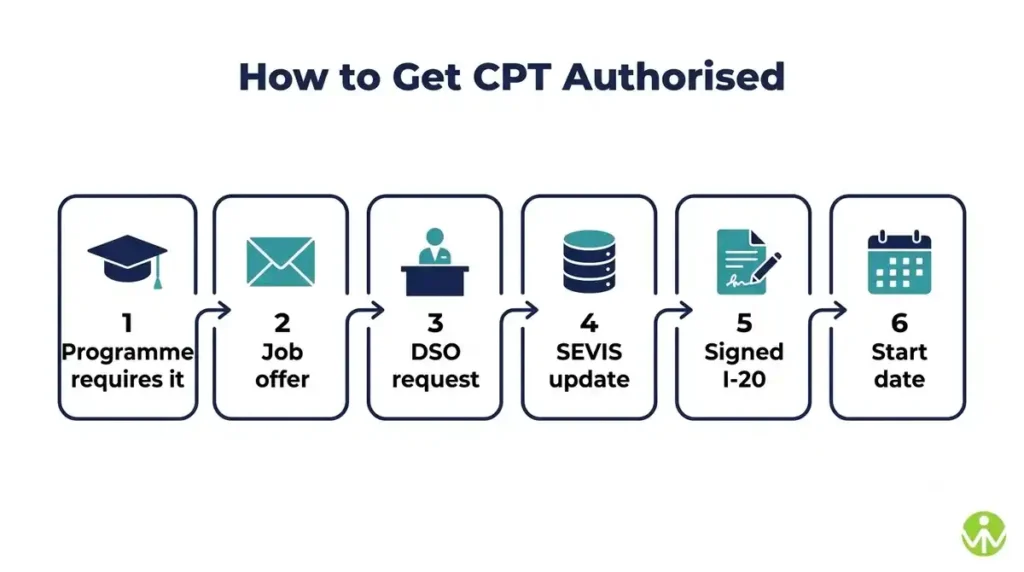
How to Get Curricular Practical Training Authorised
The process for Curricular Practical Training runs through your school, and the sequence matters more than the paperwork. You may not start work, not even unpaid onboarding, before the start date on your updated I-20.
| Step | Action |
|---|---|
| 1 | Confirm with your department and international office that the training is required for, or credited in, your programme |
| 2 | Get a written offer from an employer that describes the duties, hours and dates |
| 3 | Register for the internship or CPT course if your school requires one |
| 4 | Submit the CPT request to your DSO with the offer letter and any adviser approval |
| 5 | The DSO authorises CPT in SEVIS, recording full- or part-time, employer, location and start and end dates |
| 6 | Receive the signed Form I-20 with the CPT endorsement and start work only on the authorised start date |
| 7 | Get a new authorisation before any change of employer, hours, location or dates |
| Source: 8 CFR 214.2(f)(10)(i). School procedures vary; your DSO’s instructions take precedence. | |
Your employer completes Form I-9 using your I-20 with the CPT endorsement, together with your passport and Form I-94. CPT wages are taxable and reported on Form 1040-NR; our guide to tax filing in the USA for international students explains how, including the Social Security and Medicare exemption that usually applies to F-1 students.
The August 2026 SEVP Guidance on Curricular Practical Training
The August guidance did not amend the regulation on Curricular Practical Training. What changed is how strictly SEVP expects schools to read it.
On 12 August 2026, SEVP issued Broadcast Message 2608-01, a reminder to DSOs of their liability when authorising CPT. It said SEVP had seen a rise in authorisations that were not integral to a curriculum. It asked DSOs to approve CPT only if its absence would make attaining the degree impossible and the work is required for all students pursuing that degree. It reminded DSOs that they sign the I-20 under penalty of perjury, and warned that schools misusing CPT could lose their SEVP certification.
A second message, Broadcast Message 2608-02, followed on 24 August in question-and-answer form. It said CPT attached to an optional elective course does not meet the requirement. Every student in a curriculum requiring practical training, foreign and American alike, must take part, and CPT should be with employers that have cooperative agreements with the school. It also set up a confidential tipline for DSOs who feel pressured into approvals they consider noncompliant. Both messages state that they are not rules or final agency actions.
Schools responded quickly. Several, including the University of Colorado Boulder, narrowed CPT to programmes where practical training is a degree requirement, and others paused authorisations while they reviewed their curricula. If your Curricular Practical Training was approved under an older, broader policy, ask your DSO whether it can still be renewed or extended.
The CPT Lawsuit
On 5 October 2026, four higher-education associations sued DHS in the US District Court for the District of Massachusetts (AAU v. DHS, No. 1:26-cv-14520). The plaintiffs are the Association of American Universities, NAFSA: Association of International Educators, the Presidents’ Alliance on Higher Education and Immigration, and the Association of Independent Colleges and Universities in Massachusetts. They argue that the two broadcast messages changed the CPT framework without notice-and-comment rulemaking. As of 10 October 2026, the court had not ruled, and the guidance had not been blocked, so schools are still applying it.
| Date | Development | What it means |
|---|---|---|
| 12 Aug 2026 | SEVP Broadcast Message 2608-01 | DSOs reminded of liability; CPT only if required for all students in the degree |
| 24 Aug 2026 | SEVP Broadcast Message 2608-02 | No CPT through optional electives; all students in the curriculum must take part; cooperative agreements; DSO tipline |
| Aug-Sep 2026 | University policy changes | Several schools narrow or pause CPT authorisations |
| 5 Oct 2026 | AAU v. DHS filed (D. Mass.) | Four associations challenge both broadcast messages; no ruling yet |
| 8 Oct 2026 | Proposed OPT fees (SEVP Broadcast Message 2610-02) | USD 70,000 initial OPT, USD 30,000 later periods; CPT not covered; comments until 9 Nov 2026 |
| Status as of 10 October 2026. Neither broadcast message on CPT is a rule, and the court had not ruled on the lawsuit at that date. | ||
Rules to Follow While on Curricular Practical Training
Curricular Practical Training is narrow by design, and most status problems come from stepping outside the authorisation. Work only for the employer and at the location on your I-20, and only between the authorised dates. If your employer wants to extend your internship, change your hours from part-time to full-time, or move you to another site, get a new authorisation first. Working before the start date or after the end date is unauthorised employment, which can end F-1 status and is very hard to repair.
You must also keep a full course of study while on CPT, unless the training falls in your annual vacation or your programme counts it as full-time enrolment. If you travel abroad during CPT, carry your I-20 with a recent travel signature and the CPT endorsement, your offer letter and proof of enrolment.
For now, F-1 students are still admitted for duration of status. A DHS rule would have replaced it with fixed admission dates from 15 September 2026, but a federal court postponed it on 14 September. The existing arrangements, including the 60-day grace period after studies, continue while that litigation runs.
Curricular Practical Training and Later Visa Applications
Your Curricular Practical Training history stays in your SEVIS record and follows you. It is visible when you file for OPT, when you apply for a new visa stamp, and when an employer files for a change of status, for example to the H-1B visa. Officers may ask why the training was part of your curriculum, especially for day-one CPT. A clean record, with authorisation before every job, a clear academic reason and work that matches the I-20, is what keeps those later applications straightforward.
Frequently Asked Questions About Curricular Practical Training
Do I need an EAD for Curricular Practical Training?
No. Curricular Practical Training is authorised by your DSO in SEVIS and shown on your Form I-20. You do not file Form I-765 or receive an EAD, and there is no government fee.
Can I do CPT in my first semester?
Usually not. You normally need one full academic year in F-1 status first. The exception is a graduate programme that requires practical training immediately, which can authorise day-one CPT.
Does part-time CPT affect my OPT?
No. Only 12 months or more of full-time CPT at the same degree level removes OPT eligibility. Part-time CPT, at 20 hours a week or less, does not count, however long it lasts.
Can I have CPT with two employers at once?
It is possible if your school authorises each one separately and the combined hours fit your programme’s rules. Each employer must be recorded in SEVIS and on your I-20 before you start work for it.
Has the August 2026 guidance changed the CPT rules?
No. The regulation is unchanged, and both broadcast messages say they are not rules. What changed is the standard SEVP expects schools to apply, and many schools have tightened their own policies as a result. A lawsuit challenging the guidance was filed on 5 October 2026.
Does the proposed OPT fee apply to Curricular Practical Training?
No. The rule DHS proposed on 8 October 2026 covers Optional Practical Training only, and it is not in force. Curricular Practical Training has no government fee.
What happens if I work before my CPT start date?
That is unauthorised employment. It can end your F-1 status and usually cannot be fixed through reinstatement, so wait until the start date on your signed I-20.
Curricular Practical Training remains a valuable way to gain US work experience during a degree, but it now rewards careful documentation more than ever. Confirm with your DSO that your programme qualifies, keep the paperwork that shows why the training is required, and track your full-time months against your OPT plans. For related reading, see our guides to Optional Practical Training and the F-1 student visa.