
An Italy tourist visa is the short-stay Schengen visa that Italian consulates issue to people who need a visa to holiday in Italy, visit friends or see the country for up to 90 days. It is not a separate Italian document. The same Type C visa covers the whole Schengen Area, but Italy handles the application when it is your main destination, and it adds a few national rules of its own, from a fixed proof-of-funds table to a declaration of presence after arrival.
This guide explains who needs an Italy tourist visa in 2026, what it costs, which documents consulates ask for and how the application works, step by step. For the full range of Italian visas, including work, study and residence routes, see our guide to the types of Italy visa.
Key Takeaways
- An Italy tourist visa is a uniform Schengen visa (Type C) for stays of up to 90 days in any 180-day period across all 29 Schengen countries.
- About 60 nationalities, including the UK, US, Canada, Australia and Japan, can visit Italy without a visa. ETIAS is not yet in operation.
- The Italy tourist visa fee is €90 for adults and €45 for children aged 6 to under 12. Children under 6 pay nothing.
- Apply no earlier than six months and no later than 15 days before travel. Decisions normally take 15 calendar days, and up to 45 in some cases.
- Italy publishes its own proof-of-funds minimum: €269.60 per person for a trip of up to five days, rising with a daily rate for longer stays.
- There is no Italian e-visa. Italy’s embassy in Kuwait called reports of a June 2026 e-visa launch false.
Table of Contents
Do you need an Italy tourist visa?
Whether you need an Italy tourist visa depends on your nationality, not on where you live. The EU keeps two lists in its common visa policy. Nationals of countries on the visa-required list need a Schengen visa for any short visit. Around 60 countries and territories, including the United Kingdom, the United States, Canada, Australia, Japan, Brazil and Singapore, are exempt and can visit Italy without a visa for up to 90 days in any 180-day period. EU, EEA and Swiss citizens need only a valid passport or national identity card.
The quickest way to check is the official questionnaire on Italy’s Visa for Italy portal, run by the Ministry of Foreign Affairs. You enter your nationality, country of residence, purpose and length of stay, and it tells you whether a visa is required and which documents to prepare.
Visa-free visitors: EES now, ETIAS later
Visa-exempt travellers no longer receive passport stamps. The EU’s Entry/Exit System became fully operational on 10 April 2026, so fingerprints and a facial image are recorded the first time you cross into the Schengen Area. ETIAS, the online travel authorisation planned for visa-exempt visitors, is not yet in operation and has no confirmed start date. Our ETIAS explainer covers how the system is designed to work.
What the Italy tourist visa allows
The Italy tourist visa is a uniform Schengen visa, marked Type C on the visa sticker. It lets you stay for up to 90 days in any rolling 180-day period across all 29 Schengen countries, so a trip that starts in Rome can continue to Paris or Vienna without a second visa. Our Schengen visa explainer covers the rules that apply across the whole area.
Single and multiple entries
Consulates decide how many entries to grant and for how long. First-time applicants usually receive a single-entry visa that covers the dates of the trip. Under the EU’s harmonised cascade rules, travellers who have used earlier Schengen visas lawfully can receive multiple-entry visas valid for one year, then two years, then up to five. Consulates keep discretion, so a long multiple-entry visa is never guaranteed.
What you cannot do on an Italy tourist visa
You cannot work in Italy on a tourist visa, and you cannot switch it to a residence permit from inside the country. Anyone planning to work, study for more than 90 days or move to Italy needs a national Type D visa, applied for before travel. Our Italy work visa and Italy student visa guides explain those routes. You can do a short course of up to 90 days, such as a language school, on a Schengen visa.
Italy tourist visa requirements
Every Schengen consulate checks the same core conditions, and Italy adds a fixed financial minimum on top. To qualify for an Italy tourist visa, you need:
- A passport issued within the last 10 years, valid for at least three months after the date you plan to leave the Schengen Area, with at least two blank pages.
- Travel medical insurance covering at least €30,000 for emergency treatment, hospital care and repatriation, valid in every Schengen country for the whole trip.
- Proof of accommodation, such as hotel bookings or a declaration of hospitality from your host in Italy.
- Proof of enough money for the stay and the journey home.
- Evidence that you will leave before the visa expires, such as a return ticket, a job or studies at home, or family ties.
How much money you need for an Italy tourist visa
Italy is unusual in publishing exact figures. A Ministry of the Interior directive of 1 March 2000, still in force, sets the minimum means of subsistence per person, with lower amounts when two or more people travel together. The official table is reproduced below.
Table 1 — Italy proof-of-funds minimums
| Length of stay | One person travelling alone | Two or more travelling together (per person) |
|---|---|---|
| 1–5 days | €269.60 in total | €212.81 in total |
| 6–10 days | €44.93 per day | €26.33 per day |
| 11–20 days | €51.64 fixed + €36.67 per day | €25.82 fixed + €22.21 per day |
| More than 20 days | €206.58 fixed + €27.89 per day | €118.79 fixed + €27.89 per day |
| Source: Italian Ministry of Foreign Affairs, based on the Ministry of the Interior Directive of 1 March 2000 as amended. Figures are per person, as of September 2026. Consulates can ask for more evidence. | ||
As a worked example, a solo traveller spending 14 days in Italy needs at least €51.64 plus 14 × €36.67, or about €565. A trip of up to five days needs €269.60. Bank statements, credit cards and prepaid bookings all count towards the total. You can also be checked at the border, where travellers without sufficient funds may be refused entry.
Documents for an Italy tourist visa application
Checklists vary slightly from one consulate to another, and the Visa for Italy questionnaire produces the list for your case. A typical Italy tourist visa file contains:
- The completed and signed Schengen visa application form.
- A recent passport photo that meets ICAO standards.
- Your passport, plus copies of its data page and of any earlier Schengen visas.
- A travel medical insurance certificate.
- Flight or other travel reservations for the round trip.
- Hotel bookings, or a declaration of hospitality with a copy of your host’s ID or residence permit.
- Recent bank statements and proof of income, such as payslips or tax returns.
- Proof of employment or studies, such as a letter from your employer confirming your leave.
- For a minor, a birth certificate and consent from both parents or guardians.
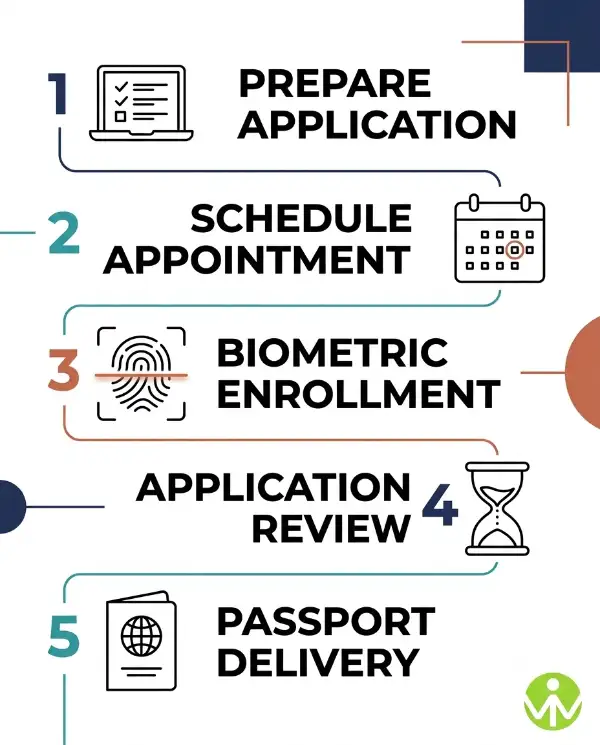
How to apply for an Italy tourist visa, step by step
You apply to the Italian embassy or consulate that covers the place where you legally live, or to the visa centre that works for it. Apply to Italy if it is your only destination or the country where you will spend the most days. If your stays are equal, apply to the country you enter first. If most of your trip is in France or Greece, apply to that country instead; our guides to the France tourist visa and the Greece tourist visa cover those applications.
Step 1: Check the requirements online
Complete the questionnaire on the Visa for Italy portal. It confirms whether you need a visa and lists the required documents and forms for your case.
Step 2: Book an appointment
Some consulates take bookings directly through the ministry’s Prenot@Mi system. Many others use an external service provider. Italy’s official list of visa service providers shows which company, such as VFS Global, TLScontact, BLS or Almaviva, handles each country. Book only through the channel your consulate names. Visa centres charge their own service fee in addition to the visa fee.
Step 3: Submit your file and give biometrics
You hand in the application in person, pay the fee and give ten fingerprints and a photo for the Visa Information System. If you had your fingerprints taken for a Schengen visa in the last 59 months, you may not have to provide them again. Children under 12 are not fingerprinted.
Step 4: Wait for the decision
Consulates must decide within 15 calendar days, extendable to 45 days when a file needs more checks or documents. Most visa centres offer online tracking.
Step 5: Collect your passport and check the visa
Check the sticker as soon as you collect it: the validity dates, the number of entries and the number of days allowed. Ask the consulate to correct any error before you travel.
Italy tourist visa fee in 2026
EU law sets the Italy tourist visa fee, and it is the same at every Schengen consulate, although it is often paid in local currency at the consulate’s exchange rate. It has been €90 for adults since June 2024, and €45 for children aged 6 to under 12. Under visa facilitation agreements, nationals of Armenia, Azerbaijan and Belarus pay €35 and nationals of Cabo Verde pay €67.50.
Table 2 — Italy tourist visa fees 2026
| Applicant | Italy tourist visa fee |
|---|---|
| Adults and children aged 12 and over | €90 |
| Children aged 6 to under 12 | €45 |
| Children under 6 | Free |
| Nationals of Armenia, Azerbaijan and Belarus | €35 |
| Nationals of Cabo Verde | €67.50 |
| Source: European Commission, as of September 2026. Fees are non-refundable. Visa-centre service fees are extra and vary by country. | |
The fee is also waived for some groups, including school pupils, students and accompanying teachers on educational trips, researchers travelling for scientific work, and representatives of non-profit organisations aged 25 or under who attend seminars, conferences or sporting, cultural or educational events. The fee is not refunded if the visa is refused.
Italy tourist visa processing time and when to apply
You can lodge an application up to six months before the trip and no later than 15 days before you leave. A standard decision takes up to 15 calendar days, and up to 45 when a consulate needs further documents or checks. Applying three to four weeks ahead is a sensible minimum, and earlier in the spring and summer peak, when appointments fill quickly.
After you arrive in Italy
The Entry/Exit System at the border
At your first entry to the Schengen Area, border officers record your fingerprints and facial image in the EES instead of stamping your passport. Keep your insurance, accommodation details and proof of funds with you, because officers can ask to see them again.
Declaration of presence
Italian law requires short-stay visitors to declare their presence within eight days of arrival. For most tourists this happens automatically: hotels, B&Bs and other licensed accommodation register their guests with the police, and people arriving directly from outside the Schengen Area are covered by their border-entry record. If you arrive from another Schengen country and stay with friends or family, you file the declaration yourself at the local Questura (police headquarters).
Can you extend an Italy tourist visa?
Only in exceptional cases. The Questura can extend a Schengen visa for force majeure, humanitarian reasons or serious personal reasons, such as a sudden illness or cancelled flights, but not simply to lengthen a holiday. Overstaying can lead to expulsion and an entry ban that applies across the Schengen Area.
If your Italy tourist visa is refused
A refusal comes on a standard form that marks the grounds, such as insufficient funds, doubts about the purpose of the trip or doubts about your intention to leave. Italy gives the decision in a language you understand or, failing that, in English, French, Spanish or Arabic. You can challenge it before the Regional Administrative Court (TAR) of Lazio within 60 days of notification, as the Foreign Ministry’s visa refusal page explains. Many applicants instead reapply with stronger evidence that answers the stated reasons, which is usually quicker and cheaper than going to court.
Italy tourist visa FAQs
Is there an Italy e-visa for tourists?
No. Italy still issues Schengen visas as stickers in the passport after an in-person appointment. In March 2026, the Italian Embassy in Kuwait said reports that an electronic visa would launch in June 2026 were false.
How long can I stay in Italy on a tourist visa?
You can stay for the number of days printed on the visa, up to a maximum of 90 days in any 180-day period. You must leave by the end date on the sticker, even if you have days left.
Can I visit other Schengen countries on an Italy tourist visa?
Yes. A uniform Schengen visa issued by Italy is valid in all 29 Schengen countries, as long as Italy is your main destination.
How much bank balance do I need for an Italy tourist visa?
Italy’s official minimum is €269.60 per person for a trip of up to five days, with daily rates for longer stays. A solo traveller spending 14 days needs about €565. Consulates look at your finances as a whole, not only the balance.
How early should I apply for an Italy tourist visa?
You can apply up to six months before your trip, and you must apply at least 15 days before it. Applying three to four weeks or more ahead leaves room for delays and peak-season demand.
Can I work or study on an Italy tourist visa?
You cannot work. You can take a short course of up to 90 days, but longer study needs a national student visa applied for before you travel.
Do UK or US citizens need an Italy tourist visa?
No. UK and US citizens, like other visa-exempt nationals, can visit Italy for up to 90 days in any 180-day period without a visa. They are registered in the EES at the border and will need ETIAS authorisation once it starts.