
The cap-gap extension is the rule that keeps an F-1 student in status, and often still working, between the day their Optional Practical Training or study period runs out and the day an H-1B job can begin.
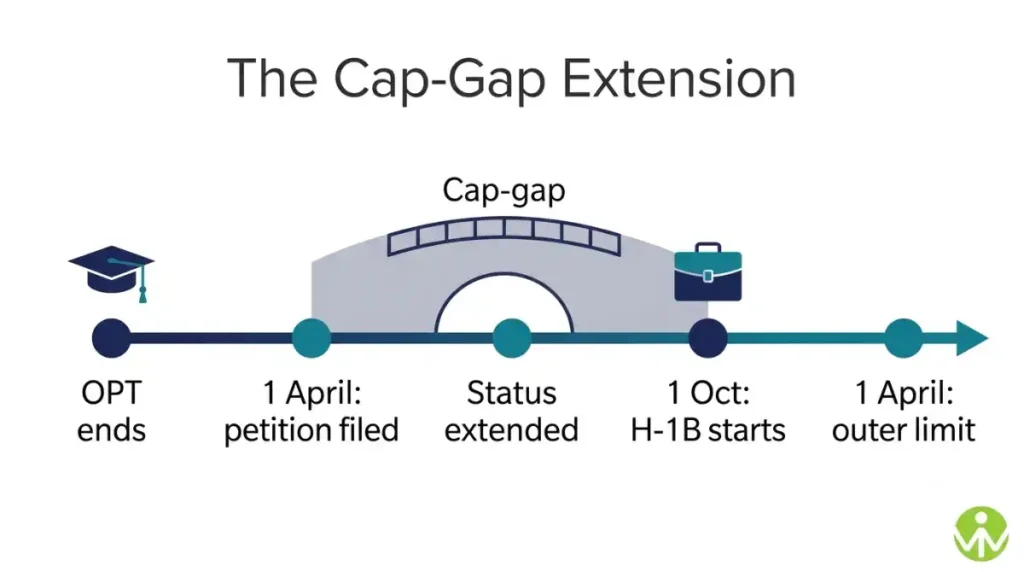
The gap exists because of the H-1B calendar. Employers can file cap-subject petitions from 1 April, but H-1B employment cannot start before 1 October, the first day of the US fiscal year. Many graduates find their OPT or STEM OPT ends somewhere in between. Without a bridge, a student who had won a place in the H-1B lottery would have to leave the United States and return on an H-1B visa months later.
This guide explains who qualifies, how long the extension lasts, what it does and does not cover, and how it fits with the rule changes of 2026, including the duration-of-status rule that a federal court blocked in September. For the category itself, see our H-1B visa guide.
Key Takeaways
- A cap-gap extension automatically extends F-1 status when an employer files a timely cap-subject H-1B petition that requests a change of status.
- If the student holds valid OPT or STEM OPT when the petition is filed, work authorisation is extended too. A student in the grace period gets status only, with no right to work.
- Since 17 January 2025, the extension runs until the approved H-1B start date or 1 April of the fiscal year, whichever comes first. It used to end on 1 October.
- The student files nothing. SEVIS is updated once USCIS receives the petition, and the school issues an updated Form I-20 as evidence.
- A lottery selection notice is not enough. Petitions filed for consular notification, and petitions from cap-exempt employers, do not create a cap-gap extension.
- Travelling abroad while the change of status is pending abandons it.
- The F-1 grace period is still 60 days. The rule that would have cut it to 30 was blocked by a federal court on 14 September 2026, and the government has appealed.
Table of Contents
What the Cap-Gap Extension Is
The cap-gap extension is a provision of the F-1 regulations, at 8 CFR 214.2(f)(5)(vi), that fills the gap between the end of F-1 status and the start of H-1B status. It applies only to H-1B petitions counted against the annual cap of 85,000 places, which is why it carries the word “cap”. It dates from 2008 and was widened by the H-1B modernisation rule that took effect on 17 January 2025.
It is automatic. There is no form, no fee and no application. What triggers it is an act by the employer, not the student: an H-1B petition, filed on time, that requests a change of status from F-1 to H-1B. USCIS sets out the conditions in its cap-gap questions and answers.
Who Qualifies for a Cap-Gap Extension
Two sets of conditions have to be met: one about the petition, and one about where the student stands on the day it is filed.
The petition
The employer must be subject to the cap and must file within the filing period that follows selection, which normally opens on 1 April. The petition must request a change of status, so that the student moves from F-1 to H-1B without leaving the United States, and it must ask for a start date in the coming fiscal year. A petition filed for consular notification, where the worker collects an H-1B visa abroad, does not qualify. Nor does one from a cap-exempt employer such as a university, which can file at any time of year and has no gap to bridge.
Being selected is not enough on its own. A registration selection notice does not trigger a cap-gap extension; only a properly filed petition that USCIS has received does.
The student’s position on the filing date
The student must hold valid F-1 status when the petition is filed. That covers three situations: still studying, working on post-completion OPT or the STEM OPT extension, or in the grace period that follows the end of studies or OPT. Which of these applies decides what the cap-gap extension covers, as Table 1 shows.
Table 1: What a cap-gap extension covers, by situation at filing
| Situation when the H-1B petition is filed | F-1 status extended | Work authorisation extended | What it means |
|---|---|---|---|
| Working on post-completion OPT (EAD still valid) | Yes | Yes | Can keep working until the H-1B starts or 1 April |
| Working on the STEM OPT extension | Yes | Yes | Same treatment as post-completion OPT |
| In the 60-day grace period after studies or OPT end | Yes | No | Can remain in the US but cannot work until H-1B status begins |
| Still enrolled in the degree program | Yes | No new authorisation | Status continues; cap-gap adds no work permission |
| Petition filed for consular notification | No | No | Must leave and obtain an H-1B visa abroad |
| Selected in the lottery, petition not yet filed | No | No | Selection alone does not trigger cap-gap |
| Source: USCIS cap-gap questions and answers; 8 CFR 214.2(f)(5)(vi). Position as of 8 November 2026, with the 60-day grace period in force while the duration-of-status rule remains blocked. | |||
How Long the Cap-Gap Extension Lasts
Before 2025 the cap-gap extension ended on 1 October. That caused a recurring problem: a petition still waiting for a decision on 1 October left the student without status or work authorisation, even though nothing had gone wrong. The H-1B modernisation rule moved the end point. Beginning with the FY2026 cap season, the extension runs until the approved H-1B start date or 1 April of the fiscal year for which H-1B status is sought, whichever comes first.
In practice, a student whose petition is approved over the summer moves into H-1B status on 1 October. A student whose petition is still pending on 1 October keeps their status, and can keep working if they were on OPT when it was filed, while USCIS decides. Only if the petition is still undecided on 1 April does the extension run out.
Proving the Cap-Gap Extension: the I-20 and SEVIS
Because the extension is automatic, the evidence for it is administrative. Once USCIS has receipted a qualifying petition, the student’s SEVIS record is updated to show the cap-gap extension, and the student asks their Designated School Official for an updated Form I-20 that records it. Schools can no longer add cap-gap language by hand on the strength of a courier receipt; the update has to come through SEVIS.
Employers use the updated I-20, together with the expired EAD card, as evidence of continued work authorisation for Form I-9 purposes. Graduates whose EAD end date is approaching should request the cap-gap I-20 early rather than assume their employer knows the rule.
Travel During a Cap-Gap Extension
Travel is the most common way to lose the benefit. Leaving the United States while the change of status is pending means USCIS treats the request as abandoned. The petition may still be approved for consular processing, but the student would then need an H-1B visa from a consulate abroad before returning, and could not come back in F-1 status to wait.
Travel after approval is possible within limits. USCIS guidance allows a student to travel and seek readmission in F-1 status during the cap-gap period where the H-1B petition and change of status have been approved, the student returns before the H-1B start date, and the student is otherwise admissible. Even then, staying in the country until H-1B status begins is the lower-risk choice.
Filing for STEM OPT During the Cap-Gap Extension
A cap-gap extension does not prevent an application for the STEM OPT extension. USCIS allows an eligible student to file for STEM OPT during the cap-gap period, and doing so is a sensible hedge: if the H-1B petition is later denied, the STEM extension offers another way to keep working. The application has to reach USCIS before the cap-gap period ends, and the usual STEM conditions still apply, including an E-Verify employer and a signed Form I-983. Our OPT guide covers the underlying rules on unemployment limits and reporting.
When the Cap-Gap Extension Ends Early
The extension ends if the H-1B petition is rejected, denied or revoked. The student then normally has the standard 60-day grace period to leave, change status or take another lawful step. That grace period does not apply where the change of status was denied because of a status violation, misrepresentation or fraud. A withdrawal by the employer also ends the extension, and a student in that position should speak to their Designated School Official straight away.
The extension also cannot repair status that has already gone. A student who exceeds the OPT unemployment limit, or otherwise falls out of status before the petition is filed, has nothing for cap-gap to extend, because it protects status that exists on the filing date.
The Cap-Gap Extension and the 2026 Rule Changes
The duration-of-status rule is on hold
A DHS final rule published on 17 July 2026 would replace open-ended “duration of status” admission for F-1 students with fixed admission dates, and would cut the post-study grace period from 60 days to 30. It was due to take effect on 15 September 2026. On 14 September, the US District Court for the District of Massachusetts granted a nationwide preliminary injunction blocking it, and on 30 September the government appealed to the First Circuit.
Until the courts decide otherwise, duration of status and the 60-day grace period still apply. The rule as published left the cap-gap extension in place, but if it were revived it would narrow one route into it: a graduate whose OPT had ended would have 30 days, rather than 60, in which a petition could still be filed and status extended. Our explainer on the end of duration of status covers the rule itself.
The weighted lottery and proposed OPT fees
Reaching the cap-gap stage at all now depends more on salary. Since 27 February 2026, H-1B registrations have been selected through a wage-weighted process, so an entry-level offer has a lower chance of selection than a senior one. Our guide to H-1B visa changes tracks how the first weighted season played out.
Separately, DHS has proposed that schools pay a fee of $70,000 for a student’s first OPT recommendation and $30,000 for each later one, including STEM OPT. It is a proposal only, with public comments closing on 9 November 2026, and it does not change the cap-gap extension itself. If finalised, it would affect students recommended for OPT or STEM OPT after it takes effect.
The Cap-Gap Extension Across a Cap Season
The timing of each stage decides whether, and when, the extension applies. Table 2 follows a typical season. Dates for the FY2028 season, expected to open in March 2027, had not been announced as of 8 November 2026.
Table 2: How the cap-gap extension fits a typical H-1B cap season
| Stage | Typical timing | Effect on the cap-gap extension |
|---|---|---|
| Registration | March | None; registering does not trigger cap-gap |
| Selection | By the end of March | None; a selection notice alone is not enough |
| Petition filing window | From 1 April, usually for 90 days | Extension begins once USCIS receives a timely change-of-status petition |
| OPT or grace period would have ended | Any time before 1 October | Status continues, and work continues if the student was on OPT at filing |
| Earliest H-1B start date | 1 October | Extension ends if the petition is approved and H-1B status begins |
| Outer limit | 1 April of the fiscal year | Extension ends even if the petition is still pending |
| Timings follow recent cap seasons. USCIS had not announced FY2028 registration dates as of 8 November 2026; registration is expected in March 2027 but is not confirmed. | ||
Not every graduate reaches this point. Anyone whose employer will not register them, or who is not selected, may want to compare the alternatives to the H-1B and the rules of their F-1 status well before their OPT runs out.
Frequently Asked Questions
Do I have to apply for a cap-gap extension?
No. It is automatic once your employer’s timely change-of-status petition is received by USCIS. You only need to ask your Designated School Official for an updated Form I-20 showing the extension.
Does being selected in the H-1B lottery give me a cap-gap extension?
No. Selection only allows your employer to file. The extension starts when a properly filed cap-subject petition requesting a change of status has been received.
Can I keep working during the cap-gap extension?
Yes, if you held valid OPT or STEM OPT on the day the petition was filed. If the petition was filed during your grace period, your F-1 status is extended but you cannot work until H-1B status begins.
Can I travel abroad during a cap-gap extension?
Not while the change of status is pending, because leaving abandons it. After approval, USCIS allows readmission in F-1 status if you return before the H-1B start date and are otherwise admissible.
What happens if my H-1B petition is denied?
The cap-gap extension ends. You normally have the standard 60-day grace period to leave or change status, unless the denial was for a status violation, misrepresentation or fraud.
Is the F-1 grace period now 30 days?
No. The rule that would have cut it to 30 days was blocked by a nationwide court order on 14 September 2026. The 60-day grace period still applies while the government’s appeal is pending.