
Countries that allow dual citizenship now include most of Europe, the Americas, and Oceania, but the rule for any one person’s case is set by two countries at once: the country whose citizenship you already hold and the country you want to join. Taking a new passport does not always cost you the old one, yet in some countries it still does, automatically and without any notice.
This guide lists countries that allow dual citizenship by region, countries that allow it only with conditions, and countries that do not allow it at all. It also explains the changes made between 2020 and 2026, from Germany’s 2024 reform to Ukraine’s 2026 law, and how to check your own position before you apply.

Key Takeaways
- The countries that allow dual citizenship include most of Europe, the Americas and Oceania, among them the United States, the United Kingdom, Canada, Australia, France, Italy and Germany.
- Two countries’ laws decide the outcome: the country you naturalise in and the country whose citizenship you already hold.
- Germany has allowed multiple citizenship since 27 June 2024, Norway since 1 January 2020, and Ukraine, for approved countries only, since 16 January 2026.
- South Africa’s Constitutional Court ended automatic loss of citizenship for South Africans who take another nationality on 6 May 2025.
- Spain, Pakistan, South Korea, the Netherlands and Austria are among the countries that allow dual citizenship only through treaties, listed countries or narrow exceptions.
- China, India, Japan, Singapore, Indonesia and Malaysia generally do not allow adult citizens to hold a second nationality.
Table of Contents
What dual citizenship means
Dual citizenship, also called dual nationality, means being a citizen of two countries at the same time. It can arise automatically, for example, when a child is born in a country that grants citizenship by birth to parents who hold another nationality. It can also come later in life, when an adult naturalises after years of residence, claims citizenship by descent or acquires it through marriage.
No international rule decides whether two citizenships can coexist. Each country decides for itself, which is why the question always has two halves. The country you join decides whether you must give up your current nationality before it accepts you. The country whose passport you already hold decides whether you lose it when you take another. Dual citizenship works only when both answers allow it.
The most complete comparative source is the GLOBALCIT Citizenship Law Dataset, maintained by the European University Institute, which codes the nationality laws of 191 states. The tables below draw on national laws and official government pages checked in October 2026, and they are grouped into three categories: countries that allow dual citizenship, countries that allow it only with conditions, and countries that do not allow it.
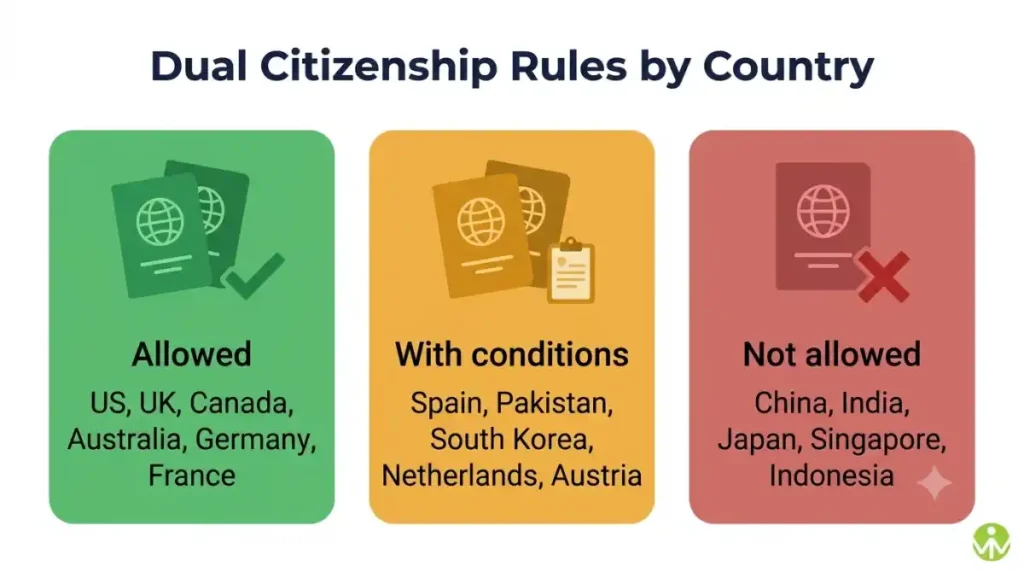
Countries that allow dual citizenship, by region
The countries that allow dual citizenship in Table 1 accept it in both directions. Foreigners who naturalise there are not required to renounce their previous nationality, and citizens who take another nationality keep their own. A few still apply practical limits, such as treating a dual national only as their own citizen while the person is on their territory.
Table 1: Countries that allow dual citizenship, by region
| Region | Countries that allow dual citizenship | Recent change to note |
|---|---|---|
| Europe | Belgium, Cyprus, Czech Republic, Denmark, Finland, France, Germany, Greece, Hungary, Iceland, Ireland, Italy, Luxembourg, Malta, Norway, Poland, Portugal, Sweden, Switzerland, United Kingdom | Germany since 27 June 2024; Norway since 1 January 2020 |
| Americas | Brazil, Canada, Colombia, Mexico, United States | A US Senate bill to end dual citizenship (S.3283) has not passed |
| Asia-Pacific | Australia, New Zealand, Philippines | Natural-born Filipinos can keep or reacquire citizenship under Republic Act 9225 |
| Middle East and Africa | Israel, Kenya, South Africa | South Africa ended automatic loss of citizenship on 6 May 2025 |
| Allowed both for foreigners who naturalise and for citizens who acquire another nationality. Sources: national nationality laws and official government pages, checked October 2026. Always check the other country’s rules too. | ||
Italy has allowed dual citizenship since 16 August 1992, as our guide to Italian citizenship explains, and Norway joined the countries that allow dual citizenship on 1 January 2020, according to the Norwegian Directorate of Immigration. The United States does not require a choice either: the State Department’s guidance on dual nationality says US law does not require a person to choose one nationality, and our guide to US dual citizenship covers the routes in both directions.
Recent changes among countries that allow dual citizenship
The list of countries that allow dual citizenship has grown since 2020, and most of the recent changes have widened it rather than narrowed it.
Germany: multiple citizenship since June 2024
Germany’s Act on the Modernisation of Citizenship Law took effect on 27 June 2024. Foreigners who naturalise no longer have to give up their previous nationality, and Germans who acquire another citizenship no longer lose their German one. The same reform cut the usual residence requirement for naturalisation from eight years to five, a route set out in our guide to permanent residency in Germany. Our guide to the German citizenship test explains the 33-question exam most applicants still need to pass.
South Africa: automatic loss struck down in 2025
On 6 May 2025, South Africa’s Constitutional Court confirmed in Democratic Alliance v Minister of Home Affairs that section 6(1)(a) of the Citizenship Act was unconstitutional. South Africans no longer lose their citizenship by taking another nationality without a retention permit, and the court declared that people who lost it under that section since October 1995 are deemed never to have lost it. South Africa now sits firmly among the countries that allow dual citizenship.
Ukraine: approved countries from January 2026
Ukraine’s law on multiple citizenship took effect on 16 January 2026. It allows Ukrainians to hold the citizenship of countries on a list approved by the Cabinet of Ministers. It does not allow citizenship of any state Ukraine designates as an aggressor, and civil servants must still hold Ukrainian citizenship only. The law made Ukraine one of the countries that allow dual citizenship, though only with listed partners.
Pakistan and Spain: longer treaty lists
Pakistan’s Directorate General of Immigration and Passports now lists 22 countries with which it has dual nationality arrangements, up from 19 in 2019, following a 2024 amendment to the Pakistan Citizenship Act. Spain added France to its treaty list when the Spanish-French nationality agreement took effect on 1 April 2022.
United States: a bill, not a law
The Exclusive Citizenship Act of 2025 (S.3283), introduced in the US Senate on 1 December 2025, would require Americans to hold only US citizenship. It has not passed either chamber of Congress, so it has no legal effect, and the United States remains one of the countries that allow dual citizenship.
Countries that allow dual citizenship only with conditions
Some countries allow dual citizenship only with particular countries, only for particular groups, or only with official permission obtained in advance. For people from these countries, the timing and order of each step matters as much as eligibility.
Table 2: Countries that allow dual citizenship only with conditions
| Country | Type of rule | What it means in practice |
|---|---|---|
| Spain | Treaty countries | Dual nationality with Ibero-American countries, Andorra, the Philippines, Equatorial Guinea, Portugal and, since 1 April 2022, France. Others must declare that they renounce their nationality when they naturalise. |
| Pakistan | Listed countries | Dual nationality with 22 listed countries, including the United Kingdom, the United States, Canada, Australia and Germany. |
| South Korea | Pledge for certain groups | Marriage migrants, people of outstanding talent and former Korean citizens can keep a foreign nationality by pledging not to exercise it in Korea. Most other naturalised citizens must renounce within one year. |
| Ukraine | Approved countries | Since 16 January 2026, multiple citizenship only with countries on a Cabinet-approved list. Civil servants must hold Ukrainian citizenship only. |
| Netherlands | Renunciation with exceptions | Adults who naturalise must generally renounce. Dutch citizens who adopt another nationality generally lose Dutch nationality unless an exception applies. |
| Austria | Permission in advance | Citizens need a retention permit before acquiring another citizenship. Foreigners who naturalise generally have two years to renounce. |
| Vietnam | Presidential approval | Since 1 July 2025, some applicants, such as those with a Vietnamese spouse, parent or grandparent, may keep a foreign nationality with presidential approval. |
| Sri Lanka | By application | Citizens apply to retain, and former citizens to resume, Sri Lankan citizenship under qualifying categories, for a main applicant fee of US$2,000. |
| Thailand | Generally permitted | Thai law generally permits dual citizenship, but officers may ask naturalisation applicants to declare an intent to renounce. |
| Lithuania | Narrow exceptions | Dual citizenship is limited to exceptional cases. A 2024 referendum to widen it did not pass. |
| Sources: official immigration and nationality authorities of each country, checked October 2026. Conditions change, so confirm with the relevant embassy before you apply. | ||
For countries that allow dual citizenship only with conditions, the conditions are often stricter than they seem at first. In Austria, the official government guidance says a citizen must apply for and receive a retention permit before acquiring another citizenship, and that foreigners who naturalise generally have two years to renounce their previous one. The Dutch Immigration and Naturalisation Service says adults who naturalise must give up their other nationality unless an exception applies. In Sri Lanka, dual citizenship is granted on application under qualifying categories, and the main applicant pays US$2,000 once the minister approves the request. Our guide to Thailand citizenship explains how Thai practice works for people who naturalise.
Countries that do not allow dual citizenship
Outside the countries that allow dual citizenship, a smaller group does not allow its adult citizens to hold another nationality. Most are in Asia, and several are among the world’s largest sources of migrants, so their rules affect many people who settle abroad.
Table 3: Countries that do not allow dual citizenship
| Country | What the law says | Note |
|---|---|---|
| China | Does not recognise dual nationality. Chinese nationals who settle abroad and acquire a foreign nationality lose Chinese nationality automatically. | No alternative status for former citizens |
| India | Citizenship is lost on voluntary acquisition of another citizenship. | Former citizens can hold an Overseas Citizenship of India (OCI) card |
| Japan | People with Japanese and another nationality must choose one, by age 20 if they held both before 18. Foreigners who naturalise generally give up their nationality. | Permanent residency lets foreigners keep their passport |
| Singapore | Citizens aged 21 and over may not hold another citizenship. | Rule stated by the Immigration and Checkpoints Authority |
| Indonesia | Single nationality. Children of mixed parents may hold both until 18, then have three years to choose. | A limited dual citizenship proposal was under discussion in October 2026 |
| Malaysia | Citizenship can be lost on voluntary acquisition of another citizenship. | No alternative status for former citizens |
| Sources: national nationality laws and official government pages, checked October 2026. | ||
India does not allow dual citizenship. An Indian citizen who voluntarily acquires another citizenship loses Indian citizenship, but former Indian citizens and their descendants can hold an Overseas Citizenship of India card, which allows lifelong visits without a visa but is not citizenship and carries no right to vote. Our guide to renewing or reissuing an OCI card explains when you need to update it.
Japan requires people who hold Japanese and another nationality from childhood to choose one under the Ministry of Justice’s choice-of-nationality rules, and foreigners who naturalise generally give up their previous nationality. Many long-term residents therefore choose permanent residency in Japan instead, because it lets them keep their existing passport. Singapore’s Immigration and Checkpoints Authority states that a citizen aged 21 or over may not hold dual citizenship.
How to check if you can keep both citizenships
Because countries differ in how they allow dual citizenship, the safest approach is to check both sides before you apply for anything.
1. Check your current country’s law on acquiring another nationality: whether citizenship is lost automatically, kept only with permission, or kept without any action.
2. Check the naturalisation rules of the country you want to join, including any requirement to renounce or to declare that you renounce your current nationality.
3. Look for treaty or listed-country rules, as in Spain, Pakistan and Ukraine, where the answer depends on which two countries are involved.
4. Get any permission before you naturalise, not after. In Austria and Sri Lanka, the order matters.
5. Consider the obligations that come with two passports, including tax filing, military service and limited consular help while you are in your other country of citizenship.
Rules also change. Germany, Norway, South Africa, and Ukraine have all joined or expanded the list of countries that allow dual citizenship since 2020, so check official sources when you apply rather than relying on an older list.
The route you take also matters. A residence permit bought through a golden visa leads to a passport only through ordinary naturalisation, while citizenship by investment programmes grant one directly. Either way, your country’s rules on dual nationality apply. If travel access is the goal, our passport rankings show what each passport opens, and our guide to permanent residency worldwide covers the step before citizenship in most countries.
FAQ: countries that allow dual citizenship
Which countries allow dual citizenship?
The countries that allow dual citizenship include most of Europe, the Americas and Oceania, among them the United States, the United Kingdom, Canada, Australia, France, Germany, Italy, Ireland and Mexico. Others, such as Spain, Pakistan and South Korea, allow it only with certain countries or for certain groups.
Does the United States allow dual citizenship?
Yes. US law does not require a person to choose one nationality, and a US citizen can naturalise elsewhere without losing US citizenship. A Senate bill to end dual citizenship, S.3283, was introduced in December 2025 but has not become law.
Does India allow dual citizenship?
No. India is not among the countries that allow dual citizenship: an Indian citizen who voluntarily acquires another citizenship loses Indian citizenship. Former Indian citizens can apply for an Overseas Citizenship of India card, which is not citizenship.
Can I hold three citizenships?
Often, yes. Countries that allow dual citizenship usually do not limit how many nationalities a person can hold. Countries with treaty lists, such as Spain or Pakistan, generally require each additional citizenship to come from a listed country.
Will I lose my citizenship if I naturalise somewhere else?
It depends on your current country. Some, such as the Netherlands, Malaysia and India, end citizenship automatically when you voluntarily take another. Others, such as Austria, let you keep it only if you obtain permission before you naturalise.
Does dual citizenship affect tax or military service?
It can. Each country applies its own tax and military service rules to its citizens, and the United States taxes its citizens on worldwide income wherever they live. Check both countries’ rules before you apply.