
Optional Practical Training is the work authorisation that allows an F-1 student to take a paid job in the United States in their field of study, for up to 12 months after finishing a degree. For most international graduates, it is the first, and often the only, route to American work experience before the far narrower H-1B route opens.
2026 has been a busy year for the rules around it. A Department of Homeland Security final rule published on 17 July 2026 ends the open-ended “duration of status” admission F-1 students have held for decades and shortens the grace period after graduation. None of it abolishes Optional Practical Training: the 12 months and the 24-month STEM extension both survive. What has changed is the timetable around them, and the paperwork needed to hold status while using them.
Key Takeaways
- Optional Practical Training gives F-1 students up to 12 months of work authorisation in the field of their degree. Eligible STEM graduates can add a further 24 months, for 36 in total.
- Optional Practical Training is permission to work while holding F-1 status. It is not a visa, it is not employer-sponsored, and it does not tie a graduate to one job.
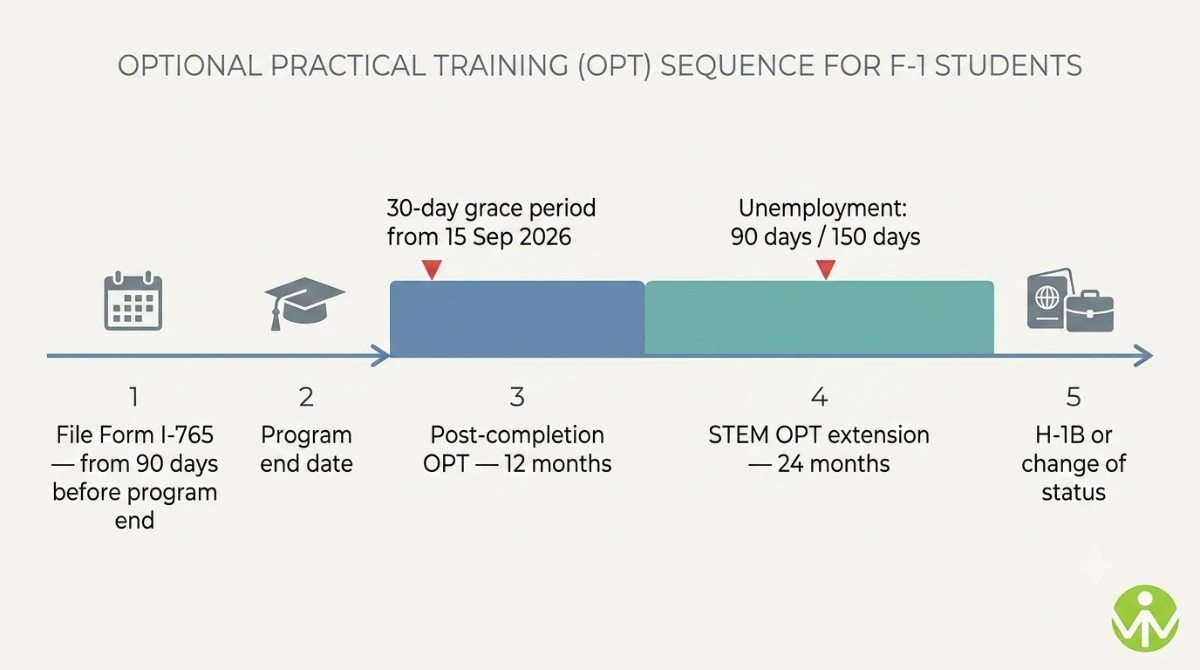
- Applications go to USCIS on Form I-765 and can be filed from 90 days before the program end date. No work may begin until the Employment Authorization Document is approved and its start date arrives.
- From 15 September 2026 F-1 admission becomes date-certain rather than open-ended, and the grace period after studies or OPT end falls from 60 days to 30.
- Students who file Form I-765 for OPT or the STEM extension on or before 18 March 2027 are spared a separate extension of stay application.
- Unemployment is capped at 90 days on post-completion Optional Practical Training, and at 150 days across OPT and the STEM extension combined.
- The rule behind the September changes is being challenged in federal court, with a hearing set for 3 September 2026.
Table of Contents
What Optional Practical Training Is
Optional Practical Training is temporary employment authorisation, granted by USCIS, for work directly related to an F-1 student’s major area of study. It is not a separate visa category. A graduate working on OPT is still an F-1 student in immigration terms, with a school still maintaining their SEVIS record, and the permission is evidenced by an Employment Authorization Document (EAD) card rather than by anything in a passport.
Two features set it apart from most US work permission. It is not tied to one employer, so a graduate can change jobs without a new application provided the role still relates to the degree. And nobody sponsors it: there is no employer petition and no labour condition application.
Each level of study carries its own allowance: a student who used all 12 months after a bachelor’s degree can use a fresh 12 months after a master’s. Unused months do not roll over.
Who Qualifies for Optional Practical Training
Eligibility for Optional Practical Training turns on status rather than merit. An applicant must have been enrolled full-time in valid F-1 status for at least one full academic year at a school certified by the Student and Exchange Visitor Program, must be pursuing a degree, and must intend to work in a role directly related to it. Students in English language training programs cannot use OPT at all.
A job offer is not required, and most applicants file without one. What does bar an application is heavy prior use of curricular practical training: 12 months or more of full-time CPT at a given education level removes eligibility at that level entirely. Part-time CPT does not, no matter how much is used.
The underlying status rules sit with the F-1 category itself — see our F-1 visa guide for eligibility, dependants and the application process.
Pre-Completion and Post-Completion Optional Practical Training
Pre-completion OPT is used while still studying: part-time, at 20 hours a week or less during term, and full-time during official school breaks. Post-completion OPT runs after the program end date, at 20 hours a week or more, and is what most people mean by the term.
Both draw on the same 12 months. Full-time pre-completion OPT is deducted month for month, part-time at half that rate, so two months of part-time use costs one month. Working full-time for a summer before graduating leaves fewer months afterwards, which is why pre-completion use is rare.
Optional Practical Training Deadlines in 2026
Timing is where most OPT applications go wrong, and the 2026 rule change tightens it. Form I-765 can be filed from 90 days before the program end date, and filing early is now the single most useful thing a graduating student can do. Once a Designated School Official issues the OPT recommendation on a new Form I-20, the application must reach USCIS within 30 days of the date printed on that I-20, or the I-20 has to be reissued.
All post-completion OPT must also be used within 14 months of the program end date. Processing delays do not move that outer limit, so a slow adjudication quietly shortens the usable period rather than pushing it back.
Table 1: Optional Practical Training deadlines before and after 15 September 2026
| Milestone | Position before 15 September 2026 | Position from 15 September 2026 |
|---|---|---|
| Earliest Form I-765 filing | 90 days before program end date | 90 days before program end date (unchanged) |
| Deadline to file after the OPT I-20 is issued | 30 days from the I-20 issue date | 30 days from the I-20 issue date (unchanged) |
| Latest filing after the program end date | 60 days | 30 days (reported, see note) |
| Latest requested OPT start date | 60 days after program end date | 30 days after program end date (reported, see note) |
| Grace period after studies or OPT end | 60 days | 30 days |
| Outer limit to use post-completion OPT | 14 months from program end date | 14 months from program end date (unchanged) |
| Maximum unemployment on 12-month OPT | 90 days | 90 days (unchanged) |
| Separate extension of stay required | No | Yes, unless Form I-765 is received on or before 18 March 2027 |
| The grace period change is stated in the DHS final rule (Federal Register document 2026-14439, 17 July 2026). The 30-day filing and start-date figures are as reported by immigration practitioners in July and August 2026 and follow from the shorter grace period; they could not be confirmed against the rule text and should be checked with a Designated School Official. Status as of 23 August 2026: the rule is scheduled for 15 September 2026 and is subject to a pending court challenge. | ||
How to Apply for Optional Practical Training
Step one: the school’s recommendation
Nothing can be filed until a Designated School Official recommends Optional Practical Training in the SEVIS record and issues an updated Form I-20 showing the recommendation, the requested dates and the employment type. Schools set internal deadlines for this, often weeks before USCIS would accept a filing, so the operative deadline is usually the university’s.
Step two: Form I-765 and the fee
The Optional Practical Training application is Form I-765, filed with USCIS online or on paper, with the signed I-20, passport and visa pages, the most recent Form I-94 and two passport photographs. Online filing is cheaper and gives a clearer view of case status.
Table 2: USCIS filing fees relevant to OPT
| Form | Purpose | Online filing | Paper filing |
|---|---|---|---|
| Form I-765 | Employment authorisation for OPT and STEM OPT | $470 | $520 |
| Form I-539 | Extension of stay, where required from 15 September 2026 | $420 | $470 |
| Fees as published on the USCIS fee schedule and current at 23 August 2026. No separate biometrics fee is charged for either form in these categories, although USCIS may still schedule a biometrics appointment. Premium processing is not available for a Form I-539 extension of stay for F-1 students. | |||
Read: Indian Students Studying Abroad – The Latest Statistics
Approval produces the EAD card, which carries a start and an end date. Work may not begin before the start date printed on it, regardless of what an employer expects. Earnings are subject to federal income tax and, in most states, state income tax; nonresident students are generally exempt from Social Security and Medicare withholding, though payroll systems often get this wrong enough to be worth checking on a first payslip. Our guide to tax filing for international students covers the obligations in full.
The Unemployment Limit on Optional Practical Training
A graduate on post-completion Optional Practical Training may accrue no more than 90 days of unemployment. The count begins on the EAD start date, not on graduation day, and it is cumulative rather than consecutive: three separate month-long gaps exhaust the allowance as surely as one continuous stretch. Exceeding it is a status violation, not an administrative lapse.
Qualifying employment on Optional Practical Training is broader than a conventional salaried job. Multiple employers, short-term contracts, self-employment with a business licence, agency work and even unpaid internships can count, provided the role relates directly to the degree and occupies at least 20 hours a week. Each employer must be recorded in SEVIS: unreported work does not count, however real it is.
How the STEM Extension Builds on Optional Practical Training
Graduates whose degree appears on the DHS STEM Designated Degree Program List can apply for a further 24 months, taking total authorisation to 36. The conditions are stricter: the employer must be enrolled in E-Verify, employer and student must sign a formal training plan on Form I-983, and there must be a genuine employer-employee relationship, which rules out most self-employment and many staffing placements.
It can be filed up to 90 days before the current EAD expires, and filing on time extends work authorisation automatically for up to 180 days while USCIS adjudicates. The unemployment allowance rises by 60 days, to 150 across the whole period. Our guide to the STEM OPT extension covers the I-983 and the reporting cycle in detail.
Table 3: Post-completion Optional Practical Training compared with the STEM extension
| Feature | Post-completion OPT | STEM OPT extension |
|---|---|---|
| Duration | Up to 12 months per education level | A further 24 months |
| Maximum combined authorisation | 12 months | 36 months |
| Eligible degrees | Any qualifying F-1 degree program | Degree on the DHS STEM Designated Degree Program List |
| Employer must use E-Verify | No | Yes |
| Formal training plan | Not required | Form I-983, signed by student and employer |
| Self-employment | Permitted with a proper business licence | Generally not permitted |
| Maximum unemployment | 90 days | 150 days across both periods combined |
| Reporting cycle | Changes reported within 10 days | Changes within 10 days, plus six-monthly validation and annual self-evaluation |
| Earliest filing | 90 days before program end date | 90 days before the current EAD expires |
| Both periods run under F-1 status and both require the work to be directly related to the student’s major area of study. Current at 23 August 2026. | ||
What the Fixed-Admission Rule Changes for Optional Practical Training
The DHS final rule published on 17 July 2026, due to take effect on 15 September 2026, replaces duration of status with a fixed date. F-1 students will receive an admit-until date on Form I-94 set to their program end date, capped at four years. Extending beyond it means filing Form I-539 with USCIS, where previously a school could simply extend an I-20. The grace period after studies or Optional Practical Training end drops from 60 days to 30.
Four years is a ceiling, not an entitlement, and that detail matters most for OPT. A two-year master’s generates a two-year admission; the unused time is not held in reserve to cover practical training afterwards. Authorisation and admission are separate questions: an approved EAD does not extend the admit-until date, so a graduate can hold valid work permission while their admission expires underneath it. Our explainer on the end of duration of status sets out the rule across the F, J and I categories.
The 18 March 2027 transition
There is a real concession for students already in the country. Anyone admitted for duration of status before 15 September 2026 who files Form I-765 for post-completion OPT or the STEM extension on or before 18 March 2027 need not file a separate extension of stay, and keeps the 60-day grace period. What counts is the date USCIS receives the form, not the graduation date.
It is fragile in one way: leaving the United States and being readmitted after 15 September 2026 converts the traveller to a date-certain admission with the 30-day grace period, and the benefit is gone. Anyone planning to file is better off not travelling until the application is in.
The court challenge that could change this
None of it is settled. On 18 August 2026, a coalition led by NAFSA and the Presidents’ Alliance on Higher Education and Immigration, joined by several unions, sued the Department of Homeland Security in the US District Court for the District of Massachusetts, arguing the rule was adopted without adequate assessment of its costs or meaningful response to comments. They have asked for a preliminary injunction, and a hearing is listed for 3 September 2026 — twelve days before the rule is due to bite. As of 23 August 2026, it has not been blocked and should be planned for, but anyone filing close to the deadline should check whether it survived.
Working, Reporting and Travel on Optional Practical Training
Reporting duties
Optional Practical Training carries reporting obligations that are easy to overlook after leaving campus. Changes of address, changes of employer and periods of unemployment must be reported within 10 days, through the SEVP Portal or the Designated School Official. Because the school still holds the SEVIS record, a graduate who stops answering their international office can have that record terminated over an unreported house move.
Travel
Travelling while an application is pending is the riskiest moment in the sequence, particularly after the program end date: a student who leaves before the EAD is issued may be unable to return, and re-entry after 15 September 2026 forfeits the transition concession above. Once the card is in hand, re-entry requires the EAD, a valid F-1 visa, an I-20 endorsed for travel within the last six months, and evidence of a job or job offer.
After Optional Practical Training: the H-1B and Cap-Gap
For most graduates the plan after OPT is an H-1B, and two things about that route have changed in ways older guidance has not caught up with. It is still capped, but it is no longer a random draw: since 27 February 2026 registrations have been selected through a wage-weighted process in which a beneficiary’s entry count depends on the OEWS wage level of the salary offered, so a junior offer is materially less likely to be selected than a senior one. FY2027 was the first cap season run this way.
The second is the $100,000 H-1B fee introduced by proclamation in September 2025. A federal court in Massachusetts vacated it on 8 June 2026 as, in substance, a tax, and the First Circuit declined to stay that ruling on 24 July 2026. A case in Washington, D.C., went the other way in December 2025 and is on appeal, so the position could change. The charge is not being collected at present, and it never applied to petitions for candidates already in the United States — the position of essentially every graduate on OPT.
One protection bridges the two statuses. Where an employer files a cap-subject H-1B petition requesting a change of status while the student holds valid F-1 status in an approved period of post-completion OPT, cap-gap relief extends both status and work authorisation past the EAD expiry — since January 2025, as far as 1 April of the following fiscal year. The July 2026 rule leaves it untouched. Not everyone reaches that point: international student numbers in the US have fallen sharply, and alternatives are worth mapping before the EAD runs down.
Frequently Asked Questions
How long does Optional Practical Training last?
Up to 12 months for each higher level of study completed. Graduates with a qualifying STEM degree can add 24 months, for a maximum of 36. Any pre-completion OPT used while studying comes out of the same allowance.
Can I apply for Optional Practical Training after I have graduated?
Yes, but the window is short and shrinking. Applications have been accepted up to 60 days after the program end date; practitioners reading the July 2026 rule expect that to fall to 30 days under the new regime. Filing before graduation, up to 90 days ahead, avoids the question.
Do I need a job offer to apply for Optional Practical Training?
No. Post-completion OPT is applied for without any employer involvement, and most students file before they have an offer. The 90-day unemployment clock, though, starts on the EAD start date whether or not a job has materialised.
What happens if I exceed 90 days of unemployment?
It is a violation of F-1 status. The school terminates the SEVIS record, work authorisation ends with it, and the graduate is expected to depart or change status. Reporting employment promptly matters, because unreported work counts as unemployment even when it is real.
Do I have to file Form I-539 as well as Form I-765?
Not if you were admitted for duration of status before 15 September 2026 and USCIS receives your OPT or STEM OPT application on or before 18 March 2027. Outside that window — including for anyone who leaves and re-enters after 15 September 2026 — an extension of stay on Form I-539 will generally be needed alongside the employment application.
Does OPT lead to an H-1B visa?
Not automatically. OPT buys time in which an employer can register a graduate for the H-1B cap, and the STEM extension buys enough for three attempts rather than one. Selection is now weighted by wage level rather than random, so the salary attached to the offer affects the odds.
Optional Practical Training in 2026: What to Do Now
Optional Practical Training survives 2026 intact in substance and tighter in administration. The 12 months are still there, the STEM extension is still there, and neither needs an employer to sponsor anything. What has gone is the slack.
Three dates carry most of the risk: 15 September 2026, when the fixed-admission rule is due to take effect; 3 September 2026, when a federal court hears the challenge to it; and 18 March 2027, the end of the transition that spares a separate I-539. The response to all three is the same and unglamorous — know the program end date, file Form I-765 at the earliest permitted moment, and confirm the current position with a Designated School Official before travelling or filing late. The full text of the rule is published in the Federal Register.