
US citizenship is acquired in one of four ways: by birth on American soil, through a US citizen parent, through qualifying military service, or by naturalisation after a period as a lawful permanent resident. For most people reading this, the fourth route is the one that matters. They already hold a green card, they have counted the years, and they want to know exactly what US Citizenship and Immigration Services will ask of them. This guide covers all four routes and then goes deep on naturalisation, because that is the only route an adult applies for.
Two policy changes have made that application harder than it has been in three decades. In August 2025, USCIS replaced its checklist approach to good moral character with a holistic one. On 25 August 2026, it formalised neighbourhood investigations in its Policy Manual. Separately, a proposed rule would nearly double the cost of applying. All three reshape what a US citizenship application looks like in practice, and all three are covered below.
Key Takeaways
- There are four routes to US citizenship: birth in the United States, acquisition through a US citizen parent, military service, and naturalisation after a period as a lawful permanent resident.
- Naturalisation is the only route an adult applies for. The general rule is five years as a green card holder; three years if you are married to and living with the same US citizen throughout.
- Form N-400 currently costs $710 online or $760 on paper. A proposed rule published on 23 June 2026 would raise that to $1,280 and $1,330 and abolish fee waivers. It is not law yet.
- The civics test changed on 20 October 2025. Applicants now draw 20 questions from a 128-question bank and must answer 12 correctly.
- USCIS formalised neighbourhood investigations in its Policy Manual on 25 August 2026. Officers may check your residence, employment and community reputation, and may waive the check case by case.
- Good moral character is now judged on the totality of the circumstances. Positive evidence counts, so applicants are expected to show it rather than simply have a clean record.
Table of Contents
What US citizenship means and what it adds to a green card
A green card lets you live and work anywhere in the United States indefinitely. It can also be lost, through long absences abroad, certain criminal convictions, or abandonment of residence. US citizenship cannot be taken away except in narrow cases involving fraud in the original application. That single difference is why the naturalisation queue exists at all, and why US citizenship is worth the paperwork to people who already have the right to stay.
Beyond security of status, US citizenship carries the vote in federal elections, eligibility for most federal jobs and security clearances, and a US passport, which the 2026 Henley index puts at 180 destinations reachable without a visa in advance. Citizens cannot be refused entry to the country and never have to justify time spent abroad. They can also sponsor a wider circle of relatives than permanent residents can: parents, married children and siblings, not only a spouse and minor children.
There is a trade-off worth stating plainly. Green card holders and citizens are both taxed on worldwide income, so naturalising does not create a new tax burden, but it does make the existing one permanent and hard to exit. Some countries, including India, do not permit dual nationality. A citizen of such a country who naturalises in the United States gives up the original citizenship, and in India’s case applies for an Overseas Citizen of India card instead. Our guide to US dual citizenship covers which combinations are workable.
The four routes to US citizenship
Only one of the four routes to US citizenship involves an application and an eligibility decision. The other three either happen automatically or turn on facts fixed long before any form is filed. The table below sets out how each one works.
Table 1: The four routes to US citizenship
| Route | Who it covers | Key requirement | Form |
|---|---|---|---|
| Birth in the United States | Anyone born on US soil, subject to the jurisdiction of the United States | Fourteenth Amendment; status exists from birth | US birth certificate / passport |
| Acquisition through a parent | Children born abroad to a US citizen parent | Parent meets the applicable prior-residence conditions | CRBA or N-600 |
| Derivation as a minor | Green card holders under 18 in a US citizen parent’s custody | All conditions met at one point before the 18th birthday | N-600 |
| Naturalisation | Adult lawful permanent residents | 5 years as an LPR, or 3 years on the spouse route | N-400 |
| Source: Immigration and Nationality Act sections 316, 319(a), 320, 328, 329 and the USCIS Policy Manual, Volume 12. Accurate as of 28 August 2026. | |||
If you were born in the United States, or to a US citizen parent, you are already a citizen and the relevant form documents that fact rather than granting it. Everyone else who wants US citizenship as an adult goes through naturalisation, and that is where the rest of this guide sits.
US citizenship by naturalisation: who qualifies
US citizenship by naturalisation runs on two clocks. The general rule, under section 316 of the Immigration and Nationality Act, requires five years as a lawful permanent resident. For investors who hold an EB-5 visa, the two years spent as a conditional resident count towards those five years. The spouse rule, under section 319(a), shortens that to three years for applicants married to a U.S. citizen and living in a marital union with that same U.S. citizen throughout the period.
Beyond the clock, every applicant for US citizenship must be at least 18 at the time of filing, must satisfy continuous residence and physical presence tests, must have lived in the state or USCIS district where they are filing for at least three months, must show good moral character, must demonstrate an ability to read, write and speak basic English and a knowledge of US civics, and must be attached to the principles of the Constitution. The process ends with the Oath of Allegiance.
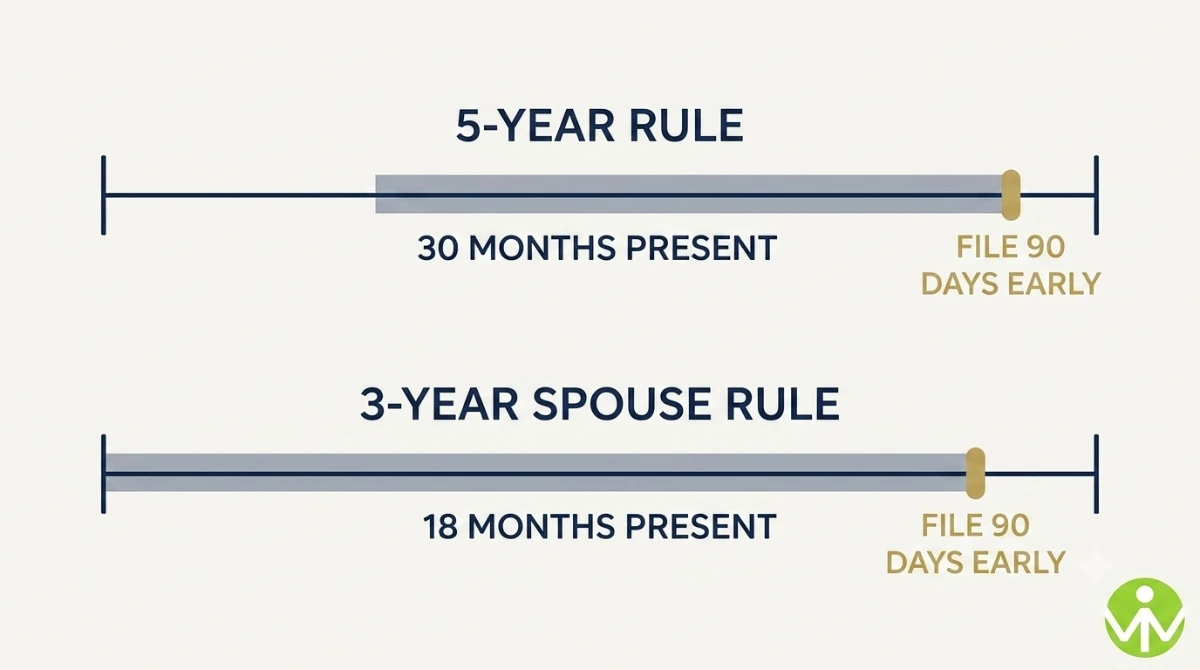
One timing rule saves applicants months. You may file Form N-400 up to 90 days before you complete the five-year or three-year residence period. Filing on day 91 is a denial, so the date is worth calculating precisely rather than approximately.
Table 2: Five-year rule vs three-year spouse rule
| Requirement | General rule (INA 316) | Spouse of a US citizen (INA 319(a)) |
|---|---|---|
| Time as a lawful permanent resident | 5 years | 3 years |
| Continuous residence | 5 years immediately before filing | 3 years immediately before filing |
| Physical presence | At least 30 months (913 days) | At least 18 months (548 days) |
| Marital union | Not applicable | Married to and living with the same US citizen for the whole 3 years |
| State or USCIS district residence | 3 months | 3 months |
| Good moral character period | 5 years, continuing to the oath | 3 years, continuing to the oath |
| Early filing window | 90 days | 90 days |
| Source: USCIS Policy Manual, Volume 12, Parts D and G. Verified 28 August 2026. | ||
Continuous residence
Continuous residence means the United States has been your home without interruption for the whole qualifying period, and it is the requirement that ends more US citizenship applications than any other. Absences are where applications break. An absence of more than six months but less than a year is presumed to break continuity, though the presumption can be rebutted with evidence: US employment kept on, family remaining in the country, a home retained, taxes filed as a resident. An absence of one year or more automatically breaks continuity, and without an approved Form N-470 the application must be denied.
The recovery timeline after a broken clock is unforgiving. An applicant on the five-year track who has broken continuous residence must generally wait four years and one day from returning before filing again, and four years and six months to avoid a fresh presumption. Anyone whose work involves long postings abroad should map absences against these thresholds before booking anything.
Physical presence
Physical presence is a straight day count and is separate from continuous residence. Five-year applicants need at least 30 months, which USCIS states as 913 days, inside the United States during those five years. Three-year spouse applicants need at least 18 months, or 548 days, during their three years. You can satisfy continuous residence and still fail physical presence, which is why keeping a travel log matters more than most applicants for US citizenship expect.
Residence in your state or USCIS district
You must have lived in the state or USCIS district where you file for at least three months before filing. This is the requirement most often broken by accident, usually by people who move house shortly before applying. Students who keep a permanent address in one state while studying in another may file in either.
Good moral character: the biggest change in 30 years
Good moral character has always been a statutory requirement, measured across the five years before filing, or three years for spouse applicants, and continuing through to the oath. What changed in 2025 and 2026 is how it is assessed. It is now the single most consequential part of a US citizenship application for people with otherwise ordinary records, and the part least served by simply having no convictions.
The totality-of-circumstances standard
A policy memorandum issued on 15 August 2025 replaced what USCIS itself described as a mechanical approach with a holistic assessment of an applicant’s behaviour, adherence to societal norms and positive contributions. The practical shift is from proving an absence of wrongdoing to affirmatively demonstrating good character.
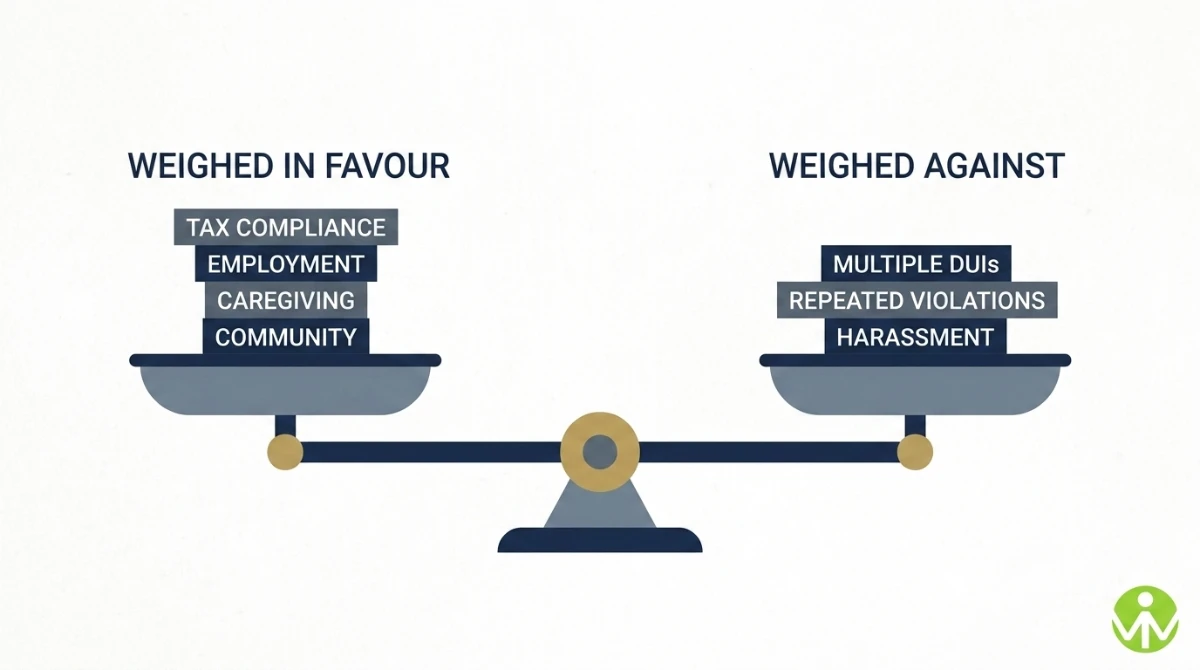
Officers now weigh positive factors: community involvement, family and caregiving responsibilities, educational attainment, stable employment, tax compliance, and evidence of genuine rehabilitation such as clearing overdue child support. They also weigh an expanded set of negative ones. Alongside the permanent bars, such as murder and aggravated felonies, and the conditional bars, such as controlled-substance offences and multiple DUI convictions, officers may now consider conduct that is technically lawful: repeated reckless traffic violations, harassment, aggressive solicitation, and other behaviour described as inconsistent with civic responsibility.
Neighbourhood investigations are back
On 25 August 2026, USCIS formalised neighbourhood investigations in its Policy Manual under section 335(a) of the Immigration and Nationality Act. The statute has always permitted them. The agency simply waived them as routine from the early 1990s, when screening shifted toward criminal-history and security database checks. An August 2025 memorandum ended that blanket waiver; the 2026 update writes the practice into standing guidance.
In a neighbourhood investigation, officers may examine an applicant’s residence, employment history and reputation in the community, and may seek statements from neighbours, employers or colleagues. The purpose is to test two of the harder-to-document requirements for US citizenship: good moral character and attachment to the Constitution. USCIS may still waive the investigation, on a case-by-case basis or for whole categories of applicant, so a check is a possibility rather than a certainty for any given file.
Character reference letters and what to do about them
The actionable part of the 2026 guidance is this: applicants may voluntarily submit character reference letters, preferably from US citizens who are not related to them, and officers may take those letters into account when deciding whether to waive an investigation. Nobody is required to file them. But for an applicant with a thin paper trail, a handful of letters from an employer, a neighbour and a community organisation is a low-cost way to put positive evidence in front of the officer before anyone goes looking for it.
The same logic generally applies to the totality standard. Tax transcripts, employment letters, volunteering records, and evidence of caregiving are now relevant to a US citizenship application in ways they simply were not three years ago.
How to apply for US citizenship: the N-400 step by step
The application itself is Form N-400, filed online or on paper. Online filing is cheaper and gives you case status inside a USCIS account. The sequence below reflects what most US citizenship applicants experience, though timing varies widely by field office.
Table 3: The N-400 process step by step
| Item | Current fee | Proposed fee (not in force) | Notes |
|---|---|---|---|
| N-400, filed online | $710 | $1,280 | 80% increase; biometrics included |
| N-400, filed on paper | $760 | $1,330 | 75% increase |
| N-400 reduced fee | $380 | Abolished | Household income at or below 400% of the Federal Poverty Guidelines |
| N-400 fee waiver | $0 | Abolished | Household income at or below 150% of the Federal Poverty Guidelines |
| N-336 appeal, online | $780 | $1,425 | 83% increase |
| N-336 appeal, on paper | $830 | $1,475 | 78% increase |
| Military applicants (INA 328, 329) | $0 | $0 | Statutory exemption, unaffected by the proposal |
| First adult US passport book | $165 | Not affected | $130 application fee plus $35 execution fee |
| Source: USCIS fee schedule and the proposed rule Naturalization Application Fee Adjustments, 91 FR 37500, published 23 June 2026. Comment period closed 24 August 2026; no final rule as of 28 August 2026. | |||
Two points are worth flagging. First, you remain a permanent resident throughout, so green card renewal deadlines still apply while the N-400 is pending. Second, USCIS may issue a Request for Evidence at any stage, and the clock effectively pauses until you answer it.
US citizenship cost in 2026 and the increase that has been proposed
Form N-400 currently costs $710 filed online and $760 filed on paper. Biometrics are included in that fee. Applicants with household income at or below 400% of the Federal Poverty Guidelines can pay a reduced fee of $380, and those at or below 150% can request a full fee waiver. Members and veterans of the US armed forces filing under sections 328 and 329 pay nothing, by statute.
That is the position today. A proposed rule published in the Federal Register on 23 June 2026 would raise the N-400 fee to $1,280 online and $1,330 on paper, increases of 80% and 75%. It would also eliminate both the fee waiver and the reduced fee for naturalization applicants, leaving only the statutory military exemption. The comment period closed on 24 August 2026, and no final rule had been published as of 28 August 2026.
Nothing about the proposed figures is in force. But anyone close to eligibility now has a concrete reason to file rather than wait, and anyone relying on a fee waiver has a reason to file well before a final rule appears. The cost of US citizenship is one of the few variables in this process an applicant can still control by acting early.
Table 4: US citizenship fees, current and proposed
| Item | Current fee | Proposed fee (not in force) | Notes |
|---|---|---|---|
| N-400, filed online | $710 | $1,280 | 80% increase; biometrics included |
| N-400, filed on paper | $760 | $1,330 | 75% increase |
| N-400 reduced fee | $380 | Abolished | Household income at or below 400% of the Federal Poverty Guidelines |
| N-400 fee waiver | $0 | Abolished | Household income at or below 150% of the Federal Poverty Guidelines |
| N-336 appeal, online | $780 | $1,425 | 83% increase |
| N-336 appeal, on paper | $830 | $1,475 | 78% increase |
| Military applicants (INA 328, 329) | $0 | $0 | Statutory exemption, unaffected by the proposal |
| First adult US passport book | $165 | Not affected | $130 application fee plus $35 execution fee |
| Source: USCIS fee schedule and the proposed rule Naturalization Application Fee Adjustments, 91 FR 37500, published 23 June 2026. Comment period closed 24 August 2026; no final rule as of 28 August 2026. | |||
The US citizenship test: English and civics
The US citizenship test has two parts. The English component checks reading, writing and speaking at a basic level and is assessed partly through the interview itself. The civics component is the one that changed.
USCIS announced a revised civics test on 18 September 2025, applying to everyone who filed Form N-400 on or after 20 October 2025. The question bank grew from 100 to 128. Officers now ask 20 questions rather than 10, and applicants must answer 12 correctly rather than 6. The questions also changed in kind, moving from recall towards explanation: where the 2008 test asked who the United States fought in the Second World War, the 2025 version asks why the United States entered it.
Applicants aged 65 or older who have held a green card for at least 20 years keep a simplified route: a marked subset of 20 questions, of which 10 are asked and 6 must be answered correctly. Age and residence-based exemptions from the English requirement, commonly known as the 50/20 and 55/15 rules, continue to apply. If you fail either component you get a second attempt, scheduled between 60 and 90 days after the first interview, and only the failed part is retaken. Our US citizenship test practice questions give a sense of the format, though the sample there predates the 2025 revision.
The naturalization interview and the Oath of Allegiance
At the interview, an officer places you under oath and goes through the N-400 line by line, confirming that nothing has changed since filing. Travel since the application was submitted, arrests however minor, changes of address, marital status and tax filings are all fair game. The English and civics tests are administered in the same appointment.
A decision may be granted on the spot, continued for more evidence or a retest, or denied. Approved applicants attend an oath ceremony, which can be the same day at some offices but is more often scheduled separately. You surrender your green card, take the Oath of Allegiance, which includes renouncing prior allegiances and undertaking to support and defend the Constitution, and receive a Certificate of Naturalisation. US citizenship begins at that moment, not at approval, and the certificate is dated accordingly.
Citizenship by birth, through parents and through military service
Anyone born on US soil holds US citizenship under the Fourteenth Amendment. That principle was tested and upheld in 2026, and we cover the ruling and what survives it in our guide to US citizenship by birth. Children born abroad to a US citizen parent may acquire citizenship at birth where the parent meets the applicable residence conditions, evidenced afterwards with a Consular Report of Birth Abroad or Form N-600.
A third automatic route runs through the Child Citizenship Act of 2000. A child under 18 who is a lawful permanent resident and is living in the United States in the legal and physical custody of a US citizen parent acquires citizenship automatically, in any order, provided all conditions are met at a single point before the eighteenth birthday. Many parents who obtain US citizenship pass it to their children the same day without realising it.
Military service provides the fourth route. Under section 328, a permanent resident with at least one year of honourable service may naturalise, with residence and physical presence waived if filing while serving or within six months of discharge. Section 329 covers service during designated periods of hostilities and is more generous still. Both are fee-exempt, and USCIS must decide service member applications for US citizenship within six months.
What changes after you get US citizenship
The Certificate of Naturalisation is your proof of status, but it is a poor travel document and an awkward thing to carry. Applying for a passport is the sensible first step: a first-time adult passport book costs $165 in total, being a $130 application fee plus a $35 execution fee. Register to vote, update your Social Security record, and file Form N-600 for any child who acquired citizenship automatically through you.
Sponsorship widens immediately. As a citizen, you can petition for parents and for married children and siblings, categories closed to permanent residents. Immediate relative petitions for a spouse, parents and minor children are not subject to annual caps. For families that arrived on an H-1B visa and spent years in the employment-based backlog, this is often the point at which the remaining relatives finally have a route. Our guide to green card eligibility explains how those categories work from the sponsor’s side.
Finally, check what your country of origin does about dual nationality before the oath, not after. The renunciation in the Oath of Allegiance is a US-law statement about allegiance; whether your first citizenship survives is decided by that country’s law, and the answer ranges from automatic loss on acquiring US citizenship to complete indifference.
Frequently asked questions about US citizenship
How long does it take to get US citizenship in 2026?
Reported processing times for Form N-400 in August 2026 run roughly 7 to 17 months to complete 80% of cases, with individual field offices averaging between about 6 and 10.5 months. That is the application stage only. The eligibility clock before it is five years as a permanent resident, or three years on the spouse route, so the realistic total from green card to oath is closer to six years than to one.
How much does US citizenship cost right now?
$710 to file Form N-400 online or $760 on paper, with biometrics included. A reduced fee of $380 and a full fee waiver are currently available on income grounds, and military applicants under sections 328 and 329 pay nothing. A proposed rule from June 2026 would raise the fee to $1,280 online and $1,330 on paper and abolish both the waiver and the reduced fee, but it has not been finalised.
Can I apply before my five years are up?
Yes, by up to 90 days. You may file Form N-400 90 days before completing the five-year or three-year residence period, and USCIS will accept it. Filing even a day earlier than that results in a denial and a lost fee, so calculate the date from your green card approval date rather than estimating it.
Will USCIS really visit my neighbours?
It may. Since the Policy Manual update of 25 August 2026, officers may conduct a neighbourhood investigation examining your residence, employment history and community reputation, and may seek statements from neighbours, employers or colleagues. USCIS can also waive the investigation, case by case or for whole categories of applicant, so it is not automatic. Submitting character reference letters from unrelated US citizens is one of the things officers may weigh when deciding whether to waive it.
Does a single traffic ticket matter?
A single minor citation is very unlikely to matter. A pattern is a different question. Under the totality-of-circumstances standard adopted in August 2025, officers may consider conduct that is technically lawful, and repeated reckless traffic violations are named among the examples. Disclose everything on the N-400 regardless: a small offence concealed is treated far more seriously than a small offence declared.
Do I lose my original citizenship if I take US citizenship?
That depends entirely on the other country, not on the United States. US law permits dual nationality, and the renunciation language in the Oath of Allegiance does not by itself strip another passport. Some countries, including India, do not allow dual citizenship and treat naturalization elsewhere as automatic loss. Check your own country’s rules before the oath ceremony, not after it.
What happens if I fail the US citizenship test?
You get one retest. USCIS reschedules you between 60 and 90 days after the first interview, and you retake only the part you failed, whether that is English or civics. Failing the retest results in a denial of that application, though you may file a new Form N-400 afterwards. Since 20 October 2025 the civics test draws 20 questions from a 128-question bank and requires 12 correct answers.