
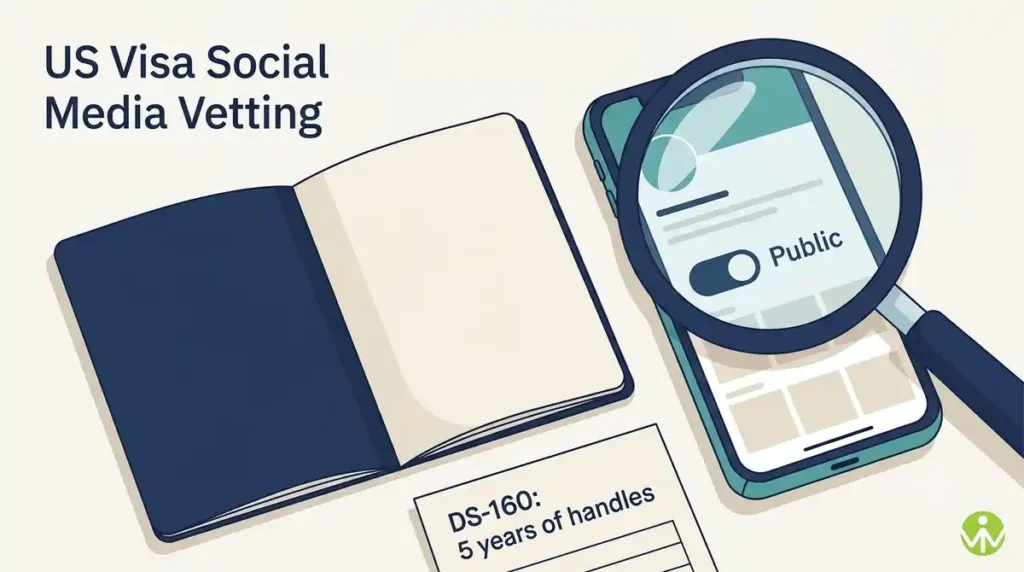
US visa social media vetting is now routine for many American visas, not a proposal under discussion. Since 2019, most applicants have had to list the social media handles they used in the past five years on their visa application, and since June 2025, a growing list of visa classes has been told to set every profile to public so that consular officers can review it.
This guide explains what is collected, which visa classes are covered and from when, who is exempt from the public-profile instruction, and how the review can affect an application’s outcome. For an overview of every category, see our guide to the types of US visa.
Key Takeaways
- US visa social media vetting has two layers: social media handles on the DS-160 or DS-260 (since 2019) and an instruction to set profiles to public (since June 2025).
- The public-profile layer of US visa social media vetting covers F, M and J students and exchange visitors, H-1B and H-4 workers, a further 14 classes from 30 March 2026, and I, TN and TD visas from 1 October 2026.
- B-1/B-2 visitors, L, O and E applicants and immigrant visa applicants are not on that list, but they still declare their handles on the application form.
- Consular officers do not ask for passwords. Missing or untruthful answers can lead to a refusal and, in serious cases, a misrepresentation finding.
- Mandatory social media disclosure for ESTA travellers was proposed in December 2025; its final status could not be confirmed in October 2026.
- Vetting adds time, so apply early and keep your online profiles consistent with your application.
Table of Contents
What US visa social media vetting means in practice
US visa social media vetting is the State Department’s review of an applicant’s online presence as part of deciding a visa application. It sits alongside the usual checks on identity, travel history, finances and ties to home. The Department describes every visa decision as a national security decision and says a visa is a privilege rather than an entitlement, so officers are expected to use all available information when deciding whether an applicant is admissible.
In practice, the process has two layers. The first applies to almost everyone: the application form asks for the social media identifiers you have used. The second applies to a named list of visa classes, whose applicants are instructed to set all their profiles to public so the officer can see what is posted. When news coverage refers to US visa social media vetting, it usually means this second layer.
What the DS-160 asks for
Since 31 May 2019, the online nonimmigrant visa application (DS-160) and the immigrant visa application (DS-260) have asked most applicants to list the identifiers, meaning usernames or handles, they used on a set of named platforms during the previous five years. The form names the platforms; you give the handle for each one you used, and you can answer “None” if you have not used social media. According to the State Department’s announcement on collecting social media identifiers and its accompanying FAQ, officers will not request passwords and applicants are not refused simply for having no social media presence.
A small group of diplomatic and official applicants is exempt from the question, including the A-1, A-2, C-2, G-1 to G-4 and NATO classifications. Everyone else answers it, whichever visa they want. The application is signed as true and complete, and the same FAQ warns that inaccurate or untruthful information, on the form or at interview, may lead to a refusal.
Which visa classes face US visa social media vetting
The public-profile side of US visa social media vetting has been extended in four stages. The State Department’s page on expanded screening and vetting for visa applicants lists every class currently covered, and the table below shows when each was added.
Table 1: Visa classes under US visa social media vetting
| Effective from | Visa classes added | Who they cover |
|---|---|---|
| 18 June 2025 | F-1, F-2, M-1, M-2, J-1, J-2 | Students, vocational students, exchange visitors and their dependants |
| 15 December 2025 | H-1B, H-4 (dependants of H-1B) | Specialty-occupation workers and their families |
| 30 March 2026 | A-3, C-3 (domestic workers), G-5, H-3, H-4 (dependants of H-3), K-1, K-2, K-3, Q, R-1, R-2, S, T, U | Domestic employees of diplomats and officials, trainees, fiancé(e)s and spouses, cultural exchange visitors, religious workers, witnesses and victims |
| 1 October 2026 | I, TN, TD | Foreign media representatives, USMCA professionals and their dependants |
| Source: US Department of State, Announcement of Expanded Screening and Vetting for Visa Applicants (updated 18 September 2026) and earlier State Department announcements. Correct as of 10 October 2026. | ||
Students and exchange visitors: F, M and J
Students and exchange visitors were the first group brought under US visa social media vetting. On 18 June 2025 the State Department resumed scheduling student visa interviews and told all F, M and J applicants, including F-2, M-2 and J-2 dependants, to set their profiles to public. Anyone planning to study should read this alongside our guides to the types of USA student visa and the F-1 visa.
H-1B and H-4 applicants
From 15 December 2025, the instruction was extended to H-1B workers and their H-4 dependants. Because H-1B and H-4 applicants no longer qualify for the US visa interview waiver, most now attend an in-person interview when they apply for a visa stamp abroad, and that is where the review is applied. Our H-1B visa guide covers the rest of the process, and the H-4 EAD guide explains work authorisation for spouses.
The March 2026 expansion
Announced on 25 March 2026 and in force from 30 March, the third stage added 14 more classifications. The largest group in practice is fiancé(e)s and spouses travelling on K visas, as explained in our K-1 visa guide. The stage also covers religious workers on R visas, trainees on H-3 visas, participants in Q cultural exchange programmes, domestic employees of diplomats and international organisation staff, and S, T, and U applicants.
TN, TD and I visas from 1 October 2026
The latest stage, from 1 October 2026, covers I visas for foreign media representatives and TN and TD visas for professionals working under the United States-Mexico-Canada Agreement and their dependants. Canadian citizens normally seek TN status at the border without a visa, so the visa instruction mainly reaches applicants who need a TN or TD visa from a consulate, such as Mexican nationals. Our TN visa guide explains both routes.
Who is not covered by the public-profile instruction
Several large categories were not on the list as of October 2026: B-1 and B-2 visitor visas, L-1 intracompany transferees, O-1 visas for extraordinary ability, E treaty trader and investor visas, P visas for athletes and entertainers, and immigrant visas. Not being on the list does not exempt you from US visa social media vetting in the broader sense. These applicants still declare their handles on the DS-160 or DS-260, and officers can review anything that is publicly visible. The B-1 visa and US tourist visa guides cover what visitors need to prepare.
Travellers from Visa Waiver Program countries who use ESTA rather than a visa are a separate case. ESTA has carried an optional social media question for years, and in December 2025 US Customs and Border Protection proposed making five years of social media history mandatory. We could not confirm whether that proposal has been approved and put into force when we last updated this guide, so check the official ESTA application before travelling. Nationals of countries under the US travel ban face separate restrictions that vetting does not change.
Table 2: US visa social media vetting: what applies to whom
| Applicant group | Social media handles on the application | Told to set profiles to public |
|---|---|---|
| F, M, J, H-1B, H-4 and other listed classes | Yes (DS-160, five years) | Yes |
| B-1 and B-2 visitors | Yes (DS-160, five years) | No |
| L, O, E, P and other unlisted nonimmigrant classes | Yes (DS-160, five years) | No |
| Immigrant visa applicants | Yes (DS-260, five years) | No |
| A-1, A-2, C-2, G-1 to G-4 and NATO | Exempt | No |
| ESTA travellers (Visa Waiver Program) | Optional question; mandatory disclosure proposed | Not applicable (no visa application) |
| Sources: US Department of State; US Customs and Border Protection proposal of December 2025. ESTA status unconfirmed as of 10 October 2026. | ||
What officers look for during US visa social media vetting
The State Department has not published a checklist. Its announcements say the review helps identify applicants who may be inadmissible, including people who could threaten national security or public safety, and that every applicant must credibly show they are eligible for the visa they want, including an intention to keep to its terms. Reporting on internal guidance issued with the June 2025 expansion said officers were asked to look for signs of hostility towards the United States and its institutions.
In everyday terms, US visa social media vetting means comparing what is online with what is on the application. A profile showing a different employer, a different job title or travel the applicant did not disclose raises questions, as do posts suggesting a plan to work on a visitor visa or to stay permanently on a temporary one. Accounts that cannot be seen at all are a concern in themselves: the same reporting said profiles kept private could be treated like a failure to provide requested information.
Refusal risks and delays
US visa social media vetting rarely produces a refusal of its own. What an officer finds feeds into the refusal grounds that already exist under the Immigration and Nationality Act (INA):
- Section 214(b), the most common refusal, applies when an applicant has not shown they qualify, for example where online activity contradicts the stated purpose of the trip.
- Section 221(g) is used when more information or administrative processing is needed. Extra review of an online presence can hold an application here for weeks or longer.
- Section 212(a)(6)(C)(i) covers misrepresentation. Leaving an account off the DS-160, or giving a false answer, can lead to this finding, which carries a permanent bar unless a waiver is granted.
- Security grounds under section 212(a)(3) can apply where content suggests support for terrorism or other threats.
Because US visa social media vetting takes time, allow a longer gap than usual between the interview and any planned travel or start date.
How to prepare for US visa social media vetting
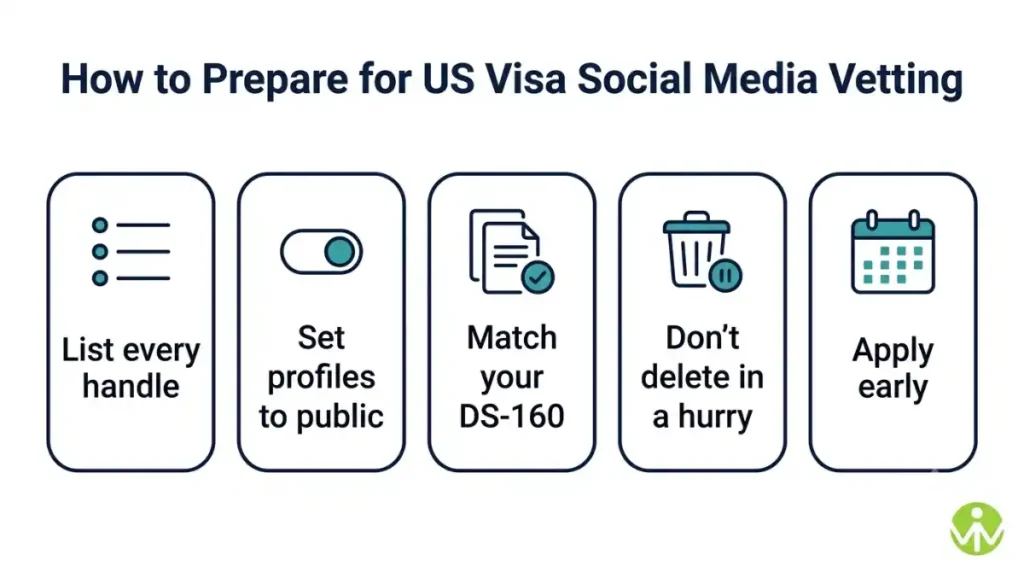
Preparing for US visa social media vetting is mostly about accuracy and consistency rather than tidying up. These steps apply to most applicants:
- Before starting the DS-160, list every account you have used on the named platforms in the past five years, including old or inactive ones.
- If your visa class is on the public-profile list, set each of those profiles to public before the interview and leave them that way while the application is pending.
- Check that job titles, employers, education and travel history online match the DS-160 and your supporting documents.
- Think carefully before deleting accounts or posts. A deleted account you used in the past five years still has to be declared, and a sudden clean-up can itself prompt questions.
- Apply well ahead of your travel or start date, since vetting adds time.
Frequently asked questions
Do I have to make my social media public for a US visa?
US visa social media vetting requires public profiles only if your visa class is on the State Department’s list: F, M and J; H-1B and H-4; the 14 classes added on 30 March 2026; and I, TN and TD from 1 October 2026. Other applicants still list their handles on the DS-160 but are not told to change their privacy settings.
Will a consular officer ask for my social media passwords?
No. The State Department says officers will not request passwords. US visa social media vetting relies on the handles you declare and on what is publicly visible.
What happens if I leave a social media account off my DS-160?
An omission can be treated as an untruthful answer. Depending on the circumstances, it can lead to a refusal or a misrepresentation finding, which is far more serious than any post on the account.
Does US visa social media vetting apply to B-2 tourist visas?
As of October 2026, B-1 and B-2 applicants were not on the public-profile list. They still declare five years of handles on the DS-160, and officers may review anything that is publicly visible.
Should I delete my social media before applying for a US visa?
Deleting accounts does not exempt you from US visa social media vetting or remove your duty to declare handles you used in the past five years, and unexplained deletions can raise questions. Accuracy and consistency matter more.
Do I need to keep my profiles public after the visa is issued?
The State Department has not said how long profiles must stay public. Visas are reviewed again at renewal, and US Customs and Border Protection can examine travellers at the port of entry, so many applicants keep their settings unchanged while they hold the visa.