
A B-1 visa is the United States’ temporary business visitor category, and one of the most misunderstood documents in the immigration system. It lets you fly in for a fortnight of meetings, sit through a trade conference, argue over a contract, or install a machine your company sold to an American buyer. It does not let you take a job. That distinction is where most refusals, and most trouble at the border, begin.
This guide sets out what a B-1 visa permits in 2026, what it costs, how long it lasts, and the four rule changes since 2025 — including a bond that applies to B visas and nothing else. It sits under our wider guide to the types of US visa, which maps every category if you are not yet sure this is the one you need.

Key Takeaways
- A B-1 visa is for temporary business activity — meetings, conferences, contract negotiations, training and equipment servicing. It is not a work permit.
- You may not draw a salary from a US source. An expense allowance or reimbursement is allowed; wages are not.
- The application fee is $185. Nationals of 50 countries must also post a visa bond of $5,000, $10,000 or $15,000, set at the interview.
- Since 15 July 2026 you must apply in your country of nationality or residence. Fees paid anywhere else are neither refunded nor transferred.
- The visa can run for up to ten years, but each entry is decided separately at the border — usually six months, one year at the outside.
- Almost every applicant now attends an interview. The only surviving waiver is a renewal within 12 months of the previous visa expiring.
Table of Contents
What is a B-1 visa
The B-1 visa is a nonimmigrant visa issued by a US embassy or consulate to someone travelling to the United States for temporary business and paid for from outside the country. It is one half of the B category: B-1 covers business, B-2 covers tourism and visits to family. Most consulates issue the two together as a combined B-1/B-2, which is why the distinction gets blurred so easily.
A B-1 visa is permission to travel to a port of entry and request admission. It is not permission to enter, and it is not a status. The officer at the border decides whether you come in and for how long, and makes that decision afresh on every trip, no matter how many years your visa still has to run.
The word doing the work is temporary. The State Department’s Foreign Affairs Manual declines to put a number on it, noting that a stay exceeding six months or a year “is not in itself controlling”. What matters is that the activity has an end, that you intend to leave, and that your income keeps coming from abroad.
What you can do on a B-1 visa
The State Department publishes an explicit list of allowable uses, and it is broader than most applicants expect. The core activities a B-1 visa covers are engaging in commercial transactions that do not involve gainful employment in the United States, negotiating contracts, consulting with business associates, litigating, taking part in scientific, educational, professional or business conventions, conferences and seminars, and undertaking independent research.
Beyond that core, the official B-1 fact sheet recognises a long tail of activities that look like work but count as incidental to business abroad: installing, servicing or repairing equipment sold by a foreign company and training American workers to service it; attending board meetings of a US corporation; specialised trainers passing on proprietary techniques; professional athletes and their support staff; investors scouting for somewhere to put their money; and participants in international sporting events and trade fairs.
One route inside the category is worth naming, because the internet is full of claims that it was abolished. It was not. 9 FAM 402.2-5(F) still allows someone who would qualify for H-1 or H-3 classification to travel on a B-1 for a short professional assignment, provided the pay keeps coming from the business abroad. The visa is annotated “B-1 IN LIEU OF H, PER 9 FAM 402.2-5(F)”. A 2020 proposal to scrap it was never finalised. It is narrow, it is scrutinised, and it is still on the books.
Table 1: What a B-1 visa allows and what it does not
| Allowed on a B-1 visa | Not allowed on a B-1 visa |
|---|---|
| Commercial transactions that do not involve gainful employment in the US | Employment for a US employer, of any length |
| Negotiating contracts | Any salary or wage from a US source |
| Consulting with business associates | Study for academic credit |
| Litigating | Paid performance before an audience |
| Conventions, conferences and seminars — scientific, educational, professional, business | Work as foreign press, radio, film or other media |
| Independent research | Arrival as a crew member on a ship or aircraft |
| Installing, servicing or repairing equipment sold by a foreign company, and training US workers to service it | Taking up permanent residence |
| Attending meetings as a board member of a US corporation | Childbirth tourism |
| Investors scouting for an investment | Directing or running a US business you have invested in |
| Professional athletes, international sporting events, trade fairs and expositions | Work billed to a US client while you are in the US |
| Sources: US Department of State, FACT SHEET: U.S. Business Visas (B-1) and Allowable Uses; Visitor Visa page; 9 FAM 402.2. Retrieved 13 September 2026. | |
What a B-1 visa does not allow
The hard rule is remuneration. 9 FAM 402.2 puts it plainly: a person in B-1 status “may not receive a salary from a U.S. source for services rendered” in connection with their activities in the United States. A US source may cover an expense allowance or reimburse incidental costs. It may not pay you.
Everything else follows. A B-1 visa does not authorise employment for an American employer, however short. The State Department’s visitor visa page lists the rest: no study for academic credit, no paid performance before an audience, no work as foreign press or media, no arrival as a crew member. It is not a route to permanent residence, and entering with a settled intention to stay can be treated as misrepresentation.
Two misuses come up repeatedly. The first is remote work — the idea that because your laptop connects to an office in Frankfurt, the days you bill from a hotel in Austin do not count. The rule is about the source of the pay and the nature of the activity, not about where the Wi-Fi is. The second is the B-1 visa as a bridge, used to bridge a gap while an H-1B petition is resolved. Changing status is a formal application to USCIS with its own outcome, not something to assume. If the work is real, paid American work, you need a work category, and our guide to the alternatives to the H-1B visa explains what those are.
B-1, B-2 or ESTA: which one you need
Three documents cover short visits to the United States, and picking the wrong one is a common and avoidable error.
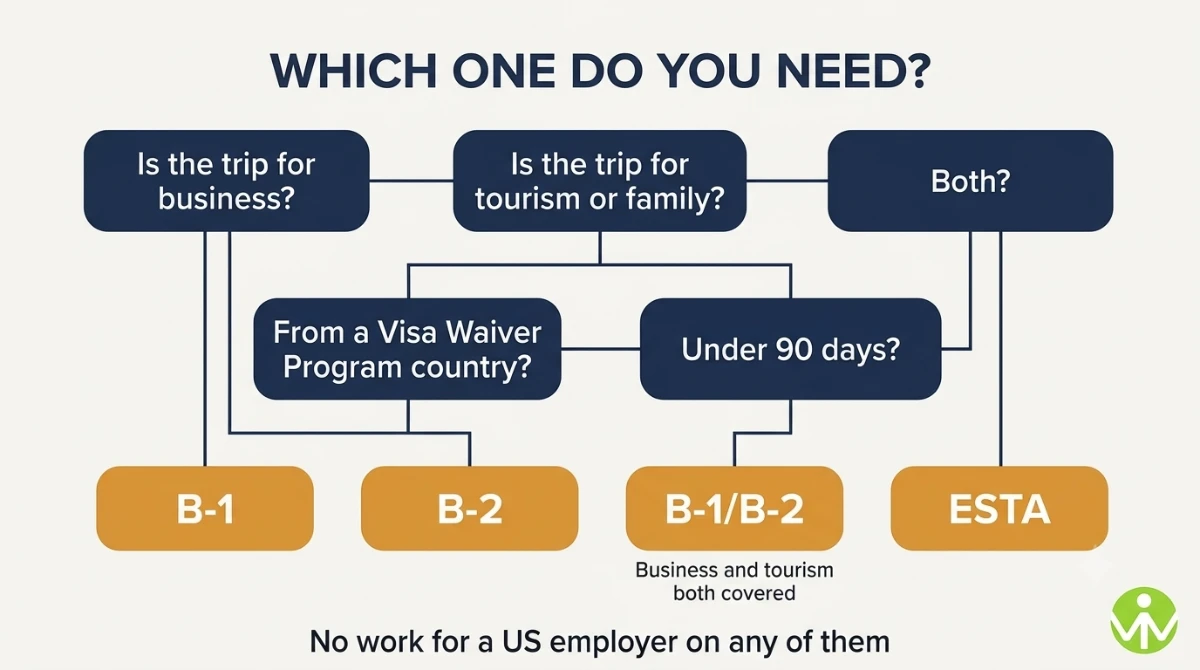
The B-1 visa is for business. The B-2 is for tourism, family visits, social events and medical treatment. A combined B-1/B-2 covers both, and if your trip mixes a conference with a fortnight’s holiday, that is the one you want. Nationals of 38 Visa Waiver Program countries can skip the visa entirely and travel on an approved ESTA for stays of 90 days or less, provided they hold an e-passport. ESTA covers business as well as tourism, which surprises people — a Dutch or Japanese executive flying in for meetings usually needs no B-1 visa at all.
The exceptions matter. Anyone who has visited North Korea, Iran, Iraq, Libya, Somalia, Sudan, Syria or Yemen on or after 1 March 2011, or Cuba on or after 12 January 2021, must apply for a visa, as must dual nationals of Cuba, North Korea, Iran, Iraq, Sudan or Syria. Separate entry restrictions apply to several nationalities and override everything else here.
One practical advantage of a B-1 visa over an ESTA: a US visa opens doors elsewhere. Our guide to the countries you can visit with a US visa sets out where a B-1/B-2 gets you in visa-free or on arrival.
B-1 visa eligibility and what you must prove
There is no petition, employer sponsorship, or quota for a B-1 visa. What there is instead is a presumption in US law that every applicant intends to immigrate, and the burden sits on you to displace it.
A consular officer wants to see four things: that the purpose is genuine temporary business of the kind listed above; that the visit has a defined end and you have concrete reasons to return, such as employment, family or property; that the trip can be paid for; and that whoever pays you for the work is based outside the United States.
Documents that carry weight include a letter from your employer stating the purpose and duration of the trip and confirming who bears the cost, an invitation or contract from the US company you are meeting, conference registration, and evidence of ties at home. None of it guarantees approval. The B-1 visa interview is a judgment call made in a few minutes, and the strongest applications are the ones where the story is simple, and the paperwork matches it.
How to apply for a B-1 visa, step by step
The B-1 visa application goes through the consulate, not USCIS, and the sequence is almost the same everywhere.
1. File Form DS-160. Submit the online nonimmigrant visa application electronically, and cannot be amended afterwards, so check it before you send it. Keep the confirmation page with its barcode.
2. Pay the application fee. $185, non-refundable, payable whether or not the visa is issued. Keep the receipt — you cannot book an appointment without it.
3. Book in the right country. Since 15 July 2026, you are expected to apply in your country of nationality or residence. This is new, and it has teeth; the consequences are set out below.
4. Give biometrics and attend the interview. Most posts run these as two appointments, fingerprints and photograph first. Almost everyone interviews in person now; the interview waiver survives only for renewals inside a narrow window.
5. Post a bond, if your nationality requires one. For applicants from 50 countries, the officer sets a bond amount at the interview, and the visa is not issued until it is posted.
6. Collect the visa. If approved, the passport comes back with the visa foil. Some nationalities also owe a reciprocity issuance fee at this point, on top of the $185.
Before you travel, read our notes on social media and US immigration, because online presence review is now routine, and arrange visitor health insurance — nothing in a B-1 visa gives you access to American healthcare.
What a B-1 visa costs in 2026
The headline number is small and the surrounding numbers are not. The application fee is $185, charged per applicant whatever the outcome. Everything else depends on your passport and your circumstances.
Table 2: What a B-1 visa costs in 2026
| Cost | Amount (USD) | Who pays it | Status |
|---|---|---|---|
| Visa application fee (MRV) | 185 | Every applicant, refunded to nobody | Published and in force |
| Reciprocity issuance fee | Varies | Some nationalities on approval; none for Indian nationals | Published per country |
| Visa bond | 5,000 / 10,000 / 15,000 | Applicants on passports from 50 named countries | In force, phased in to 2 April 2026 |
| Expedited appointment fee | 750 | Optional; B visas only, six countries, to 31 Dec 2026 | Pilot programme |
| Visa Integrity Fee | 250 | Legislated for most nonimmigrant visa holders | Not on the published fee schedule |
| ESTA, instead of a visa | 40.27 | Visa Waiver Program travellers | In force from 1 January 2026 |
| Sources: US Department of State, Fees for Visa Services; Federal Register, Certain DHS Immigration Fees Required by HR-1: FY2026 Adjustments for Inflation, 19 November 2025. Amounts in US dollars. Retrieved 13 September 2026. | |||
Two figures need a word of caution. The $250 Visa Integrity Fee was created by statute in 2025, but it does not appear on the State Department’s published schedule of visa fees, and it was left out of the Federal Register notice that set the inflation-adjusted 2026 amounts for the other new fees. Reports of collection are inconsistent from post to post. Budget for it; do not assume it.
The reciprocity issuance fee, by contrast, is fixed and published per nationality. Indian nationals pay none: the reciprocity schedule gives B-1 and B-2 as multiple entry, 120 months, no issuance fee. Others pay a few dollars or a few hundred.
Visa bonds: the rule that applies only to B visas
This change is most likely to catch a business traveller out, and it exists nowhere else in the visa system. Applicants holding passports from 50 named countries must post a bond of $5,000, $10,000 or $15,000 before a B-1 visa or B-2 visa is issued. The consular officer sets the amount at the interview; it is not published in advance, and the requirement applies wherever you apply.
It was phased in between 20 August 2025 and 2 April 2026 and covers B-1 and B-2 applicants only. The bond is cancelled and the money returned automatically in the circumstances the State Department sets out, and it is waived for nationals of competing countries who bought 2026 FIFA World Cup tickets by 15 April.
Table 3: The 50 countries whose nationals must post a B-1/B-2 visa bond
How long a B-1 visa lasts, and how long you can stay
Two different clocks run here, and confusing them is the most common mistake in the whole subject.
The first is the validity of the B-1 visa itself, printed on the foil. It is set by reciprocity with your country and can be anything from a few months to ten years — Indian nationals get 120 months, multiple entry. That period tells you how long you may keep turning up at a port of entry and asking to be let in. It says nothing about how long you may stay once you are.
The second is the period of admission, recorded on your I-94 by the officer who admits you. Under 8 CFR 214.2(b), a B-1 visitor “may be admitted for not more than one year and may be granted extensions of temporary stay in increments of not more than six months each”. A year is the ceiling, not the norm; six months is the usual grant, and a short trip often gets less.
If you need longer, the extension is a USCIS matter and runs on Form I-539. File before your I-94 expires. Overstaying does not merely make you unlawfully present; it voids the B-1 visa automatically, and the next application has to be made in your home country.
What changed for B-1 visa applicants in 2026
Four changes since late 2025 have altered how a B-1 visa is obtained. None of them changed what it permits; all of them changed the process.
Apply where you live. From 15 July 2026 the State Department expects applicants to be interviewed in their country of nationality or residence. Fees paid for an application made elsewhere “will not be refunded and cannot be transferred”, waits will be significantly longer, and applicants “may find it more difficult to qualify”. This ends the practice of booking wherever the queue is shortest.
Almost everyone interviews. From 1 October 2025 the age exemptions went: applicants under 14 and over 79 now attend in person like everyone else. The only B-1 visa renewals that still qualify for a waiver are those made within 12 months of the previous visa expiring, where the prior visa was issued for full validity and the applicant was at least 18.
You can now pay to jump the queue, in six countries. A pilot programme lets B visa applicants pay $750 on top of the $185 fee for an interview within ten business days. It runs in Mexico, Canada, Colombia, Guatemala, Costa Rica and Honduras and expires on 31 December 2026. The fee “does not guarantee visa issuance or expedited processing, it only provides an earlier appointment”.
Vetting has widened. Expanded online presence review took effect on 30 March 2026 for a named list of categories that does not include B-1. That is a relief rather than an exemption: social media has fed the DS-160 and consular discretion for years, and a B-1 visa application is refused or approved on the officer’s overall judgement.
When a B-1 visa is the wrong answer
Three situations regularly arrive dressed as business trips and are not.
You are moving to run the US arm of your company. That is an intra-company transfer and belongs on an L-1, which carries a real right to work and, for managers and executives, a credible path to permanent residence. A B-1 visa used to set the office up before the transfer is legitimate; one used to run it is not.
You are investing in an American business. Scouting for an investment is allowable. Directing and developing the business you have invested in is not — that is the E-2 treaty investor visa, if your country has a treaty with the United States, or the EB-5 immigrant investor programme if what you want is a green card.
You have a job offer. No framing survives this one. If an American entity will pay you for work done in the United States, the B-1 visa is the wrong document, and using it is a misrepresentation that follows you through every future application.
Frequently asked questions
Can I work on a B-1 visa?
No. A B-1 visa covers business activity, not employment, and you may not receive a salary from a US source for services rendered. A foreign employer may continue to pay you, and a US company may reimburse your expenses.
How long can I stay in the US as a business visitor?
The regulation caps a single admission at one year, with extensions in increments of up to six months. Six months is the usual grant and short trips often get less. The length of your visa is a separate question from the length of your stay.
What is the difference between B-1 and B-2?
B-1 is for business — meetings, conferences, negotiations, training. B-2 is for tourism, family visits and medical treatment. Most consulates issue a combined B-1/B-2 covering both.
Do I need a B-1 visa if I have an ESTA?
Usually not. An approved ESTA covers business visits of up to 90 days for nationals of the 38 Visa Waiver Program countries. You need a B-1 visa if the trip will run longer, if you are not from a participating country, or if a travel-history or dual-nationality exception applies.
Can a business visa be converted to a work visa?
A change of status can be requested from inside the United States, but it is a formal application with an uncertain outcome, and entering with that plan already formed can be treated as misrepresentation. The safer route is to apply for the correct category from abroad.
How much does a B-1 visa cost in 2026?
The application fee is $185. Some nationalities also owe a reciprocity issuance fee. Applicants from 50 countries must post a bond of $5,000, $10,000 or $15,000. A $250 Visa Integrity Fee has been legislated but is not on the State Department’s published fee schedule.