
Key Takeaways
- All types of US visa split into two legal groups: nonimmigrant visas admit you temporarily for a stated purpose, immigrant visas admit you for permanent residence.
- In practice the types of US visa fall into six families — visit, study, work, family, investment and permanent residence.
- H-1B and L-1 are dual intent, which is why they are the usual bridge from temporary work to a green card. B, F and most other categories are not.
- Application fees across the types of US visa in 2026 are $185, $205 or $315 depending on category, and are never refunded if the visa is refused.
- Four changes reshaped 2026: near-universal interviews, applying in your country of residence, a wage-weighted H-1B lottery, and the end of duration of status on 15 September.
- Validity and permitted stay differ across the types of US visa. The visa gets you to the border; the I-94 sets how long you may remain.
Every one of the types of US visa answers the same two questions: are you coming temporarily, or are you coming to stay? Almost everything else — which form you file, what you pay, how long you may remain, whether you can ever apply for a green card — follows from the answer.
Getting that split wrong at the start is the most expensive mistake in the process. Application fees aren’t refunded when a visa is refused, and a refusal stays on your record for every later application. This guide maps all the main types of US visas: what each family is for, what it costs in 2026, how long it lasts, and which routes lead to permanent residence. Where a category has its own full guide on this site, we link to it instead of repeating it.
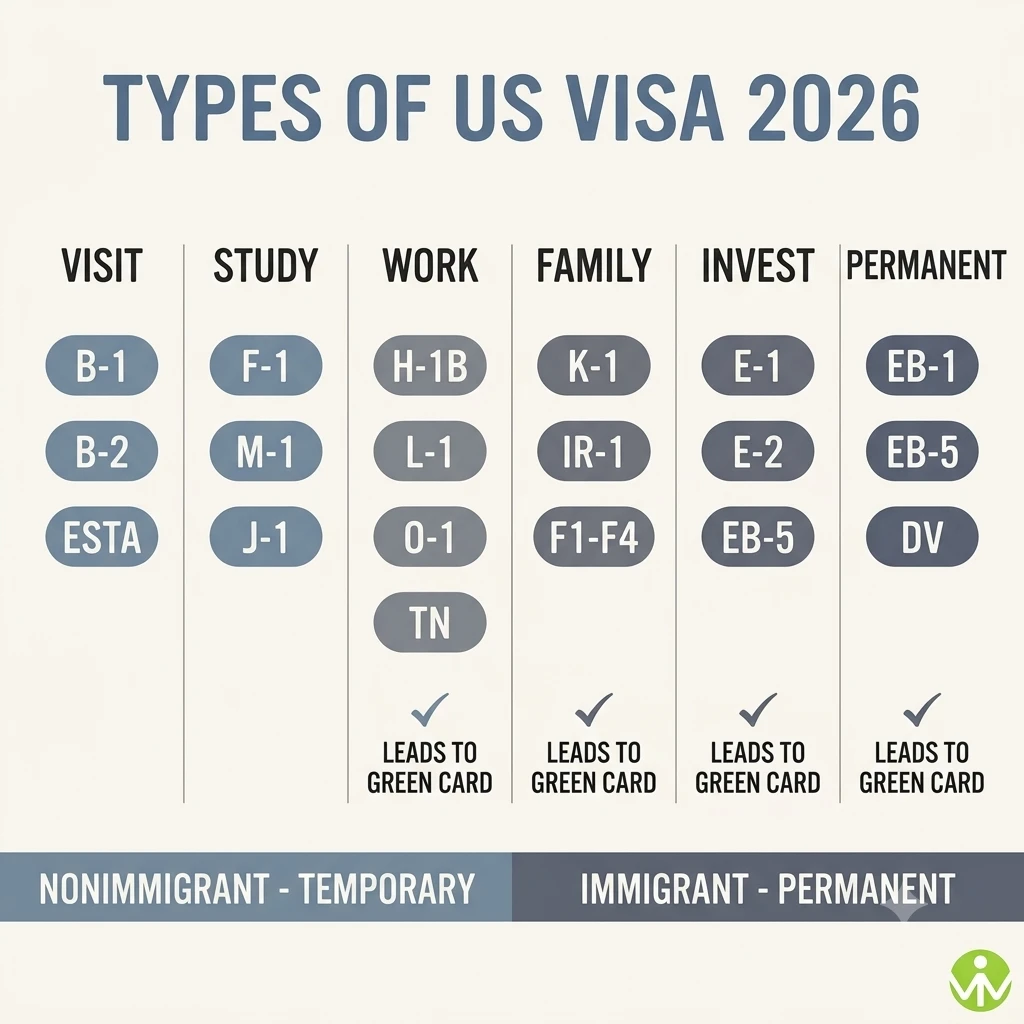
How the US visa system is organised
US law sorts all types of US visa into two groups, and that division does more work than any other distinction in immigration law.
A nonimmigrant visa admits you for a stated purpose and a fixed period. You are expected to leave when it ends. Most nonimmigrant categories also require you to demonstrate nonimmigrant intent — evidence of a home, a job or family ties abroad that you mean to return to. Visitor, student and exchange applicants are refused on that test more often than on anything in their paperwork.
An immigrant visa admits you for permanent residence. It becomes a green card once you enter the country. No purpose test is attached to it, and the underlying status has no expiry.
Two categories sit deliberately between the two groups. H-1B and L-1 are dual intent visas: you may hold one while an employer sponsors you for permanent residence, and the pending application is not held against you at the border. That single feature is why the H-1B visa is the most common bridge from temporary work into a green card, and why a B-2 visitor visa is not.
Every category carries a letter and usually a number — B-2, F-1, H-1B, EB-5. The letter names the family; the number marks a position within it, normally the principal holder first and dependants after.
One caution about totals. The State Department publishes a Directory of Visa Categories but points readers to the Foreign Affairs Manual “for all nonimmigrant visa categories”, which means the public list is not exhaustive and no official total exists. Any page telling you there are exactly 185 types of US visa is quoting a figure the State Department does not publish.
The types of US visa at a glance
The table below sets out the types of US visa by what you are coming to do. Find your purpose in the first column, then read across. Every family in it is covered in more detail further down the page.
| What you are coming to do | Main visa classes | Group | Can it lead to a green card? |
|---|---|---|---|
| Tourism, visiting family, medical treatment | B-2, or ESTA under the Visa Waiver Program | Nonimmigrant | No |
| Business meetings, conferences, negotiations | B-1, or ESTA | Nonimmigrant | No |
| Academic study | F-1 (F-2 dependants) | Nonimmigrant | Not by itself |
| Vocational or technical training | M-1 (M-2 dependants) | Nonimmigrant | Not by itself |
| Exchange programmes, research, au pair work | J-1 (J-2 dependants) | Nonimmigrant | Not by itself |
| Sponsored professional work | H-1B (H-4 dependants) | Nonimmigrant, dual intent | Yes, via employer sponsorship |
| Intra-company transfer | L-1A, L-1B (L-2 dependants) | Nonimmigrant, dual intent | Yes, via EB-1C |
| Extraordinary ability | O-1 (O-3 dependants) | Nonimmigrant | Yes, via EB-1A |
| Seasonal or temporary labour | H-2A, H-2B | Nonimmigrant | No |
| Treaty trade or investment | E-1, E-2 | Nonimmigrant | No, not by itself |
| Canadian and Mexican professionals | TN | Nonimmigrant | No, not by itself |
| Marriage to a US citizen | K-1 fiancé(e), or IR-1/CR-1 spouse | Mixed | Yes |
| Sponsorship by a US relative | IR categories, F1 to F4 preference | Immigrant | Yes |
| Employment-based permanent residence | EB-1 to EB-5 | Immigrant | Yes |
| Diversity lottery | DV | Immigrant | Yes |
| Transit, crew, media, diplomatic, religious | C, D, I, A, G, R | Nonimmigrant | No |
| Group follows the legal classification, not the practical outcome. Dual intent means a pending green card application does not undermine the visa. Compiled from the US Department of State Directory of Visa Categories, September 2026. | |||
Two columns decide most cases. The group column tells you whether the visa is temporary or permanent. The last column tells you whether the route can lead anywhere — and for several of the most popular types of US visa, including E-2 and TN, the honest answer is that it cannot, however long you hold one.
Visitor and business visas: B-1, B-2 and the Visa Waiver Program
The B visa is the most used of all US visa types, and it covers short visits. B-2 is for tourism, visiting family, social events and medical treatment; B-1 is for business meetings, conferences, contract negotiations and similar activity that is not paid employment in the United States. Most applicants are issued a combined B-1/B-2. Neither allows you to work for a US employer or to enrol in a course for academic credit.
Nationals of 38 countries can skip the visa altogether under the Visa Waiver Program, travelling instead on an approved ESTA for stays of 90 days or less with an e-passport valid for at least six months. The exceptions matter: anyone who has visited North Korea, Iran, Iraq, Libya, Somalia, Sudan, Syria or Yemen on or after 1 March 2011, or Cuba on or after 12 January 2021, must apply for a visa, as must dual nationals of Cuba, North Korea, Iran, Iraq, Sudan or Syria.
Two 2026 costs are easy to miss. ESTA rose to $40 on 30 September 2025, and B-1/B-2 applicants holding passports from 51 named countries must now post a visa bond of $5,000, $10,000 or $15,000 before the visa is issued — a requirement that applies regardless of where they apply. Separately, nationals of 39 countries face full or partial visa suspensions under the US travel ban.
Visitor categories are also the types of US visa most often renewed, so our full guides cover how to apply for a US tourist visa, who still qualifies for a US visa interview waiver, and the countries you can visit with a US visa once you hold one.
Student and exchange visas: F, M and J
Three of the types of US visa cover study, and the letter you need depends on what you will study rather than where. F is for academic study at an accredited college, university or language programme; M is for vocational and technical training; J is for exchange visitors, which stretches from au pairs and camp counsellors to visiting professors and research scholars. Each has a dependent class — F-2, M-2, J-2 — for a spouse and unmarried children under 21.
All three require admission to a school approved by the Student and Exchange Visitor Program, a Form I-20 or DS-2019, and payment of the SEVIS fee before the interview.
The single biggest change to these types of U.S. visas in a generation took effect on 15 September 2026. Duration of status — the open-ended “D/S” admission that F and J holders have had for nearly fifty years — ended for new arrivals on that date, replaced by a fixed “admit until” date on the I-94: the programme length shown on the I-20 or DS-2019, capped at four years, plus a 30-day grace period. Anyone already in the country on D/S keeps it, subject to outer limits. Our guide to the end of duration of status sets out what each group has to do.
Work rights are narrower than most applicants expect. On-campus work is permitted; off-campus work needs authorisation. Optional Practical Training gives 12 months of work in your field after graduation, with a further 24 months for eligible STEM graduates. See our guides to the types of USA student visa and the F-1 student visa for the details.
Types of US visa for work
Work is where the system is most crowded. More types of US visas fall into this category than any other, and the choice matters more here than anywhere else because only some lead to permanent residence.
The H-1B is for speciality occupations requiring at least a bachelor’s degree in a specific field. An employer sponsors and files; an individual cannot apply alone. Demand exceeds the annual cap of 65,000 plus 20,000 US master’s places, so registrations go into a lottery—and from February 2026 that lottery is weighted by wage level rather than drawn at random, shifting the odds toward senior roles. Our guides cover the H-1B visa and how the wage-weighted lottery works.
Proclamation 10973, which created a $100,000 payment for certain new H-1B petitions, was extended on 18 September 2026 for a further year, to 21 September 2027. A new executive order signed the same day tightens oversight of the H-1B programme. The payment itself still cannot be collected: a federal court in Massachusetts vacated the agencies’ implementing policy on 8 June 2026, and the First Circuit refused to pause that ruling on 24 July. The position has moved repeatedly, so check the current status of the $100,000 H-1B fee before relying on any figure.
Beyond the H-1B: L-1A and L-1B move managers and specialised-knowledge staff between offices of the same company, and L-1A leads naturally to an EB-1C green card. O-1 is for demonstrated extraordinary ability, with no cap and no lottery. P covers athletes and entertainers. TN is open to Canadian and Mexican professionals in listed occupations, and E-3 to Australian professionals. H-2A and H-2B cover seasonal agricultural and non-agricultural labour, R-1 religious workers, and I foreign media. Our guide to US work visas beyond the H-1B compares the realistic alternatives, and the TN visa guide covers the North American route.
Dependents are a category of their own. H-4 spouses can work only with an EAD, and only where the H-1B holder has reached a specific stage of the green card process — see H-4 EAD work authorisation.
Family and fiancé visas
The family types of US visa divide into two tiers, and the difference between the tiers is measured in decades rather than months.
Immediate relatives of US citizens — spouses on IR-1 or CR-1, unmarried children under 21, and parents — have no annual cap. Cases move at processing speed. Everyone else falls into the family preference categories F1 to F4, which share a ceiling of 226,000 a year and a 7% per-country limit. The effect is stark: in the October 2026 Visa Bulletin, the final action date for F-4 India — siblings of US citizens — stands at 15 December 2006.
The K-1 fiancé(e) visa is a hybrid: a nonimmigrant visa issued on the strength of an intended marriage, which must take place within 90 days of entry, after which the holder adjusts status. The V category covers certain spouses and children of permanent residents. Our guide to the US family-based green card walks through sponsorship in full.
Investor and treaty visas: E-1, E-2 and EB-5
US visa investment types split cleanly between temporary and permanent, and applicants often confuse the two at considerable cost.
E-1 treaty traders and E-2 treaty investors are nonimmigrant categories open only to nationals of countries with a qualifying treaty with the United States. They are renewable indefinitely while the business runs, which makes them attractive — but they lead nowhere on their own. An E-2 holder who wants permanent residence has to qualify separately under another category. India, notably, has no E-2 treaty. See our guide to the USA E-2 visa.
EB-5 is the immigrant route: an investment of $1,050,000, or $800,000 in a targeted employment area or an infrastructure project, that creates at least ten full-time positions for qualifying US workers. Set-asides for rural, high-unemployment and infrastructure projects currently move faster than the unreserved queue, which reached its per-country limit for India in June 2026. Our EB-5 investor programme guide covers the requirements.
Types of US visa that lead to a green card
Five routes lead to permanent residence, and this section is deliberately short because each type of US visa has its own full guide on this site.
Family sponsorship and employment sponsorship are the two large ones. The diversity visa lottery is the third, open to nationals of countries with low rates of immigration to the United States. Humanitarian routes — refugee, asylee, and protections for victims of trafficking and serious crime — are the fourth. Special immigrant categories, covering religious workers, certain former US government employees and others, are the fifth.
Annual numbers determine how long each type of U.S. visa takes. For fiscal year 2026, the Visa Bulletin puts the family-sponsored limit at 226,000, the employment-based limit at 186,317, and the diversity visa allocation at about 52,101 after statutory offsets. No single country may take more than 7% of the preference totals, which is why applicants from India and, to a lesser extent, China wait far longer than the headline numbers suggest — the October 2026 bulletin, the first of fiscal year 2027, puts EB-2 India at a final action date of 1 November 2013 and EB-3 India at 1 January 2014.
Start with our guide to the US green card, which covers eligibility, the five routes and the application steps, and the green card lottery guide if the diversity route applies to you. Where the ladder ends is US citizenship, normally five years after permanent residence, or three if you are married to a US citizen.
Transit, crew, media and the specialist categories
The remaining types of US visa form a long tail, covering situations the six main families do not, and applicants sometimes need one without realising it exists.
- C-1 — transit through the United States to a third country. Excluded from many visa-free entry schemes elsewhere, so it is a weaker document than it looks.
- D — crew members on ships and aircraft, often issued in combination as C-1/D.
- I — representatives of foreign media, restricted after 15 September 2026 to a fixed admission period of up to 240 days.
- A and G — diplomats, foreign government officials, and employees of designated international organisations. NATO has its own series.
- R-1 — religious workers employed by a non-profit religious organisation.
- T, U and S — victims of human trafficking, victims of serious crime who assist law enforcement, and witnesses and informants.
- Q — participants in international cultural exchange programmes.
- BCC and CW-1 — the Mexican border crossing card, and the transitional worker classification for the Northern Mariana Islands.
What the types of US visa cost
Three separate costs sit behind almost every application across the types of US visa, and applicants routinely budget for only the first. There is the application fee paid to the State Department, any category-specific fee such as SEVIS or a fraud prevention fee, and — increasingly in 2026 — a bond or additional charge attached to particular nationalities or categories.
| Fee | Amount (USD) | Who pays it |
|---|---|---|
| Nonimmigrant application fee, non-petition | 185 | B, C-1, D, F, I, M, TN/TD applicants |
| Nonimmigrant application fee, petition-based | 205 | H, L, O, P, Q and R applicants |
| Nonimmigrant application fee, treaty categories | 315 | E-1 and E-2 applicants |
| Fiancé(e) visa application fee | 265 | K-1 and K-3 applicants |
| ESTA authorisation | 40 | Visa Waiver Program travellers, from 30 September 2025 |
| Land-border I-94 | 30 | Arrivals at land border ports of entry |
| EVUS enrolment | 30 | PRC nationals holding ten-year visas |
| Visa bond, B-1/B-2 | 5,000 to 15,000 | Applicants on passports from 51 named countries |
| Visa integrity fee (see note) | 250 | Legislated for most nonimmigrant issuances; not yet on the published schedule |
| L-1 fraud prevention and detection fee | 500 | Petitioning employer, principal applicant only |
| Immigrant petition, Form I-130 | 675 | US citizen or permanent resident sponsor |
| Immigrant visa processing, family | 325 | Per person |
| Immigrant visa processing, employment | 345 | Per person |
| Diversity visa application | 330 | Per person, plus $1 registration |
| Affidavit of support review | 120 | Domestic review only |
| Amounts as published by the US Department of State Fees for Visa Services schedule and the CBP fee notice at 90 FR (Federal Register 2025-16453), checked 8 September 2026. The visa integrity fee is created by Public Law 119-21 but is not listed on the State Department schedule as at that date. | ||
Two entries in that table need a caveat. The $250 visa integrity fee was created by the One Big Beautiful Bill Act in July 2025 and is CPI-indexed, but it does not appear on the State Department’s own Fees for Visa Services schedule as of 8 September 2026, and reports of collection at individual consulates are not the same as a published fee. Treat it as legislated and being phased in rather than as a settled line on your budget. The $100,000 H-1B payment is not being collected either: its proclamation was extended to September 2027, but the June 2026 court ruling still blocks it — see the dedicated guide.
Application fees for all types of US visas are non-refundable. If the visa is refused, the fee is gone, which is why you should confirm the category before filing, not after.
How long each of the types of US visa lasts
Two different numbers govern your stay on any of the types of US visa, and confusing them is one of the commonest ways people fall out of status.
Visa validity is how long the sticker in your passport can be used to travel to a US port of entry. It is set by a reciprocity schedule negotiated with your country of nationality, so two people in the same category can hold visas of very different lengths. Period of admission is how long you may actually remain, and it is set by the officer at the border and recorded on your I-94. The I-94 governs. A ten-year visa does not give you ten years in the country.
| Visa | Typical period of admission | Extension or renewal |
|---|---|---|
| B-1/B-2 | Up to 6 months per entry, set by the officer | Extension possible; visa validity set by reciprocity, often up to 10 years |
| ESTA (Visa Waiver Program) | 90 days maximum, no extension | ESTA valid 2 years or until passport expiry |
| F-1 | Programme length on the I-20, capped at 4 years, plus 30 days, for arrivals from 15 September 2026 | Extension of stay filed with USCIS |
| J-1 | Programme length on the DS-2019, capped at 4 years, plus 30 days, from 15 September 2026 | Extension of stay filed with USCIS |
| M-1 | Course length plus 30 days, up to 1 year | Limited extensions |
| H-1B | 3 years initially | Extendable to 6 years; longer where a green card case is pending |
| L-1A / L-1B | 3 years initially (1 year for a new office) | L-1A to 7 years, L-1B to 5 years |
| O-1 | Up to 3 years | 1-year extensions, no overall limit |
| E-1 / E-2 | Up to 2 years per admission | Indefinitely renewable while the business qualifies |
| TN | Up to 3 years | Indefinitely renewable |
| K-1 | 90 days, single entry | No extension; marry and adjust status within 90 days |
| I (media) | Up to 240 days for arrivals from 15 September 2026 | Extension of stay filed with USCIS |
| Immigrant visa | Must be used within 6 months of issue | Becomes permanent residence on entry |
| Visa validity is the period in which the visa can be used to travel. Period of admission is what the officer records on the I-94 and is what governs your stay. F, J and I periods reflect the rule taking effect 15 September 2026. | ||
Overstaying the I-94 date, even by a short period, triggers bars on re-entry that no later application can easily undo. Check the date on the I-94, not the visa.
What changed for US visa applicants recently
More has changed across US visa types in the past year than in the decade before. The nine developments below reach applicants in every category.
- Interviews for almost everyone. The exemptions for children under 14 and adults over 79 ended on 1 October 2025, so families applying together must book an appointment for each member.
- Apply where you live. From 15 July 2026, the State Department expects nonimmigrant applicants to interview in their country of nationality or residence, closing off the practice of booking an earlier slot in a third country.
- A wage-weighted H-1B lottery. From February 2026, selection favours higher wage levels rather than random drawing.
- The $100,000 H-1B payment. Proclamation 10973 was extended on 18 September 2026 to September 2027, but a June 2026 court ruling means the payment is still not collected.
- The end of duration of status on 15 September 2026, replacing open-ended F, J and I admission with a fixed date on the I-94.
- Higher border and travel fees. ESTA rose to $40, the land-border I-94 fee to $30 and EVUS to $30, all from 30 September 2025.
- Visa bonds of $5,000 to $15,000 for B-1/B-2 applicants holding passports from 51 named countries.
- Expanded screening and vetting, announced in March 2026 and applied specifically to H-1B and H-4 applicants from December 2025.
- Public charge bonds for immigrant visa applicants starting in August 2026, along with a $250 visa integrity fee that is legislated but not yet on the published fee schedule.
How to choose between the types of US visa
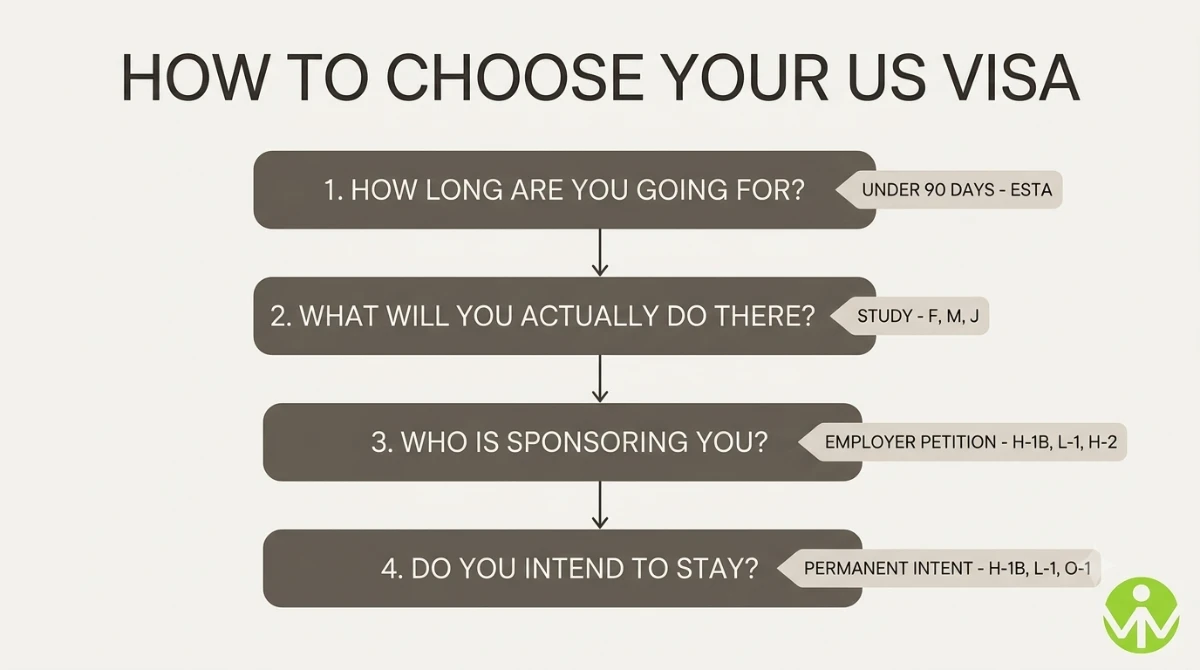
Four questions settle the category for most people, in this order.
How long are you going for? Under 90 days for tourism or business, and from a Visa Waiver Program country, ESTA is enough. Longer, or from anywhere else, and you need a visa.
What will you actually do there? Not what you would like to do — what you will do. Study needs F, M or J even for a short course taken for credit. Paid work for a US employer needs a work category, and no amount of remote-work framing turns a B-1 into one.
Who is sponsoring you? Several US visa types can’t be self-filed at all. H-1B, L-1, H-2, and most family categories require a US employer or relative to file a petition first, which sets the timeline before you do anything.
Do you intend to stay? If permanent residence is the goal, start on a route that gets you there. H-1B, L-1 and O-1 do. E-2 and TN do not, however comfortable they are, and years spent on one leave you no closer.
Answer those four honestly, and the shortlist narrows from all the types of US visa to one or two. From there, our guides to the US green card and to business visas to the USA pick up the detail, and the State Department’s immigrant visa pages set out the official routes.
Frequently asked questions
How many types of US visa are there?
There is no official total. The State Department publishes a Directory of Visa Categories listing the main nonimmigrant classes but refers readers to the Foreign Affairs Manual for the complete set, and it publishes no count. The commonly quoted figure of 185 does not come from any State Department page. What matters in practice is that the types of US visa group into two legal classes and six practical families.
What is the difference between a nonimmigrant and an immigrant visa?
A nonimmigrant visa admits you temporarily for a stated purpose — study, work, tourism — and then ends. An immigrant visa admits you for permanent residence and becomes a green card on entry. Most nonimmigrant U.S. visa types also require you to show you intend to return home, which immigrant categories obviously do not.
Which types of US visa let you work?
H-1B, H-2A, H-2B, H-3, L-1, O-1, P, Q, R-1, E-1, E-2, E-3, TN, and I all permit employment, each within its own limits and usually only for the sponsoring employer. F-1 and J-1 holders can work in narrowly defined circumstances, mainly on campus or under Optional Practical Training. Dependents such as H-4 and L-2 spouses may work only with a separate work permit.
Can a tourist visa be changed to a work or student visa?
Sometimes, but it is not the intended route and it carries real risk. Entering on a B-2 with a plan to switch can be treated as misrepresentation, particularly within the first 90 days. Changing between types of US visa from inside the country is filed with USCIS as a change of status, and approval is never guaranteed.
Which types of US visa lead to a green card?
Directly: the family preference and immediate relative categories, EB-1 to EB-5, the diversity lottery, and the humanitarian and special immigrant routes. Indirectly: H-1B, L-1 and O-1, because they are compatible with an employer sponsoring you for permanent residence while you hold them. E-2, TN, B-1/B-2 and F-1 do not lead anywhere by themselves.
How long does a US visa take to get?
For most types of US visa, it depends far more on the consulate than on the category. Interview wait times range from days to more than a year by post, and the July 2026 requirement to apply in your country of residence removes the option to book a faster slot elsewhere. Petition-based categories add the employer’s filing time before the interview stage begins, so an H-1B or L-1 timeline is measured in months rather than weeks.