
The EB-1A and the EB-2 NIW are the only two employment-based routes to a US green card that let a person petition for themselves — with no employer, no job offer and no labour certification standing between them and the filing. That shared feature is why the two are constantly compared, and it is also why the comparison so often goes wrong. They sit in different preference categories, they are assessed against entirely different legal tests, and in the queue as it stands today they can be separated by more than a decade of waiting.
This guide sets the two routes side by side: what each one actually requires, how the adjudication differs, where each sits in the visa queue, and how to tell which argument you are in a position to make.
Key Takeaways: EB-1A vs EB-2 NIW
- EB-1A and EB-2 NIW are the only two employment-based green card routes that allow a self-petition — no employer, no job offer, no labour certification.
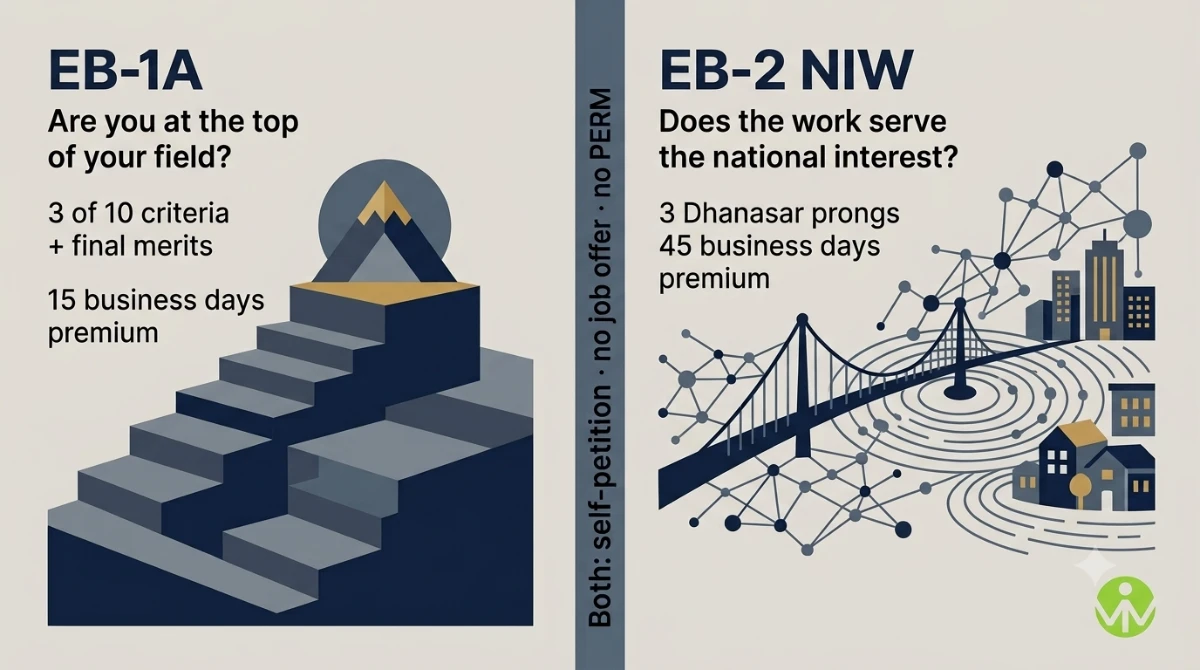
- They are judged by different tests. EB-1A asks whether you are already at the top of your field. The NIW asks whether waiving the job-offer requirement serves the national interest.
- EB-1A sits in the first preference and EB-2 NIW in the second, so for applicants charged to India the queue difference is currently measured in years, not months.
- EB-1A is faster under premium processing — 15 business days against 45 for a national interest waiver — but its approval rate is falling while the NIW rate is recovering.
- Neither route is a shortcut. The EB-2 NIW is not an easier EB-1A; it is a different argument about a different question.
Table of Contents
What EB-1A and EB-2 NIW have in common
Both routes are filed on Form I-140, the immigrant petition for a foreign worker, and both sit within the five employment-based preference categories. In each case the applicant is both the petitioner and the beneficiary. Nobody has to sponsor you, and neither route requires the Department of Labor’s PERM labour certification — the step that adds a year or more to most employment-based cases before the petition is even filed.
Both can be filed from inside the United States in almost any status, or from abroad with consular processing to follow. Both still require an available immigrant visa number before permanent residence can be granted, which is where the two diverge sharply. And both are subject to the same US green card eligibility rules on admissibility that apply to every immigrant category.
What they do not share is the question being asked. That is the whole of the difference, and it is worth being precise about it before comparing anything else.
EB-1A vs EB-2 NIW at a glance
The table below summarises the structural differences. The sections that follow explain what each line means in practice.
| Feature | EB-1A | EB-2 NIW |
|---|---|---|
| Preference category | First (EB-1) | Second (EB-2) |
| Self-petition | Yes | Yes |
| Job offer required | No | No |
| PERM labour certification | Not required | Waived |
| Core legal test | Sustained national or international acclaim; three of ten criteria, then a final merits determination | Advanced degree or exceptional ability, then the three Dhanasar prongs |
| What is being assessed | The person’s standing in their field | The endeavour and the balance of national interest |
| Premium processing | 15 business days | 45 business days |
| Most recent approval rate | 47% (FY2026 Q1) | ~43% (FY2026 Q1) |
| Best suited to | A completed record of recognition | A specific, well-evidenced future project |
| Sources: USCIS Policy Manual Volume 6, Part F, Chapters 2 and 5; USCIS I-140 data, FY2026 Q1. Verified 22 August 2026. | ||
How EB-1A works: ten criteria and a final merits test
EB-1A is the extraordinary ability category. The statutory standard is sustained national or international acclaim, and the regulations translate that into a two-part evidentiary exercise set out in the USCIS Policy Manual.
An applicant either holds a one-time major internationally recognised award — the Nobel Prize is the example the regulations themselves give — or satisfies at least three of ten listed criteria.
The ten EB-1A criteria
- Lesser nationally or internationally recognised prizes or awards for excellence in the field.
- Membership in associations that require outstanding achievement, judged by recognised experts.
- Published material about you in professional or major trade publications, relating to your work.
- Judging the work of others in the same or an allied field.
- Original scientific, scholarly, artistic, athletic or business contributions of major significance.
- Authorship of scholarly articles in professional or major trade publications.
- Display of your work at artistic exhibitions or showcases.
- A leading or critical role for organisations with distinguished reputations.
- A high salary or remuneration relative to others in the field.
- Commercial success in the performing arts, shown by box office or sales figures.
A policy update on 15 October 2024 broadened how several of these are read — team awards can now count, memberships need not be current, and published material about a team may be credited to an individual member where the evidence supports it.
Why meeting three criteria is not enough
This is the part applicants most often miss. Under the two-step analysis USCIS applies, satisfying three criteria only gets you past step one. The officer then performs a final merits determination, weighing all the evidence together to decide whether you genuinely demonstrate sustained acclaim and sit among “that small percentage who have risen to the very top of the field”.
A petition can therefore tick four or five criteria on paper and still be denied, because the totality of the record does not show someone at the top of their field. Comparative evidence matters here in a way it does not at step one: not just that you have published, but how your citation record compares with others in your discipline; not just that you judged, but how selective that role was.
How the EB-2 NIW works: the three Dhanasar prongs
The NIW starts somewhere else entirely. First you must qualify for the second preference in the ordinary way — either an advanced degree, or exceptional ability in the sciences, arts or business. That is the entry ticket, not the argument.
The argument is the waiver itself. Since Matter of Dhanasar, 26 I&N Dec. 884 (AAO 2016), USCIS applies three prongs, set out in the Policy Manual. To succeed, an EB-2 NIW petition must show that:
- the proposed endeavour has both substantial merit and national importance;
- the person is well positioned to advance that endeavour; and
- on balance, it would benefit the United States to waive the job offer and labour certification requirements.
Note what is absent. There is no requirement that you be at the top of your field, and no counting exercise. An EB-2 NIW is an argument about the work and its consequences, not a ranking of the person against their peers. That is why a mid-career researcher with a focused, well-evidenced endeavour can succeed on an EB-2 NIW while failing EB-1A comfortably.
What “well positioned” means in practice
The second prong is where most EB-2 NIW petitions are won or lost. It is forward-looking: not whether the endeavour has already succeeded, but whether this particular person is placed to carry it forward. Education, record of progress, a plan with concrete steps, and interest from people who would use or fund the work all speak to it.
A policy update on 15 January 2025 tightened how this is assessed, with more attention to whether the stated endeavour is specific enough to evaluate and whether the evidence actually connects the person to it. Generic statements about a field’s importance carry less weight than they once did.
EB-2 NIW or EB-1A: which standard is actually harder
On the legal standard alone, EB-1A is the higher bar. “Very top of the field” is a demanding phrase and the final merits determination gives officers wide latitude to apply it.
But harder is not the same as less likely to be approved, and the two questions are frequently conflated. The waiver asks for something more diffuse — a persuasive case about national importance and balance of interests — and a diffuse standard is easier to argue badly. A great many NIW denials are not cases of unimpressive applicants; they are cases where the endeavour was described so broadly that the second and third prongs had nothing specific to attach to.
The practical distinction is this. EB-1A rewards a record that is already exceptional and largely finished being built. The EB-2 NIW rewards a clearly defined piece of future work and a credible claim that you are the person to do it. If your evidence is a career, look at EB-1A. If your evidence is a project, look at the EB-2 NIW.
Queue position: where EB-1A and EB-2 NIW sit in the visa bulletin
This is the difference that most often decides the question, and it has nothing to do with the merits of either petition. EB-1A sits in the first preference. The EB-2 NIW sits in the second. Each preference has its own queue, and each queue has its own per-country limits.
The figures below come from the August 2026 Visa Bulletin, the most recent published at the time of writing.
| Preference | All chargeability areas | China (mainland born) | India |
|---|---|---|---|
| EB-1 (includes EB-1A) | Current | 1 July 2023 | 15 October 2022 |
| EB-2 (includes EB-2 NIW) | Current | 1 September 2021 | Unavailable |
| EB-3 (for comparison) | 1 September 2024 | 1 January 2022 | 1 January 2014 |
| Source: US Department of State, Visa Bulletin for August 2026, Table A (final action dates). “Unavailable” means the annual limit for that category and country has been reached; it resets at the start of the fiscal year on 1 October. Verified 22 August 2026. | |||
For most of the world both preferences are current, and the queue is not a factor in choosing between EB-1A and EB-2 NIW. For applicants charged to India it is often the only factor that matters: EB-2 was unavailable for the remainder of the fiscal year in the August 2026 bulletin, having exhausted its annual limit, while EB-1 stood at October 2022. The gap is a consequence of the per-country cap, which allots each country the same share regardless of population or demand.
One practical consequence: for an Indian-born applicant who could plausibly qualify for either, the EB-2 NIW may be the stronger petition on paper and still be the slower path to a green card by several years.
EB-1A and EB-2 NIW approval rates, speed and cost
USCIS publishes I-140 outcomes by classification. The most recent quarter available is the first quarter of fiscal year 2026, and it points in two directions at once.
| Measure | EB-1A | EB-2 NIW |
|---|---|---|
| Approval rate, FY2026 Q1 | 47% | ~43% |
| Previous quarter | 53% | ~36% |
| Direction | Falling | Recovering |
| Pending inventory | 24,653 | 82,812 |
| Regular processing | ~30 months | ~28 months |
| Premium processing | 15 business days | 45 business days |
| Premium processing fee | $2,965 | $2,965 |
| Source: USCIS I-140 receipts and adjudications, fiscal year 2026 first quarter — the most recent quarter published. Processing times are service-centre averages and move month to month. Verified 22 August 2026. | ||
EB-1A approvals have been falling — 47% in the quarter, down from 53% the quarter before — while the NIW rate has recovered from a low of around 36% to roughly 43%. The two are converging, which undercuts the common assumption that EB-1A is the safer filing.
Speed is the clearer distinction. Premium processing costs $2,965 (convert) on either route, but the clock is not the same: 15 business days for EB-1A against 45 business days for a national interest waiver. The base I-140 filing fee is identical whichever route you choose, so it is not a factor in the decision.
Note also the pending inventory. There are more than three times as many EB-2 NIW petitions waiting as EB-1A petitions, which is worth weighing if you are relying on regular processing.
Choosing between EB-1A and EB-2 NIW
A short way to structure the decision:
- Where is your evidence concentrated? A long record of recognition — awards, citations, press, selective roles — points to EB-1A. A specific piece of work with a clear beneficiary points to the EB-2 NIW.
- What is your country of chargeability? For India, the first preference queue is currently years ahead of the second. That can outweigh a stronger EB-2 NIW case.
- How urgent is the filing? If you need an approved I-140 quickly — to hold a priority date, or to support an extension — EB-1A’s 15-day premium window is three times faster.
- Can you describe the endeavour in one specific sentence? If not, the EB-2 NIW petition is not ready, whatever your credentials look like.
Filing both is permitted and not uncommon. There is no penalty for having two I-140 petitions pending, and the earlier priority date carries across. Many applicants on an H-1B visa do exactly that, using the EB-2 NIW as the substantive filing and EB-1A as the faster one. Applicants already holding an O-1 often find the O-1 visa to green card evidence maps closely onto the EB-1A criteria.
Frequently asked questions about EB-1A and EB-2 NIW
Is the EB-2 NIW easier to get than EB-1A?
Not straightforwardly. EB-1A applies a higher legal standard, but recent USCIS data shows the two approval rates converging — 47% for EB-1A against roughly 43% for the NIW in the first quarter of fiscal 2026. It is a more open-ended argument, which makes it easier to attempt and easier to argue poorly.
Can I file EB-1A and EB-2 NIW at the same time?
Yes. There is no restriction on having more than one I-140 pending, and if both are approved you keep the earlier priority date. The cost is duplicated filing fees and the work of preparing two different arguments.
Do I need a job offer for an EB-2 NIW?
No. The waiver removes both the job offer and the labour certification requirement. You do need to show what you intend to work on in the United States, but no employer has to commit to hiring you.
How many EB-1A criteria do I need to meet?
At least three of the ten, unless you hold a one-time major internationally recognised award. Meeting three only clears the first step; the officer then makes a final merits determination on the record as a whole, and petitions that satisfy three or more criteria are still routinely denied at that stage.
Does an advanced degree qualify me for an EB-2 NIW?
It qualifies you for the EB-2 category, which is the starting point rather than the case. The waiver itself is decided on the three Dhanasar prongs, and a degree on its own addresses none of them.
Is premium processing available on both routes?
Yes, at the same fee, but not at the same speed. EB-1A is adjudicated in 15 business days; an NIW petition takes 45 business days. This is one of the most frequently misreported figures on the subject.
Which route is better for applicants from India?
Usually EB-1A, for queue reasons rather than merit. In the August 2026 Visa Bulletin, EB-2 India was unavailable while EB-1 India stood at 15 October 2022. An approved EB-2 NIW does not shorten that wait — it places you in the second preference queue.