
Japan visa types fall into two layers: the visa a Japanese embassy or consulate issues before you travel, and the status of residence immigration grants when you arrive, which determines what you may do in Japan and for how long. This guide to the types of Japan visa sets out every main route for 2026, covering short stays, work, study, business, family, permanent residence and citizenship, together with the fee increases that took effect on 1 July and 1 October 2026.
Rules are set by the Ministry of Foreign Affairs of Japan for visas and by the Immigration Services Agency (ISA) for statuses of residence. If a rule affecting Japan visa types has changed recently, the date is provided so you can check it against the official source before you apply.
Key Takeaways
- The types of Japan visa work in two layers: an embassy issues the visa, and the Immigration Services Agency grants one of 29 statuses of residence that decides what you may do in Japan.
- Nationals of 74 countries and regions can visit Japan without a visa, usually for up to 90 days; a pre-travel authorisation (JESTA) is planned for the 2028 financial year.
- Visa fees rose for the first time since 1978 on 1 July 2026: ¥15,000 for a single-entry visa and ¥30,000 for a multiple-entry visa.
- From 1 October 2026, extensions and changes of status cost ¥10,000 to ¥75,000 depending on the period granted, and a permanent residence application costs ¥200,000.
- Work-based types of Japan visa range from Engineer/Specialist in Humanities/International Services to Specified Skilled Worker and the points-based Highly Skilled Professional status, which can lead to permanent residence in one to three years.
- Business Manager now needs ¥30 million in capital, and naturalisation has required 10 years of residence in practice since 1 April 2026.
Table of Contents
Japan visas fall into two layers: the visa a Japanese embassy or consulate issues before you travel, and the status of residence immigration grants when you arrive, which decides what you may do in Japan and for how long. This guide to the types of Japan visa sets out every main route for 2026, covering short stays, work, study, business, family, permanent residence and citizenship, together with the fee increases that took effect on 1 July and 1 October 2026.
Rules are set by the Ministry of Foreign Affairs of Japan for visas and by the Immigration Services Agency (ISA) for statuses of residence. If a rule affecting Japan visa types has changed recently, the date is provided so you can check it against the official source before you apply.
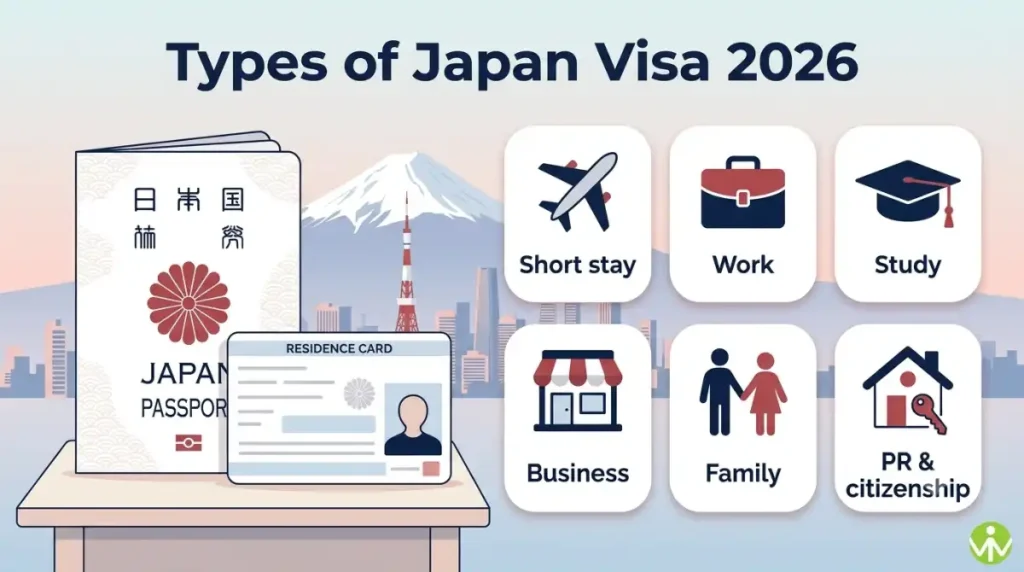
Types of Japan Visa at a Glance
The table below lists the main types of Japan visa and the status of residence each one leads to. Short stays use the Temporary Visitor status. Almost every longer stay starts with a Certificate of Eligibility sponsored by an employer, school or family member in Japan.
Table 1: Types of Japan visa at a glance (2026)
| Visa route | Status of residence | Main purpose | Typical period of stay | Path to permanent residence |
|---|---|---|---|---|
| Short-term stay (tourism, business, visiting relatives) | Temporary Visitor | Sightseeing, meetings, family visits; no paid work | 15, 30 or 90 days | No |
| Work (professional) | Engineer/Specialist in Humanities/International Services, Intra-company Transferee and other work statuses | Skilled employment with a Japanese employer | 3 months to 5 years, renewable | Yes, standard 10-year route |
| Specified Skilled Worker | Specified Skilled Worker (i) or (ii) | Work in designated sectors with labour shortages | (i) up to 5 years in total; (ii) renewable | (ii) only |
| Highly Skilled Professional | Highly Skilled Professional (i) and (ii) | Points-based route (70 points or more) or J-Skip | 5 years, then unlimited under (ii) | Yes, after 1 or 3 years |
| Business Manager | Business Manager | Running a company in Japan (¥30 million capital) | 3 months to 5 years, renewable | Yes, standard 10-year route |
| Startup visa and J-Find | Designated Activities | Preparing a business or looking for work | Up to 2 years | No direct route |
| Digital nomad | Designated Activities | Remote work for employers or clients outside Japan | 6 months, no extension | No |
| Student | Student | Study at a university, college, vocational school or language school | Up to 4 years and 3 months | Only after changing to a work status |
| Working holiday | Designated Activities | Holiday with incidental work, generally ages 18 to 30 | Up to 1 year | No |
| Family | Dependent; Spouse or Child of Japanese National; Spouse or Child of Permanent Resident; Long-term Resident | Living with family in Japan | 3 months to 5 years, renewable | Yes (shorter route for spouses) |
| Sources: Ministry of Foreign Affairs of Japan and Immigration Services Agency of Japan. The period granted to an individual applicant may be shorter than the maximum shown. Checked October 2026. | ||||
Most readers need only one or two rows of this summary of the types of Japan visa. The sections below explain each of the types of Japan visa in turn, starting with how the system itself works.
How the Types of Japan Visa Work: Visa vs Status of Residence
Japan separates two things that many countries combine. Understanding this split makes the types of Japan visa much easier to follow. A visa is the embassy or consulate’s recommendation that you be admitted. The status of residence, granted by the ISA at the port of entry, sets your permitted activities and your period of stay. The ISA lists 29 statuses of residence, from Professor and Journalist to Student and Long-term Resident, and every one of the types of Japan visa in this guide maps onto one of them.
For any stay longer than 90 days, the process normally starts inside Japan. A sponsor, such as an employer, school or spouse, applies to a regional immigration bureau for a Certificate of Eligibility (COE). Once the COE is issued, and it can now be issued electronically, the applicant takes it to a Japanese embassy or consulate, which issues the visa. Mid- to long-term residents receive a residence card on arrival at the main airports.
Immigration bureaus in Japan, not embassies, handle extensions and status changes for all long-stay types of Japan visa. Since 1 October 2026, their fees depend on the length of stay granted, as set out in the fees section below.
Activity-based and status-based types of Japan visa
Most statuses are activity-based: you may do only the work or study the status describes, and paid work outside it needs separate permission. Four statuses are based on personal or family status instead: Permanent Resident, Spouse or Child of Japanese National, Spouse or Child of Permanent Resident, and Long-term Resident. These carry no restriction on the kind of work you do, which is why they are the most flexible types of Japan visa.
Do You Need a Visa for Japan?
Japan has visa exemption arrangements with 74 countries and regions. Nationals can enter as Temporary Visitors without a visa for tourism, business meetings, or visiting relatives, usually for up to 90 days. The limit is 15 days for Indonesia and Thailand and 30 days for Brunei and Qatar, and some exemptions apply only to certain passport types. Nationals of several European countries can apply to the ISA to extend a visa-free stay to up to six months. For these travellers, none of the short-stay types of Japan visa is needed.
Everyone else needs a short-stay Japan visa before travelling. Residents of a growing list of countries can apply through Japan’s eVISA system, which issues a single-entry tourist visa for stays of up to 90 days. Applicants in Australia, Brazil, Cambodia, Canada, Saudi Arabia, South Africa, Taiwan, the United Kingdom and the United States apply online directly, while applicants in several other places, including China, India, Indonesia, the Philippines and Vietnam, apply through accredited agencies.
Japan also plans a pre-travel authorisation for visa-exempt visitors, the Japan Electronic System for Travel Authorization (JESTA), with a target launch in the 2028 financial year. No application is required yet.
Short-Stay Types of Japan Visa
All short-stay types of Japan visa lead to the Temporary Visitor status, which allows stays of 15, 30 or 90 days and does not allow paid work in Japan. The purpose of the trip decides which supporting documents the embassy expects.
Tourist visa
The tourist visa covers sightseeing and leisure travel. Applicants usually provide a passport, application form, photograph, itinerary and proof of funds, and some nationalities also need a guarantor in Japan. Our Japan tourist visa guide covers the application in more detail.
Short-term business visa
This visa covers meetings, negotiations, contract signing, market research and conferences. It does not allow you to be paid by a Japanese organisation; that requires a work status. An invitation letter from the Japanese company is normally part of the application.
Visiting relatives or friends
Visitors staying with family or friends usually submit an invitation letter and, for many nationalities, a letter of guarantee from the person in Japan.
Transit and medical stay
Travellers who stay airside while changing flights generally do not need a visa, while a transit visa covers a brief entry on the way to a third country. A separate visa for medical stay is available to patients travelling for treatment in Japan and the people accompanying them.
Work Types of Japan Visa
Work-based Japan visa types require a job offer first. The employer sponsors the COE, and the status you receive must match the job; you can’t do work outside your status until you change it.
Engineer/Specialist in Humanities/International Services
This is the most widely used work status. It covers engineering and IT, business roles such as finance, marketing and sales, and work drawing on a foreign culture, such as translation, interpreting or language teaching in companies. Applicants generally need a degree related to the job or 10 years of relevant experience (three years for some international-services roles), and pay must be at least equal to what a Japanese employee would receive. Periods of stay are 3 months, 1 year, 3 years or 5 years.
Intra-company Transferee
Employees who have worked for a company abroad for at least one year can transfer to its branch, head office or affiliate in Japan. The work allowed is similar to the Engineer/Specialist in Humanities/International Services status.
Specified Skilled Worker
The Specified Skilled Worker (SSW) system admits workers into designated sectors with labour shortages, such as nursing care, construction, manufacturing, agriculture, food service and accommodation, with 16 fields in 2026. SSW (i) requires a skills test and Japanese at JLPT N4 or JFT-Basic level, is limited to five years in total and does not allow family members to accompany the worker. SSW (ii) is for workers with higher skills, can be renewed without a cap, allows a spouse and children to join, and can count towards permanent residence. Fields can close to new applicants once they reach their quota, as food service did in April 2026.
Technical Intern Training and Employment for Skill Development
The Technical Intern Training programme is due to be replaced on 1 April 2027 by a new system, Employment for Skill Development (ikusei shuro). It is designed as a three-year training employment route that leads into SSW (i), and it allows workers to change employers under set conditions, which the old programme largely prevented.
Other professional statuses
Several other work types of Japan visa exist as separate statuses: Professor, Researcher, Instructor (teaching in schools), Medical Services, Legal/Accounting Services, Journalist, Artist, Entertainer, Religious Activities, Nursing Care (for certified care workers) and Skilled Labor, which includes chefs of foreign cuisine and similar trades. Each has its own qualification rules, so check the ISA status page for the one that matches your job.
Highly Skilled Professional, J-Skip and J-Find
The Highly Skilled Professional (HSP) status is the fastest of the long-stay types of Japan visa. Applicants are scored on academic background, career, annual salary, age and extras such as Japanese ability, and 70 points qualifies. HSP (i) is granted for five years and adds benefits such as permission for a spouse to work full time and, in some cases, for parents or a domestic worker to accompany the holder. After three years, holders can move to HSP (ii), which has no time limit.
HSP is also the shortest route to settlement. Holders with 70 points can apply for permanent residence after three years, and those with 80 points or more after one year.
J-Skip
J-Skip (Special Highly Skilled Professional) replaces the points test with income and experience thresholds. Researchers and engineers need a master’s degree or higher and annual income of at least ¥20 million, or 10 years of experience and the same income. Business managers need five years of experience and at least ¥40 million a year. J-Skip holders receive HSP (i) with extra benefits and can apply for permanent residence after one year.
J-Find
J-Find (Future Creation Individual) is for graduates of universities ranked in the global top 100 by at least two of three major rankings, within five years of graduation, with savings of at least ¥200,000. It allows up to two years in Japan to look for work or prepare a business. Our Japan startup visa guide compares J-Find and J-Skip with the founder routes.
Business Manager and the Startup Visa
Of all the types of Japan visa for founders, Business Manager is the status that authorises running a company or branch in Japan. Since 16 October 2025, new applicants need ¥30 million in capital, a dedicated office, at least one qualifying full-time employee, and Japanese at JLPT N2 level from either the applicant or that employee. Existing holders have until 16 October 2028 to meet the new standard.
Founders who are not ready for those requirements can start with the startup visa, a Designated Activities status of up to two years granted after a certifying local government or approved body confirms the business plan. Since 1 January 2025 the scheme has operated nationwide. Our Japan startup visa guide explains both stages, and our overview of startup visas by country shows how Japan compares with other founder routes.
Japan Digital Nomad Visa
Since March 2024, Japan has offered a digital nomad status under Designated Activities. Applicants need an annual income of at least ¥10 million, must be nationals of a country or region that is both visa-exempt for Japan and covered by a tax treaty with Japan, and must hold private medical insurance with at least ¥10 million of cover. The stay is limited to six months with no extension; applicants must then spend six months outside Japan before applying again. A spouse and children can accompany the holder, and the holder does not receive a residence card.
It is one of the narrower types of Japan visa, aimed at high earners who work remotely for employers or clients outside Japan. Our digital nomad visa guide compares it with schemes in other countries.
Japan Student Visa
The Student status is one of the most common long-stay types of Japan visa. It covers universities, junior colleges, vocational schools, Japanese language schools and some high schools. The school sponsors the COE, and applicants must show they can pay tuition and living costs. Periods of stay run up to four years and three months.
Students can work part time only with permission to engage in an activity outside their status, which can be granted at the main airports on first arrival. The limit is 28 hours a week during term and up to 8 hours a day, or 40 hours a week, during long vacations set by the school.
After graduating, students can change to a work status once they have a job offer, or move to a Designated Activities status for job hunting, generally for up to one year. Among the study-related types of Japan visa, this transition is the most common route into long-term work.
Working Holiday Visa
Japan has working holiday arrangements with 32 countries and regions as of 1 April 2026. Applicants are generally aged 18 to 30, although some partners set 25 as the upper limit, and they may stay for up to one year, working only to supplement their travel funds. Some partner countries have annual quotas, and several now allow a second working holiday under set conditions. Unlike most types of Japan visa, it needs no job offer or sponsor.
Family Types of Japan Visa
The family types of Japan visa depend on the status of the person you are joining.
Dependent
The Dependent status, one of the main family types of Japan visa, covers the spouse and children of holders of most work and study statuses. Dependents may work only with permission, up to 28 hours a week. It does not cover parents, and SSW (i) holders cannot bring dependents.
Spouse or Child of Japanese National and of Permanent Resident
Spouses and children of Japanese nationals, and of permanent residents, receive a status-based permit with no restriction on the type of work. Periods of stay run from six months to five years and can be renewed.
Long-term Resident
The Long-term Resident status is granted at the discretion of the Minister of Justice in particular circumstances, such as third-generation descendants of Japanese emigrants or a foreign spouse who remains in Japan after divorce or bereavement with a settled life there.
Japan Visa Fees in 2026
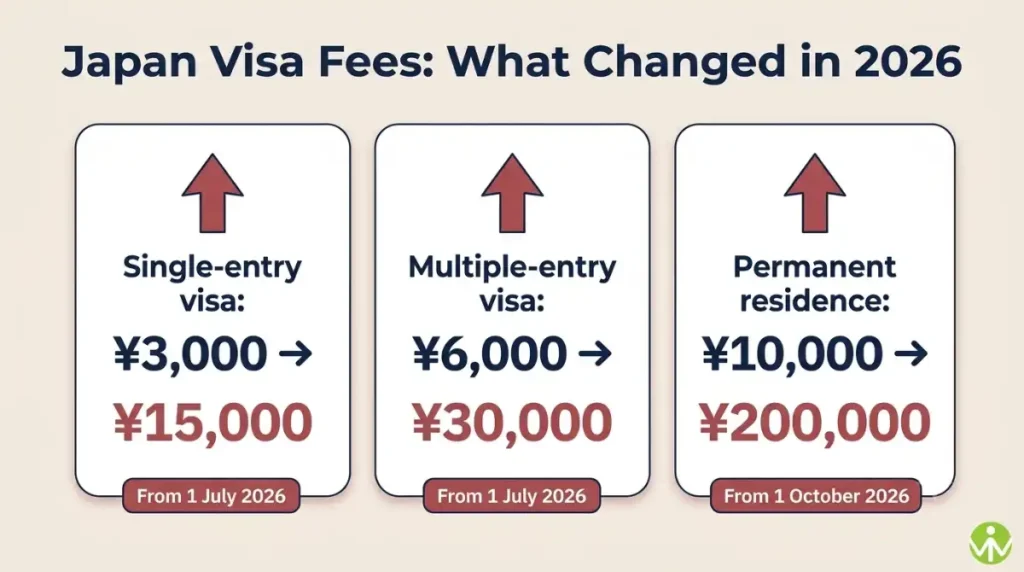
Japan raised visa issuance fees on 1 July 2026, the first change since 1978. A single-entry visa now costs ¥15,000 and a multiple-entry visa ¥30,000. Fees are paid in the local currency of the issuing embassy, some nationalities pay a different amount or nothing under reciprocal arrangements, and no fee is charged if a visa is refused.
Fees for residence procedures in Japan rose on 1 October 2026. Extensions and changes of status are now priced by the period of stay granted, and a permanent residence application costs ¥200,000, up from ¥10,000. The figures below come from the ISA fee leaflet.
Table 2: Japan visa and residence fees in 2026
| Procedure | Fee before the change | Fee after the change (counter / online) | Applies from |
|---|---|---|---|
| Single-entry visa | ¥3,000 | ¥15,000 | 1 July 2026 |
| Multiple-entry visa | ¥6,000 | ¥30,000 | 1 July 2026 |
| Extension or change of status: 3 months or less | ¥6,000 / ¥5,500 | ¥10,000 / ¥10,000 | 1 October 2026 |
| Extension or change of status: over 3 months but not more than 6 months | ¥6,000 / ¥5,500 | ¥18,000 / ¥15,000 | 1 October 2026 |
| Extension or change of status: over 6 months but less than 1 year | ¥6,000 / ¥5,500 | ¥25,000 / ¥21,000 | 1 October 2026 |
| Extension or change of status: 1 year | ¥6,000 / ¥5,500 | ¥33,000 / ¥27,000 | 1 October 2026 |
| Extension or change of status: over 1 year but less than 3 years | ¥6,000 / ¥5,500 | ¥48,000 / ¥42,000 | 1 October 2026 |
| Extension or change of status: 3 years or more but less than 5 years | ¥6,000 / ¥5,500 | ¥64,000 / ¥56,000 | 1 October 2026 |
| Extension or change of status: 5 years or more | ¥6,000 / ¥5,500 | ¥75,000 / ¥65,000 | 1 October 2026 |
| Permanent residence | ¥10,000 | ¥200,000 (counter only) | 1 October 2026 |
| Re-entry permit | ¥4,000 single / ¥7,000 multiple | Unchanged | Not applicable |
| Sources: Ministry of Foreign Affairs of Japan (visa fees) and Immigration Services Agency of Japan fee leaflet (residence procedures). Visa fees are paid in local currency and may differ or be waived for some nationalities. Online residence payments carry a separate transaction fee. Applications received by 30 September 2026 pay the old residence fees. Checked October 2026. | |||
Applicants already in Japan should budget for these fees when comparing the long-stay types of Japan visa, because a five-year grant now costs more up front than a one-year grant but less per year.
Permanent Residence in Japan
Permanent residence is the end point of most long-stay types of Japan visa. The standard route requires 10 years of continuous residence, including at least five years in a work or status-based status, together with good conduct, an independent livelihood and a full record of taxes, pension and health insurance contributions. Highly Skilled Professionals can apply after one or three years, J-Skip holders after one year, and spouses of Japanese nationals or permanent residents after five years of marriage and three years of residence.
On 1 October 2026, the ISA revised its permanent residence guidelines. The new tests include household income at or above the average for Japanese households of the same size, a projected pension, and Japanese at B1 level or above, with exceptions for groups such as Highly Skilled Professionals. The spouse route was lengthened from three years of marriage and one year of residence. Reporting indicates the full tests apply to new applications from April 2027, with the income and payment checks also applied to pending cases. Our guide to permanent residency in Japan covers the application, and our global PR guide compares Japan with other countries.
Japanese Citizenship (Naturalisation)
Citizenship sits outside the types of Japan visa: it is a nationality decision made by the Ministry of Justice. Under the Nationality Act, applicants for naturalisation need five years of residence, must be at least 18, of good conduct and able to support themselves, and must be willing to give up their other nationality. Since 1 April 2026 the Ministry of Justice has applied a 10-year residence requirement in practice, although the wording of the Act has not changed. Applications are made at a Legal Affairs Bureau, and everyday Japanese ability is assessed during the process.
Japan does not generally allow adults to hold dual citizenship, so naturalisation usually means giving up your current passport. Our list of countries that allow dual citizenship explains how other countries treat this.
How to Choose Between the Types of Japan Visa
Choosing between the types of Japan visa starts with your purpose and how long you plan to stay. The types of Japan visa map onto these common situations:
- A short holiday or business trip: check whether your nationality is visa-exempt; if not, apply for a short-term visa, online through eVISA where available.
- A job offer: your employer sponsors a COE for the matching work status; check whether you score 70 points for Highly Skilled Professional.
- Remote work with income of ¥10 million or more: the digital nomad status, for up to six months.
- Study: the Student status, with part-time work allowed with permission.
- Starting a business: the startup visa, followed by the Business Manager visa once the ¥30 million capital and other tests are met.
- Aged 18 to 30 from a partner country: the working holiday visa.
- Joining a spouse or parent: the Dependent or spouse statuses, depending on their status.
Frequently Asked Questions About the Types of Japan Visa
How many types of Japan visa are there?
The Ministry of Foreign Affairs groups visas into a handful of categories, including diplomatic, official, working, general, short-term stay, specified and transit visas. What governs your stay, however, is the status of residence, and the ISA lists 29 of them. Most people need one of about ten common types of Japan visa, as shown in the table above.
Do I need a visa to visit Japan as a tourist?
Not if you hold a passport from one of the 74 countries and regions exempt from the short-stay types of Japan visa; you can usually stay up to 90 days. Other nationals need a short-term visa, which some can obtain online through eVISA.
How much does a Japan visa cost in 2026?
Since 1 July 2026, a single-entry visa costs ¥15,000 and a multiple-entry visa ¥30,000, paid in local currency. Some nationalities pay a different amount. Residence procedures inside Japan have separate fees, which rose on 1 October 2026.
Can I work in Japan on a tourist visa?
No. The Temporary Visitor status does not allow paid work. You need a work status sponsored through a Certificate of Eligibility, or a status such as working holiday that allows incidental work.
Which types of Japan visa lead to permanent residence?
Work, Business Manager and family statuses can lead to permanent residence through the standard 10-year route or the shorter spouse route. Highly Skilled Professional and J-Skip are the fastest types of Japan visa for this, at one to three years. Short-stay, digital nomad and working holiday statuses do not lead to permanent residence.
What is a Certificate of Eligibility?
A Certificate of Eligibility (COE) is a document issued by the ISA confirming that you meet the conditions for a particular status of residence. Your sponsor in Japan applies for it, and you then use it to apply for a visa at a Japanese embassy or consulate.
Can I change from a student visa to a work visa in Japan?
Yes. Once you have a job offer that matches a work status, you apply to a regional immigration bureau for a change of status. Since 1 October 2026 the fee depends on the period of stay granted, from ¥10,000 to ¥75,000 at the counter.