
Key Takeaways
- The Japan startup visa is really two stages, not one: up to two years on Designated Activities status, then Business Manager status once the business qualifies.
- The Business Manager capital bar rose from ¥5 million to ¥30 million on 16 October 2025 — six times higher than most existing guides state.
- New Business Manager applicants also need a dedicated office, at least one qualifying full-time employee, and JLPT N2-level Japanese (or equivalent).
- Existing Business Manager holders get until 16 October 2028 to meet the new standard; renewals filed before then are judged on progress, not a hard cutoff.
- J-Find and J-Skip are separate, narrower routes — for job-hunting graduates of top universities and for very high earners respectively — not substitutes for the Japan startup visa.
Table of Contents
What the Japan Startup Visa Actually Covers Now
The Japan startup visa is not, on its own, a licence to run a business in Japan. It is a preparatory status — officially “Designated Activities” for startup preparation — that gives a founder time in the country to set up the company, find premises, and reach the requirements of the visa that actually authorises business activity: Business Manager status. Guides written before 2025 describe a narrower, older version of this system: a handful of National Strategic Special Zone municipalities running their own local programmes, each granting six months to a year, feeding into a Business Manager test that asked for ¥5 million in capital and two employees.
That system no longer exists. On 1 January 2025, the special-zone programme was folded into a single nationwide scheme, administered by the Ministry of Economy, Trade and Industry (METI) and certified by participating local governments and private bodies across the country, rather than by a short list of zones. The preparatory period was extended at the same time, from a maximum of 18 months to 2 years. Then, on 16 October 2025, the destination status — Business Manager — was itself substantially rewritten. The capital threshold jumped from ¥5 million to ¥30 million, and three requirements were added that the older system lacked: a dedicated office, a qualifying full-time employee, and a Japanese-language bar. A reader planning around the old figures is not looking at a slightly outdated article; they are planning around a programme that has been superseded twice in ten months.
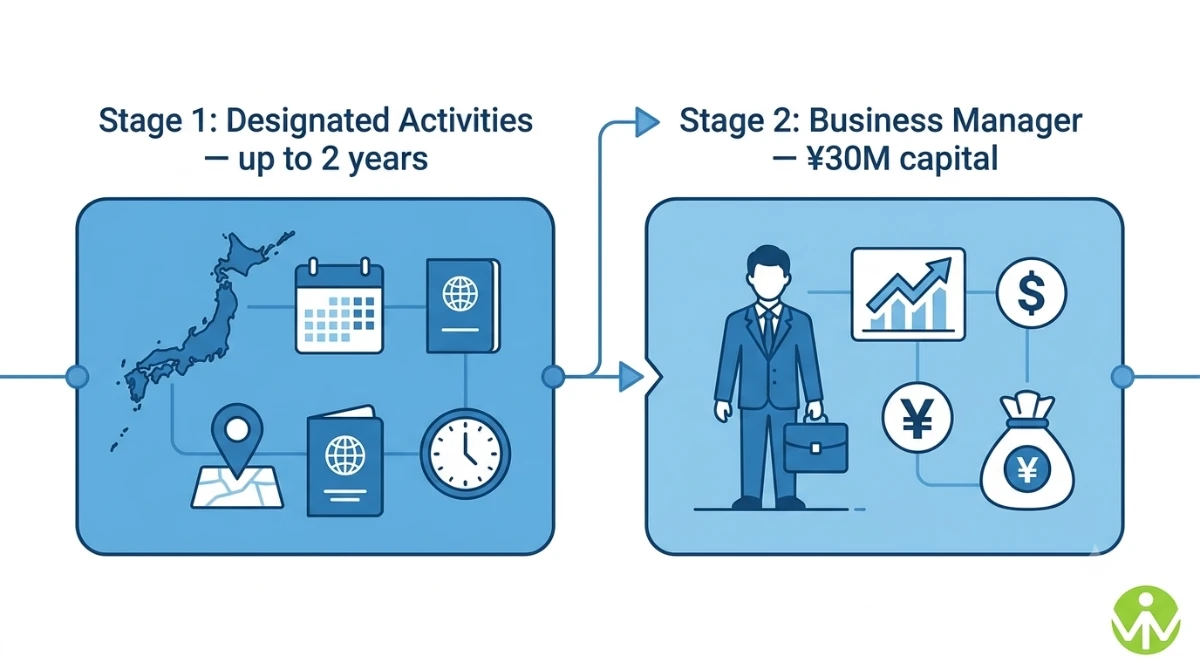
Stage 1: The Nationwide Japan Startup Visa (Designated Activities)
The first stage is the one most people mean when they say “Japan startup visa,” and it is where the older, now-superseded version of the Japan startup visa system diverges most sharply from the current one. A prospective founder applies to a certifying municipality or approved private organisation with a business plan; once that plan is confirmed, the applicant receives “Designated Activities” status and can enter or remain in Japan to prepare the business — opening a bank account, securing premises, registering the company — without yet holding a status that authorises running it day to day.
Three things changed with the 1 January 2025 nationwide rollout, as JETRO’s own guidance for foreign businesses confirms:
- Geography. The status is no longer limited to National Strategic Special Zone municipalities. Any certifying local government or approved body, anywhere in Japan, can now confirm a startup preparation plan.
- Duration. The preparatory period is now up to two years, renewed in increments, rather than the old six-to-twelve-month window tied to the special zones.
- The target. Because the destination status is Business Manager, and Business Manager itself changed in October 2025, the two-year window exists specifically to give a founder time to reach the new ¥30 million bar — not the ¥5 million figure the preparatory stage was originally designed around.
There is no fixed capital or income requirement to obtain Designated Activities status itself. What the certifying body is assessing is the credibility of the plan to build a real, staffed, capitalised business within the window — which in practice means an applicant now needs to plan toward Business Manager’s revised requirements from the outset, not treat them as a later problem.
Stage 2: Business Manager and the October 2025 Reform
Business Manager (経営・管理) is the status that actually authorises running a company or a branch office in Japan, and it is the status every Japan startup visa holder is working toward. As of 16 October 2025, a new applicant needs to clear four requirements together, not just one, per the Immigration Services Agency’s official notice on the revised Business Manager criteria:
- Capital: ¥30,000,000 minimum. This is up from ¥5,000,000 — a sixfold increase, and the single most consequential number in this entire framework. For a corporation this is registered capital; for a sole proprietor it is calculated across business premises, projected staff salaries, and equipment investment.
- Staffing: at least one qualifying full-time employee. The employee must be a Japanese national, a special permanent resident, or hold a “Table 2” status — permanent resident, spouse of a Japanese national, spouse or child of a permanent resident, or long-term resident. A business run solely by its foreign founder, with no such employee, no longer qualifies on its own.
- Office: dedicated business premises. A home address or a virtual office is not accepted in principle. The business needs premises appropriate to its scale.
- Language: JLPT N2 or equivalent. Either the applicant or the qualifying full-time employee must demonstrate Japanese ability at JLPT N2 level or above, or an equivalent such as BJT (Business Japanese Proficiency Test) 400 points or higher.
None of the last three requirements existed under the pre-October 2025 system. A plan built around raising ¥5 million and hiring two people — the old benchmark — addresses none of them.
The Transition Rule for Existing Business Manager Holders
Anyone who already holds Business Manager status is not asked to meet the new ¥30 million standard the next time their renewal comes up. Between 16 October 2025 and 16 October 2028, renewal applications are assessed individually: examiners weigh the company’s current business conditions, documented evidence of operational stability, whether tax and social-insurance obligations have been met, and — specifically — the likelihood that the company will reach the new standards, rather than applying a pass/fail test against ¥30 million on day one.
That discretion has a hard edge to it, though. After 16 October 2028, full compliance with the amended requirements is required for any renewal. Three years sounds generous next to a sixfold capital increase, but it is a fixed date, not a rolling grace period from each individual’s renewal — a Business Manager holder whose next renewal falls in 2027 has less runway to plan around than one renewing in early 2026.
The Immigration Services Agency’s own summary of startup-related visa measures sets out how the Startup Visa, J-Find, J-Skip, and Business Manager statuses fit together — the primary source for the comparison below. This transition window matters most to the earliest cohorts of the Japan startup visa’s nationwide rollout, who are only now reaching their first Business Manager renewal.
Japan Startup Visa vs J-Find vs J-Skip vs Business Manager
The Japan startup visa is often confused with two other routes that also use Designated Activities status and touch on entrepreneurship — J-Find and J-Skip — even though all three lead to different outcomes. The table below compares all four statuses a founder or highly skilled professional is likely to encounter.

Table 1: Japan Startup Visa vs J-Find vs J-Skip vs Business Manager
| Japan Startup Visa | J-Find | J-Skip | Business Manager | |
|---|---|---|---|---|
| Capital | None required to obtain it — up to 2 years to build toward ¥30M | None required | N/A — income-gated, not capital-gated | ¥30,000,000 minimum (up from ¥5,000,000, since 16 Oct 2025) |
| Income | No fixed threshold; proof of living-expense funds | ~¥200,000/month from own resources (not family remittance) | ¥20M/yr (research & technical tracks) or ¥40M/yr (business-management track) | No fixed figure; company must sustain the capital and staffing requirements |
| Duration | Up to 2 years (renewed in increments) | 1 year + 1-year extension = max 2 years, no further renewal | 5 years (Highly Skilled Professional I) | Typically 1, 3, or 5 years, renewable subject to criteria review |
| PR timeline | No direct path — must convert to Business Manager (or another qualifying status) first | No direct path — must convert to a qualifying status first | Eligible after just 1 year (Highly Skilled Professional fast-track) | Standard 10-year rule (incl. 5 years on a work-qualifying status); no fast-track unless separately HSP-qualified |
| As of 16 October 2025 (Business Manager reform) and 1 January 2025 (Startup Visa nationwide rollout). Sources: Immigration Services Agency, JETRO, Cabinet Office. | ||||
Table: how the Japan startup visa compares with J-Find, J-Skip, and Business Manager on capital, income, duration, and the path to permanent residency.
J-Find (Designated Activities, notice 54) is for recent graduates of universities ranked in the top 100 globally by at least two of the QS, THE, or ARWU rankings, within five years of graduation. It grants up to two years combined (one year plus a one-year extension, with no further renewal) to job-hunt or prepare a startup, on proof of roughly ¥200,000 per month in living expenses from the applicant’s own resources. A J-Find holder who successfully launches a business still has to clear Business Manager’s October 2025 requirements to convert into it — J-Find shortens the search, it doesn’t lower the bar at the end of it.
J-Skip (System for Special Highly Skilled Professionals) is not a founder route at all, despite the overlap in who might consider it. It fast-tracks people with strong academic, technical, or business-management credentials and high income — ¥20 million a year for the research and technical tracks, ¥40 million a year for the business-management track — into Highly Skilled Professional status, with eligibility for permanent residency after just one year. It is a route for senior executives and specialists Japan wants to attract quickly, not for an early-stage founder trying to reach ¥30 million in capital.
Business Manager, as covered above, is the only one of the four that actually authorises operating a business, and the only one with a capital threshold attached to it — the status every Japan startup visa is ultimately measured against.
How to Apply for the Japan Startup Visa
Here is how the Japan startup visa application process runs in practice, from certification through to the Business Manager conversion:
1. Identify a certifying body. Confirm which local governments or approved private organisations near your intended business location are currently certifying startup preparation plans, since certification (not the immigration application itself) is the first gate to the Japan startup visa.
2. Prepare a business plan built around the ¥30 million target. The plan should show a credible path to Business Manager’s capital, staffing, office, and language requirements within the two-year window, not just a viable business idea.
3. Obtain certification and apply for Designated Activities status. Once the certifying body confirms the plan, apply to the Immigration Services Agency for Designated Activities status.
4. Build the business during the preparatory period. Register the company, open accounts, secure premises that meet the “not a home address, not a virtual office” standard, and recruit any qualifying employee needed to meet the staffing requirement.
5. Apply to convert to Business Manager status once capital, staffing, office, and language requirements are all met, within the up-to-two-year Designated Activities window.
Frequently Asked Questions About the Japan Startup Visa
How much money do you need for a Japan business visa?
To hold Business Manager status — the visa that actually authorises running a business — you need a minimum of ¥30 million in capital as of 16 October 2025. That figure is six times the ¥5 million that applied before the reform, and it sits alongside a separate staffing, office, and Japanese-language requirement. The Japan startup visa itself, which precedes Business Manager, does not require you to hold that capital on day one — it requires a credible plan to reach it within the preparatory period.
Can I still get a Japan startup visa with ¥5 million?
You can still obtain Designated Activities status — the Japan startup visa itself — without meeting any fixed capital figure, since it is a preparatory status, not the operating one. What you cannot do is convert that status into Business Manager on ¥5 million any longer: since 16 October 2025, new Business Manager applications need ¥30 million. A plan built around ¥5 million will not clear the status the startup visa is meant to lead into.
What is the difference between the Japan startup visa and the Business Manager visa?
The Japan startup visa is Designated Activities status: a preparatory stage, up to two years, that lets a founder set up a business without yet holding authorisation to run it. Business Manager is the operating status that follows it, and since October 2025 requires ¥30 million in capital, a qualifying full-time employee, dedicated business premises, and JLPT N2-level Japanese (or equivalent). The startup visa is the runway; Business Manager is the licence to actually fly.
How long does the Japan startup visa preparation period last?
Up to two years, following the 1 January 2025 nationwide rollout that replaced the old National Strategic Special Zone system’s six-to-twelve-month window. The period is granted and renewed in increments rather than as a single two-year block up front.
Can J-Find visa holders start a business in Japan through the Japan startup visa?
J-Find and the Japan startup visa are both Designated Activities statuses, but they are separate notices with separate eligibility rules — J-Find is restricted to recent graduates of specific top-ranked universities. A J-Find holder who wants to found a business generally works toward Business Manager status directly during their J-Find period, rather than switching into the startup visa’s own certification process, though the practical route can depend on individual circumstances and is worth confirming with a certifying body or immigration specialist.
Does the Japan startup visa lead to permanent residency?
Not directly. Neither Designated Activities status (the Japan startup visa or J-Find) nor Business Manager status provides a fast track to permanent residency on its own. The general route to Japanese permanent residency requires 10 years of continuous residence, including at least 5 years in a work-qualifying status such as Business Manager, along with a clean immigration and tax record. J-Skip is the exception among the routes covered here, offering eligibility for permanent residency after just one year — but J-Skip is a high-income fast-track for specialists and executives, not a startup route.
What happens if I already hold Business Manager status under the old ¥5 million rule?
If you reached Business Manager status through the Japan startup visa route before 16 October 2025, you are not immediately held to the new ¥30 million standard. Renewal applications filed between 16 October 2025 and 16 October 2028 are assessed on your company’s current business conditions, tax and dues compliance, and the documented likelihood that you will reach the new standard — not a hard pass/fail against ¥30 million. After 16 October 2028, full compliance with the amended requirements is required for any renewal, so the grace period is a fixed calendar window, not extra time counted from your own renewal date.
Also See
More on the Japan startup visa’s place among global options, and what else changed nearby: