
A Spain student visa is the long-stay national visa that non-EU nationals need to study in Spain for more than 90 days. It covers university degrees, master’s and doctoral programmes, higher-level vocational training, and post-compulsory secondary education such as the Bachillerato, and it leads to a student stay authorisation for the length of the course.
This guide explains who needs a Spain student visa, the required documents and funds, the €90 fee, how to apply, what to do after arrival, how many hours students can work, and how to stay on after graduating. It reflects the immigration regulation in force since 20 May 2025. For every other route, see our guide to the types of Spain visa.
Key Takeaways
- A Spain student visa is a national (type D) visa for courses longer than 90 days; shorter courses use a Schengen visa or visa-free entry.
- The Spain student visa fee is €90 for most applicants, and some nationalities pay a different reciprocity rate.
- Students must show 100% of IPREM, which is €600 a month in 2026, plus €450 for the first family member and €300 for each further one.
- Apply at the Spanish consulate for the place where you live at least two months before studies begin; the consulate decides within one month.
- Higher-education students can work up to 30 hours a week without a separate work permit.
- Graduates with at least a bachelor’s degree from a Spanish institution can apply for a 24-month job-search residence permit.
Table of Contents
What is a Spain student visa?
The Spain student visa is a national (type D) visa, not a Schengen visa. Spanish consulates issue it, and it gives the holder a long-stay authorisation for studies under Royal Decree 1155/2024, the immigration regulation that took effect on 20 May 2025. For a higher-education course, the authorisation lasts for the full length of the programme. For post-compulsory secondary education, it runs for the length of the course, up to one year at a time.
Courses of 90 days or less don’t need a Spain student visa. Depending on nationality, students on short courses enter Spain visa-free or with a Spain tourist visa, which is a Schengen visa valid for up to 90 days in any 180-day period.
Courses a Spain student visa covers
The visa covers full-time programmes at an authorised institution that lead to a qualification: official university degrees and universities’ own titles, higher artistic education, higher-level vocational training, the Bachillerato, intermediate vocational training, and professional music and dance studies. Non-university programmes need at least 50% in-person attendance. Separate long-stay authorisations under the same regulation cover student mobility programmes, volunteering, and training activities such as language assistant posts and Spanish language courses.
Who needs a Spain student visa?
Non-EU nationals need a Spain student visa for any course longer than 90 days. Citizens of the EU, the EEA, and Switzerland don’t need one, whatever the course length; they register their residence after arrival instead. To apply from abroad for higher education, applicants must be at least 17.
Adults already living legally in Spain don’t need to go home to apply. They can request a higher-education stay authorisation from inside Spain, at least two months before their current status ends, and the Immigration Office decides within two months.
Spain student visa requirements
The Ministry of Inclusion, Social Security and Migration sets out the Spain student visa requirements on its official student stay information sheet. They fall into five groups: admission, money, health insurance, background checks, and a valid passport.
Admission and paid enrolment fees
Applicants need an admission letter from an authorised institution for a full-time programme, plus proof that they have paid the enrolment fees. Consulates reject vague letters, so the letter should name the course, its dates, and the weekly hours.
Proof of funds for a Spain student visa
Applicants must show enough money to live on, not counting tuition. Spain measures this against IPREM, its Public Indicator of Income for Multiple Effects, which stays at €600 a month in 2026 because Spain has not passed a new state budget since 2023. A student needs 100% of IPREM a month, or €600. The first accompanying family member adds 75%, or €450, and each further family member adds 50%, or €300. Proof that accommodation is prepaid for the whole stay can reduce the amount.
Accepted evidence includes bank statements, a scholarship or grant award, and a sponsorship letter from parents with proof of their means. For a nine-month academic year, a single student should plan to show at least €5,400.
| Household | Per month | For a nine-month academic year |
|---|---|---|
| Student alone | €600 | €5,400 |
| Student and one family member | €1,050 | €9,450 |
| Student and two family members | €1,350 | €12,150 |
| Student and three family members | €1,650 | €14,850 |
| Based on IPREM of €600 a month (100% for the student, 75% for the first family member, 50% for each further one). Prepaid accommodation can reduce the amount. As of November 2026. | ||
Health insurance
The Spain student visa requires health insurance from an insurer authorised to operate in Spain, with cover similar to Spain’s public health system. Consulates expect no co-payments, waiting periods, or cover limits, and they don’t accept travel insurance.
Criminal record and medical certificate
Adults staying more than six months need a criminal record certificate covering the past five years from each country where they have lived. Applicants from abroad also need a medical certificate confirming that they have no disease with serious public health implications under the 2005 International Health Regulations. Consulates apply these two rules differently: some ask for a criminal record for shorter stays, and some ask for a medical certificate only for stays over 180 days. Check the checklist of the consulate that will handle your application.
Spain student visa documents
Each consulate publishes its own checklist, but the core Spain student visa documents are the same everywhere. Foreign documents need an apostille or consular legalisation and, where they aren’t in Spanish, an official translation.
| Document | What it must show |
|---|---|
| National visa application form | Completed and signed; a parent signs for a minor |
| Passport | Valid for at least one year, with blank pages; original and copy |
| Photo | Recent passport-size colour photo on a light background |
| Admission letter | Full-time course at an authorised institution, with enrolment fees paid |
| Proof of funds | At least €600 a month for the student, plus family amounts |
| Health insurance | Insurer authorised in Spain; no co-payments or waiting periods |
| Criminal record certificate | Adults staying over six months; covers the past five years |
| Medical certificate | No disease with serious public health implications |
| Visa fee | €90, paid in local currency on submission |
| Source: Ministry of Inclusion information sheet (Hoja 1, November 2025) and Spanish consulate checklists. Consulates may ask for more documents. | |
Spain student visa fee
The Spain student visa costs €90, the standard fee Spain charges for every national visa under Orden AUC/891/2024. Applicants pay in local currency when they submit, and consulates don’t refund it if they refuse the visa. Nationals of some countries, including Australia, Bangladesh, Canada, the United Kingdom, and the United States, pay a different reciprocity rate set by their consulate. Visa centres that handle appointments add their own service charge, and the foreigner identity card issued after arrival carries a separate fee.
| Stage | Fee or deadline |
|---|---|
| Visa fee | €90; some nationalities pay a reciprocity rate |
| When to apply | At least two months before studies begin |
| Consulate decision | Within one month; no reply means refusal |
| Collecting the visa | Within two months of approval |
| TIE card | Within one month of arrival, for stays over six months |
| Extension | Two months before to three months after expiry |
| Job-search permit | 60 days before to 90 days after the stay ends |
| Source: Orden AUC/891/2024 and Ministry of Inclusion information sheets 1 and 20. As of November 2026. | |
How to apply for a Spain student visa
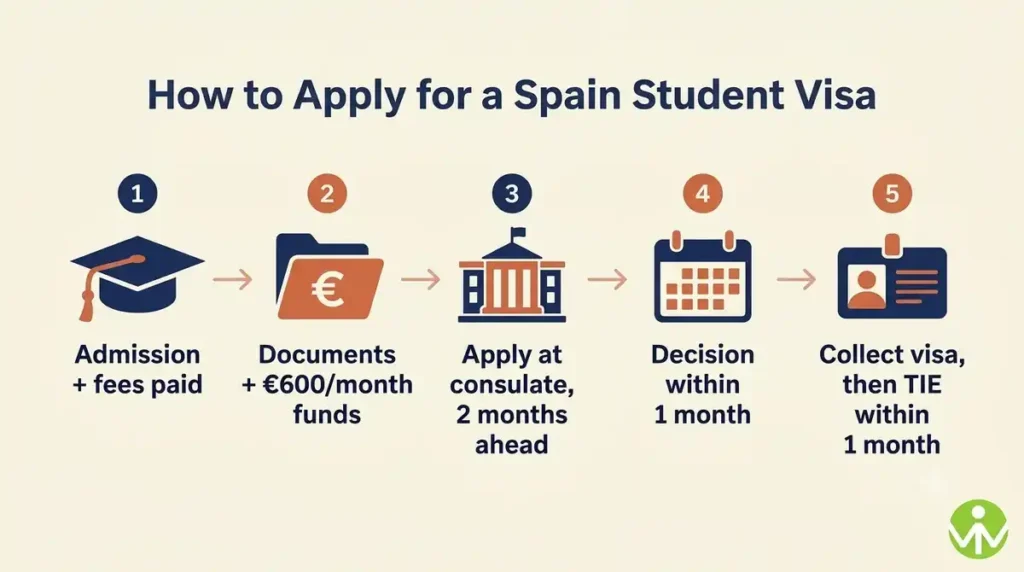
The Spain student visa application happens in person, in the country where you live. The five steps below apply at most consulates.
Step 1: Secure a place and pay the enrolment fees
Accept an offer from an authorised institution and pay the enrolment fees. The consulate checks both before it looks at anything else.
Step 2: Gather documents and proof of funds
Collect the documents in the table above, get foreign documents apostilled and translated, and buy health insurance that meets the Spanish standard.
Step 3: Book an appointment and submit
Apply at the Spanish embassy or consulate for the place where you live, or at the visa centre it uses; find yours in the Ministry of Foreign Affairs directory of embassies and consulates. Submit at least two months before the course starts. A parent or authorised representative can apply on behalf of a minor.
Step 4: Wait for the decision
The consulate must decide within one month of submission, though it can extend that period if it calls an interview or asks for more documents. If it doesn’t reply in time, the application counts as refused.
Step 5: Collect the visa and travel
Collect the visa in person within two months of approval. After that, the consulate treats the visa as renounced.
If the consulate refuses a Spain student visa
Refusals come in writing, with reasons. Ask the consulate to reconsider within one month, or appeal to the High Court of Justice of Madrid within two months.
After you arrive: the TIE card and extensions
For a course of six months or less, the Spain student visa covers the whole stay. For longer courses, the visa covers the first 90 days, and students must apply in person for a foreigner identity card (Tarjeta de Identidad de Extranjero, or TIE) within one month of arrival, at the police station for the place where they live. The TIE proves legal status for the rest of the course.
Extending a Spain student visa stay
Students who continue their studies can extend the authorisation from inside Spain. Apply online to the Immigration Office (Oficina de Extranjería) of the province that granted it, during the two months before or the three months after it expires. Each extension needs proof of enrolment, funds, and insurance, and lasts for the next course, up to one year. The office decides within one month, and an authorisation can be extended twice.
Working on a Spain student visa
Higher-education students can work up to 30 hours a week, as employees or self-employed, without applying for a separate permit, provided the job fits around their studies. The 30-hour cap dates from a reform that took effect in August 2022. The regulation in force since 20 May 2025 kept the cap and made the right to work automatic for higher-education students only. Students on other courses need a work authorisation, which the employer requests from the Immigration Office for employed work and the student requests for self-employment.
Work rights end when the student stay ends, and they apply within one autonomous community. Going over 30 hours a week is grounds for ending the stay. Curricular internships that form part of the programme need no extra authorisation. The Ministry of Inclusion publishes the full rules on student work. Spain’s cap is higher than Italy’s 20 hours a week, as our Italy student visa guide explains.
Bringing family on a Spain student visa
Higher-education students can bring a spouse or registered partner and their minor children, and in some cases adult children who depend on them. Family members can apply at the same time as the student or later, provided the student has at least 90 days left on the authorisation. They need proof of the relationship, their own health insurance, and the extra funds shown in the table above. Family members can’t work while they hold this status.
Staying in Spain after graduation
Graduates with at least a bachelor’s degree from an authorised Spanish higher-education institution can apply for a residence permit to look for work or start a business. The Ministry of Inclusion’s job-search permit information sheet sets its length at 24 months, with no extension. Apply within the 60 days before the student stay expires, or up to 90 days after. Applicants show the same 100% of IPREM per month, and the permit doesn’t allow work: once a graduate finds a job, they apply for a work and residence permit.
Graduates with a qualifying job offer can also compare Spain’s highly qualified routes with the EU Blue Card, and graduates who want to start a company can read our guide to the Spanish entrepreneur visa.
Spain student visa FAQs
How much does a Spain student visa cost?
The Spain student visa costs €90 for most applicants, paid in local currency at the consulate. Some nationalities, including Australian, Canadian, British, and US citizens, pay a different reciprocity rate.
How much money do I need for a Spain student visa?
You need 100% of IPREM, which is €600 a month in 2026, for each month of the stay. Add €450 a month for the first family member and €300 for each further one.
Can I work on a Spain student visa?
Yes. Higher-education students can work up to 30 hours a week without a separate permit, as long as the work fits around their studies. Students on other courses need a work authorisation first.
How long does a Spain student visa take?
The consulate must decide within one month of submission, and it can take longer if it calls an interview. Apply at least two months before your course starts.
Do I need a Spain student visa for a course shorter than 90 days?
No. A course of 90 days or less needs only a Schengen visa or, for some nationalities, no visa at all.
Can I stay in Spain after my studies?
Yes. Graduates with at least a bachelor’s degree from a Spanish institution can apply for a 24-month residence permit to look for work or start a business.
Can I apply for a Spain student visa from inside Spain?
Adults already living legally in Spain can apply for a higher-education stay authorisation from inside Spain, at least two months before their current status ends. Everyone else applies at a consulate abroad.