
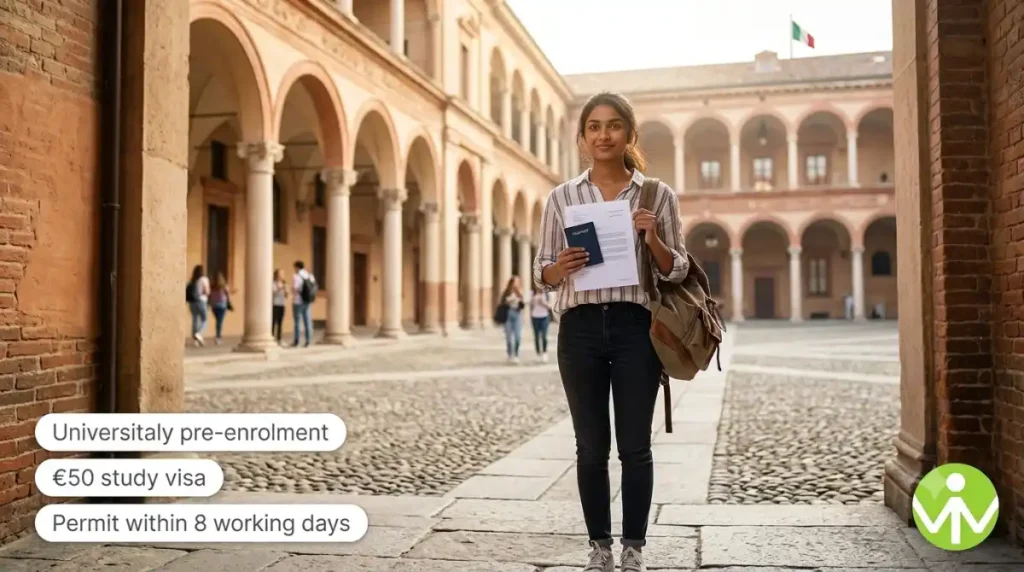
An Italy student visa is a long-stay national visa (Type D) that non-EU nationals need to follow a degree programme or another course in Italy lasting more than 90 days. It lets you enter Italy for study, and it is the first of two steps: within eight working days of arrival, you also apply for a residence permit for study, which is what allows you to stay for the length of your course.
This guide covers the 2026/27 rules: who needs the visa, the Universitaly pre-enrolment step, the proof of funds and other requirements, fees, deadlines, and what happens after you arrive. For an overview of every category, see our guide to the types of Italy visa.
Key Takeaways
- An Italy student visa is a long-stay national visa (Type D) for courses lasting more than 90 days. Shorter courses use a Schengen visa or visa-free entry.
- University applicants pre-enrol on the Universitaly portal first. The consulate will not process the Italy student visa without a validated pre-enrolment summary.
- The national study visa fee is €50. The higher €116 figure applies to other national visas, not to study.
- For 2026/27 you must show at least €10,179.85 a year in funds, accommodation, health insurance and, for most degree courses, B2-level language skills.
- Degree applicants must apply by 30 November 2026, and must request a residence permit for study within eight working days of arriving in Italy.
- Students can work up to 20 hours a week (1,040 hours a year) and can stay on after graduating to look for work.
Table of Contents
What is an Italy student visa?
Italy issues two kinds of visa to students. Courses of up to 90 days are covered by the short-stay Schengen visa (Type C), the same visa used by tourists, or by visa-free entry if your nationality allows it. Anything longer needs the national study visa, which is what most people mean by an Italy student visa.
The national visa is only an entry document. Your right to live in Italy for the whole course comes from the permesso di soggiorno per studio, the residence permit for study, which you request after you land. Our Schengen visa guide explains how national visas differ from short-stay visas across the Schengen area.
Short course or full degree: which visa do you need?
The table below compares the two routes. If your course is 90 days or shorter, read our Italy tourist visa guide, because the application process, documents and fee for a short study stay are the same as for a Schengen visit.
Table 1: Schengen visa vs Italy student visa
| Schengen visa (Type C) | Italy student visa (Type D) | |
|---|---|---|
| Course length | Up to 90 days | More than 90 days |
| Visa fee | €90 (adults) | €50 |
| Pre-enrolment | Not required | Universitaly for degree courses |
| Residence permit | Not needed | Required within 8 working days of arrival |
| Work allowed | No | Up to 20 hours a week |
| Where it is valid | Schengen area, 90 days in any 180 | Italy, plus short trips in the Schengen area |
| Fees from the Embassy of Italy in Pretoria fee table, updated 27 July 2026. Consulates charge the equivalent in local currency. | ||
Who needs an Italy student visa?
Citizens of EU member states, the European Economic Area and Switzerland do not need a visa to study in Italy; they register their residence locally instead. Every other nationality needs an Italy student visa for a course longer than 90 days, including nationals of countries that can visit Italy visa-free for short stays.
The national study visa covers several kinds of study, not only university degrees:
- Bachelor’s (Laurea), master’s (Laurea Magistrale) and single-cycle degree programmes at universities
- Courses at AFAM institutions (fine arts, music and dance academies and conservatories) and SSML schools for language mediators
- Foundation courses that prepare students for admission to an Italian degree
- Exchange and mobility programmes such as Erasmus, and the Marco Polo and Turandot programmes
- Other recognised courses, vocational training and research placements, subject to the consulate’s own checklist
Italy student visa requirements for 2026/27
The rules for university applicants are set each year by a circular from the Ministry of University and Research (MUR). The requirements below come from the 2026/27 circular as published by Italian embassies and consulates. Each consulate adds its own checklist, so always compare your file with the list for the office that covers your place of residence.
Universitaly pre-enrolment
Applicants to degree courses must pre-enrol online through the Universitaly portal, the Ministry’s free official portal. You choose a course, upload your documents, and the university reviews the request. Once the university validates it, you download the pre-enrolment summary, and the consulate uses that summary to process your Italy student visa. Only the university decides whether your foreign qualifications give you access to the course; the consulate does not assess them.
A validated pre-enrolment does not guarantee a visa or even a visa appointment. The consulate still decides the Italy student visa application on its own merits.
Proof of funds
For 2026/27 you must show at least €10,179.85 for each year of study. Accepted evidence usually includes bank statements, a scholarship award or a guarantee from an Italian institution, but the exact documents vary by consulate. The Consulate General in Jerusalem also asks for about €500 to cover the cost of returning home, a requirement other consulates do not list.
Accommodation
You need proof of where you will live: a university residence booking, a rental contract, a hotel booking of at least 30 days, or a declaration of hospitality from the person hosting you.
Language level
For courses taught in Italian, the 2026/27 rules ask for at least B2 on the Common European Framework of Reference (B1 is accepted for foundation courses). For courses taught in English or another language, you need a certificate at B2 or above. Universities can set a higher bar. If you are starting from scratch, our tips on finding a language tutor in Italy can help.
Health insurance
You need health cover for your whole stay. Consulates generally ask for a policy covering medical treatment, hospital care and repatriation, with a minimum of €30,000. After arriving you can buy private cover or register voluntarily with the Italian national health service (SSN), which costs at least €700 a year for students.
Italy student visa documents checklist
A typical application includes:
- The national visa application form (Type D), completed and signed
- A passport valid for at least three months beyond the visa’s expiry date, plus a copy
- One recent passport photograph
- The Universitaly pre-enrolment summary validated by your university, or an admission letter for other courses
- Proof of funds and proof of accommodation
- Language certificates and copies of your educational qualifications
- A CV and a motivation letter, which many consulates now request
- Health insurance and a flight reservation
How to apply for an Italy student visa
The steps are broadly the same at every consulate. Start early, because the busiest months for appointments are the summer months before the academic year begins.
Step 1: Apply to your course
Choose a course and apply directly to the university, AFAM institution, or school, following its admission calendar. Many institutions require an application or an entrance test before they validate a pre-enrolment.
Step 2: Pre-enrol on Universitaly
Submit the pre-enrolment request on Universitaly and wait for the university to validate it. Non-university courses skip this step and use the institution’s admission letter instead.
Step 3: Check your document list
Use the Foreign Ministry’s Visto per l’Italia questionnaire to confirm that you need a national study visa and to see the standard document list. Then check the website of the embassy, consulate or visa application centre that serves your area for local rules.
Step 4: Book an appointment and submit your application
Book an appointment, submit your documents in person and pay the fee. Consulates collect the fee in local currency, calculated from the euro amount. Some consulates also hold a short interview to check that your study plan makes sense.
Step 5: Collect your visa and travel
Once the Italy student visa is issued, check the dates and the purpose printed on it before you travel. Keep copies of your enrolment and insurance documents: you will need them again for the residence permit.
Italy student visa fees and costs
The national visa fee for study is €50, according to the fee table of the Embassy of Italy in Pretoria (updated 27 July 2026). The €116 figure seen in older guides, and still shown on the EU Immigration Portal, is the fee for other national visas. The fee is not refunded if the visa is refused. The main costs are shown below.
| Item | Amount | Notes |
|---|---|---|
| National study visa (Type D) | €50 | Non-refundable; paid in local currency |
| Schengen visa for courses of up to 90 days | €90 | Adults; reduced fee for children |
| Residence permit fee | €40 or €50 | €40 for 3 to 12 months; €50 for 12 to 24 months |
| Tax stamp (marca da bollo) | €16 | Paid when you submit the permit kit |
| Electronic permit card | €30.46 | Issuance cost |
| Postal kit submission | €30 | Paid at the post office |
| Voluntary SSN health registration | From €700 a year | Alternative to private health insurance |
| Proof of funds (not a fee) | €10,179.85 a year | Minimum for 2026/27 |
| Sources: Embassy of Italy in Pretoria (visa fees, 27 July 2026); EU Immigration Portal (residence permit costs, updated 1 April 2025); Italian Ministry of Health note of 12 January 2024 (SSN); MUR 2026/27 rules via Italian consulates (funds). | ||
Check the full picture of residence permit rules and fees on the EU Immigration Portal page for students in Italy before you budget.
Italy student visa deadlines for 2026/27
Degree applicants must apply for the Italy student visa by 30 November 2026, and some universities set earlier dates. Foundation course applicants can apply at any time of year, as long as they apply well before the course starts.
| Stage | When | Notes |
|---|---|---|
| Apply to your course | Set by each institution | Check the admission calendar of your university |
| Universitaly pre-enrolment | Before the visa application | The university must validate it |
| Visa application (degree courses) | By 30 November 2026 | Universities may set an earlier date |
| Visa application (foundation courses) | Any time of year | Apply well before the course starts |
| Residence permit request | Within 8 working days of arrival | Kit from a post office, then the Questura |
| Visa application for 2027/28 degree courses | By 31 October 2027 | Published by the Consulate General in Jerusalem; confirm when the 2027/28 rules are issued |
| Based on the 2026/27 rules for international students as published by Italian embassies and consulates, checked 27 September 2026. | ||
Consulates do not publish a fixed processing time for study visas, so apply as soon as your pre-enrolment is validated.
After you arrive: the residence permit for study
Within eight working days of entering Italy, you must request a permesso di soggiorno per studio. In most cities you collect an application kit at a post office offering the Sportello Amico service, send it by registered post, and then attend an appointment at the Questura (police headquarters) to give your fingerprints.
The permit normally matches the length of your course and is renewed each year, provided you keep up with your studies. You can request the renewal from 30 days before to 30 days after the expiry date.
Working while you study in Italy
An Italy student visa leads to a permit that lets you work part-time, up to 20 hours a week and no more than 1,040 hours a year. Work must not get in the way of your studies, and your employer needs to register the contract in the usual way.
Staying in Italy after graduation
If you graduate from an Italian degree programme, you can apply for a 12-month permit to look for a job, or convert your study permit into a work permit if you already have an offer. Our Italy work visa guide covers the employment routes, and our guide on how to migrate to Italy covers longer-term residence.
Why Italy student visa applications are refused
Consulates must assess whether an applicant presents a migration risk. They review your finances, your previous education, and whether the course fits your academic path. Common problems include untraceable funds, a course that doesn’t follow from your earlier studies, missing language certificates, and applications filed too close to the deadline. You can appeal a refusal, and the refusal notice explains how.
Italy Student Visa FAQs
Do I need an Italy student visa for a course shorter than 90 days?
No. For a course of 90 days or less you need a Schengen short-stay visa, or no visa at all if your nationality can visit Italy visa-free. The national Italy student visa is only for courses longer than 90 days.
How much does an Italy student visa cost?
The national study visa fee is €50, paid in local currency at the consulate. Budget separately for the residence permit, which costs about €116 to €126 in fees and charges, and for health insurance.
How much money do I need to show for an Italy student visa?
For the 2026/27 academic year, the minimum is €10,179.85 per year of study. Some consulates ask for extra funds, such as the cost of a return ticket.
What is the deadline to apply for an Italy student visa in 2026?
Degree applicants for 2026/27 must apply by 30 November 2026, although your university may set an earlier date. Foundation course applicants can apply at any time, as long as they apply early.
Do I need to speak Italian to get a student visa?
Not always. Courses taught in Italian generally require at least B2, or B1 for foundation courses. Courses taught in English require a B2 certificate in English instead.
Can I work on an Italy student visa?
Yes. With a residence permit for study, you can work up to 20 hours a week, capped at 1,040 hours a year.
Can I stay in Italy after my studies?
Yes. Graduates of Italian degree programmes can apply for a 12-month permit to look for work, or convert their study permit into a work permit if they have a job offer. Graduates who want to found an innovative company can convert their permit through the Italia Startup Hub, as explained in our Italy startup visa guide.