
An Italian language test is part of the path to staying in Italy for good: non-EU residents need A2 Italian for the EU long-term residence permit, and most people applying for citizenship must prove B1. This guide explains which Italian language test applies to you, how the free A2 test works, which B1 certificates are accepted for citizenship, and how to find a language tutor in Italy or at home to prepare.
It is part of our guide to the types of Italy visas, which covers every route into the country, from short stays to work, study and family visas.
Key Takeaways
- The Italian language test you need depends on the status you want: A2 for the EU long-term residence permit, B1 for citizenship by residence or marriage, and usually B2 for a degree taught in Italian.
- The A2 Italian language test for the long-term permit is free, booked online and organised by the prefecture. You need 80% to pass, and no certificate is issued.
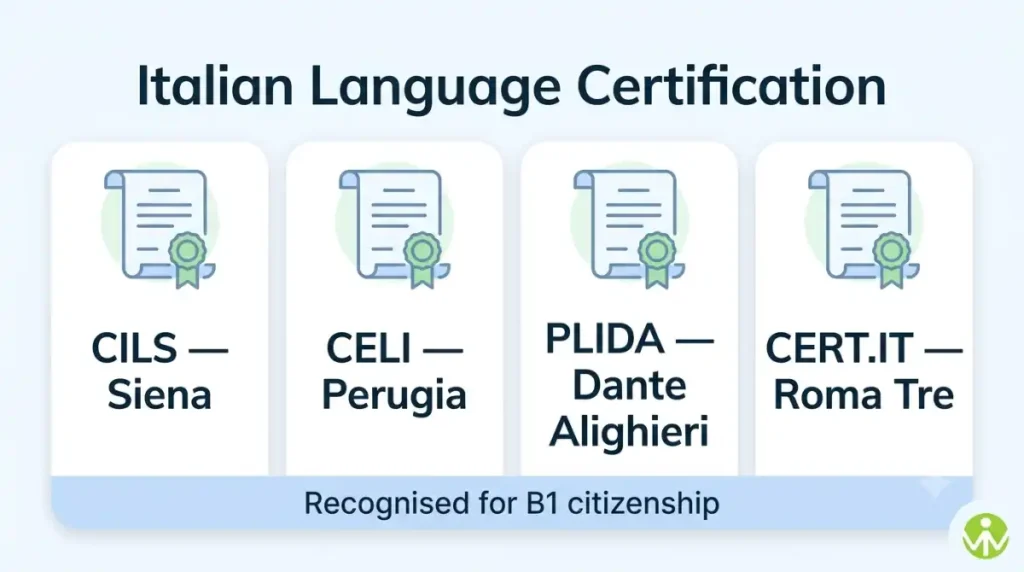
- For citizenship, the usual proof is a B1 certificate from CILS (Siena), CELI (Perugia), PLIDA (Società Dante Alighieri) or CERT.IT (Roma Tre), or from a CPIA adult-education centre.
- Citizenship-only B1 exams, such as CILS B1 Cittadinanza, are shorter, but the certificate cannot be used for anything else.
- Each exam centre sets its own fee. The 2026 examples we checked cost €90 and €120.
- Free CPIA courses, the universities for foreigners, Italian Cultural Institutes and private tutors are the main ways to prepare.
Table of Contents
Italian language test requirements at a glance
The level you must prove, and the way you prove it, depends on the status you are applying for. Table 1 sets out the main cases, from the long-term permit to a university place.
| Purpose | Level required | How to prove it | Cost |
|---|---|---|---|
| EU long-term residence permit (Italy permanent residency) | A2 | Free prefecture test, an A2 or higher certificate, or an exemption | Free (test); exam fee if you use a certificate |
| Integration agreement (first permit of one year or more) | A2 (spoken), within two years | Certificate, course credits or a check arranged by the prefecture | No fee for the prefecture check |
| Citizenship by residence or marriage | B1 | B1 certificate from a recognised body or a CPIA, or an exemption | Set by each exam centre (€90 and €120 in the 2026 examples checked) |
| University degree taught in Italian (student visa) | B2 (B1 for foundation courses) | Certificate accepted by the university | Exam fee |
| Tourist and work visas (entry) | None | Not applicable | Not applicable |
| Sources: Ministerial Decree of 4 June 2010; Law 91/1992, article 9.1; Italy’s 2026/27 rules for international students; exam centre notices for 2026. As of 30 September 2026. | |||
Which Italian language test do you need?
For Italy permanent residency: A2
The EU long-term residence permit, often called Italy permanent residency, requires Italian at A2 level on the Common European Framework of Reference (CEFR). A2 is a basic level: you can understand short, common phrases and handle simple everyday exchanges. Most applicants either sit the free Italian language test organised by the prefecture or submit an A2 certificate from a recognised body.
For Italian citizenship: B1
Italian citizenship by residence or marriage has required B1 Italian since 4 December 2018. B1 is an intermediate level: you can deal with most everyday situations, describe experiences and give short reasons for your opinions. There is no state-run B1 Italian language test, so you prove the level with a certificate. Descent claims and the declaration routes for minors have no language requirement.
For students and new arrivals
Degree courses taught in Italian generally ask for B2, or B1 for foundation courses, as our Italy student visa guide explains. Universities can set a higher bar.
Non-EU nationals who receive a first residence permit of at least one year also sign an integration agreement. It commits them to reach A2 spoken Italian and a basic knowledge of civic life within two years. Entering Italy on an Italy tourist visa or an Italy work visa involves no Italian language test at the visa stage.
The A2 Italian language test for the long-term permit
The A2 Italian language test was set up by a ministerial decree of 4 June 2010. It is for non-EU nationals aged 14 or over who apply for the EU long-term residence permit after five years of legal residence.
How to book the A2 Italian language test
You request the test online through the Interior Ministry’s services portal (portaleservizi.dlci.interno.it). The prefecture then sends the date and place by post and email. There is no fee. According to a prefecture information leaflet, the test checks that you understand short texts, sentences and common expressions. It is normally taken on a computer, with a paper version on request, and you need at least 80% of the total score to pass.
No certificate is issued when you pass. The result is recorded for your permit application, so a pass cannot later be reused as proof of Italian for citizenship. If you fail, you can apply to sit the test again. One prefecture’s guidance sets a wait of 90 days before the retake.
Who is exempt from the A2 test
You do not sit the test if any of the following applies:
- You are under 14.
- You have a serious difficulty learning a language because of age, illness or disability, certified by a public health facility.
- You hold a certificate at A2 or above from a recognised certifying body.
- You passed an A2 (or higher) Italian course at a CPIA (Centro Provinciale per l’Istruzione degli Adulti).
- Your integration agreement recorded A2 Italian.
- You hold an Italian secondary school diploma, or you are enrolled at an Italian university or on a postgraduate course.
- You hold international protection.
- You entered as a senior manager, university professor, translator, interpreter or journalist under article 27 of Legislative Decree 286/1998.
B1 Italian for citizenship: the certificate you need
For citizenship, the Italian language test is in practice a certificate exam. Prefecture guidance on B1 certificates lists two sources: the four certifying bodies recognised by the Foreign and Education ministries, and the public CPIA adult-education centres.
The four recognised certifying bodies
The four bodies form the CLIQ association (Certificazione Lingua Italiana di Qualità), listed by Italy’s Ministry of Foreign Affairs: the University for Foreigners of Siena (CILS), the University for Foreigners of Perugia (CELI), Roma Tre University (CERT.IT) and the Società Dante Alighieri (PLIDA). Each runs its exams through a network of affiliated centres in Italy and abroad, including many Italian Cultural Institutes.
| Certificate | Issued by | Standard B1 exam | Citizenship-only B1 exam |
|---|---|---|---|
| CILS | University for Foreigners of Siena | CILS Uno – B1 | CILS B1 Cittadinanza |
| CELI | University for Foreigners of Perugia | CELI 2 | CELI 2 i cittadinanza |
| PLIDA | Società Dante Alighieri | PLIDA B1 | Check with the exam centre |
| CERT.IT | Roma Tre University | B1 – CERT.IT | Check with the exam centre |
| Sources: Ministry of Foreign Affairs (CLIQ members); Politecnico di Torino certificate correspondence table; University of Padua language centre; University of Milan CELI notice. Levels follow the CEFR. As of 30 September 2026. | |||
Standard B1 or a citizenship-only Italian language test?
CILS and CELI both offer a B1 exam designed only for citizenship applicants. According to the University of Padua’s language centre, CILS B1 Cittadinanza has 6 tests instead of 14 for the standard B1, and results arrive in about 40 to 45 working days rather than about three months.
The trade-off is that the certificate is valid only for a citizenship application, and you cannot carry passed sections forward: if you fail one part, you retake the whole exam. A standard B1 certificate is also accepted for citizenship, and you can use it for work or study as well.
Fees and exam dates
Each exam centre sets its own fee and calendar. In the 2026 notices we checked, CELI 2 i cittadinanza cost €90 at the University of Milan, and CILS B1 Cittadinanza cost €120 at the Italian Cultural Institute in Stuttgart. Citizenship sessions run several times a year, and registration usually closes a month or more before the exam.
Who does not need a B1 certificate
You do not attach a B1 certificate if you hold the EU long-term residence permit or signed the integration agreement, although the B1 standard still applies. An Italian school or university qualification also counts as proof. In March 2025, the Constitutional Court ruled that people whose serious disability prevents them from learning Italian must be exempt.
How to find a language tutor in Italy
Whether you are preparing for an Italian language test or simply want to settle in, the right course depends on your level, budget and time. These are the main options.
CPIA public adult-education centres
Every province has a CPIA offering Italian courses for adult foreigners, from literacy up to A2 and often beyond. Courses are generally free or low-cost. A CPIA certificate at A2 exempts you from the prefecture test, and prefecture guidance also lists CPIA among the sources of a B1 certificate for citizenship. Ask the CPIA for your area, or your town hall (comune), about enrolment dates.
Universities for foreigners and language schools
The Universities for Foreigners of Perugia and Siena run Italian courses through the year alongside their CELI and CILS exams, and many private language schools across Italy prepare students for a specific Italian language test. A school is the fastest route if you can study intensively, and a short course of up to 90 days can be taken on a Schengen visa.
Italian Cultural Institutes and Dante Alighieri committees abroad
If you are still outside Italy, the Italian Cultural Institutes (Istituti Italiani di Cultura) linked to Italian embassies, and the local committees of the Società Dante Alighieri, run courses and host CILS, CELI and PLIDA exams. Starting before you move helps you meet the integration agreement’s A2 target sooner.
Private tutors, online lessons and conversation exchange
A private tutor can focus on the exact format of your exam. Ask whether the tutor has prepared students for CILS, CELI, PLIDA or CERT.IT, request a trial lesson, and check that sessions include speaking and listening, not only grammar. Language exchanges with Italian speakers, through universities, local associations or online groups, add everyday practice at little or no cost.
How to prepare for an Italian language test
Start by finding your current level. The certifying bodies publish sample papers, and a tutor or school can place you with a short test. Then work backwards from the exam date, since registration often closes a month or more before the session.
Practise all four skills. The B1 citizenship exams test listening, reading, writing and speaking, while the A2 test relies on understanding short everyday texts. Timed practice with the certifying body’s own sample papers is the most direct preparation for any Italian language test.
Keep the original certificate safe once you pass, since you will need its details when you apply for citizenship. If you are aiming for both statuses, going straight for a standard B1 certificate covers the A2 requirement for the long-term permit as well.
Italian language test: frequently asked questions
Is the Italian language test for the long-term permit free?
Yes. The A2 test organised by the prefecture has no fee. You book it online, and the prefecture sends the date and place by post and email.
Can I use my A2 test result for Italian citizenship?
No. Citizenship requires B1, which is a higher level, and the A2 test does not produce a certificate. You will need a B1 certificate from a recognised body or a CPIA, unless you are exempt.
Which B1 certificate is accepted for Italian citizenship?
Certificates from the four CLIQ bodies (CILS, CELI, PLIDA and CERT.IT) and from CPIA centres. Both standard B1 and citizenship-only B1 exams are accepted for a citizenship application.
Can I take an Italian language test outside Italy?
Yes, for certificates. CILS, CELI, PLIDA and CERT.IT exams are held at affiliated centres around the world, including Italian Cultural Institutes. The free A2 test for the long-term permit is held only in Italy.
What happens if I fail the Italian language test?
For the A2 test, you can apply again; one prefecture’s guidance says after 90 days. For a certificate exam, you register for another session and pay the fee again. With CILS B1 Cittadinanza, you must resit the whole exam.
Do children need to take an Italian language test?
Children under 14 are exempt from the A2 test for the long-term permit. Minors who become citizens through a parent, and people claiming citizenship by descent, face no language requirement.