
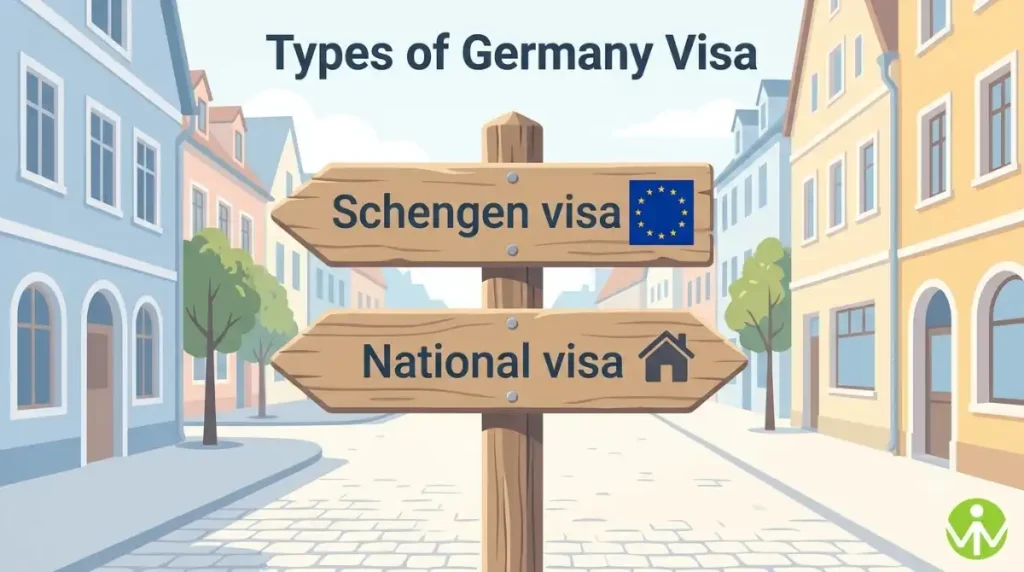
The types of Germany visa fall into two groups: short-stay Schengen visas for trips of up to 90 days, and national long-stay visas for study, work, family and other stays in Germany. Which one applies depends on why you are travelling, how long you will stay and which passport you hold.
This guide is the hub for every Germany visa topic on Immigration World. It explains each of the main types of Germany visa, what it costs in 2026, and how the routes connect to permanent residence and citizenship. Where we have a detailed guide, the section links to it. Rules and fees change, so check the Federal Foreign Office visa pages before you apply.
Key Takeaways
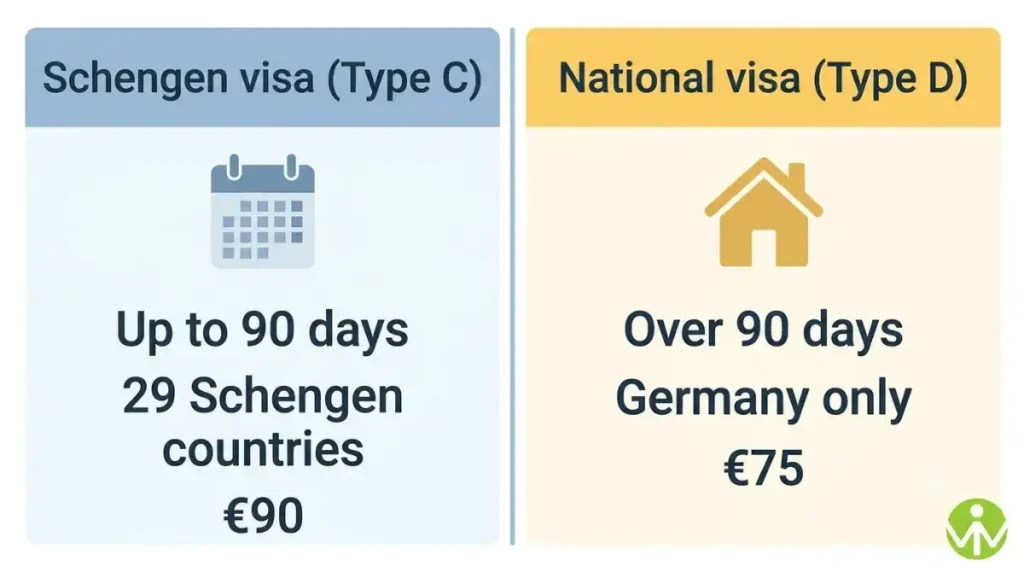
- The main types of Germany visa are the Schengen visa (Type C, up to 90 days, €90) and the national visa (Type D, over 90 days, €75).
- Long-stay routes include study, skilled work, the EU Blue Card, the Opportunity Card (Chancenkarte), self-employment, vocational training and family reunification.
- The 2026 EU Blue Card salary thresholds are €50,700, or €45,934.20 for shortage occupations and new entrants.
- The Opportunity Card lasts up to one year, and applicants on the points route need at least 6 points.
- International students may work 140 full days or 280 half days a year.
- German citizenship generally needs 5 years of residence; the 3-year fast track was repealed in October 2025.
Table of Contents
Types of Germany visa at a glance
Germany issues visas under the EU’s common short-stay rules and under its own national rules for longer stays. The table compares the main types of Germany visa by purpose, maximum stay, fee and whether the route can lead to permanent residence. Each row is explained in a section below.
Table 1 – Types of Germany visa comparison
| Visa type | Purpose | Maximum stay or validity | Fee | Leads to permanent residence? |
|---|---|---|---|---|
| Schengen visa (Type C) | Tourism, family visits, business, short courses | 90 days in any 180 days | €90 (€45 ages 6 to 11; free under 6) | No |
| Airport transit visa (Type A) | Changing planes without entering Germany | Airport transit zone only | €90 | No |
| Study visa (Type D) | Degree study at a German university | Initial permit usually 2 years, renewable | €75 | Indirectly, via work after graduation |
| Skilled worker visa (Type D) | Qualified job with a recognised qualification | Up to 4 years | €75 | Yes, after about 3 years |
| EU Blue Card (Type D) | Graduate job at €50,700 (€45,934.20 shortage or new entrant) | Up to 4 years | €75 | Yes, after 21 or 27 months |
| Opportunity Card (Type D) | Job search with a points score of 6 or more | Up to 1 year | €75 | No, switch to a work permit |
| Self-employment and freelance (Type D) | Running a business or freelance work | Initial permit up to 3 years | €75 | Yes, after 3 years of success |
| Vocational training (Type D) | Company-based or school-based training | Length of the training | €75 | Indirectly, via work after training |
| Family reunification (Type D) | Joining a family member in Germany | Linked to the sponsor’s permit | €75 | Yes, through the sponsor |
| Fees are the Federal Foreign Office figures checked on 1 October 2026; exemptions and reductions apply to some nationalities and groups. Salary figures are 2026 thresholds. Settlement timelines are indicative. This table covers the main types of Germany visa only. | ||||
Do you need a visa for Germany?
Citizens of EU and EEA countries and Switzerland do not need a visa to enter or live in Germany. Nationals of many other countries can visit without a visa for up to 90 days in any 180-day period under the EU’s visa-exempt list. Everyone else needs a Schengen visa before travelling. The Visa Navigator on the Federal Foreign Office website asks about your nationality and purpose and shows which of the types of Germany visa applies to you.
Citizens of a short list of countries, including Australia, Canada, Israel, Japan, New Zealand, South Korea, the United Kingdom and the United States, may enter without a visa and apply for a residence permit after arrival in Germany. Everyone else who plans a long stay normally applies for a national visa at a German mission first. Visa-free visitors should also read our Schengen visa guide for the 90/180 rule and the full country list.
Schengen (Type C) vs national (Type D): the two main types of Germany visa
The two headline types of Germany visa differ in scope, length and what you can do with them. A Schengen visa (Type C) is a short-stay visa valid across the 29 Schengen countries. It allows stays of up to 90 days in any 180-day period for tourism, family visits, business trips or short courses, and it is not a work permit.
A national visa (Type D) is issued by Germany alone for stays longer than 90 days. It is usually an entry visa: after you arrive, the local foreigners authority issues the residence permit that matches your purpose, such as study, work or family. Older guides, including earlier versions of this one, describe Type A and Type B transit visas. Only the airport transit visa remains in the current rules, and it is covered below.
Short-stay types of Germany visa (Type C)
Short-stay types of Germany visa cover trips of up to 90 days. They share one application process and one fee.
Tourist, family-visit and business visas
The Schengen visa costs €90 for adults and €45 for children aged six to 11, and children under six pay nothing. Nationals of some countries with EU visa facilitation agreements pay a reduced fee. You can apply up to six months before travel and no later than 15 days before, and a decision normally takes about 15 days but can take up to 45. The same visa covers tourism, visits to family or friends, business meetings and short study or training. Our guide to the German tourist visa application covers documents and appointments.
Airport transit visa
Some nationalities need an airport transit visa (Type A) even to change planes at a German airport without entering the country. The EU Visa Code lists the nationalities concerned, and individual member states may add more. Check your nationality in the Visa Navigator before booking a connection through Germany.
Entry/Exit System and ETIAS
Since 10 April 2026 the EU’s Entry/Exit System has recorded biometric data and crossing details of short-stay travellers and has replaced passport stamps. The separate ETIAS travel authorisation for visa-exempt visitors is not yet in operation, and no firm start date had been published at the time of writing. Schengen visa holders do not need ETIAS. Our Schengen visa guide tracks both.
Work-related types of Germany visa
Germany has several work-related types of Germany visa, and the right one depends on your qualification, salary and occupation. For a full walk-through of the work route, see our German work visa guide. The sections below explain how the main options differ.
Skilled worker visa
The skilled worker visa is the broadest of the work-related types of Germany visa. It is for people with a job offer in a qualified position. Your qualification must be recognised in Germany or comparable to a German academic qualification, and the Federal Employment Agency assesses the employment conditions. According to Make it in Germany, the residence permit runs for up to four years or the length of the contract plus six months, whichever is shorter. If you are over 45 and new to the German job market, you need a gross annual salary of at least €55,770 in 2026 or proof of adequate pension provision. After at least three years on an employment-based permit you may qualify for a settlement permit.
Experienced workers without formal recognition have a separate route, and IT specialists have several. The official guidance for IT professionals explains that, for IT specialists, three years of relevant work experience within the last seven years can substitute for a formal degree when applying for a Blue Card.
EU Blue Card Germany
The EU Blue Card is the best-known of the work-related types of Germany visa for graduates. You need a German degree or a comparable foreign qualification, or a tertiary qualification of at least three years at ISCED level 6 or above, plus a job paying at least €50,700 gross a year in 2026. The threshold is €45,934.20 for shortage occupations and new entrants. The card is issued for the length of your contract plus six months, up to a maximum of four years.
Blue Card holders can apply for a settlement permit after 21 months with B1 German or 27 months with A1 German, and family members can join them. Our general EU Blue Card guide explains the programme across EU countries, and the Make it in Germany Blue Card page publishes the current German thresholds.
Opportunity Card (Chancenkarte)
Among the types of Germany visa, the Opportunity Card (Chancenkarte) is the only one that lets qualified people come to Germany to look for work without a job offer. It is valid for up to one year. Holders may work up to 20 hours a week in a part-time job and may do trial work of up to two weeks per employer. The card has a route for applicants whose foreign qualification is already recognised, and a points route that needs at least 6 points.
On the points route, applicants earn points for partial recognition of a qualification (4), German at B2 (3), B1 (2) or A2 (1), English at C1 (1), professional experience of at least five of the last seven years (3) or at least two of the last five (2), a qualification in a shortage occupation (1), age under 35 (2) or 35 to 39 (1), six months of legal residence in Germany in the last five years (1), and a spouse or partner who also applies (1). Applicants must also show German at A1 or English at B2 and prove they can support themselves, with €1,091 a month (€13,092 for a year) in a blocked account, a part-time job contract or a sponsor. The national visa fee of €75 applies. The official Make it in Germany self-check calculates your score. Germany’s older six-month Job Seeker visa has largely been overtaken by this card, so check the Visa Navigator for your case.
Study and training types of Germany visa
Two of the long-stay types of Germany visa are built around education: the study visa and the vocational training visa.
Study visa
A study visa, one of the long-stay types of Germany visa, is for people admitted to a German higher education institution. The first residence permit is usually issued for two years and can be renewed for another two if the studies are not complete. You must show funds, and the 2026 blocked-account amount is €11,904. Students may work up to 140 full days or 280 half days a year, or up to 20 hours a week, and part-time student jobs at the university do not count towards that limit.
After graduating you can stay up to 18 months to look for qualified work, then switch to a skilled worker permit or an EU Blue Card. For application steps see our German student visa guide, for costs see how much it costs to study in Germany, and for tax see the tax filing guide for international students. Language-course visas and study-related internships are separate routes described on Make it in Germany.
Vocational training (Ausbildung) visa
The vocational training visa, a lesser-known one of the types of Germany visa, is for people with a confirmed place in company-based or school-based training. You need B1 German and proof of funds, which in 2026 means at least €959 net a month for school-based training or €1,048 gross (€822 net) for company-based training. The permit lasts for the training, and you may take a second job of up to 20 hours a week if it is independent of the training. The official training visa page sets out the details.
After training you can stay up to 18 months to find qualified work, or up to 12 months, extendable by six, in healthcare and care professions. If you have not yet found a place, a separate visa allows up to nine months of searching for applicants under 35 who have B1 German and can prove €1,091 a month.
Self-employment and freelance visa
Self-employment is the least obvious of the types of Germany visa, because Germany has no dedicated startup visa. Founders and freelancers use the self-employment residence permit, which our startup visa by country guide covers alongside other countries. Business founders must show an economic interest in, or regional demand for, their product or service, evidence that it can be financed, and a foreseeable positive effect on the economy. Freelancers must show funds for their projects and any professional licence their field requires. Applicants over 45 must show adequate retirement provision.
The first permit is issued for up to three years. After three years of successful operation you may apply for a settlement permit, according to the official self-employment page.
Family reunification visa
Of all the types of Germany visa, family reunification is the one most shaped by the sponsor’s own status. Family reunification visas let spouses, and in many cases children, join a family member who lives in Germany. Spouses of most foreign residents must show basic German at A1 level. There are exemptions, including where the sponsor holds an EU Blue Card or an ICT card, a skilled worker, researcher or self-employed residence permit, or is a citizen of Australia, Israel, Japan, Canada, South Korea, New Zealand, the United Kingdom or the United States. Hardship exemptions apply where learning German is impossible or unreasonable, and consulates may waive the certificate if you show A1 at your appointment.
Sponsors usually also need to show adequate income and housing. Our Germany dependent visa guide explains the documents and process in more detail.
Other types of Germany visa, and why asylum is not on this list
Make it in Germany lists further national visas for nursing assistants, researchers, language learners, study-related internships, professional drivers, artists, language teachers, professional athletes and coaches, and eSports professionals. Each has its own requirements.
Asylum is not a visa. People seeking protection apply through the asylum procedure run by the Federal Office for Migration and Refugees. Earlier versions of this guide had a refugee section, which we have removed because asylum is a protection status rather than one of the types of Germany visa.
Germany visa fees in 2026
The standard Schengen visa fee is €90 for adults and €45 for children aged six to 11, according to the Federal Foreign Office. A national visa costs €75 for adults and half that, €37.50, for minors. Fee waivers and reductions apply to some groups, such as children under six, students on study trips and researchers, and German missions can waive or reduce fees in individual cases.
The cost of each of the types of Germany visa also depends on the route. Other costs can add up. They can include a blocked account, health insurance, translations and, after arrival, a separate fee set by the local authority for the residence permit.
How to apply for a Germany visa
The steps are similar for most of the types of Germany visa, although national visas take longer and need more documents.
- Use the Visa Navigator to confirm whether you need a visa and which type fits your purpose.
- Check the requirements for your route, for example the Blue Card, training or study pages on Make it in Germany.
- Gather your documents: a valid passport, photographs, health insurance, proof of funds and the papers specific to your route.
- Book an appointment at the German mission or visa centre responsible for your place of residence and pay the fee.
- Attend the appointment, where fingerprints are usually taken, and answer any questions about your plans.
- Wait for the decision. Schengen visas normally take about 15 days and can take up to 45. Long-stay timelines vary by route, and a national visa is followed by registration and a residence permit in Germany.
From visa to permanent residence
No visa is permanent, but several of the types of Germany visa lead to a settlement permit, which is Germany’s permanent residence. Blue Card holders can apply after 21 or 27 months depending on German level. Skilled workers and self-employed people may qualify after three years, and spouses, children or parents of German citizens after three years of living together. Other residence permits typically need around five years of legal residence plus language, income and insurance conditions. Our permanent residency in Germany guide covers eligibility, documents and fees.
German citizenship
Citizenship is the end point of the long-stay types of Germany visa rather than a visa in itself. Naturalisation generally requires five years of legal residence, B1 German, a secure livelihood and knowledge of German society and law. Germany still tolerates dual citizenship. The three-year fast track was repealed when the change was published in the Federal Gazette on 29 October 2025, and it had no grace period for pending applications. Marriage and the restoration of citizenship for descendants of people persecuted under the Nazi regime follow separate rules. Our German citizenship test guide covers the test.
What changed for the types of Germany visa in 2026
Several rules that older guides still repeat have changed. The EU Blue Card thresholds are now €50,700 and €45,934.20. The Opportunity Card has added a points-based job-search route. Student work limits are 140 full days or 280 half days. The three-year naturalisation fast track was repealed in October 2025, so five years is now the general rule. The Entry/Exit System began replacing passport stamps on 10 April 2026, and the Schengen fee has been €90 since June 2024. Check any guide against these figures before relying on it.
How to choose between the types of Germany visa
The simplest way to choose between the types of Germany visa is to start with your main purpose.
- Visiting for up to 90 days: a Schengen visa (Type C), unless your nationality is visa-exempt.
- Working with a job offer: the skilled worker visa, or the EU Blue Card if you hold a degree and meet the 2026 salary threshold.
- Working without an offer yet: the Opportunity Card, if you score at least 6 points or hold a recognised qualification.
- Studying: the study visa, followed by an 18-month job-search period after graduation.
- Training for a trade: the vocational training visa, with B1 German.
- Starting a business or freelancing: the self-employment residence permit.
- Joining a relative: the family reunification visa, with A1 German unless an exemption applies.
Types of Germany visa: frequently asked questions
How many types of Germany visa are there?
There are two main families of types of Germany visa: the Schengen short-stay visa (Type C) and the national long-stay visa (Type D), plus an airport transit visa (Type A) for some nationalities. National visas then split by purpose, such as study, skilled work, the EU Blue Card, the Opportunity Card, self-employment, training and family reunification.
Can I work in Germany on a Schengen visa?
No. A Schengen short-stay visa is not a work permit. Paid employment needs the right national visa or residence permit, such as the skilled worker visa or the EU Blue Card.
What is the difference between the EU Blue Card and the skilled worker visa?
The Blue Card needs a degree and a minimum salary of €50,700 in 2026, or €45,934.20 in shortage occupations and for new entrants. It leads to a settlement permit after 21 or 27 months. The skilled worker visa needs a recognised qualification and a job in a qualified position, and usually leads to a settlement permit after three years.
Can I stay in Germany long term on an Opportunity Card?
No. The card lasts up to one year and is meant for finding work. Once you have a job, you switch to a work residence permit such as a skilled worker permit or an EU Blue Card.
How much does a Germany visa cost in 2026?
The types of Germany visa differ in price. A Schengen visa costs €90 for adults and €45 for children aged six to 11. A national visa costs €75 for adults and €37.50 for minors. Some nationalities and groups pay less or nothing.
How long does it take to become a German citizen?
Naturalisation generally needs five years of legal residence in Germany, together with B1 German and a secure livelihood. The three-year fast track no longer exists.
Can my family join me in Germany?
Usually yes, under the family reunification type of Germany visa. Spouses normally need A1 German, but Blue Card holders’ spouses and several other groups are exempt. Sponsors usually need adequate income and housing.