
ETIAS, the European Travel Information and Authorisation System, is an online pre-travel check that visa-exempt visitors will need before short trips to 30 European countries, but it is not in operation yet and has no start date. Once it opens, travellers from around 60 countries and territories whose citizens can now enter the Schengen Area without a visa, including the United States, the United Kingdom, Canada, Australia, Japan and Brazil, will have to apply online and pay a fee before they travel. This guide explains who will need the authorisation, what it will cost, how the application is meant to work, and how it differs from a Schengen visa and from the Entry/Exit System already running at Europe’s borders.
Key Takeaways
- ETIAS is an online travel authorisation, not a visa, for visa-exempt travellers making short trips to 30 European countries.
- It is not in operation. The EU dropped its late-2026 target in July 2026 and has not set a new start date, but has promised several months’ notice.
- The fee will be €20, charged only to applicants aged 18 to 70. Approval will last three years or until the passport expires.
- Travellers who need a Schengen visa will not need it. The Entry/Exit System (EES), fully operational since 10 April 2026, applies to all non-EU visitors.
- No website can take applications today, so treat any site asking for payment with caution.
Table of Contents
What is ETIAS?
ETIAS is a travel authorisation, not a visa. It screens visa-exempt travellers before they set off, checking their passport details and answers against EU security, migration and public-health databases. Approval does not guarantee entry: border guards still make the final decision on arrival, as they do today.
The authorisation is linked electronically to the passport used to apply. There is no sticker or stamp; airlines, ferry operators and coach companies check it before boarding. It covers short stays of up to 90 days in any 180-day period for tourism, business trips, family visits and similar purposes. It does not allow its holder to work, study long term or settle, which need a national visa or permit, such as the EU Blue Card for highly qualified workers.
The scheme was created by Regulation (EU) 2018/1240. Frontex runs its central unit, and eu-LISA, the EU agency for large-scale IT systems, builds and operates the technology. The European Commission’s ETIAS page is the authoritative source on its status.
ETIAS start date: where things stand
There is no confirmed ETIAS start date. The system was first meant to open in 2021 and has been postponed several times since, largely because it can start only after the Entry/Exit System is fully running. The EU later named the last quarter of 2026 as its target, but in mid-July 2026 it removed that target from its official website without naming a replacement.
The official position now is that the system is not in operation, no applications are being collected, and the EU will announce the start date several months before launch. Press reports in the summer of 2026 said eu-LISA had concluded that a 2026 launch was no longer realistic, and much of the travel industry now expects a start in 2027. That is an expectation, not an official date. Anyone travelling to Europe before a date is announced does not need to do anything about the authorisation.
Who needs ETIAS?
The authorisation will be needed by nationals of countries whose citizens can visit the Schengen Area without a visa, when they travel on that passport for a short stay. Table 1 lists those nationalities. The EU updates its visa policy from time to time, so the official list published at launch is the one that counts.
Table 1. Nationalities that will need ETIAS
| Region | Visa-exempt nationalities |
|---|---|
| Europe (outside the EU) | Albania, Bosnia and Herzegovina, Georgia, Kosovo, Moldova, Montenegro, North Macedonia, Serbia, Ukraine, United Kingdom |
| North, Central and South America | Argentina, Brazil, Canada, Chile, Colombia, Costa Rica, El Salvador, Guatemala, Honduras, Mexico, Nicaragua, Panama, Paraguay, Peru, United States, Uruguay, Venezuela |
| Caribbean | Antigua and Barbuda, Bahamas, Barbados, Dominica, Grenada, Saint Kitts and Nevis, Saint Lucia, Saint Vincent and the Grenadines, Trinidad and Tobago |
| Asia and the Middle East | Brunei, Hong Kong SAR, Israel, Japan, Macao SAR, Malaysia, Singapore, South Korea, Taiwan, Timor-Leste, United Arab Emirates |
| Africa | Mauritius, Seychelles |
| Oceania | Australia, Kiribati, Marshall Islands, Micronesia, Nauru, New Zealand, Palau, Samoa, Solomon Islands, Tonga, Tuvalu |
| Source: visa-exempt list in Annex II of Regulation (EU) 2018/1806, as at October 2026. Vanuatu’s visa waiver is suspended, so its nationals need a Schengen visa. The official list published at launch is definitive. | |
US citizens can see where else they can go without a visa in our list of countries US citizens can travel to without a visa, British travellers in our list of visa-free countries for UK citizens, and our passport rankings compare access for every nationality.
Who will not need ETIAS
Several groups fall outside the scheme, even if their nationality appears in Table 1:
- citizens of EU countries, Iceland, Liechtenstein, Norway and Switzerland;
- anyone holding a valid Schengen visa or a long-stay national visa;
- holders of a residence permit or residence card issued by one of the 30 participating countries;
- non-EU family members of EU citizens who hold a residence card under EU free-movement rules.
Travellers who need a visa for Europe, including citizens of India, China, Nigeria and many other countries, apply for a Schengen visa instead and will not need the authorisation as well. Indian travellers can read how border checks have changed in our round-up of US, UK and Schengen visa changes for Indians.
The 30 countries that will require ETIAS
The authorisation will be valid for all 29 Schengen countries plus Cyprus, which is not yet a full Schengen member. Four of the 30 are outside the EU: Iceland, Liechtenstein, Norway and Switzerland. Ireland is not part of the scheme and keeps its own entry rules.
Table 2. The 30 countries where ETIAS will apply
| Country | Schengen member | EU member |
|---|---|---|
| Austria | Yes | Yes |
| Belgium | Yes | Yes |
| Bulgaria | Yes | Yes |
| Croatia | Yes | Yes |
| Cyprus | No (joining in progress) | Yes |
| Czechia | Yes | Yes |
| Denmark | Yes | Yes |
| Estonia | Yes | Yes |
| Finland | Yes | Yes |
| France | Yes | Yes |
| Germany | Yes | Yes |
| Greece | Yes | Yes |
| Hungary | Yes | Yes |
| Iceland | Yes | No |
| Italy | Yes | Yes |
| Latvia | Yes | Yes |
| Liechtenstein | Yes | No |
| Lithuania | Yes | Yes |
| Luxembourg | Yes | Yes |
| Malta | Yes | Yes |
| Netherlands | Yes | Yes |
| Norway | Yes | No |
| Poland | Yes | Yes |
| Portugal | Yes | Yes |
| Romania | Yes | Yes |
| Slovakia | Yes | Yes |
| Slovenia | Yes | Yes |
| Spain | Yes | Yes |
| Sweden | Yes | Yes |
| Switzerland | Yes | No |
| 29 Schengen countries plus Cyprus, as at October 2026. Ireland is not covered. | ||
ETIAS fee and validity
The fee will be €20 per application. The original 2018 regulation set it at €7, a figure that still appears on many websites. The European Commission raised it to reflect inflation and higher running costs, and the increase became law through Delegated Regulation (EU) 2025/1411, in force since 18 November 2025. Applicants will pay it only once the system is running.
Applicants under 18 or over 70 on the day they apply will pay nothing, and neither will non-EU family members of EU citizens who exercise free-movement rights. They still need to apply and be approved.
An approved authorisation will be valid for three years or until the linked passport expires, whichever comes first, so a new passport means a new application. Within that period the holder can make as many short trips as they like, provided each stay respects the 90/180-day rule.
How the ETIAS application will work
Applications will be made online only, through the EU’s official website or mobile app, before the journey. There will be no option to apply at the border. The form asks for:
- passport details and personal data, such as name, date and place of birth and nationality;
- contact details and home address;
- level of education and current occupation;
- the first country the traveller intends to enter;
- answers to background questions about serious criminal convictions, stays in conflict zones and earlier refusals of entry or removal orders.
Most applications are expected to be approved automatically within minutes. If the automated check flags a possible match, the application goes to a national unit for manual review, which should normally take up to 96 hours. If that unit asks for more documents or invites the applicant to an interview, a decision can take up to 30 days, so applying well before booking non-refundable travel is sensible.
Refusals and appeals
A refusal must give reasons, and the applicant can appeal in the country that made the decision, under that country’s law. An authorisation can also be annulled or revoked later if the conditions for issuing it were not, or are no longer, met.
Transitional and grace periods
The rules provide for a soft start. During a transitional period after launch, travellers will be encouraged to apply but will not be refused boarding or entry for lacking an authorisation. A grace period follows, during which a traveller who should hold one but does not may be let in once, provided they meet every other entry condition. After that, the requirement is fully enforced and carriers must check it before boarding. The regulation sets each phase at six months by default, but the exact dates will be fixed only once a launch date is announced.
ETIAS vs EES vs Schengen visa
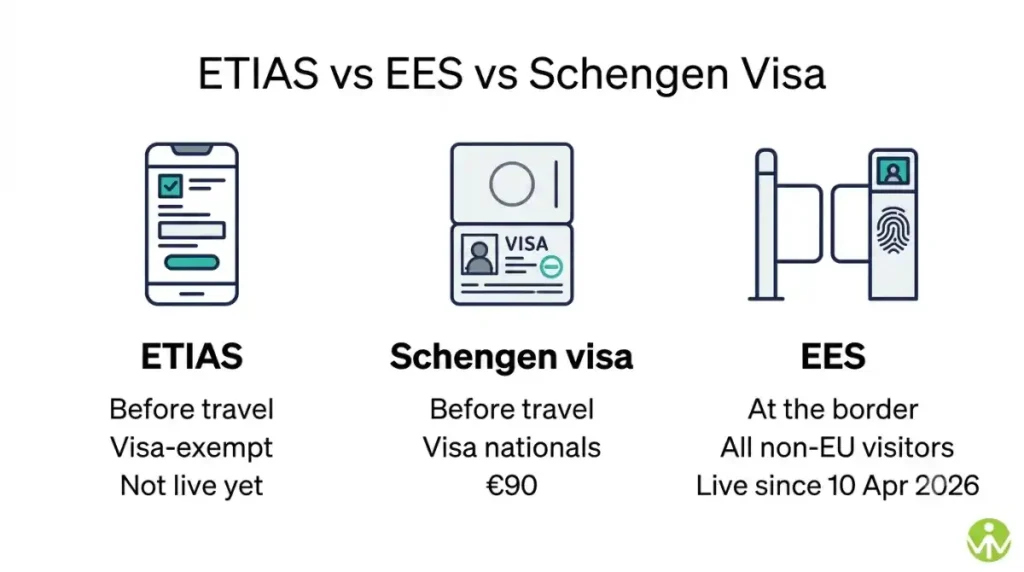
The authorisation is one of three things a visitor to the Schengen Area may come across, and they are easy to confuse. The Entry/Exit System (EES) became fully operational on 10 April 2026. It registers the fingerprints and facial image of every non-EU short-stay traveller at the external border and has replaced passport stamps. It applies whether or not the traveller needs a visa, and it is already running. Table 3 compares the three.
Table 3. ETIAS, EES and the Schengen visa compared
| Feature | ETIAS | Schengen visa | Entry/Exit System (EES) |
|---|---|---|---|
| What it is | Pre-travel online authorisation | Short-stay visa | Biometric border register |
| Who it applies to | Visa-exempt travellers | Travellers who need a visa | All non-EU short-stay travellers |
| Status | Not yet in operation | In operation | Fully operational since 10 April 2026 |
| When it happens | Online, before travel | At a consulate or visa centre, before travel | At the external border, on each entry and exit |
| Cost | €20 (free under 18 and over 70) | €90 for adults, €45 for children aged 6 to 11 | Free |
| Validity | 3 years or until the passport expires | As stated on the visa | Records kept for a set period |
| As at October 2026. Visa fees are the standard Schengen fees; some nationalities pay less under visa facilitation agreements. | |||
Our country guides show how these systems apply in practice for the Germany tourist visa and the Italy tourist visa. For longer stays, see the types of Germany visa, types of Italy visa and types of Portugal visa.
How to avoid unofficial ETIAS websites
Because the system is not open, no website can submit an application today. Several commercial sites use the name in their web addresses, offer to pre-register travellers or still quote the old €7 fee. When the scheme opens, the official application channel will be the EU’s own Travel Europe website and app, under the europa.eu domain. Agents may offer to apply on a traveller’s behalf, but they usually add a service charge and are not required.
ETIAS FAQ
Do I need ETIAS to travel to Europe now?
No. The system is not in operation and no applications are being accepted. Visa-exempt travellers currently need only a valid passport, and they are registered in the Entry/Exit System at the border.
When will ETIAS start?
No start date has been set. The EU withdrew its late-2026 target in July 2026 and has said it will announce the date several months before launch. Much of the travel industry expects 2027, but that is not confirmed.
How much will ETIAS cost?
The fee will be €20 per application. Applicants under 18 or over 70, and certain family members of EU citizens, will pay nothing but still need approval.
Do I need ETIAS if I have a Schengen visa?
No. The authorisation is only for visa-exempt travellers. Visa holders, and holders of residence permits from a participating country, do not need it, although they are still registered in the Entry/Exit System.
How long will an ETIAS authorisation be valid?
Three years, or until the passport used to apply expires, whichever comes first. It allows unlimited short trips within that period, each subject to the 90/180-day rule.
Does ETIAS cover the UK or Ireland?
No. The 30 participating countries are the 29 Schengen states and Cyprus. Ireland keeps its own entry rules, and the UK runs a separate Electronic Travel Authorisation scheme.
Can I work or study in Europe with ETIAS?
No. It covers short visits only. Paid work, long courses and moving to Europe need a national visa or residence permit from the country concerned.