
A Schengen visa is a single short-stay visa that lets its holder travel across 29 European countries for up to 90 days in any 180-day period, for tourism, family visits or business. The countries share one set of rules on who needs a visa, what it costs and how applications are assessed, set out in the EU Visa Code and summarised on the European Commission’s Schengen visa application page.
This guide explains which countries are in the Schengen area in 2026, who needs a Schengen visa, the different visa types, how the 90/180 rule works, what documents and fees apply, and what changed at the border with the Entry/Exit System. It then points to our country-by-country guides.
Key Takeaways
- A Schengen visa is one short-stay visa for up to 90 days in any 180-day period across all 29 Schengen countries.
- The Schengen visa fee is €90 for adults and €45 for children aged 6 to 11; children under 6 pay nothing.
- You apply to the country where you will spend the longest time; if stays are equal, to the country you enter first.
- Apply no earlier than six months and no later than 15 calendar days before travel. A decision normally takes 15 days, up to 45.
- Passport stamps ended on 10 April 2026: the Entry/Exit System now records every entry and exit digitally.
- ETIAS will not apply to Schengen visa holders. It is for visa-exempt travellers and is expected in the last quarter of 2026.
Table of Contents
What is a Schengen visa?
The name comes from the village of Schengen in Luxembourg, where Belgium, France, West Germany, Luxembourg and the Netherlands signed an agreement on 14 June 1985 to phase out checks at their shared borders. A follow-up convention in 1990 set the detailed rules, and border controls between the first members were lifted in 1995. The area has since grown to 29 countries.
Because there are no routine checks at internal borders, the members also operate a common visa policy. A visa issued by one member is generally valid in all the others, and time spent in any of them counts towards the same 90-day limit. It is not a separate travel document: it is a sticker placed in your passport, and each member’s consulates issue it on behalf of the whole area.
A Schengen visa only covers short stays. Anyone planning to study, work or live in a Schengen country for longer than 90 days needs a national visa and, usually, a residence permit from that country.
Schengen countries in 2026
The Schengen area has 29 members: 25 EU member states plus Iceland, Liechtenstein, Norway and Switzerland, according to the European Commission’s Schengen area overview. Croatia joined in January 2023. Bulgaria and Romania removed air and sea border checks in March 2024 and became full members on 1 January 2025.
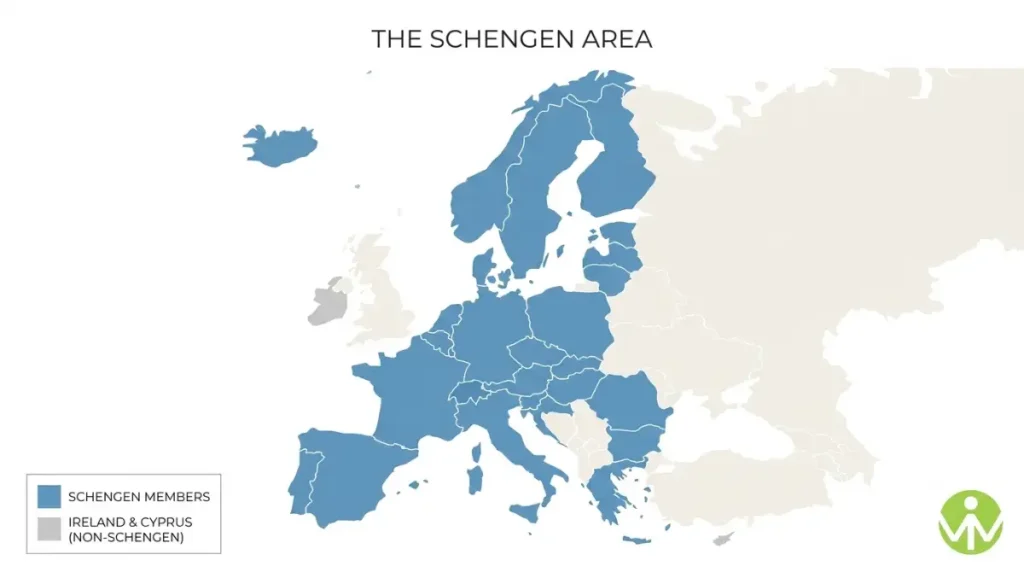
Table 1 — Schengen countries 2026
| Country | EU member | Schengen rules applied in full |
|---|---|---|
| Austria | Yes | 1997 |
| Belgium | Yes | 1995 |
| Bulgaria | Yes | 2025 |
| Croatia | Yes | 2023 |
| Czechia | Yes | 2007 |
| Denmark | Yes | 2001 |
| Estonia | Yes | 2007 |
| Finland | Yes | 2001 |
| France | Yes | 1995 |
| Germany | Yes | 1995 |
| Greece | Yes | 2000 |
| Hungary | Yes | 2007 |
| Iceland | No | 2001 |
| Italy | Yes | 1997 |
| Latvia | Yes | 2007 |
| Liechtenstein | No | 2011 |
| Lithuania | Yes | 2007 |
| Luxembourg | Yes | 1995 |
| Malta | Yes | 2007 |
| Netherlands | Yes | 1995 |
| Norway | No | 2001 |
| Poland | Yes | 2007 |
| Portugal | Yes | 1995 |
| Romania | Yes | 2025 |
| Slovakia | Yes | 2007 |
| Slovenia | Yes | 2007 |
| Spain | Yes | 1995 |
| Sweden | Yes | 2001 |
| Switzerland | No | 2008 |
| Source: European Commission, Schengen area (29 members). Years are when internal land border checks were lifted. Not in Schengen: Ireland (opt-out) and Cyprus (accession pending). As of 27 September 2026. | ||
Two EU countries are outside the area. Ireland has an opt-out and runs its own visa policy, so the visa is not valid there. Cyprus applies part of the Schengen rules but still checks travellers at its borders; the Commission has assessed it as ready, but the final decision rests with the Council and had not been taken at the time of writing. Monaco, San Marino and Vatican City are not members, but they have open borders with their Schengen neighbours and are in practice reached with a Schengen visa.
Do you need a Schengen visa?
Whether you need a Schengen visa depends on your nationality, not on where you live. The EU keeps two lists: countries whose nationals need a visa, and around 60 countries and territories whose nationals can visit visa-free for up to 90 days in any 180. Both lists are published on the Commission’s EU visa policy page. The visa-free group includes the United States, the United Kingdom, Canada, Australia, Japan, Brazil and many Latin American and Balkan states; our list of countries US citizens can visit without a visa and our list of visa-free countries for UK citizens show how this plays out for those passports.
The lists change. The EU removed Vanuatu from the visa-free list in December 2024 over its citizenship-by-investment scheme, and in March 2026 it suspended visa-free travel for Georgian diplomatic, service and official passports under a revised suspension mechanism. Ordinary Georgian passport holders were still visa-exempt at the time of writing. Always check the current list before booking.
Visa-free travellers do not need a visa, but they will need an ETIAS travel authorisation once that system starts. Holders of a residence permit or long-stay visa issued by a Schengen country can also travel in the rest of the area for up to 90 days in any 180 without a separate Schengen visa.
Types of Schengen visa
Four visa categories matter to short-stay travellers. Only the first two are valid across the whole area.
Table 2 — Types of Schengen visa at a glance
| Visa | Code | Valid in | Maximum stay | Typical use |
|---|---|---|---|---|
| Uniform Schengen visa | C | All 29 Schengen countries | 90 days in any 180 | Tourism, family visits, business, events |
| Airport transit visa | A | International transit zone of the airport only | No entry to the country | Changing flights, for listed nationalities |
| Limited territorial validity visa | LTV | Issuing country or named countries only | Up to 90 days in any 180 | Humanitarian or exceptional cases |
| National visa | D | Issuing country (plus short trips elsewhere) | More than 90 days | Study, work, family, research |
| Source: EU Visa Code (Regulation (EC) No 810/2009, as amended). A type D visa is a national visa, not a Schengen visa. As of 27 September 2026. | ||||
Uniform Schengen visa (type C)
The uniform Schengen visa is the standard short-stay visa, used for tourism, visiting family, business meetings, conferences, sport and cultural events, and short medical treatment. It can be issued for a single entry, two entries or multiple entries. A single-entry visa ends once you leave the area, even if days remain on it.
Airport transit visa (type A)
An airport transit visa lets you change planes in the international zone of a Schengen airport without entering the country. Most travellers do not need one. It is required for nationals of 12 countries listed in the Visa Code, including Afghanistan, Bangladesh, Iran, Nigeria, Pakistan and Sri Lanka, and some member states add further nationalities for their own airports. Holders of certain valid visas or residence permits, such as those issued by the United States, Canada or Japan, are usually exempt.
Limited territorial validity visa (LTV)
A limited territorial validity visa is valid only in the country that issued it, or in named countries. It is issued in exceptional cases, such as humanitarian grounds or national interest, or when a traveller’s passport is not recognised by every Schengen state. Travelling on to other members with an LTV is not allowed.
National visa (type D)
A national visa is issued under a country’s own law for stays longer than 90 days, for study, work, family reunion or research, and is not a Schengen visa. Each country sets its own requirements and fee; Italy, for example, charges €116 for most national visas, as our guide to the types of Italy visa explains. Holders of a valid type D visa may still travel to other Schengen countries for up to 90 days in any 180. Skilled workers can also compare national routes with the EU Blue Card.
The Schengen visa 90/180 rule explained
The 90/180 rule caps the time a non-EU visitor can spend in the Schengen area at 90 days within any 180-day period. The window is rolling, not fixed: on each day of your stay, look back over the previous 180 days and count every day you were in any Schengen country. If the total, including today, is more than 90, you are overstaying. Both the day you enter and the day you leave count as full days.
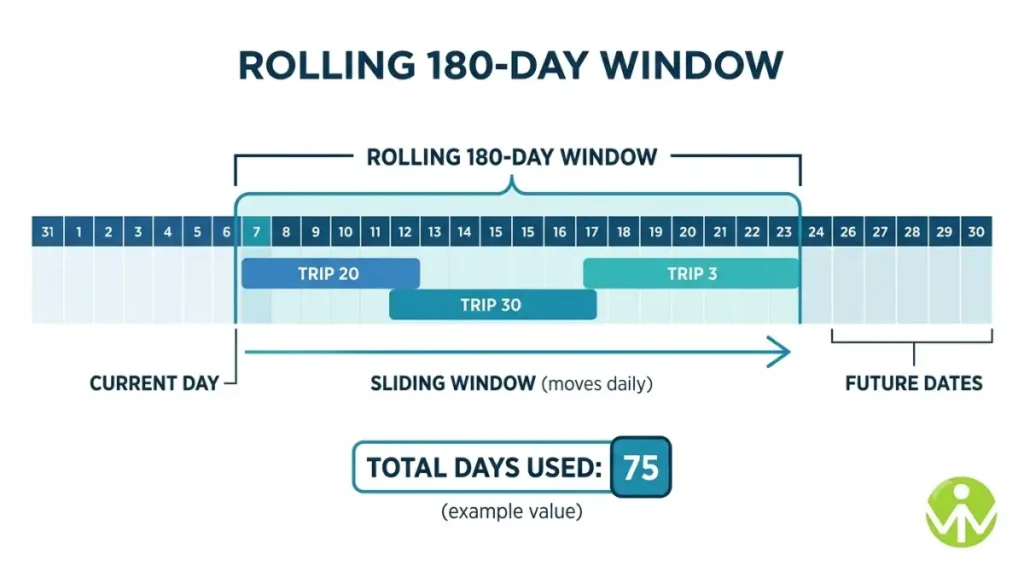
Because the rule applies to the whole area, 30 days in France and 60 in Spain use up the full 90, and a week in Ireland or Cyprus does not count because neither applies the Schengen rules in full. The Commission’s short-stay calculator works out the figure for past and planned trips. With the Entry/Exit System now recording every crossing, border officers can see an overstay automatically, and overstaying can lead to a fine, an entry ban or refusal of future applications.
Schengen visa validity vs duration of stay
Every Schengen visa sticker carries two separate limits. The validity is the period between the first and last dates on which the visa can be used. The duration of stay is the number of days you may actually spend in the area within that period. The two are often different, and both must be respected.
Suppose a visa is valid from 1 to 20 March with a 10-day duration of stay. If you arrive on 1 March, you must leave by 10 March. If you arrive on 15 March, you must leave by 20 March, when the visa expires, even though you have used only six days. On a double-entry visa, the two trips together cannot exceed 10 days.
Multiple-entry Schengen visas for frequent travellers
Since the Visa Code was revised in 2020, frequent travellers with a good record can receive longer multiple-entry visas under a so-called cascade. A traveller who has obtained and lawfully used three visas in the previous two years can normally receive a one-year multiple-entry visa, followed by two-year and then five-year visas, provided the passport is valid long enough. The EU has also adopted country-specific cascades for several nationalities. Each consulate still assesses every application individually, so a longer visa is never guaranteed.
Schengen visa requirements and documents
The core Schengen visa requirements are the same everywhere, although consulates can ask for additional supporting documents depending on the purpose of travel and local conditions. Expect to provide:
- A completed and signed application form.
- A passport issued within the previous 10 years, valid for at least three months after your planned departure from the Schengen area, with at least two blank pages.
- A recent colour photograph that meets ICAO standards, typically 35 mm × 45 mm with a plain background and a neutral expression.
- Travel medical insurance valid across the Schengen area for the whole trip, covering emergency treatment and repatriation, with minimum cover of €30,000.
- Proof of the purpose of the trip, such as a hotel booking, an invitation letter, a conference registration or a business letter.
- Proof of accommodation and a travel itinerary, including how you will leave the area.
- Proof that you can pay for the trip, such as recent bank statements, payslips or a sponsor’s letter. Each country sets its own reference amount per day.
- Evidence of ties to your home country, such as employment, studies or property, to show you intend to return.
Applicants aged 12 and over also give fingerprints at the appointment. They are stored in the Visa Information System and normally reused for 59 months, so frequent travellers do not have to give them every time.
Extra documents for minors
Children usually need a birth certificate, an application form signed by both parents or legal guardians, copies of both parents’ passports and, if they are travelling without one or both parents, a signed parental consent. Some consulates ask for the consent to be notarised.
How to apply for a Schengen visa
Where to submit your Schengen visa application
You must apply to the consulate of the country that is your main destination, meaning the country where you will spend the longest time. If you will spend the same amount of time in two or more countries, apply to the country whose external border you will cross first. For example, a traveller spending eight nights in Italy and three in France applies to Italy, as our Italy tourist visa guide describes. You normally apply in the country where you legally live.
Many consulates outsource appointments and document collection to external service providers such as VFS Global, TLScontact or BLS International. These centres charge a service fee on top of the visa fee, normally capped at half the standard visa fee. Some countries also let you book appointments online through their own portals.
When to apply
You can lodge a Schengen visa application no earlier than six months and no later than 15 calendar days before your trip. Seafarers can apply up to nine months ahead. Applying early is sensible in busy seasons, when appointment slots can run out weeks in advance; our general guides on how to apply for a tourist visa and how to apply for a visa cover planning in more detail.
The application process, step by step
- Identify your main destination and the visa type you need.
- Check the consulate or service provider’s local document list and book an appointment.
- Complete the application form and gather your documents, photograph and insurance.
- Attend the appointment, pay the fee and give fingerprints if required.
- Track the application and collect your passport, with the visa sticker or a refusal notice.
Schengen visa fee in 2026
The standard Schengen visa fee has been €90 for adults since 11 June 2024, when the EU raised it from €80 in its three-yearly review, as the Commission’s fee announcement confirms. Children aged 6 to 11 pay €45, and children under 6 pay nothing. Nationals of countries with an EU visa facilitation agreement pay less: €35 in most cases and €67.50 for Cabo Verde.
Table 3 — Schengen visa fees 2026
| Applicant | Fee |
|---|---|
| Adults and children aged 12 and over | €90 |
| Children aged 6 to 11 | €45 |
| Children under 6 | Free |
| Nationals covered by most EU visa facilitation agreements | €35 |
| Nationals of Cabo Verde | €67.50 |
| Nationals of countries judged not to cooperate on returns | €120 or €160 |
| Exempt categories (study trips, researchers, young NGO delegates, family members of EU citizens) | Free |
| Source: European Commission, fees in force since 11 June 2024. External service provider charges are extra. National (type D) visa fees are set by each country. As of 27 September 2026. | |
The fee is also waived for some groups, including school pupils, students and accompanying teachers on study trips, researchers from outside the EU travelling for scientific research, and representatives of non-profit organisations aged 25 or under attending seminars, conferences or sports and cultural events. Family members of EU citizens covered by EU free movement rules do not pay. The fee is not refunded if the application is refused.
The Visa Code also allows the EU to charge a higher fee, of €120 or €160, to nationals of countries that it judges are not cooperating on the return of their citizens. Fees for national type D visas are separate and set by each country.
Schengen visa processing time
Consulates must normally decide on a Schengen visa application within 15 calendar days of it being lodged. In individual cases, for example when more documents or an interview are needed, this can be extended to 45 days. The date you lodge the application counts, not the date you first book an appointment, so the real wait in peak season can be longer than the legal limit.
Service providers usually offer passport tracking, and some sell premium services such as courier return or evening appointments. These are optional and do not speed up the consulate’s decision.
At the border: EES and ETIAS
A Schengen visa allows you to present yourself at the border; it does not guarantee entry. Border officers can still ask about the purpose of the trip, your accommodation, your funds and your return ticket, and can refuse entry if they are not satisfied.
The Entry/Exit System
The Entry/Exit System (EES) began operating in stages on 12 October 2025 and, according to the Commission, became fully operational on 10 April 2026. It records the name, travel document, fingerprints and facial image of every non-EU short-stay traveller, along with the date and place of each entry and exit, and it has replaced passport stamps. It applies to visa holders and visa-exempt travellers alike, and it calculates the 90/180 count automatically. Our overview of US, UK and Schengen visa changes for Indian travellers describes what the first registration involves.
ETIAS
ETIAS, the European Travel Information and Authorisation System, is an online pre-travel check for visa-exempt travellers. It will not apply to anyone who holds a Schengen visa. The authorisation will cost €20 and is expected to last three years or until the passport expires. The EU has said it expects to launch it in the last quarter of 2026, followed by a six-month transitional period and a six-month grace period, but no firm start date had been published at the time of writing. Our ETIAS explainer covers the system in more detail.
The EU has also adopted rules to move visa applications online and to replace the visa sticker with a digital visa. The EU-wide online platform is not yet in use, so paper and appointment-based applications remain the norm in 2026.
Schengen visa guides by country
The rules above apply everywhere, but each country’s consulates publish their own document lists, proof-of-funds amounts and booking systems. Our country guides cover the details for the main destinations:
- Italy: how to apply for an Italy tourist visa, with the €90 fee, proof-of-funds table and booking system.
- Germany: the German tourist visa application and the full range of German visa types.
- France: the France tourist visa and the other types of visa to France.
- Spain: the Spain tourist visa.
- Netherlands: the Netherlands tourist visa.
- Greece: the Greece tourist visa.
- Nordic countries: the Finland tourist visa, the Sweden tourist visa and the Denmark tourist visa, plus the types of Sweden visa and the types of visa to Denmark.
- Austria: the types of visas to Austria.
How far a passport goes without any visa at all is a separate question, which our passport rankings track.
If your Schengen visa is refused
A refusal is issued on a standard EU form that ticks the grounds, such as an unjustified purpose of travel, insufficient funds, doubts about your intention to leave, missing insurance or a previous overstay. The form also explains how to appeal. Appeals are handled under the national law of the country that refused the visa, so deadlines and procedures differ; some countries start with an administrative review, others go straight to a court.
You can also submit a fresh application that addresses the reasons given. Past refusals do not bar a new application, but you must declare them, and the new application should fix what went wrong rather than repeat it.
Schengen visa FAQs
How long can I stay in Europe with a Schengen visa?
Up to 90 days in any 180-day period across all 29 Schengen countries combined, and never longer than the duration of stay printed on your visa. The 180-day window rolls forward day by day.
Can I visit several countries on one Schengen visa?
Yes. A uniform Schengen visa is valid in every Schengen country unless it is marked as a limited territorial validity visa. You apply to your main destination, or to the first country of entry if stays are equal.
How much does a Schengen visa cost in 2026?
The fee is €90 for adults and €45 for children aged 6 to 11, while children under 6 are exempt. External service providers add their own service charge, and some nationalities pay a reduced fee under facilitation agreements.
How early should I apply for a Schengen visa?
You can apply up to six months before your trip and no later than 15 calendar days before it. A decision normally takes 15 calendar days but can take up to 45, so applying at least a month ahead is sensible.
Is a Schengen visa valid in Cyprus, Ireland or the UK?
No. Ireland and the United Kingdom have their own visa systems, and Cyprus has not yet fully joined the Schengen area. Each needs to be checked separately, and days spent there do not count towards the 90/180 limit.
Do Schengen visa holders need ETIAS?
No. ETIAS applies only to visa-exempt travellers. If you need and hold a visa, you will not need ETIAS, although you will still be registered in the Entry/Exit System at the border.
Can I work on a Schengen visa?
No. A Schengen visa allows business meetings, conferences and similar activities, but not paid employment. Working in a Schengen country requires a national work visa or permit from that country.