
To apply for a work visa, you first need to know which one you need. “Work visa” is not a single document: it is a family of permits that differ by country, by occupation and by whether an employer sponsors you. Choosing the wrong route is one of the most common and expensive mistakes applicants make, because fees are rarely refunded.
This guide explains the main types of work visa, the requirements most countries check, the steps that apply almost everywhere, and the current fees, salary floors and processing times in eight popular destinations. It is a starting point: each section links to our country guides, and our wider guide on how to apply for a visa covers tourist, student and family visas as well.
Key Takeaways
- “Work visa” is a family of permits, not one document. Before you apply for a work visa, match your situation to a type: employer-sponsored, points-based, highly skilled, intra-company, job-seeker, seasonal, working holiday or self-employed.
- To apply for a work visa on most routes, you need a job offer from an approved employer, a minimum salary and proof of skills. Canada’s Express Entry, Germany’s Opportunity Card and working holiday schemes are among the exceptions.
- Germany’s EU Blue Card does not require German. Its 2026 salary floor is €50,700, or €45,934.20 for shortage occupations and recent graduates.
- The government fee to apply for a work visa ranges from S$105 plus S$225 in Singapore to about A$4,015 in Australia; the UK adds a health surcharge of £1,035 a year.
- Many work visas lead to permanent residence: 5 years in the UK, 27 months on a German Blue Card (21 with B1 German), and about 2 years before Australia’s employer-nominated route opens.
Types of work visa: which one fits you?
Before you apply for a work visa, match your situation to one of the families below. The names change from country to country, but the logic is similar: who is asking for you, how long you can stay, and whether the permit can lead to permanent residence.
Table 1 — Types of work visa
| Type | Who it suits | How it usually works | Examples |
|---|---|---|---|
| Employer-sponsored skilled worker visa | People with a job offer from an approved employer | Employer sponsors; salary and skill floors apply | UK Skilled Worker visa, Australia Skills in Demand visa, Ireland Critical Skills Employment Permit |
| Points-based or selection-pool visa | Skilled workers who may not have a job offer | Scored profile; top scorers invited | Canada Express Entry, Australia subclass 189, New Zealand Skilled Migrant Category |
| Highly skilled or talent visa | Graduates on a high salary, researchers, recognised talent | Higher salary floor or endorsement; faster settlement | EU Blue Card, UK Global Talent visa, US O-1 visa |
| Intra-company transfer | Employees moved to a branch abroad | Employer files; tied to that company | US L-1 visa, EU intra-corporate transfer permit, UK Senior or Specialist Worker visa |
| Job-seeker visa | Qualified people who want to look for work on the ground | Time-limited stay to find a job | Germany Opportunity Card |
| Seasonal or temporary work visa | Fixed-term work in farming, tourism or care | Tied to a sector; rarely leads to settlement | UK Seasonal Worker visa, US H-2A visa |
| Working holiday visa | Young adults, usually aged 18 to 30 or 35 | Travel with casual work | Schemes run by Australia, Canada, New Zealand and Japan |
| Self-employed, freelance or digital nomad visa | Freelancers, founders and remote workers | Own income or business; no local employer | Germany freelance permit, startup visas, digital nomad visas |
| Examples are illustrative. Names, rules and quotas change; check the official page before you apply for a work visa on any route. ImmigrationWorld, November 2026. | |||
Two of these families have their own cross-country guides. Remote workers who will not take a local job should read our guide to digital nomad visas, and founders can compare schemes in startup visa by country. Within the European Union, the EU Blue Card sits alongside each member state’s national work permits.
Do you need a job offer to apply for a work visa?
In most countries, yes. The usual way to apply for a work visa starts with an employer that agrees to sponsor you, and the job offer fixes your salary, occupation and start date, which the visa then checks.
Some routes let you apply for a work visa, or for permanent residence, without an offer. Canada’s Express Entry ranks candidates in a pool and invites the highest scorers to apply for permanent residence. Australia’s points-tested skilled visas work in a similar way. Germany’s Opportunity Card lets qualified people enter to look for work, and working holiday schemes allow casual jobs for younger travellers. Self-employed and digital nomad routes rely on your own income instead of a local employer.
Requirements to apply for a work visa
Rules differ by country and route, but five checks appear in almost every skilled work visa application.
An approved employer or a qualifying job
On most sponsored routes, you can only apply for a work visa once the employer holds a licence or approval: a licensed sponsor in the UK, an accredited employer in New Zealand, an approved sponsor in Australia. In Canada, many employers need a Labour Market Impact Assessment showing that no Canadian worker was available, and in the US the employer files a petition with the immigration service. Some countries also require the job to be advertised locally before it can go to a foreign worker; Ireland’s General Employment Permit is one example.
Qualifications and skills recognition
Your degree or trade qualification may need to be compared with local standards. Germany checks that a foreign degree is recognised or comparable, Canada’s Express Entry asks for an Educational Credential Assessment, and Australia requires a formal skills assessment for its points-tested visas and for some sponsored occupations. Assessments can take weeks or months, so start well before you apply for a work visa.
Language requirements
If you apply for a work visa in an English-speaking country, you will usually need a recognised test result. The UK Skilled Worker visa now requires English at CEFR level B2 for new applicants (B1 for people who already held the visa before 8 January 2026), and Canada and Australia score language results in their points systems.
Other countries are often more flexible than applicants expect. Germany does not require German for the EU Blue Card or for its standard skilled worker visa, although German helps with settlement and is needed for some regulated jobs, such as nursing. The Opportunity Card asks for basic German (A1) or good English (B2). Our German work visa guide sets out each route.
A minimum salary
Most skilled routes set a salary floor. The UK requires at least £41,700 a year or the going rate for the job, whichever is higher. Germany’s 2026 EU Blue Card threshold is €50,700, or €45,934.20 for shortage occupations and recent graduates. Singapore’s Employment Pass starts at S$5,600 a month and rises with age. These figures are usually updated every year, so check them in the table below and on the official page before you sign a contract or apply for a work visa.
Police certificates and medical checks
Most countries ask for police certificates from countries where you have lived for a set period as an adult, often six or twelve months. Australia, Canada and New Zealand may also require a medical examination by an approved doctor. Both can add several weeks, so request them as soon as you decide to apply for a work visa.
How to apply for a work visa, step by step
The order below fits most employer-sponsored routes. Points-based systems follow the same pattern, with an invitation from the selection pool in place of the job offer.
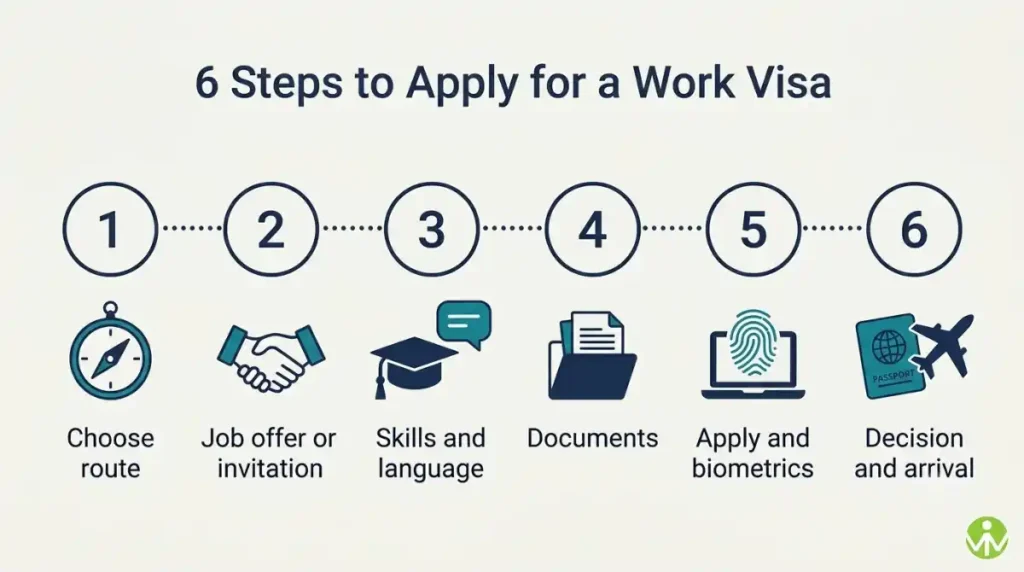
Step 1: Choose the destination and the exact route
Before you apply for a work visa, read the official page for the route you plan to use, not a summary, and note its salary floor, language level and the documents it lists. If your case is unusual, a registered immigration adviser or lawyer in the destination country can confirm which route fits.
Step 2: Secure the job offer or the invitation
For sponsored routes, the employer usually acts first. It assigns a certificate of sponsorship in the UK, lodges a nomination in Australia, obtains a Labour Market Impact Assessment in Canada where one is required, or files a petition in the US. For points-based routes, you create a profile, wait for an invitation, and then apply for a work visa or for permanent residence within the deadline.
Step 3: Get qualifications assessed and take language tests
Book these before you apply for a work visa. Test centres can have waiting lists, and most destinations accept language results only if they are recent, usually within two years.
Step 4: Gather your documents
The core set for most sponsored work visas includes:
- a passport valid for the length of your stay, with blank pages
- the signed job offer or employment contract, showing salary, job title and start date
- the employer’s sponsorship reference, nomination or approval
- degree certificates and transcripts, plus any recognition or skills assessment
- language test results, where required
- police certificates and, where required, medical results
- proof of funds or health insurance, where the route asks for them
- translations of any document not in the official language
Step 5: Apply for a work visa online, pay and give biometrics
Most countries now take applications online, followed by fingerprints and a photo at a visa application centre or consulate. US work visas also need an interview at a US embassy or consulate. Keep copies of everything you submit, because consistency between forms is one of the first things officers check.
Step 6: Wait for a decision and plan your arrival
Do not resign or move until the visa is granted. Some countries finish the process after you arrive: Germany converts the entry visa into a residence permit at the local foreigners office, Ireland registers new residents with immigration, and Singapore issues the Employment Pass card once you are in the country.
Work visa fees, salary floors and processing times by country
The table compares the main skilled route in eight common destinations. It shows what the main applicant pays the government to apply for a work visa; employer charges, dependants and adviser fees are extra.
Table 2 — Work visa fees, salary floors and processing times
| Country | Main skilled route | Government fee (main applicant) | Minimum salary | Typical processing time |
|---|---|---|---|---|
| United Kingdom | Skilled Worker visa | £819 (up to 3 years) or £1,618, from outside the UK, plus Immigration Health Surcharge of £1,035 a year | £41,700 or the job’s going rate, whichever is higher | Usually 3 weeks from outside the UK; 8 weeks from inside |
| Germany | EU Blue Card or skilled worker visa | €75 national visa | Blue Card: €50,700, or €45,934.20 for shortage occupations and recent graduates (2026) | Varies by embassy; often several weeks to a few months |
| Ireland | Critical Skills Employment Permit | €1,000 permit fee (90% refunded if refused) | €40,904 for listed roles with a degree; €68,911 for other eligible roles | Varies; published by the Department of Enterprise |
| Canada | Employer-specific work permit | C$155 work permit plus C$85 biometrics | The prevailing wage for the job | Varies by country of application |
| United States | H-1B visa | I-129 petition US$780 (US$460 small employers and non-profits) plus US$215 registration; further employer fees apply | At least the prevailing or actual wage, whichever is higher | Registration each March; earliest start date 1 October |
| Australia | Skills in Demand visa (subclass 482) | About A$4,015 (from 1 July 2026) | About A$79,500 (Core Skills Income Threshold) | Varies by stream |
| Singapore | Employment Pass | S$105 application plus S$225 issuance | S$5,600 a month (S$6,200 in financial services), higher for older applicants; S$6,000 for new applications from 1 January 2027 | Usually within 10 business days online |
| New Zealand | Accredited Employer Work Visa | From NZ$1,540 | The market rate for the job | 80% decided within 5 weeks |
| Government fees for the main applicant only, from each authority’s official page, checked 3 November 2026 (Australia from published 1 July 2026 fee tables). Employer charges, dependants, translations and adviser fees are extra. Figures change, often each April, July or January. | ||||
In other currencies, the UK fee of £819 and the US petition fee of US$780 give a sense of the range, alongside Germany’s €75 national visa, Canada’s C$155 work permit, Australia’s A$4,015, Singapore’s S$105 application fee and New Zealand’s NZ$1,540. Ireland’s Critical Skills permit costs €1,000, of which 90% is refunded if it is refused.
A US$100,000 payment on some new H-1B petitions, announced in 2025, has been vacated by a federal court and is not being collected while the appeal continues. Our H-1B visa guide tracks the case. In the UK, employers also pay an Immigration Skills Charge on top of the applicant’s fees; the UK Skilled Worker visa guide explains it. The official pages for Canada, Singapore, Ireland and New Zealand list current fees.
Within Europe, the official EU Immigration Portal explains each member state’s work permits and the EU-wide rules, including how the Blue Card works in the 25 participating countries.
From work visa to permanent residence
For many people, the reason to apply for a work visa is the longer path it opens. Most skilled routes count towards permanent residence if you keep working legally and meet the conditions.
Table 3 — Work visa to permanent residence
| Country | Usual route to permanent residence | Typical qualifying period |
|---|---|---|
| United Kingdom | Indefinite leave to remain | 5 years (a longer earned settlement model is proposed but not yet in force) |
| Germany | Settlement permit | 27 months on an EU Blue Card, or 21 months with B1 German; usually 3 years on a skilled worker permit |
| Ireland | Stamp 4, then long-term residence | Stamp 4 after 2 years on a Critical Skills permit; long-term residence after 5 years |
| Canada | Express Entry, Canadian Experience Class | At least 1 year of skilled work experience in Canada |
| United States | Employment-based green card | No fixed period; depends on the category and the backlog for your country of birth |
| Australia | Employer Nomination Scheme (subclass 186) | Generally 2 years of full-time work in Australia on a sponsored visa |
| Singapore | Permanent residence application to the ICA | No fixed period; assessed case by case |
| New Zealand | Skilled Migrant Category resident visa | Points-based; skilled work in New Zealand counts towards the points |
| Typical qualifying periods for the main skilled routes, November 2026. Absences, salary and language conditions apply; check the official rules if settlement is part of your reason to apply for a work visa. | ||
Rules on settlement change more often than any other part of the system. The UK, for example, has proposed a longer “earned settlement” model, but it is not yet part of the Immigration Rules. Our guides to indefinite leave to remain and permanent residency in Germany cover those two routes in detail.
Work visa guides by country
Once you know which type fits, our country guides explain how to apply for a work visa in each destination:
- Germany: the German work visa, including the Opportunity Card and the EU Blue Card
- Italy: the Italy work visa and the Decreto Flussi quotas
- Ireland: the Ireland work visa and its employment permits
- United Kingdom: the Skilled Worker visa
- Australia: the Skills in Demand visa
- New Zealand: the Skilled Migrant visa
- Singapore: types of Singapore work visa
- United States: the H-1B visa and the L-1 intra-company transfer visa
- Canada: types of Canadian visa, including work permits
- Portugal: types of Portugal visa, including the work routes
- South Korea: the South Korea work visa
Frequently asked questions about how to apply for a work visa
Can I apply for a work visa without a job offer?
Sometimes. Canada’s Express Entry, Australia’s points-tested skilled visas, Germany’s Opportunity Card and working holiday schemes do not need a job offer at the application stage. Most other routes, including the UK Skilled Worker visa, the US H-1B and Singapore’s Employment Pass, depend on a sponsoring employer.
Can I start working on a tourist visa while my work visa is processed?
No. Working on a visitor visa breaks its conditions almost everywhere and can lead to removal or a ban. Some countries let certain nationalities switch status after arrival, but most expect you to apply for a work visa from outside the country. Our guide on how to apply for a tourist visa explains what a visitor visa allows.
How long does it take to apply for a work visa?
The visa decision itself can take from about two weeks (Singapore) to three weeks (UK, from outside the country) or several months. The whole process, including the job search, sponsorship, skills assessment and language tests, often takes three to twelve months. US H-1B applicants also depend on the annual registration in March, with an earliest start date of 1 October.
How much does it cost to apply for a work visa?
Government fees for the main applicant range from a few hundred US dollars to several thousand, depending on the country and the length of the visa. The UK also charges a health surcharge for each year of the visa, and many countries charge employers separately.
Do I need to speak the local language?
Not always. English-speaking countries test English, but Germany’s EU Blue Card and standard skilled worker visa do not require German. Language matters more later: many countries reward or require it for permanent residence and citizenship.
Can my family come with me?
Most skilled routes allow a partner and dependent children to apply as dependants, usually at the same time as you apply for a work visa. Work rights for partners, income thresholds and language rules differ by country, so check the dependant rules before you accept an offer.
What happens if I change employers?
On sponsored routes, a new employer usually has to sponsor you again, or you must report the change. The UK requires a new certificate of sponsorship and application, while the EU Blue Card may require you to report a change in the first 12 months. Points-based permanent residence is not tied to one employer.
Does my nationality affect my work visa application?
The main tests are your job, salary and skills, not your passport. Nationality can still matter: some countries have bilateral schemes or working holiday agreements with particular countries, and visa requirements for travel differ. Our passport rankings show how travel access varies.
Before you apply for a work visa
Confirm the route on the official site, check this year’s salary floor and fee, and start the slow steps, such as recognition, language tests and police certificates, before you need them. Applications that fail usually do so because a document is missing, a figure is out of date, or the job does not match the route, not because the applicant was ineligible. If you are still deciding where to apply for a work visa, start with the type of work visa that fits your situation and then follow the country guide above.