
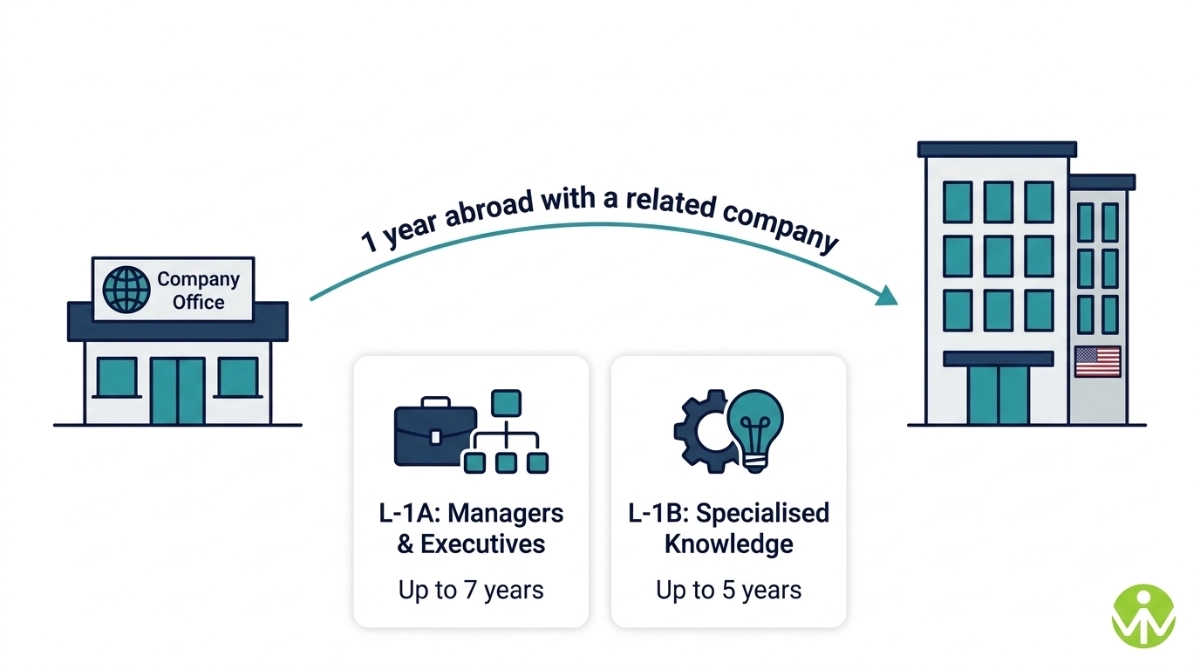
The L-1 visa lets a multinational company move an existing employee from one of its offices abroad to a related office in the United States, with no lottery, no annual cap and no labour market test. It is one of the employer-sponsored routes in our guide to the types of US visa, and it comes in two forms: L-1A for managers and executives, and L-1B for employees with specialised knowledge of the company. This guide covers who qualifies for an L-1 visa, blanket petitions, the fees after the rule change of 9 September 2026, length of stay, L-2 family members and the route to a green card.
Key Takeaways
- The L-1 visa moves an existing employee from a related company abroad to a US office. You need one continuous year of work for that group abroad within the last three years.
- L-1A covers managers and executives and runs to seven years; L-1B covers specialised knowledge staff and runs to five.
- There is no annual cap, no lottery and no prevailing wage requirement, and the L-1 visa is dual intent.
- Most employers pay a $1,385 filing fee, a $600 Asylum Program Fee and a $500 fraud fee on a new petition.
- Since 9 September 2026, covered employers pay a $4,500 9-11 fee on every L-1 petition, including same-employer extensions.
- L-2 spouses can work incident to status, and L-1A holders can move to an EB-1C green card without labour certification.
Table of Contents
What is an L-1 visa?
The L-1 visa is a nonimmigrant classification for intracompany transferees. The employer files the petition, not the employee, and the US job must be with a parent, branch, subsidiary or affiliate of the organisation the person already works for abroad. The two entities have to stay related, and keep doing business in the United States and in at least one other country, for as long as the employee holds L-1 status.
Because there is no cap, an L-1 visa petition can be filed at any point in the year. That is the main reason employers use it alongside the H-1B visa, where most cap-subject cases now depend on a wage-weighted lottery. It is widely used by IT services firms, consultancies and banks that rotate staff between countries, and by smaller companies opening their first US office.
It is not a route for someone who simply wants to work in the United States. If you have not already worked for the company abroad, this route is closed to you, and our guide to US work visas beyond the H-1B compares the routes that remain open.
L-1A vs L-1B: the two types of L-1 visa
The L-1A is for people coming to work in a managerial or executive capacity. A manager runs the organisation, a department or an essential function and has real authority over staff or operations. An executive directs the organisation or a major part of it, sets its goals and policies, and answers mainly to senior executives, a board or shareholders.
The L-1B is for employees with specialised knowledge. That means special knowledge of the company’s products, services, research, equipment, techniques or management and how they are applied in international markets, or an advanced level of knowledge of its processes and procedures. Knowledge that is common across an industry, or that a new hire could pick up quickly, does not qualify, and it is on this point that most L-1B requests for evidence turn.
Table 1 — L-1A vs L-1B at a glance
| Feature | L-1A | L-1B |
|---|---|---|
| Who it is for | Managers and executives | Employees with specialised knowledge |
| Initial stay | Up to 3 years (1 year for a new office) | Up to 3 years (1 year for a new office) |
| Extensions | Up to 2 years at a time | Up to 2 years at a time |
| Maximum stay | 7 years | 5 years |
| Blanket petition | Yes | Only for specialised knowledge professionals |
| Placement at a client site | Permitted | Restricted: no control by the client, no labour-for-hire |
| Usual green card route | EB-1C, no labour certification | PERM, then EB-2 or EB-3 |
| Source: 8 CFR 214.2(l); USCIS; 9 FAM 402.12. Maximum stay includes time in H status. As of 17 September 2026. | ||
One further limit applies only to the L-1B. Under the L-1 Visa Reform Act of 2004, an L-1B employee cannot be placed mainly at the worksite of an unaffiliated company if that company controls and supervises the work, or if the arrangement is in substance labour-for-hire rather than the provision of the petitioner’s own specialised product or service.
L-1 visa requirements
Whichever type applies, every L-1 visa petition has to establish the three things USCIS lists for L-1A managers and executives and L-1B specialised knowledge staff.
- A qualifying relationship. The US and foreign employers must be the same organisation, or linked as parent, branch, subsidiary or affiliate through ownership and control. A sole proprietorship cannot petition for its own owner, but a corporation or LLC with a single owner can, because it is a separate legal entity.
- One continuous year abroad. The employee must have worked full-time for the qualifying organisation outside the United States for one continuous year within the three years before the petition is filed. Brief business or pleasure trips to the US do not break that year, but time spent working in the US does not count towards it.
- The right kind of role. The year abroad must have been in a managerial, executive or specialised knowledge position, and the US job must be managerial or executive for an L-1A, or require specialised knowledge for an L-1B. The two roles do not have to be identical.
An individual L-1 visa petition has no degree requirement, no minimum salary and no labour condition application. The evidence still has to be detailed: organisation charts, payroll records, ownership documents and specific job descriptions.
Opening a new office on an L-1 visa
A company that has been doing business in the United States for less than a year can still use the L-1 to send someone to set up its operation. The employer must show that it has secured physical premises, that the transferee meets the one-year rule, and, for an L-1A, that the new office will support a managerial or executive position within one year. Approval is limited to one year. At extension, USCIS looks for proof the business has started: staff hired, revenue, and a manager no longer doing all the hands-on work. A B-1 visa can cover meetings and site visits before the transfer, but not running the office.
Individual vs blanket L-1 visa petitions
Most employers file an individual petition. The employer submits Form I-129 with the L Classification Supplement to USCIS, and once it is approved the employee applies for the visa at a US embassy or consulate, or changes status without leaving the country if already in the United States lawfully.
Large multinationals can instead obtain a blanket L petition once and then send qualifying employees straight to a consulate with Form I-129S, skipping the individual USCIS filing. According to the State Department’s Foreign Affairs Manual, the US petitioner must have an office that has been doing business for at least one year, three or more domestic and foreign branches, subsidiaries or affiliates, and at least one of the following: ten or more L approvals in the past 12 months, combined US annual sales of at least $25 million, or a US workforce of at least 1,000 employees.
Blanket coverage is open to L-1A managers and executives and to L-1B specialised knowledge professionals, meaning L-1B employees who also hold a bachelor’s degree or equivalent in a recognised profession. Other L-1B employees need an individual petition. The consular officer decides a blanket case directly and can refer an unclear case back for an individual petition with USCIS.
How to apply for an L-1 visa
Step 1: The employer files the L-1 visa petition
The employer files Form I-129 with evidence of the qualifying relationship, the employee’s year abroad and the US role, plus the fees set out below. Premium processing is optional and brings a decision within 15 business days. Under a blanket, the employer instead prepares Form I-129S for the employee to take to the consulate.
Step 2: Apply for the visa at a US consulate
With the approval notice (Form I-797) or the I-129S in hand, the employee completes the DS-160 online application, pays the visa fee and attends an interview. L-1 and L-2 applicants are not covered by the US visa interview waiver, so an in-person appointment should be expected. Canadian citizens do not need a visa and can present an L petition or blanket documents directly to US Customs and Border Protection at certain ports of entry, which is one reason Canadian professionals also consider the TN visa.
L-1 visa fees in 2026
L-1 costs fall mostly on the employer. The table lists government fees from the USCIS fee schedule and the Federal Register.
Table 2 — L-1 visa fees in 2026
| Fee | Amount (USD) | Who pays and when |
|---|---|---|
| Form I-129, L classification | $1,385 | Employer; $695 for small employers (25 or fewer full-time employees) and nonprofits |
| Asylum Program Fee | $600 | Employer; $300 for small employers, $0 for nonprofits |
| Fraud Prevention and Detection Fee | $500 | Employer, on initial petitions and changes of employer; paid at the consulate for blanket cases |
| 9-11 Response and Biometric Entry-Exit Fee | $4,500 | Covered employers only; since 9 September 2026 also on every extension |
| Premium processing (Form I-907) | $2,965 | Optional; decision within 15 business days |
| Visa application (MRV) fee | $205 | Applicant, at the consulate |
| Visa Integrity Fee | $250 | Applicant, on visa issuance; being phased in at consular posts |
| Sources: USCIS Form G-1055 (edition 09/09/26); 91 FR 51360; US Department of State. Reciprocity fees vary by nationality. As of 17 September 2026. | ||
For a typical large employer that is not a covered employer, a new L-1 visa petition costs $2,485 in USCIS fees. A covered employer filing a new petition with premium processing pays $9,950 before any consular costs, and a covered employer’s same-employer extension now costs $6,485 without premium processing.
The biggest change this year is to the 9-11 Response and Biometric Entry-Exit Fee. It applies to covered employers, meaning those with 50 or more US employees of whom more than half hold H-1B or L-1 status. Until September 2026 the $4,500 charge applied only to initial petitions and changes of employer. A DHS final rule published on 10 August 2026 (91 FR 51360) extended it from 9 September 2026 to every extension of status, including an extension for the same employee with the same employer. The fee is currently set to expire on 30 September 2027 unless Congress extends it again.
Two H-1B costs do not apply to the L-1 visa at all. The $100,000 payment created by Proclamation 10973 is limited to H-1B petitions, and so is the proposed $103,265 fee on cap-subject H-1B petitions published on 25 August 2026. See the current status of the $100,000 H-1B fee.
How long you can stay on an L-1 visa
An L-1 visa petition is normally approved for up to three years, or one year for a new office. Extensions are granted in increments of up to two years, to a maximum of seven years in total on an L-1A and five years on an L-1B. Time spent in H-1B or other H status counts towards that maximum. Days spent outside the United States can be recaptured if you keep travel records.
An L-1B employee promoted into a managerial or executive role can move to L-1A and stay up to seven years in total, but only after spending at least six months in L-1A status before the five-year L-1B limit is reached. Once the maximum is used up, the employee must live outside the United States for one full year before a new L or H petition can be approved.
If an extension is filed on time with the same employer, the employee can keep working for up to 240 days while it is pending. The L-1 visa is not portable: an employee can move only within the corporate group, and a job with an unrelated company needs a different status, such as an H-1B.
L-2 visa for spouses and children
The spouse and unmarried children under 21 of an L-1 visa holder can come as L-2 dependants, with stays tied to the principal’s. Since January 2022, L-2 spouses have been employment authorised incident to status, so they can work without first obtaining an employment authorisation document (EAD). An I-94 annotated L-2S serves as proof, and an EAD remains optional. L-2 children can study but cannot work. The position is simpler than for H-4 spouses, who can work only with an H-4 EAD in limited situations.
From L-1 visa to green card
For L-1A holders, the usual route is the EB-1C category for multinational managers and executives. It needs no PERM labour certification: the employer files Form I-140 directly, showing that the employee worked abroad for the organisation in a managerial or executive role for at least one of the three years before arriving in L-1 status, that the US entity has been doing business for at least a year, and that the US job is managerial or executive. Our employment-based green card guide sets out how EB-1C compares with the other preference categories.
L-1B holders generally follow the PERM labour certification route into EB-2 or EB-3, the same path described in our guide to moving from an H-1B to a green card. One difference matters. The H-1B can be extended past six years while a green card case is pending, but the L-1 has no equivalent, so the seven- or five-year maximum is a hard deadline. Nationals of high-demand countries such as India and China can face long waits for a green card number even in EB-1, so check the monthly Visa Bulletin before relying on a timeline.
L-1 visa vs H-1B and other options
The L-1 visa and the H-1B are often both open to the same employee. The table compares the points that usually decide the choice.
Table 3 — L-1 visa vs H-1B
| Feature | L-1 visa | H-1B visa |
|---|---|---|
| Annual cap and lottery | None | 85,000 cap; wage-weighted lottery |
| Prior work abroad | 1 continuous year with a related company | Not required |
| Degree | Not required (except blanket L-1B) | Bachelor’s degree in a specific specialty |
| Wage rule | No prevailing wage requirement | Must pay the higher of actual or prevailing wage |
| Maximum stay | 7 years (L-1A) or 5 years (L-1B) | 6 years, extendable while a green card is pending |
| Changing employer | Only within the corporate group | Portable to a new H-1B employer |
| Spouse work rights | L-2 spouse authorised incident to status | H-4 spouse only with an EAD, in limited cases |
| 9-11 fee for covered employers | $4,500 | $4,000 |
| Sources: 8 CFR 214.2(h) and (l); 91 FR 51360; USCIS. As of 17 September 2026. | ||
Business owners sometimes weigh the L-1 against the E-2 treaty investor visa. The E-2 is available only to nationals of countries on the State Department’s list of treaty countries, and India, for example, has no E-2 treaty with the United States. For many managers transferring within their own company, the L-1 is the only employer-led option that does not depend on nationality or a lottery.
Frequently asked questions about the L-1 visa
Can I apply for an L-1 visa myself?
No. The US employer, or the employer’s qualifying organisation, must file the petition. You apply at a consulate only once the petition is approved or you hold an I-129S under a blanket.
Is there a minimum salary for an L-1 visa?
No. The L-1 has no prevailing wage requirement and no labour condition application, unlike the H-1B. Pay should still fit the role described in the petition.
Can an L-1 visa holder change employers?
Only within the same corporate group. Moving to an unrelated company requires a new status, such as an H-1B or O-1, before starting the new job.
Does the $100,000 H-1B fee apply to L-1 petitions?
No. That payment applies only to certain H-1B petitions. Covered employers do, however, pay the $4,500 9-11 fee on L-1 petitions, which, since 9 September 2026, includes extensions.
Can my spouse work on an L-2 visa?
Yes. L-2 spouses are employment authorised incident to status, and a separate EAD is optional.
What happens when I reach the maximum stay on an L-1 visa?
You must leave and spend one full year outside the United States before a new L or H petition can be approved, unless you have moved to another status or received a green card.