
The H-1B visa is the primary route for a foreign professional to work in the United States in a speciality occupation, and almost everything about its allocation has changed since January 2025. A wage-weighted lottery replaced the random draw in February 2026. The definition of a speciality occupation was tightened. Automatic work-permit extensions for spouses ended. A $100,000 charge on some petitions was created, then blocked in court. This guide sets out how the H-1B visa works now, in August 2026, and clearly marks where the rules remain unsettled.
| Key Takeaways – The H-1B visa is an employer-sponsored US work visa for speciality occupations. There is no self-application route — a company must register and petition for you. – There are 85,000 new cap-subject places each year: 65,000 in the general pool and 20,000 reserved for holders of a US master’s degree or higher. Universities and non-profit research bodies are cap-exempt and sponsor without limit. – Since 27 February 2026, the lottery is weighted by wage level, not random. A Level IV registration receives four entries in the pool; a Level I registration receives one. – Registration costs $215. Government fees on a typical new petition run from roughly $1,900 for a small employer to over $7,000 for a large one, before legal costs. – The $100,000 proclamation payment was struck down in June 2026 and is not being collected as of August 2026. The appeal is unresolved. – An H-1B visa runs up to three years and extends to six, with further extensions available under AC21 for workers waiting in the green-card queue.H-4 spouses may work only with an employment authorisation document, and the automatic extension of that document while a renewal is pending ended on 30 October 2025. |
Table of Contents
What is the H-1B visa?
The H-1B visa is a non-immigrant classification that lets a US employer temporarily employ a foreign worker in a speciality occupation. It is not a visa an individual can apply for alone. An employer must sponsor the worker, file the petition, and pay most of the government fees.
Three features define the category. It is employer-specific, so the approval is tied to a particular job at a particular company. It is capped, with a fixed number of new places each year. And it is dual-intent, meaning an H-1B visa holder may pursue permanent residence without jeopardising their non-immigrant status — one of the main reasons the category is used as a stepping stone to a green card.
The programme is administered jointly. The Department of Labor certifies the wage and working-condition attestations. US Citizenship and Immigration Services adjudicates the petition. The State Department issues the visa itself at a consulate abroad.
Who qualifies for an H-1B visa?
Two things must be true: the job must be a specialty occupation, and the worker must be qualified to do it.
What counts as a specialty occupation now
A speciality occupation requires theoretical and practical application of a body of highly specialised knowledge, together with a bachelor’s degree or higher in a specific speciality as a minimum entry requirement.
The H-1B Modernisation rule that took effect on 17 January 2025 sharpened this considerably. The degree field must now be directly related to the duties of the position, meaning there has to be a logical connection between what the person studied and what they will do. A role may accept more than one qualifying field, but each one must clear that test individually. References to broad degree titles such as business administration were removed from the regulation, so a general degree on its own no longer carries a petition.
The same rule made three other changes that matter in practice. It codified deference to prior approvals, so an officer reviewing an extension involving the same parties and the same facts should follow the earlier decision unless there was a material error or something has changed. It requires the employer to show that a bona fide position is actually available on the requested start date and allows USCIS to request contracts as evidence. And it wrote the agency’s site-visit authority into the regulations, with refusal to co-operate a ground for denial or revocation.
The worker qualifies by holding the relevant US bachelor’s degree or higher, an equivalent foreign degree, or a combination of education and progressive experience judged equivalent. Where the occupation is licensed — medicine, law, and engineering in some states — a licence is generally required too.
Employers exempt from the cap
Not every H-1B visa petition competes in the lottery. Higher-education institutions, non-profits affiliated with them, non-profit research organisations and governmental research organisations are cap-exempt and may file at any point in the year. The 2025 rule widened this: an organisation now qualifies if research is a fundamental activity rather than its primary mission, and a worker not directly employed by such an organisation can still be exempt if at least half their time supports that organisation’s purposes.
The H-1B visa cap: 65,000 plus 20,000
Congress sets a cap of 65,000 new H-1B visas per fiscal year, with an additional 20,000 reserved for individuals holding a master’s degree or higher from a US institution. Together, that is 85,000 — a figure the old framing of “only 65,000” misses by nearly a quarter.
A slice of the 65,000 is set aside under trade agreements: 6,800 places go to the H-1B1 category for nationals of Chile and Singapore. Unused H-1B1 numbers fall back into the general pool the following year.
Everyone in the advanced-degree pool is also entered in the general pool, which is why holding a US master’s improves the odds rather than simply moving an applicant sideways.
How the H-1B visa lottery works in 2026
Because demand routinely exceeds supply by 3 to 4 times, USCIS conducts a selection process before any petition is filed.
Electronic registration
Since 2020 employers have had to register electronically before filing. The registration process takes basic details of the company and each proposed worker. The fee is $215 per registration, raised from $10 for the FY2026 season.
Since FY2025, selection has been beneficiary-centric: each person is entered once, regardless of how many employers register them. That change alone sharply reduced the volume of duplicate registrations and increased the selection rate.
H-1B visa cap season: registrations and selections, FY2024–FY2027
| Fiscal year | Eligible registrations | Eligible unique beneficiaries | Registrations selected | Approximate selection rate | Selection method |
|---|---|---|---|---|---|
| FY2024 | Not comparable (registration-based) | Not published | Not published | About 24.8% | Random draw, registration-based |
| FY2025 | 470,342 | 423,028 | 135,137 | About 29% | Random draw, beneficiary-centric |
| FY2026 | 343,981 | 336,153 | 120,141 | About 35% | Random draw, beneficiary-centric |
| FY2027 | Not yet published | Not yet published | Not yet published | Not yet published | Wage-weighted, beneficiary-centric |
| Source: USCIS cap season data as reported by Ogletree Deakins (FY2024–FY2026); USCIS confirmed the FY2027 cap was reached in July 2026 but had not published FY2027 registration totals as of 12 August 2026. | |||||
The new wage-weighted selection
This is the single largest change to the H-1B visa in more than a decade. DHS published a final rule on 29 December 2025 replacing the random draw with weighted selection, effective 27 February 2026.
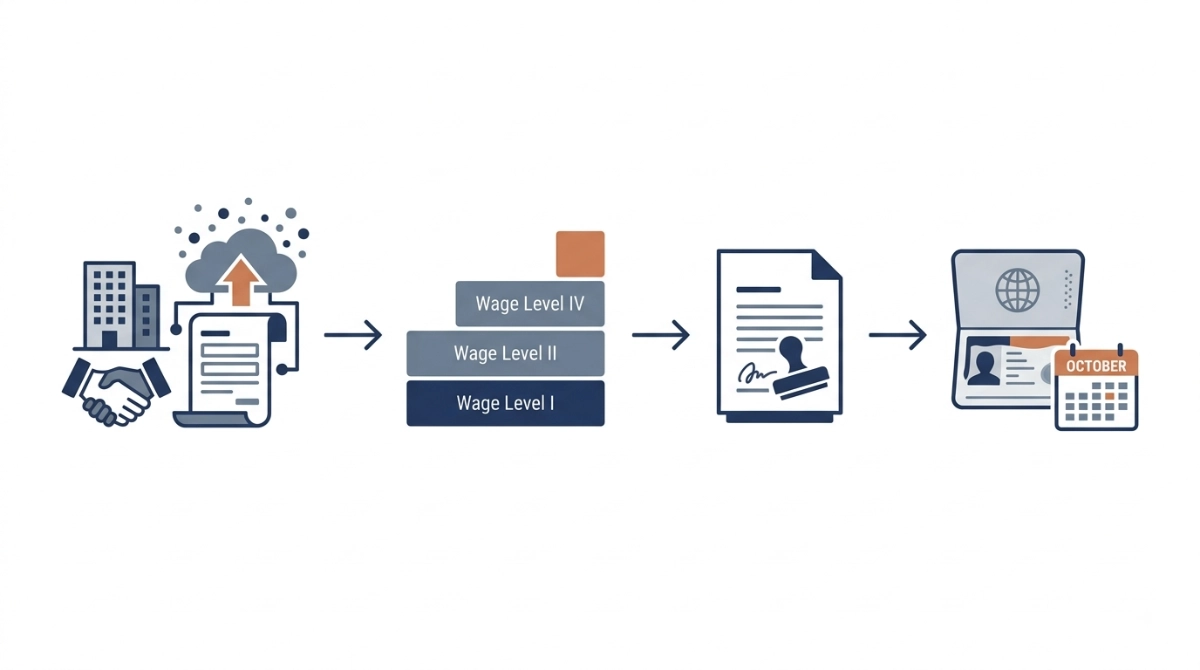
Each registration is now assigned one to four entries in the pool, based on the Occupational Employment and Wage Statistics wage level to which the offered salary corresponds for that occupation and location. A Level IV offer gets four entries, Level III gets three, Level II two, and Level I one. Every beneficiary still counts only once against the cap, regardless of how many entries they hold, and the weighting applies to the advanced-degree exemption as well as the general pool.
The practical effect is substantial. Modelling by TRAC put the selection probability for a Level IV registration at roughly 61 per cent compared with a random-draw baseline of about 30 per cent, while Level I fell to around 15 per cent. Entry-level roles were not excluded, but they became markedly harder to place.
The first cycle under the new rule bore that out. FY2027 registrations fell to about 211,600 from 343,981, and roughly 71.5% of selected beneficiaries held US advanced degrees, up from about 57% a year earlier, with only around 17.7% of selections at the lowest wage level. See the full breakdown of H-1B visa changes in 2026.
Because wage levels are set by occupation and geography, the same job can pay different amounts in different cities. TRAC’s example of a software developer at Level IV ranges from about $80,000 in Hattiesburg, Mississippi to about $265,000 in San Jose, California. See how the H-1B lottery now works.
H-1B visa weighted selection: entries and modelled odds by OEWS wage level
| OEWS wage level | Entries in the selection pool | Modelled selection probability, weighted | Modelled selection probability, random draw |
|---|---|---|---|
| Level I (entry) | 1 | 15.29% | 29.59% |
| Level II (qualified) | 2 | 30.58% | 29.59% |
| Level III (experienced) | 3 | 45.87% | 29.59% |
| Level IV (fully competent) | 4 | 61.16% | 29.59% |
| Source: DHS final rule, Weighted Selection Process for Registrants and Petitioners Seeking To File Cap-Subject H-1B Petitions, 90 FR (29 December 2025), effective 27 February 2026; modelled probabilities from TRAC Reports, Report 768. Probabilities are projections, not observed outcomes. | |||
H-1B visa cap season: the annual timeline
H-1B visa cap season runs on a fixed annual cycle. The FY2027 season ran to this pattern, and FY2028 is expected to follow it.
Registration opened at noon Eastern on 4 March 2026 and closed at noon Eastern on 19 March 2026. USCIS completed selection on 31 March 2026. Selected employers had a 90-day filing window from 1 April to 30 June 2026 to submit the petition itself. Approved workers could start no earlier than 1 October 2026, the first day of the fiscal year. In July 2026, USCIS confirmed the FY2027 cap had been reached and that no second selection round would be run.
USCIS had not published the FY2027 registration and selection totals at the time of writing.
How to apply for an H-1B visa
An H-1B visa petition follows the same sequence whether it came through the lottery or from a cap-exempt employer.
The employer first obtains a certified Labor Condition Application from the Department of Labor, attesting that it will pay at least the prevailing wage for the occupation and location, and that hiring the worker will not adversely affect conditions for comparable US staff. The Department reviews within seven working days, and filing cannot begin more than six months before the intended start date.
The employer then files Form I-129 with the certified application and evidence of the position and the worker’s credentials. Premium processing is optional and guarantees action within 15 business days.
After approval, the path splits. A worker already lawfully in the United States — most commonly a student on F-1 — can change status without leaving. A worker abroad applies for the visa at a consulate. This distinction has become financially significant and determines whether the disputed $100,000 charge described below is even in play.
One further change: the broad interview waivers that allowed many H-1B visa applicants to use drop-box renewal ended with State Department notices effective 2 September 2025 and 1 October 2025. Applicants should now plan for an in-person interview.
H-1B visa fees and who pays
H-1B visa costs fall on the employer by law, almost without exception. The worker may generally be asked to pay only for premium processing, and only when it is not primarily for the employer’s benefit.
H-1B visa costs in 2026
| Cost item | Amount | Who pays | Notes |
|---|---|---|---|
| Electronic registration fee | $215 per registration | Employer | Cap-subject cases only. Raised from $10 for the FY2026 season. |
| Form I-129 base filing fee | $780 | Employer | $460 for employers with 25 or fewer full-time equivalent staff, and for non-profits. |
| Asylum Program Fee | $600 | Employer | $300 for employers with 25 or fewer full-time equivalent staff; $0 for non-profits. |
| ACWIA training fee | $1,500 | Employer | $750 for employers with 25 or fewer full-time equivalent staff. Some employers exempt. |
| Fraud Prevention and Detection Fee | $500 | Employer | Initial petitions and change-of-employer petitions. |
| 9-11 Response and Biometric Entry-Exit Fee | $4,000 | Employer | Employers with 50 or more US staff of whom more than half hold H-1B or L-1 status. Extended to all extension petitions from 9 September 2026. |
| Premium processing (Form I-907) | $2,965 | Optional; employer or worker | 15 business days. Increased from $2,805 on 1 March 2026. |
| Visa application fee (MRV) | $205 | Worker | Petition-based categories. Paid at a consulate; not applicable to change of status inside the US. |
| Visa integrity fee | $250 | Worker | Charged at visa issuance. Nominally refundable on compliant departure; refund mechanism not yet operating. |
| Proclamation 10973 payment | $100,000 | Employer | NOT currently collected. Vacated 8 June 2026; First Circuit declined to stay the vacatur on 24 July 2026. Litigation continuing. |
| Source: USCIS fee schedule; DHS final rule 91 FR (10 August 2026); DHS premium processing adjustment, 91 FR (12 January 2026); US Department of State schedule of consular fees. Amounts current at 12 August 2026. | |||
The $100,000 proclamation charge is currently blocked. Presidential Proclamation 10973 of 19 September 2025 imposed a one-time $100,000 payment on certain petitions for beneficiaries outside the United States, leaving change-of-status cases untouched. On 8 June 2026, the US District Court for the District of Massachusetts vacated it, holding it was in substance a tax beyond presidential authority. The government appealed, and on 24 July 2026 the First Circuit declined to stay that ruling. As of August 2026, the charge is not being collected. The full timeline of the $100,000 H-1B fee, from the proclamation through to the appeal, is set out separately.
A conflicting decision from the District of Columbia means the question may yet reach the Supreme Court, so anyone planning a consular filing should confirm the position at the time of filing.
A $4,000 surcharge is about to widen. On 10 August 2026, DHS published a final rule extending the 9-11 Response and Biometric Entry-Exit fee to all extension petitions, not just initial grants and changes of employer. It takes effect on 9 September 2026 and applies to employers with 50 or more US staff of whom more than half hold H-1B or L-1 status — which is to say, principally the large IT services firms.
Separately, a $250 visa integrity fee is now charged at issuance on most non-immigrant visas, including the H-1B visa. It is nominally refundable on compliant departure, but the refund mechanism is not yet operating.
How long an H-1B visa lasts
An initial H-1B visa is normally granted for up to three years and may be extended to a total of six years. Time spent physically outside the United States can be recaptured, and periods in H-4 or other statuses do not count against the six years.
Beyond six years, the American Competitiveness in the Twenty-First Century Act provides two routes. A worker whose labour certification or immigrant petition has been pending more than 365 days may take one-year extensions. A worker with an approved I-140 who cannot file for adjustment because no immigrant visa number is available may take three-year extensions — the provision that keeps tens of thousands of Indian nationals in status through very long green-card queues.
Portability lets a worker begin employment with a new sponsor as soon as that employer’s petition is properly filed, without waiting for approval. If employment ends, a discretionary grace period of up to 60 days, or until the existing validity expires if sooner, allows time to find a new sponsor or change status.
Cap-gap: moving from F-1 to H-1B
Students are the largest single source of new H-1B visa workers, and the cap-gap provision is what stops them falling out of status while a petition is pending.
Where a cap-subject petition requesting change of status is filed on time for an F-1 student, the student’s status and any Optional Practical Training work authorisation are automatically extended. The 2025 rule pushed the end of that extension from 1 October to 1 April of the relevant fiscal year, closing the gap that used to open when a petition was still pending on the intended start date. Students on a STEM OPT extension are covered on the same basis.
H-4 dependants and work authorisation
Spouses and unmarried children under 21 may accompany an H-1B visa holder in H-4 status. H-4 dependants may study; they may only work if they hold an employment authorisation document.
The H-4 EAD rule was never rescinded. The Supreme Court declined to hear the long-running challenge in Save Jobs USA v. DHS on 14 October 2025, leaving the programme intact. Eligibility is unchanged: the H-1B spouse must have an approved I-140, or have been granted an extension beyond six years under AC21.
What did change is renewals. From 30 October 2025, the automatic extension of employment authorisation while a renewal is pending was eliminated. Work authorisation now ends on the date printed on the card. With processing taking several months, filing early is essential — the detail is set out in our guide to H-4 EAD work authorisation.
Who actually gets H-1B visas
H-1B visa approvals are heavily concentrated by nationality, occupation and employer. USCIS approved 406,348 H-1B petitions in FY2025. Around 72 per cent were extensions or renewals rather than new hires, which is why approval totals dwarf the annual cap of 85,000.
Nationals of India received roughly 70 per cent of approvals in FY2025, about 283,772, with China second on 49,161. The concentration has been stable for years. Computer-related occupations accounted for 252,088 approvals, around 62 per cent of the total, and 58 per cent of beneficiaries held a master’s degree or higher.
Top countries of birth for approved H-1B beneficiaries, FY2024
| Country of birth | Approved petitions | Share of all approvals |
|---|---|---|
| India | 283,397 | 71.0% |
| China | 46,680 | 11.7% |
| Philippines | 5,248 | 1.3% |
| Canada | 4,222 | 1.1% |
| South Korea | 3,983 | 1.0% |
| Mexico | 3,333 | Under 1% |
| Taiwan | 3,099 | Under 1% |
| Pakistan | 3,052 | Under 1% |
| Brazil | 2,638 | Under 1% |
| Nigeria | 2,273 | Under 1% |
| Source: USCIS, Characteristics of H-1B Specialty Occupation Workers, Fiscal Year 2024. FY2024 is the most recent year for which a full country breakdown is available. For FY2025, India accounted for about 283,772 approvals and China for 49,161. | ||
Employer patterns have shifted more sharply. Analysis by the National Foundation for American Policy found that, in FY2025, the four largest sponsors of new H-1B workers were all US technology companies for the first time, while the top seven India-headquartered IT services firms together accounted for 4,573 approvals — a 37 per cent year-on-year fall. Denial rates remain low: 2.8 per cent for initial employment and 1.9 per cent for continuing employment.
Largest sponsors of new H-1B workers, FY2025
| Employer | Petitions approved for initial employment, FY2025 |
|---|---|
| Amazon | 4,644 |
| Meta Platforms | 1,555 |
| Microsoft | 1,394 |
| 1,050 | |
| Top seven India-headquartered IT services firms (combined) | 4,573 |
| Source: National Foundation for American Policy, H-1B Petitions and Denial Rates in FY 2025 (November 2025). FY2025 was the first year in which the four largest sponsors of new H-1B workers were all US technology companies. The combined India-headquartered total fell 37% year on year. | |
The data and the debate
The argument about the H-1B visa has run since the category was created in 1990, and both sides draw on the same statistics.
Critics point to the concentration of demand at the lowest wage level as evidence that the programme has been used to fill ordinary roles cheaply rather than genuinely scarce ones, and to the outsourcing model in which staff are placed at third-party client sites. The wage-weighted rule was justified in exactly these terms.
Supporters point to persistent unfilled vacancies in computing and engineering, to the role of immigrant founders and researchers in US technology firms, and to evidence that H-1B visa hiring is associated with additional rather than substituted employment. They also note that the programme requires payment of a prevailing wage, and that the six-year ceiling and employer-specific approval leave workers with limited bargaining power — a design problem, on this reading, rather than a case for a smaller cap.
Both positions are now shaping policy at once: the cap has not moved, but selection favours higher-paid roles, and the cost of sponsorship has risen steeply.
What is still changing
Three parts of the H-1B visa framework are unresolved as of August 2026.
The litigation over the $100,000 charge continues, with a circuit split that points towards the Supreme Court. The expanded $4,000 surcharge takes effect on 9 September 2026. And DHS published a proposed rule on 3 November 2025 that would substantially widen biometric collection across immigration filings — including facial imagery, iris and retina scans, voice prints and partial DNA profiles, with no age limit. Comments closed on 2 January 2026 and it has not been finalised. This proposal replaces an earlier one from September 2020 that was withdrawn in May 2021; that older version is sometimes still described as imminent, which it is not.
A fourth proposal, to remove the 60-day grace period after job loss, went to the White House for regulatory review on 8 August 2026 but has not been published for comment. Our guide to the current H-1B visa changes tracks each of these, including which are enforced and which are only proposed.
Anyone weighing options beyond this category may want to read our overview of US work visa alternatives to the H-1B, or, for broader work-authorisation background, US work permit visa requirements.
Frequently Asked Questions
How many H-1B visas are issued each year?
85,000 new cap-subject places: 65,000 in the general pool and 20,000 reserved for holders of a US master’s degree or higher. Cap-exempt employers such as universities and non-profit research organisations may sponsor without limit, so total approvals each year run far higher.
Is the H-1B lottery still random?
No. From 27 February 2026, selection is weighted by wage level. The wage-level lottery odds at each level.
Can I apply for an H-1B visa myself?
No. A US employer must register you and file the petition. There is no self-petition route in this category.
What is the $100,000 H-1B fee, and do I have to pay it?
It was a one-time charge created by proclamation in September 2025 on certain petitions for people outside the United States. A federal court vacated it in June 2026 and an appeals court refused to revive it in July 2026, so it is not being collected as of August 2026. The litigation is ongoing – where each case now stands is tracked in detail – so verify before filing.
How long can I stay on an H-1B visa?
Six years in total, in increments of up to three. Extensions beyond six years are available under AC21 where a green-card application is pending or an approved I-140 is waiting on a visa number.
Can my spouse work?
Only with an H-4 employment authorisation document, which requires the H-1B spouse to hold an approved I-140 or an AC21 extension. Since 30 October 2025 there is no automatic extension while a renewal is pending, so apply well before the card expires.
What happens if I lose my job?
A discretionary grace period of up to 60 days applies, or until your current validity ends if that comes first. Within it you can find a new sponsor, change to another status, or depart.
Also See
- The $100,000 H-1B Fee: Current Status and Full Timeline
- H-1B to Green Card: Process, Backlog and Wait Times in 2026
- EB-1A vs EB-2 NIW: Which Self-Petition Route Fits?
- Employment-Based Green Card: The Five EB Categories Explained (2026)
- H-1B to Green Card: Process, Backlog and Wait Times in 2026
- US work visas: H-1B visa alternatives for job seekers
- H-4 EAD work authorisation for H-1B spouses
- H-1B visa changes in 2026: fees, lottery and rules
- Optional Practical Training (OPT) in the US
- STEM OPT extension
- US work permit visa requirements