
US dual citizenship means holding US citizenship and the citizenship of at least one other country at the same time, and US law has allowed it for decades. It works in two directions. A US citizen can add a second nationality through ancestry, investment, residence or marriage, and a person who naturalizes in the United States can often keep the nationality they started with. Whether they can depends on the other country, not on Washington.
This guide explains what US dual citizenship means in law, where the bill that would end it stands, the four routes US citizens use to add a second passport, and what does not change, above all, US tax on worldwide income. Figures are current to September 2026.
Key Takeaways
- Is US dual citizenship legal? Yes. US law permits dual nationality, and since 1967 the Supreme Court has held that US citizenship can only be lost by a voluntary act done with the intent to give it up.
- The bill to watch The Exclusive Citizenship Act (S.3283), introduced on 1 December 2025, would force a choice of one nationality. It has not moved beyond referral to committee.
- Naturalizing in the US The United States does not make you prove you have given up your first nationality. Your home country’s law decides whether you keep it.
- Four routes for US citizens Descent, citizenship by investment, a golden visa followed by naturalization, and ordinary naturalization after years of residence.
- The travel rule US citizens must enter and leave the United States on a US passport, whatever other passport they hold.
- The tax rule A second citizenship does not reduce US tax. Worldwide income stays taxable, and foreign accounts above US$10,000 in aggregate must be reported.
Compiled 25 September 2026. Sources are linked in the article.
Table of Contents

What US dual citizenship means
A dual national is a citizen of two countries at once, with rights and obligations in both. The US Department of State’s guidance on dual nationality describes the usual ways it arises: being born in the United States to a parent of another nationality, being born abroad to a US-citizen parent, or naturalizing in the United States while the first country continues to recognise you as its citizen.
The United States keeps no register of dual citizens and does not ask you to declare a second nationality. Nor does it take sides between your two countries. While you are in the other country, that country will generally treat you as its own national, which can limit the consular help the United States is able to give you there.
Birth is the most common source. A child born on US soil is a US citizen under the Fourteenth Amendment, the subject of our guide to US citizenship by birth, and may inherit a parent’s nationality at the same moment. For that child, US dual citizenship is automatic rather than chosen.
Is US dual citizenship legal?
Yes. Nothing in US law prohibits it, and US dual citizenship has rested on two Supreme Court decisions for decades. In Afroyim v. Rusk (1967) the Court held that Congress cannot strip citizenship from someone who has not agreed to give it up. In Vance v. Terrazas (1980) it added that the government must show the person intended to relinquish it.
How US citizenship can and cannot be lost
Section 349 of the Immigration and Nationality Act lists expatriating acts, including naturalizing in another country and formally renouncing US citizenship before a US consular officer. Acquiring another nationality is on that list, but it costs US citizenship only if it is done voluntarily and with the intention of giving US citizenship up. In practice, a second passport does not end US dual citizenship. A formal renunciation does.
Renunciation is a deliberate and irrevocable step, taken in person at a US embassy or consulate. The fee for the Certificate of Loss of Nationality fell from US$2,350 to US$450 on 13 April 2026, under a final rule published in the Federal Register.
The Exclusive Citizenship Act and US dual citizenship
The one live threat to US dual citizenship is a bill. The Exclusive Citizenship Act of 2025 (S.3283) was introduced by Senator Bernie Moreno on 1 December 2025, with Senator Roger Marshall as co-sponsor. It would require US citizens who hold another nationality to choose one within a year, on pain of losing US citizenship.
The bill was referred to the Senate Judiciary Committee on the day it was introduced and, as of September 2026, has seen no further action. Any version that did pass would have to be reconciled with Afroyim v. Rusk. For now it changes nothing.
US dual citizenship when you naturalize in the US
For people becoming American, US dual citizenship is usually possible on the US side. The Oath of Allegiance includes a pledge to renounce prior allegiances, but US authorities do not treat the oath as ending your other nationality, and they do not ask for proof that it has ended. Our guide to US citizenship covers the oath and the naturalization process in full.
The deciding law is your first country’s. Some countries end citizenship automatically when a national voluntarily acquires another, India, China and several Gulf states among them. Others ignore it, and some require permission in advance. Check the list of countries that allow dual citizenship before the oath ceremony, not after it. Where the first nationality is lost, a few countries offer a substitute status, of which India’s OCI card is the best known.
Timing matters as well. The naturalization clock normally starts with a US green card: five years as a permanent resident before you can apply, or three if you are married to and living with a US citizen.
Four routes to US dual citizenship for US citizens
For people who are already American, US dual citizenship comes through one of four routes. They differ in cost, in time, and in how much of your life they ask you to move.
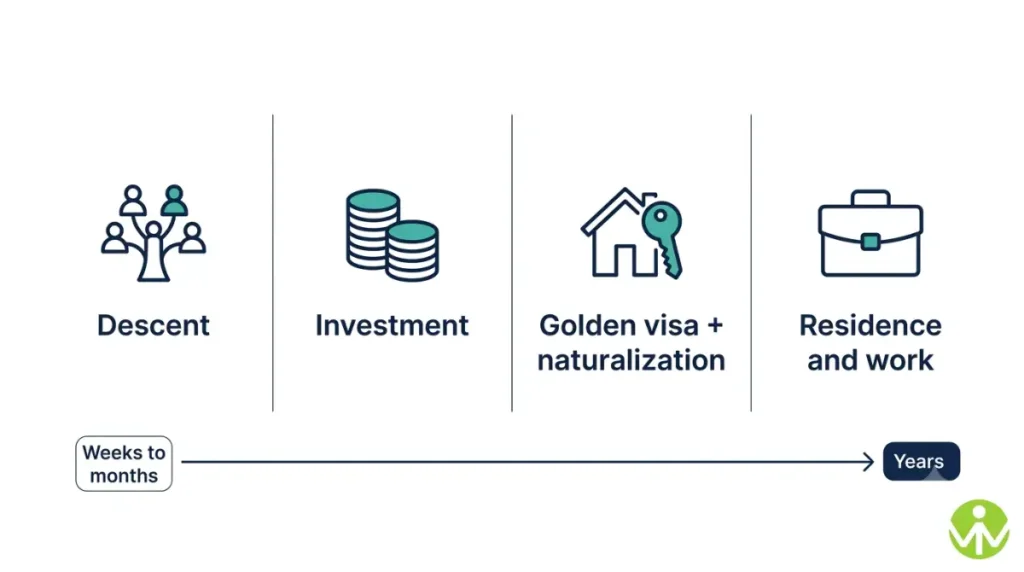
Citizenship by descent
If a parent or grandparent held another nationality, you may already be entitled to it, and so to US dual citizenship without buying anything or moving anywhere. Descent claims are recognitions of an existing right rather than applications for a new one, so the work is mostly documentary: birth, marriage and naturalization records, often going back two or three generations.
Table 1 — Citizenship by descent: main routes for US citizens
| Country | Who may qualify | Key conditions in 2026 | How to apply |
|---|---|---|---|
| Ireland | Child of an Irish citizen; grandchild of someone born in Ireland | Grandchildren must be entered in the Foreign Births Register before citizenship takes effect | Foreign Births Register; no residence or language requirement |
| Italy | Child or grandchild of an Italian citizen, under Law 74/2025 | The parent or grandparent must have held only Italian citizenship, or a parent must have lived in Italy for two years before the applicant’s birth; uupheld by the Constitutional Court (judgment 63/2026, decided 11 March, filed 30 April 2026); further questions referred to the EU Court of Justice in July 2026 | Italian consulate or Italian court; documentation-heavy |
| Germany | Descendants of people deprived of German citizenship by the Nazi regime | Restoration under Article 116(2) of the Basic Law and section 15 of the Nationality Act | German mission abroad or the Federal Office of Administration |
| Poland | Descendants of Polish citizens | No generational cap, but records must show citizenship was never lost along the line | Confirmation of citizenship through a Polish consulate or voivode |
| Mexico | Children of a Mexican national | Since 2021 this includes children born abroad to Mexican parents who were themselves born abroad | Birth registration at a Mexican consulate |
| Portugal | Children of a Portuguese citizen; grandchildren under stricter conditions | The Sephardic descent route closed on 19 May 2026 under Organic Law 1/2026 | Portuguese consulate or Central Registry Office |
| Summarised from each country’s nationality law as it stood in September 2026. Italy and Portugal both changed their rules in 2025 and 2026, so confirm with the consulate before gathering documents. Compiled 25 September 2026. | |||
Descent is the cheapest route to US dual citizenship, since the costs are documents, translations and consular fees. It is also the route most exposed to change. Italy and Portugal both narrowed their rules within a year of each other, and claims already in progress were not always protected. Our guide to Italian citizenship explains who still qualifies by descent under Italy’s Law 74/2025.
Citizenship by investment
Citizenship by investment is the fastest route to US dual citizenship. It grants a passport in return for a donation or a qualifying investment, usually with no requirement to live in the country. Five Caribbean states run the best-known programmes and are now regulated jointly through a new regional authority, ECCIRA. Our citizenship by investment guide compares every open programme. The table below shows the most commonly considered options and what each passport opens. Minimums are in US dollars (US$250,000 in euros).
Table 2 — Citizenship by investment: programmes most often considered
| Country | Minimum investment | Passport rank (July 2026) | Visa-free destinations | Indicative timeline |
|---|---|---|---|---|
| St Kitts and Nevis | US$250,000 | 21st | 157 | 6 months or more |
| Antigua and Barbuda | US$230,000 | 24th | 154 | 3-6 months |
| Grenada | US$235,000 | 27th | 148 | 3-4 months |
| Dominica | US$200,000 | 30th | 144 | 6-9 months |
| Saint Lucia | US$240,000 | 31st | 143 | 6 months or more |
| Vanuatu | US$130,000 | 58th | 86 | 30-60 days |
| Minimums are for a single applicant and exclude government, due diligence and processing fees. Ranks and destination counts from the Henley Passport Index, July 2026. Minimums and timelines match the ImmigrationWorld citizenship by investment guide; confirm with each national authority. Compiled 25 September 2026. | ||||
Three points matter more than the price. St Kitts citizenship carries the strongest passport of the five and comes from the oldest programme, running since 1984. Grenada citizenship is the only one of the five with an E-2 investor treaty with the United States, but an investor who gained Grenadian nationality through investment must have been domiciled in Grenada for three continuous years before applying for an E-2 visa.
Second, the European Union has asked the five Caribbean states to phase out their programmes by 1 June 2028 to keep visa-free Schengen access, and it has already ended visa-free travel for Vanuatu nationals. Third, a US presidential proclamation of 16 December 2025 restricted the entry of nationals of Antigua and Barbuda and of Dominica, citing their programmes. None of this affects a US citizen entering the United States on a US passport, but it does affect what the second passport is worth.
No EU country sells citizenship. The EU’s top court ended Malta’s citizenship programme in April 2025, and Malta’s investor route now grants permanent residence, not a passport. Price is a poor guide to value in any case: the most expensive passports are not the strongest ones.
Residence by investment, then naturalization
A golden visa grants residence, not citizenship. US dual citizenship follows only if you later naturalize under that country’s ordinary rules, which is why the naturalization law matters more than the investment. Our guide to golden visas by country covers each programme and its minimum.
Portugal shows the risk. Its golden visa is open, from EUR 250,000 for a cultural contribution or EUR 500,000 in qualifying funds (EUR 250,000 in US dollars), with light physical-presence requirements. But Organic Law 1/2026, in force since 19 May 2026, extended the residence needed for naturalization from five years to ten, or seven for citizens of EU and Portuguese-speaking (CPLP) countries. The golden visa itself did not change. The finish line moved. Our guide to Portugal permanent residency covers the residence side.
Greece now sets three tiers for property: EUR 800,000 in Attica, Thessaloniki, Mykonos, Santorini and the larger islands, EUR 400,000 elsewhere, and EUR 250,000 only for converting commercial buildings to residential use or restoring listed buildings. Spain closed its golden visa to new applicants on 3 April 2025, so it no longer offers a path to US dual citizenship.
Naturalization through residence and work
The slowest route is also the most ordinary: live in another country on a work, family or residence permit, then apply for citizenship, and with it US dual citizenship, once you qualify. It needs the right permit first, and our guide on how to apply for a work visa sets out the options. After that, it needs years of genuine residence.
Table 3 — Naturalization through residence: standard adult routes
| Country | Residence before naturalization | Notes for 2026 |
|---|---|---|
| Canada | 3 years (1,095 days) of physical presence in the 5 years before applying | Dual citizenship permitted |
| Germany | 5 years | Three-year fast track abolished in October 2025; dual citizenship permitted since June 2024 |
| Ireland | 5 years of reckonable residence in the last 9, including 1 continuous year before applying | Dual citizenship permitted |
| Portugal | 10 years (7 for EU and CPLP nationals) | Extended from 5 years on 19 May 2026 |
| Italy | 10 years for non-EU nationals | B1 Italian language certificate required |
| Spain | 10 years (2 for nationals of Ibero-American countries, Andorra, the Philippines, Equatorial Guinea and Portugal) | Most applicants must declare renunciation of their previous nationality |
| Mexico | 5 years (2 for Latin American and Iberian nationals) | Applicants formally renounce their previous nationality under Mexican law |
| Standard adult routes only; marriage, descent and special routes are shorter in several countries. Dual-citizenship notes refer to the country of naturalization. Compiled 25 September 2026. | ||
Check the dual-nationality rule of the country you naturalize in, too. Spain asks most applicants to declare that they renounce their previous nationality. For US dual citizenship, that declaration does not by itself end US citizenship, because US law requires intent, but it is a question to settle with a lawyer before the ceremony.
Living with US dual citizenship: passports, travel and obligations
The rule that surprises most people new to US dual citizenship is simple. US law requires US citizens to enter and leave the United States on a US passport, even if they hold another one. Use the other passport for the other country, and for third countries where it gives better access. The US passport currently opens 180 destinations without a visa, and our list of countries US citizens can visit without a visa goes through them.
US dual citizenship also means obligations to both countries. The other country may require military service, jury service or national registration, and on its own soil it will usually treat you as its citizen, which limits US consular help there. A nationality gained through investment can carry continuing duties of its own, such as the biometric enrolment St Kitts and Nevis now requires of its investor citizens.
US dual citizenship and tax: what does not change
The United States taxes its citizens on worldwide income wherever they live. A second nationality does not change that, so US dual citizenship on its own brings no US tax benefit, including through Caribbean states that levy no personal income tax.
- Annual return: a US citizen files a federal return on worldwide income, using foreign tax credits or the foreign earned income exclusion to limit double taxation where they apply.
- FBAR: if the combined value of your foreign financial accounts exceeds US$10,000 at any point in the year, you must file an FBAR with FinCEN.
- Form 8938: FATCA reporting of specified foreign financial assets applies above separate, higher thresholds.
- Renunciation: giving up US citizenship can trigger the expatriation tax for covered expatriates, broadly those with a net worth of US$2 million or more, an average annual income tax liability above an inflation-adjusted threshold, or who cannot certify five years of tax compliance.
Tax planning around US dual citizenship is specialist work. Take advice from a US-qualified international tax adviser, not only an immigration lawyer, before acting.
Why demand for US dual citizenship has grown
Demand from Americans for a second passport has risen sharply. Henley & Partners, one of the largest investment migration firms, reported in October 2025 that Americans had become “by far the largest group of applicants” for its programmes, and that applications from US nationals by the end of the third quarter were already 67% above the total for 2024. These are one firm’s client figures rather than a market-wide count, but they point the same way as the passport data.
On mobility, the US passport has slipped from first place in 2006 to tenth. In the July 2026 Henley Passport Index it opened 180 destinations, against 192 for Singapore in first place. For most applicants a second citizenship works as insurance rather than an exit: it adds a right to live somewhere else without removing any right at home. That is the core of US dual citizenship, and why the rules above matter more than the headline price.
Frequently asked questions about US dual citizenship
Does the US allow dual citizenship?
Yes. US law permits it, and since 1967 the Supreme Court has held that US citizenship can only be lost through a voluntary act done with the intent to give it up. A second passport on its own does not end US citizenship.
Do I have to give up my citizenship to become a US citizen?
Not in US practice. The Oath of Allegiance includes renouncing prior allegiances, but whether your first citizenship survives is decided by your own country’s law. Some countries end it automatically. Others do not.
Will the Exclusive Citizenship Act end US dual citizenship?
Not as things stand. S.3283 was introduced on 1 December 2025 and referred to the Senate Judiciary Committee, and there had been no further action by September 2026. Any law that passed would also have to be reconciled with Afroyim v. Rusk.
Can I enter the US on my other passport?
No. US dual citizenship does not change the passport rule: US citizens must enter and leave the United States on a US passport. Use the other passport for the other country, and for third countries where it gives better access.
Does US dual citizenship reduce my US taxes?
No. US citizens are taxed on worldwide income wherever they live, and foreign accounts above US$10,000 in aggregate must be reported. Only renouncing US citizenship ends US tax obligations, and renunciation can itself trigger an exit tax.
How much does it cost to renounce US citizenship?
The State Department fee for a Certificate of Loss of Nationality has been US$450 since 13 April 2026, down from US$2,350. Renunciation is irreversible and can carry exit tax, so for most people it is not the aim of US dual citizenship.