
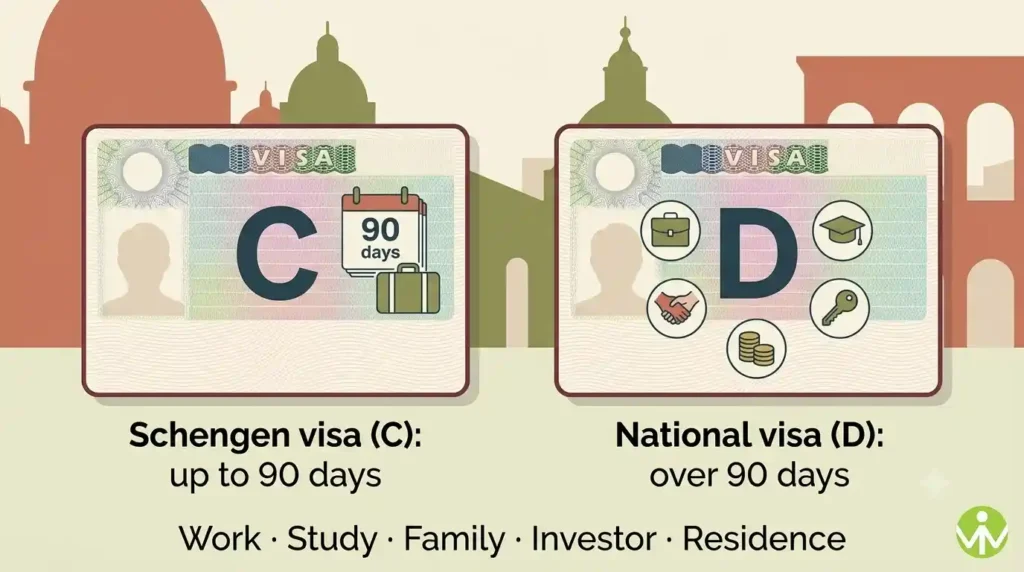
Italy visas fall into two families: short-stay Schengen visas for visits of up to 90 days, and long-stay national visas for anyone who plans to work, study, invest, join family, or retire in Italy. Which type of Italy visa you need depends on three things: your nationality, why you are going, and how long you will stay.
Italy is part of the Schengen Area, so a short-stay visa it issues is normally valid across all 29 Schengen countries. A long-stay visa works differently. It is issued under Italian national law, it only gets you through the border, and it has to be followed by a residence permit once you arrive. This guide covers all the main types of Italy visas, what each one costs in 2026, how to apply and what has changed this year.
Key Takeaways
- There are two broad types of Italy visa: the short-stay Schengen (Type C) visa for up to 90 days in any 180-day period, and the long-stay national (Type D) visa for anything longer.
- Nationals of about 60 countries, including the UK, the US, Canada, Australia and Japan, can visit Italy visa-free for up to 90 days in any 180, but cannot work.
- Fees in 2026: €90 for an adult Schengen visa, €116 for most long-stay types of Italy visa and €50 for a study visa.
- Most work visas depend on the annual Decreto Flussi quota (164,850 places in 2026); other types of Italy visa, including the EU Blue Card, investor, digital nomad and research routes, sit outside it.
- Every long-stay visa holder must apply for a residence permit (permesso di soggiorno) within 8 working days of arriving in Italy.
- The Entry/Exit System has replaced passport stamps since 10 April 2026; ETIAS is not yet in operation and has no confirmed start date.
Table of Contents
Types of Italy visa at a glance
The table below lists the main types of Italy visa, the letter each one carries on the sticker, and who it is designed for. Each row is covered in more detail further down, with a link to our dedicated guide where one exists.
| Visa | Type | Typical length | Who it is for |
|---|---|---|---|
| Schengen short-stay visa (tourism, family, business) | C | Up to 90 days in any 180 | Visitors, business travellers and short courses |
| Airport transit visa | A | Airport international zone only | Certain nationalities changing flights in Italy |
| Work visa (salaried employment) | D | Linked to the contract; first permit up to 2 years | Employees with a nulla osta issued under the quota |
| EU Blue Card | D | 2 years, or the contract plus 3 months | Graduates with a job paying the salary threshold |
| Self-employment and Italia Startup Visa | D | 1 year, renewable | Freelancers, entrepreneurs and startup founders |
| Investor visa | D | 2 years, renewable for 3 | Investors of €250,000 to €2,000,000 |
| Study visa | D | Length of the course, renewed yearly | Students on courses longer than 90 days |
| Family reunification visa | D | Linked to the sponsor’s permit | Spouses, children and dependent parents of residents |
| Elective residence visa | D | 1 year, renewable | Retirees and people living on passive income |
| Digital nomad and remote worker visa | D | Up to 1 year, renewable | Highly skilled remote workers |
| Working holiday visa | D | Up to 12 months | Young adults from six partner countries |
| Research visa | D | Length of the research project | Researchers with a hosting agreement |
| Source: Italian Ministry of Foreign Affairs (vistoperitalia.esteri.it) and Italian embassy guidance, checked September 2026. Lengths are typical; the residence permit, not the visa, sets how long you may stay. | |||
Two points apply to all of the long-stay types of Italy visa. First, you apply from the country where you legally live, not from inside Italy. Second, the visa only authorises entry; the permit you collect afterwards is what lets you stay.
Do you need a visa for Italy?
Citizens of the EU, the European Economic Area and Switzerland never need a visa for Italy. They can live and work there freely, registering their residence with the local town hall if they stay longer than three months.
Nationals of about 60 other countries and territories, including the UK, the United States, Canada, Australia, New Zealand, Japan, South Korea, Brazil, Mexico and Singapore, can enter Italy without a visa for up to 90 days in any 180-day period. That allowance covers the whole Schengen Area, not Italy alone, and it does not allow paid work. The list is set by EU regulation rather than by Italy, and it changes from time to time, so the safest check is the questionnaire on the Italian foreign ministry’s official Visa for Italy portal, which asks for your nationality, country of residence, purpose and length of stay.
Everyone else needs one of the short-stay types of Italy visa for a short trip. And anyone who is not an EU citizen needs one of the long-stay types of Italy visa to stay longer than 90 days, whatever their passport.
The Entry/Exit System replaced passport stamps
Since 10 April 2026, the EU’s Entry/Exit System is fully operational at every Schengen border. Non-EU visitors on short stays have their fingerprints and a facial image recorded at their first crossing, and each entry and exit is logged digitally instead of being stamped in the passport. It applies whether you hold a Schengen visa or travel visa-free.
ETIAS is not yet in operation
ETIAS, the travel authorisation that visa-exempt visitors will eventually need, is not a visa and will not replace any of the types of Italy visa. It has not started yet. The EU dropped its late-2026 target during the summer, and as of late September 2026 no new start date had been announced. When it does launch, it is set to cost €20 and to last three years or until the passport expires. No website can take ETIAS applications yet, so treat any that claims to with caution.
Short-stay Schengen types of Italy visa
In practice, short-stay Italy visas are one type: the uniform Schengen visa, marked Type C. It allows up to 90 days in any 180-day period across the Schengen Area. What changes from one purpose to the next is the supporting evidence the consulate asks for, not the visa itself. The main purposes are:
- Tourism, backed by an itinerary, accommodation bookings and proof of funds.
- Visiting family or friends, usually with an invitation from the host.
- Business, such as meetings, trade fairs or negotiations, backed by a letter from the Italian company.
- Medical treatment, with confirmation from the Italian hospital or clinic and proof that costs are covered.
- Cultural, sporting or religious events, backed by an invitation from the organiser.
- Study courses of up to 90 days, such as a language school or summer programme.
You can apply up to six months before you travel and no later than 15 days before. A decision normally takes 15 calendar days, but can be extended to 45 when a consulate needs more checks. Every applicant needs travel medical insurance covering at least €30,000, and frequent travellers with a good record can be given multiple-entry visas valid for several years. Our guide to the Italy tourist visa walks through the documents, and our Schengen visa explainer covers the rules that apply across the whole area.
In rare cases, Italy issues a visa with limited territorial validity (LTV). It is granted on humanitarian grounds, for reasons of national interest or because of international obligations, usually when a standard Schengen visa cannot be issued, and it is valid only for Italy or for the countries named on it.
Italy airport transit visa
The airport transit visa (Type A) is the narrowest type of Italy visa. It lets a traveller wait in the international transit area of an Italian airport between two flights without entering the Schengen Area. Most nationalities do not need one. According to Italy’s official airport transit visa list, nationals of the 16 countries below do.
Table 2: Nationalities that need an Italy airport transit visa
| Nationality | Region |
|---|---|
| Afghanistan | Asia |
| Bangladesh | Asia |
| Democratic Republic of the Congo | Africa |
| Eritrea | Africa |
| Ethiopia | Africa |
| Ghana | Africa |
| Iran | Middle East |
| Iraq | Middle East |
| Nigeria | Africa |
| Pakistan | Asia |
| Senegal | Africa |
| Somalia | Africa |
| Sri Lanka | Asia |
| Syria | Middle East |
| Tajikistan | Central Asia |
| Uzbekistan | Central Asia |
| Source: Italian Ministry of Foreign Affairs list of countries subject to the airport transit visa, checked September 2026. Holders of certain visas or residence permits are exempt. | |
Travellers from these countries are exempt if they hold a valid visa or residence permit from an EU or Schengen country, or a valid visa or residence permit from certain other countries, including Canada, Japan and the United States. Family members of EU citizens, holders of diplomatic passports and flight crew are also exempt.
Long-stay national types of Italy visa
Long-stay Italy visas are national visas, marked Type D, for stays of more than 90 days. The Italian embassy or consulate responsible for your place of residence issues them. Most of them follow the same pattern. First, someone in Italy, or you yourself, obtains an authorisation called a nulla osta. Then you apply for the visa abroad. Finally, you enter Italy and apply for the residence permit. A national visa also allows short trips to other Schengen countries while it is valid.
Work visa and the Decreto Flussi
Of Italy’s long-stay visa types, the work visa is the most requested and the most restricted. For ordinary salaried work, the employer applies for a nulla osta at the immigration desk (Sportello Unico per l’Immigrazione) of the local prefecture. Applications are only accepted within the annual quota set by the Decreto Flussi, the flows decree, and they are submitted online on fixed “click days”. The current decree covers three years at once and allows 497,550 permits between 2026 and 2028.
Table 3: Decreto Flussi work permit quotas, 2026 to 2028
| Year | Seasonal work | Non-seasonal work | Total |
|---|---|---|---|
| 2026 | 88,000 | 76,850 | 164,850 |
| 2027 | 89,000 | 76,850 | 165,850 |
| 2028 | 90,000 | 76,850 | 166,850 |
| 2026 to 2028 | 267,000 | 230,550 | 497,550 |
| Source: Decreto Flussi 2026 to 2028 as reported by Italian immigration practitioners, checked September 2026. Quotas are shared out by sector and by applicant nationality. | |||
The 2026 click days were 12 January for seasonal farm work, 9 February for seasonal tourism work, 16 February for non-seasonal employment and 18 February for domestic and care work. Once the nulla osta is granted, the worker applies for the visa, enters Italy and signs a residence contract at the immigration desk. Some categories sit outside the quota altogether, including executives, researchers, university teachers and intra-company transferees. Our Italy work visa guide covers the documents and the process step by step.
EU Blue Card
Among the work-related types of Italy visa, the EU Blue Card is the route for highly qualified employees, and it is not subject to the quota. Applicants need a higher-education qualification, or in some cases equivalent professional experience, plus a binding job offer of at least six months at or above a salary threshold that is updated every year. The European Commission’s EU Blue Card Italy page lists a threshold of €33,500 for 2024, and practitioners report that it has risen to around €36,000 for 2026. The card is issued for two years, or for the length of the contract plus three months. Our EU Blue Card guide compares how the card works across the EU.
Self-employment and the Italia Startup Visa
The self-employment visa (lavoro autonomo) covers freelancers, professionals and people opening a business. It usually requires evidence of the resources needed for the activity, the relevant qualifications or registrations, and a nulla osta from the police headquarters (Questura). Founders of innovative startups can use a separate, faster channel, the Italia Startup Visa. A dedicated committee reviews the business plan, and applicants must show at least €50,000 in available funding. Our Italian startup visa guide explains the committee stage, and our startup visa comparison sets Italy alongside other countries’ schemes.
Investor visa
The investor visa is the only one of the types of Italy visa tied to a fixed investment amount. It is a residence route, not a citizenship programme. It is open to people who invest €2,000,000 in Italian government bonds, €500,000 in an Italian limited company, €250,000 in an innovative Italian startup, or who donate €1,000,000 to a project of public interest in areas such as culture, education or scientific research. Property purchases do not qualify. The nulla osta is issued online by a government committee, the investment must be made within three months of arrival, and the first permit lasts two years and can be renewed for three more. Our golden visa comparison shows how Italy’s tiers compare with other European programmes.
Study visa
Students are covered by two types of Italy visa: a Schengen visa for courses of up to 90 days and a national study visa for anything longer. University applicants usually pre-enrol through the Universitaly portal and must show accommodation, health insurance and funds meeting an annual minimum set by the Ministry of University and Research. Students can work up to 20 hours a week, capped at 1,040 hours a year. Graduates of Italian universities can convert their permit into a work permit or apply for a 12-month permit to look for work. Our Italy student visa guide covers the application in detail.
Family reunification visa
Among the types of Italy visa, family reunification is the one where the process starts with a relative who already lives in Italy. Non-EU residents holding a permit valid for at least a year can bring their spouse, their minor children, and in some cases adult children or parents who depend on them. The resident applies for the nulla osta and has to show suitable housing and an income of at least the annual social allowance (assegno sociale), raised by half for each family member. The relatives then apply for the visa and, once in Italy, receive a family permit that allows them to work.
Elective residence visa
Of all the types of Italy visa, the elective residence visa is the one designed for people who want to live in Italy without working, most often retirees. Applicants must show stable passive income from pensions, rents or investments. Italian consulates have long used a guideline of about €31,000 a year for one person, raised by 20% for a spouse and by 5% for each child. Consulates apply that guideline with discretion, and some expect more. Applicants also need accommodation in Italy. The permit does not allow employment and is renewed every year.
Digital nomad and remote worker visa
The newest of the types of Italy visa, introduced in April 2024, is for highly skilled remote workers, whether employees of a foreign company or freelancers with foreign clients. Applicants need an annual income of at least three times the minimum level for exemption from healthcare charges, currently about €28,000. They also need a university degree or equivalent qualification or experience, at least six months of remote-work experience, health insurance and accommodation. No nulla osta or quota applies, and the permit lasts up to a year and can be renewed. Our digital nomad visa guide compares similar schemes elsewhere.
Working holiday visa
Italy has working holiday agreements with Australia, Canada, Hong Kong, Japan, New Zealand and South Korea. The Japan agreement was ratified in September 2025. It is the only one of the types of Italy visa with an age limit: applicants are generally aged 18 to 30, or up to 35 for Canadians. The visa lasts up to 12 months, and the main purpose of the stay must be holiday and cultural exchange, with work allowed on the terms of each agreement.
Other national visas
Italy also issues national visas for research, based on a hosting agreement with an approved institute, and for religious reasons, sport, medical treatment longer than 90 days, adoption and official missions. There is also a re-entry visa for residents whose permit expired or was lost while they were abroad. These are the less common types of Italy visa, and the consulate’s instructions for each are on the official visa portal.
What the types of Italy visa cost in 2026
Fees for all types of Italy visa are set in euros and paid in local currency at the consular exchange rate. A Schengen visa costs €90 for adults and €45 for children aged 6 to 12. Most long-stay types of Italy visa cost €116, while a study visa costs €50. When ETIAS launches, it will cost €20
Table 4: Italy visa fees in 2026
| Visa or permit | Fee | Notes |
|---|---|---|
| Schengen short-stay visa, adult | €90 | Children under 6 pay nothing |
| Schengen short-stay visa, child aged 6 to 12 | €45 | Some groups are exempt, such as students on school trips |
| Airport transit visa | €90 | Same fee as the Schengen visa |
| National long-stay visa, most types | €116 | Work, family, elective residence, investor and others |
| National study visa | €50 | Courses longer than 90 days |
| Residence permit after arrival | €40 to €100, plus about €76 | Contribution varies by permit length; the extra covers the card, a revenue stamp and postage |
| Source: Italian embassy fee schedules and the European Commission, checked September 2026. Fees are paid in local currency at the consular exchange rate; visa-centre service charges are extra. | ||
Visa application centres add their own service charges, and the residence permit you apply for after arrival has separate costs. Fees are not refunded if a visa is refused.
How to apply for an Italy visa
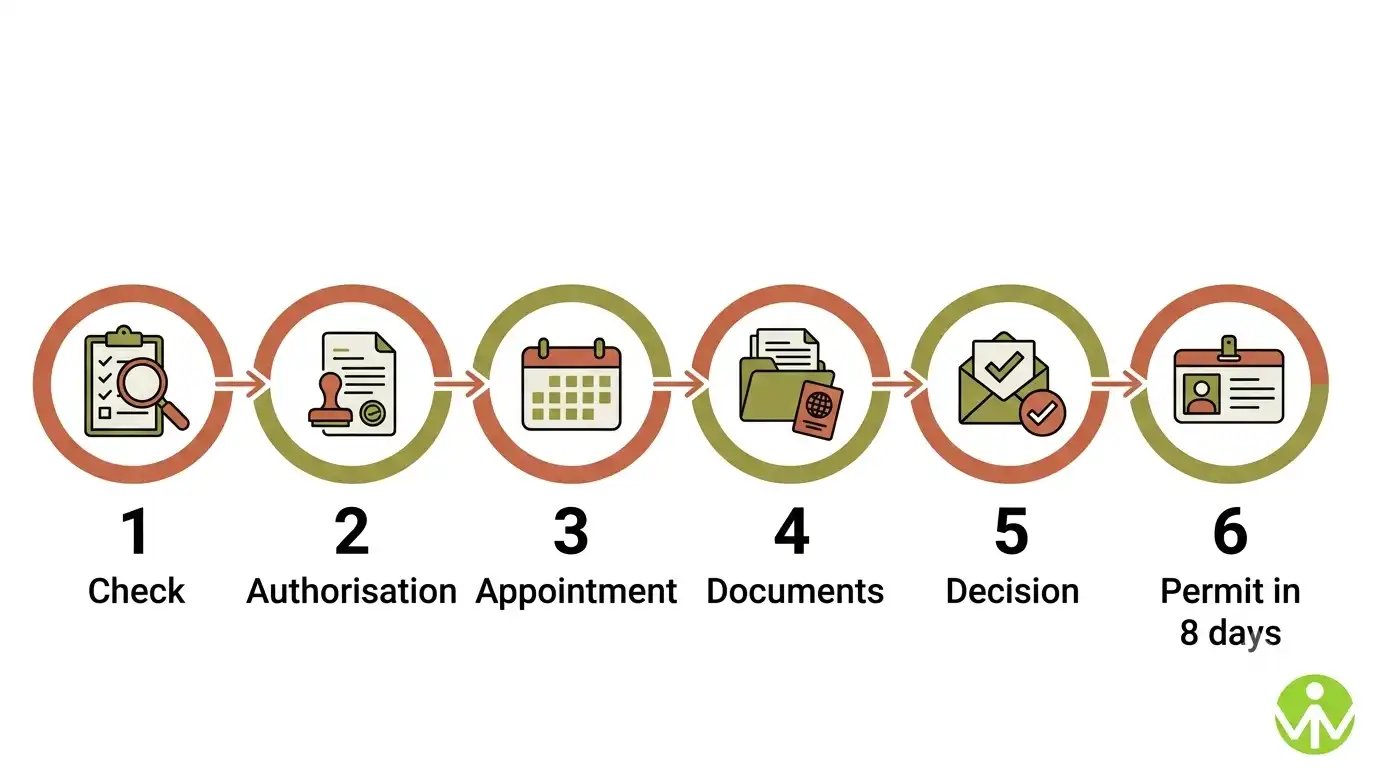
The steps are broadly the same for all types of Italy visa, although the long-stay routes add a nulla osta or similar authorisation at the start.
- Confirm which visa you need using the questionnaire on the Visa for Italy portal.
- Obtain any authorisation that must come first, such as a work or family nulla osta, investor committee approval or university pre-enrolment.
- Book an appointment with the Italian embassy, consulate or visa application centre that covers your place of legal residence.
- Submit the application form, a passport with at least three months’ validity beyond your stay, photographs, travel or health insurance, proof of funds and accommodation, and the documents specific to your purpose. Fingerprints are taken at the appointment.
- Pay the fee and wait for the decision. For a Schengen visa this is usually 15 days; long-stay visas often take several weeks.
- Travel to Italy and, if you hold a national visa, apply for your residence permit within 8 working days.
After you arrive: residence permits, long-term residence and citizenship
Whichever of the long-stay types of Italy visa you hold, you have to apply for a residence permit (permesso di soggiorno) within 8 working days of arriving. For most permit types the application is sent through a post office using a pre-printed kit, followed by an appointment at the Questura for fingerprints. Work and family permits start with the residence contract signed at the immigration desk.
After five years of continuous legal residence, non-EU nationals can apply for the EU long-term residence permit. It has no expiry date and requires a minimum income and a pass in an A2-level Italian test. Citizenship by naturalisation is generally available after ten years of legal residence for non-EU nationals, or four years for EU citizens, with B1-level Italian. A June 2025 referendum proposal to cut the ten years to five failed to reach the required turnout.
Citizenship by descent has also narrowed. A decree of March 2025, later converted into Law 74/2025, restricted recognition for people born abroad with Italian ancestry, and the Constitutional Court upheld the restrictions in April 2026. Italy does not sell citizenship; our citizenship by investment guide explains which countries do. Our guide to moving to Italy covers the practical side of settling in.
What changed for Italy visa applicants in 2026
Several of the types of Italy visa were affected by changes over the past year:
- The Entry/Exit System became fully operational on 10 April 2026, replacing passport stamps for short-stay visitors.
- ETIAS lost its late-2026 launch target and still has no confirmed start date.
- The first three-year Decreto Flussi set work quotas for 2026, 2027 and 2028 in one decree.
- The working holiday agreement with Japan, ratified in September 2025, brought the number of partner countries to six.
- The EU Blue Card salary threshold was raised again in line with its annual update.
- The Constitutional Court upheld the 2025 limits on citizenship by descent.
How to choose between the types of Italy visa
Start with the length of your stay. For 90 days or less, you need either nothing, if your passport is visa-exempt, or a Schengen visa. Anything longer means choosing among the long-stay types of Italy visa, and the choice follows your purpose.
If you have an Italian job offer, the work visa is the default. It depends on the quota, so the EU Blue Card is worth checking first if you are a graduate on a qualifying salary. If you work remotely for clients or an employer outside Italy, look at the digital nomad visa. If you plan to live on savings or a pension, the elective residence visa is the usual route. Founders should compare the self-employment visa with the Italia Startup Visa, and people with capital to deploy can consider the investor visa. Students, family members and young travellers from partner countries each have their own route. If you are still unsure which of the types of Italy visa applies, the official questionnaire gives a definitive answer for your nationality and purpose.
Frequently asked questions about types of Italy visa
How many types of Italy visa are there?
There are two broad types of Italy visa: the short-stay Schengen visa for up to 90 days and the long-stay national visa for longer stays. Within those, Italy lists around 20 purposes, from tourism and business to work, study, family, investment, elective residence and research.
Can I work in Italy on a Schengen visa?
No. A Schengen visa, and visa-free entry, allow visits, meetings and short courses but not paid work for an Italian employer. To work, you need a national work visa, an EU Blue Card or another long-stay route that allows employment.
How much does an Italy visa cost in 2026?
A Schengen visa costs €90 for adults and €45 for children aged 6 to 12. Most national visas cost €116 and a study visa costs €50. Visa-centre charges and residence-permit costs are extra.
How long does it take to get an Italy visa?
Processing times differ widely between the types of Italy visa. A Schengen visa decision normally takes 15 days, extendable to 45. National visas take longer, especially where a nulla osta is needed first; work and family routes can take several months from the employer’s or sponsor’s application.
Can I switch from a Schengen visa to a long-stay visa inside Italy?
Generally no. A long-stay visa has to be applied for from the country where you live. Short-stay entry cannot normally be converted into a residence permit, apart from a few specific exceptions.
Do I need ETIAS to visit Italy?
Not yet. ETIAS is not in operation and the EU has not announced a start date. Visa-exempt travellers currently need only a valid passport and must register through the Entry/Exit System at the border.
Which type of Italy visa lets me retire there?
The elective residence visa is the usual route for retirees. It requires stable passive income, about €31,000 a year for one person as a guideline, plus accommodation in Italy, and it does not allow you to work.