
Citizenship by investment is the shortest legal route to a second passport, and the landscape changed more between 2022 and 2026 than in the two decades before it. Four established programmes have closed. The European Union’s highest court has ruled that selling citizenship is incompatible with EU law. And the Commission has set a deadline of June 2028 for the Caribbean programmes to wind down or lose visa-free access to Schengen.
This guide sets out which programmes are still open, what they cost, which have closed and why, and how to tell the difference between a route that ends in a passport and one that only ends in a residence permit. Figures were compiled on 21 September 2026, and every closure is sourced to the government or court that ordered it.
| Question | Answer |
|---|---|
| What is citizenship by investment? | A route where a qualifying investment leads directly to a passport, with little or no residence requirement. |
| What it is not | A golden visa. Those grant residence, and citizenship follows years later through ordinary naturalisation, if at all. |
| Cheapest open route | Sao Tome and Principe, from US$90,000. Vanuatu is the fastest at 30 to 60 days. |
| The Caribbean five | Antigua and Barbuda, Dominica, Grenada, St Kitts and Nevis, St Lucia. Now regulated jointly by ECCIRA. |
| The biggest change | Malta’s programme was struck down by the EU’s top court on 29 April 2025. There is no EU citizenship by investment left. |
| The deadline that matters | The European Commission has demanded the Caribbean programmes be phased out by 1 June 2028 to keep Schengen visa-free access. |
| Portugal’s catch | Its golden visa is open, but naturalisation now takes 10 years, not 5. |
| Compiled 21 September 2026. Sources listed in the article. | |
Table of Contents
What citizenship by investment is, and what it is not
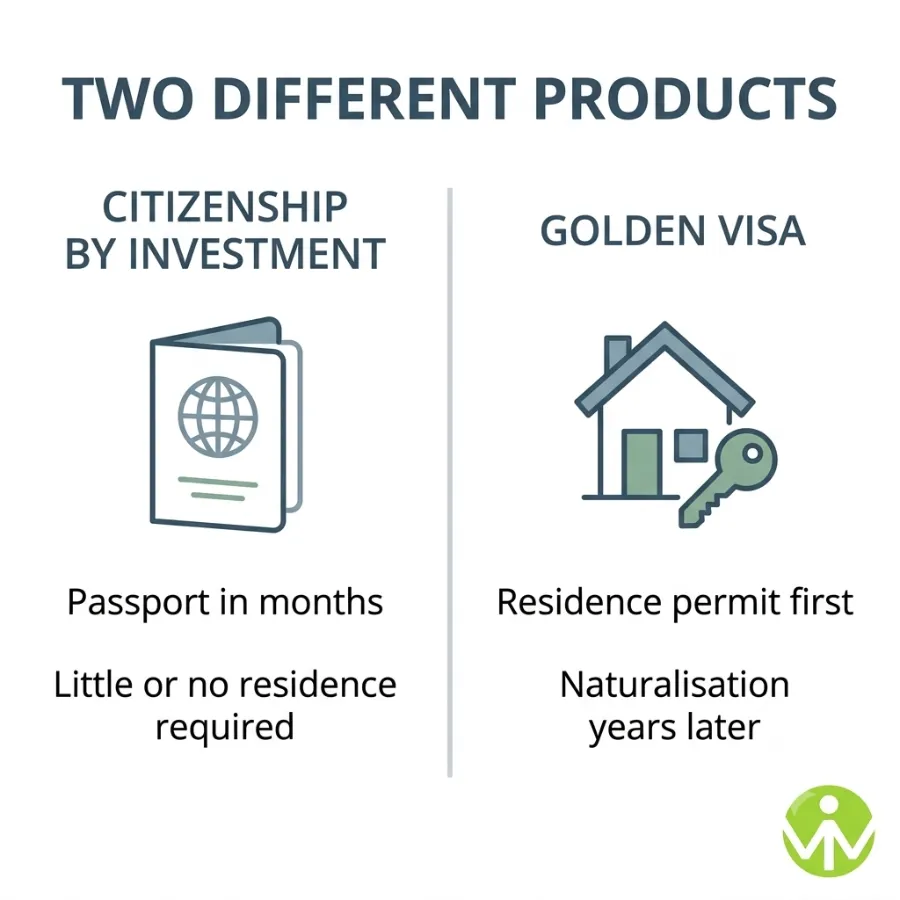
Citizenship by investment grants a passport in exchange for a qualifying economic contribution, with little or no requirement to live in the country. The application is usually handled remotely through a licensed agent, the investment is made into a government fund or approved real estate, and the outcome is naturalisation by a route written specifically for investors.
A golden visa is different and is often confused with this. A golden visa grants residence. Citizenship, if it comes at all, comes later through the ordinary naturalisation process, after a qualifying period of legal residence and usually a language test, a civics test and a good-character assessment. The distinction is the most important thing to understand before spending anything, and it is where most comparisons of these programmes fall apart. Our guide to residence and golden visa programmes covers that second category in detail.
Two consequences follow. The first is timing: a direct route delivers a passport in months, a residence route in years, and in some countries the residence route has just become considerably slower. The second is certainty. A direct programme has a published price and a published process. A residence route depends on a naturalisation law that can change while you are living under it, as investors in Portugal discovered this year.
There is also a third category worth naming and setting aside. Programmes like the United States EB-5 investor visa grant permanent residence on an employment-creation basis and are not investment migration in the sense used here, even though they are frequently marketed alongside it.
Citizenship by investment programmes open in 2026
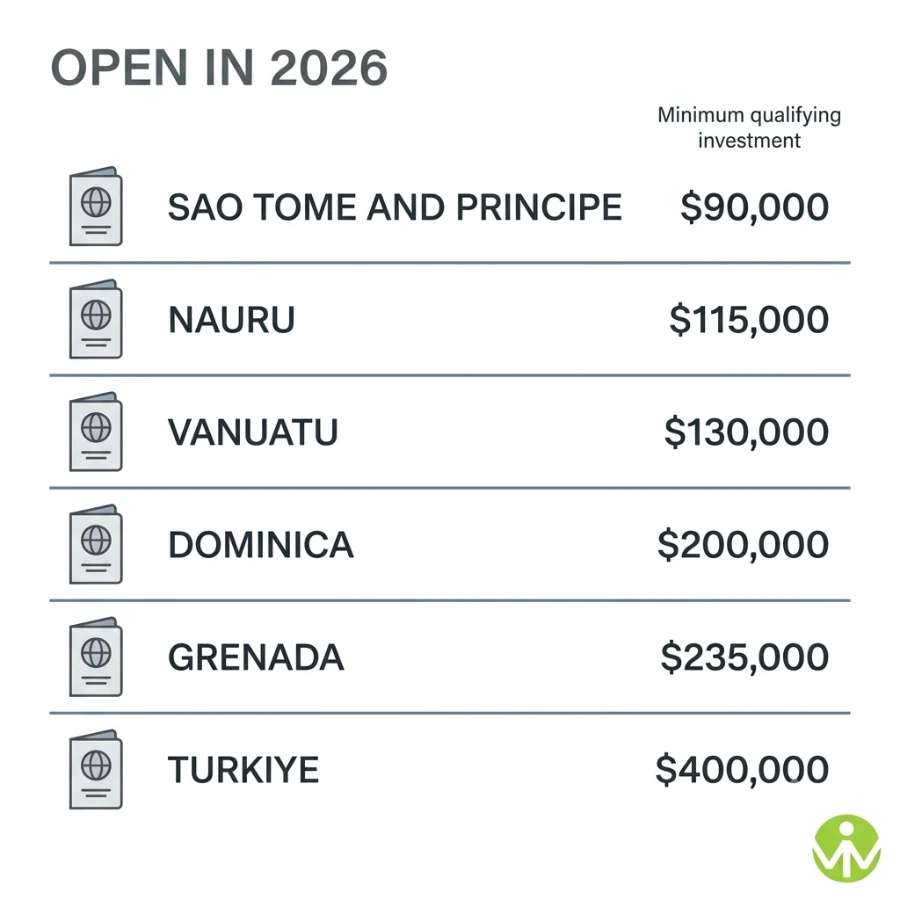
| Country | Minimum qualifying investment | Indicative timeline | Route |
|---|---|---|---|
| Sao Tome and Principe | US$90,000 | 6-8 weeks | Donation |
| Nauru | US$115,000 | 3-4 months | Contribution |
| Vanuatu | US$130,000 | 30-60 days | Donation |
| Dominica | US$200,000 | 6-9 months | Donation or real estate |
| Antigua and Barbuda | US$230,000 | 3-6 months | Donation |
| Grenada | US$235,000 | 3-4 months | National Transformation Fund or real estate |
| Saint Lucia | US$240,000 | 6 months or more | Contribution or real estate |
| Saint Kitts and Nevis | US$250,000 | 6 months or more | Donation |
| Egypt | US$250,000 | About 10 months | Investment |
| Turkiye | US$400,000 | 3-6 months | Real estate or bank deposit |
| Austria | No published figure | Case by case | Discretionary, exceptional-merit basis |
| Minimums are the published entry point for a single applicant and exclude government, due diligence and processing fees. Grenada’s figures are verified against the Investment Migration Agency. The remainder are published programme minimums and should be confirmed with each national authority before any decision. Compiled 21 September 2026. | |||
Eleven jurisdictions currently operate a route where investment leads directly to a passport. They divide into three groups.
The Caribbean five are the established core of the industry: Antigua and Barbuda, Dominica, Grenada, St Kitts and Nevis and St Lucia. All five now operate under a common regional minimum of US$200,000 and, since September 2025, a shared regulator. Grenada’s National Transformation Fund route at US$235,000 is the figure in this table that has been verified directly against the national regulator; the others are published programme minimums.
The Pacific and African programmes compete on price and speed rather than passport strength. Sao Tome and Principe starts at US$90,000, Nauru at US$115,000 and Vanuatu at US$130,000, with Vanuatu processing in 30 to 60 days. These passports open far fewer destinations than the Caribbean ones, which is the trade-off being made and is rarely stated plainly in programme marketing.
The larger economies operate on different logic. Turkiye grants citizenship at US$400,000 through real estate or a bank deposit and has by some distance the largest programme by volume. Egypt sits at US$250,000. Austria is the outlier: it has no published price and no programme in the ordinary sense, granting citizenship under a discretionary exceptional-merit provision that is occasionally used for substantial economic contribution.
Every figure above is an entry point. Government fees, due diligence fees, processing fees and per-dependant contributions sit on top, and they are not trivial: on the Grenada real estate route alone the government fee is US$50,000 before any other charge.
The programmes that have closed
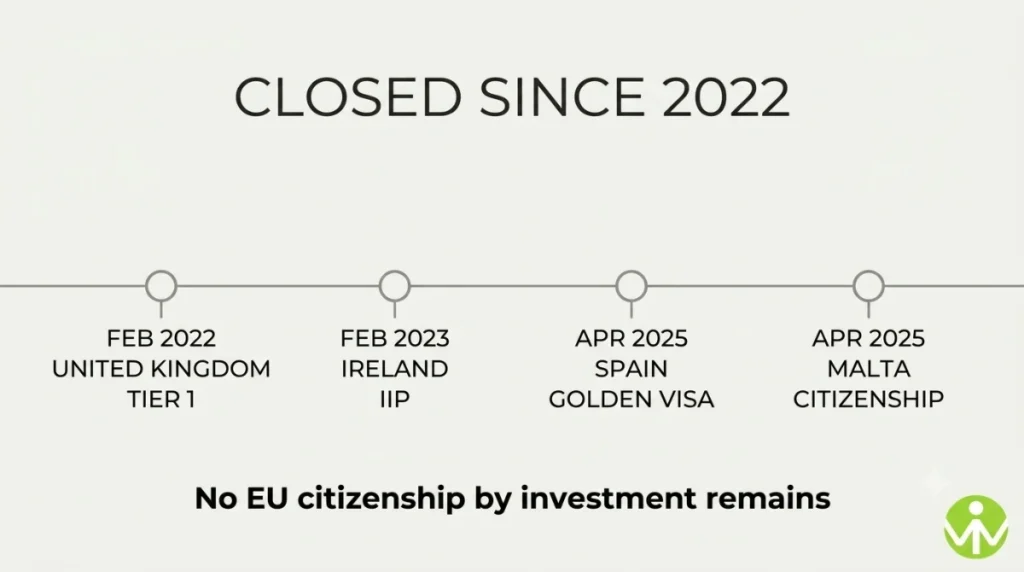
| Programme | Closed to new applications | Authority |
|---|---|---|
| United Kingdom, Tier 1 (Investor) | 17 February 2022 | UK Home Office |
| Ireland, Immigrant Investor Programme | 15 February 2023 | Irish Government |
| Spain, investor residence (golden visa) | 3 April 2025 | Organic Law 1/2025 of 2 January |
| Malta, citizenship for exceptional services by direct investment | 29 April 2025 | Court of Justice of the EU, C-181/23 |
| Sources: CJEU C-181/23; Organic Law 1/2025 (Spain); Irish Immigration Service; UK Parliament written statement HCWS492. Verified 21 September 2026. | ||
Four significant programmes have shut down since 2022, and any guide still listing them as available is out of date.
The United Kingdom closed the Tier 1 (Investor) route on 17 February 2022. A government review of the route’s operation published the following January set out the reasons. Ireland closed its Immigrant Investor Programme on 15 February 2023; existing approved investors keep their status, and the department has said the backlog will take years to clear.
Spain abolished its investor residence route through Organic Law 1/2025 of 2 January, which removed Articles 63 to 67 of Law 14/2013. No new applications have been accepted since 3 April 2025. Permits already granted remain valid to their expiry, and renewals are decided under the rules in force when they were issued.
The most consequential closure is Malta’s. On 29 April 2025, the Court of Justice of the European Union ruled in Commission v Malta, Case C-181/23 that granting nationality in exchange for predetermined payments or investments breaches the principle of sincere cooperation in Article 4(3) of the Treaty on European Union. The Court held that such a scheme manifestly disregards the special relationship of solidarity and good faith required between a state and its nationals. Malta’s programme is closed, and there is now no citizenship by investment route anywhere in the European Union.
Malta’s residence programme is a separate thing and remains open. Our Malta investor programme guide covers what it does and does not grant.
Residence by investment: the longer route to a passport
| Country | Minimum investment | What it grants |
|---|---|---|
| Latvia | EUR 50,000 (business) or EUR 250,000 (property) | Residence |
| Malta | About EUR 150,000 (Permanent Residence Programme) | Permanent residence only, not citizenship |
| Portugal | EUR 250,000 (cultural) or EUR 500,000 (funds) | Residence. Naturalisation after 10 years, or 7 for EU and CPLP nationals |
| Greece | EUR 250,000, EUR 400,000 or EUR 800,000 by location and type | Residence |
| Hungary | EUR 250,000 (fund) or EUR 1,000,000 (donation) | Residence |
| Italy | EUR 250,000 (startups) to EUR 2,000,000 (government bonds) | Residence |
| Cyprus | EUR 300,000 | Residence |
| Bulgaria | EUR 512,000 | Residence |
| Residence-by-investment minimums as published for 2026. Naturalisation timelines vary by country and are covered in the individual country guides. Compiled 21 September 2026. | ||
Eight European countries still offer residence in exchange for investment. None offers citizenship by investment, and the gap has widened sharply in the past year.
Portugal matters most, because it has been the default recommendation in this category for a decade. The golden visa itself is open and unchanged, at EUR 250,000 for cultural investment or EUR 500,000 for qualifying funds. What changed is the law at the other end. Organic Law 1/2026 came into force on 19 May 2026 and extended the residence period required before naturalisation from five years to ten, or seven for citizens of EU and CPLP member states. The residence clock now also runs from the issue of a residence title rather than the application date, which in practice lengthens it further given processing times.
Applications for naturalisation filed before 19 May 2026 are assessed under the previous wording. Investors who entered the programme expecting a five-year path did not get one, and a group is reportedly preparing litigation on legal-certainty grounds.
Greece has moved in the same direction on price rather than time, with thresholds now set at EUR 250,000, EUR 400,000 or EUR 800,000 depending on the property type and location. Italy runs a tiered investor visa from EUR 250,000 for innovative startups up to EUR 2,000,000 in government bonds. Latvia remains the cheapest entry in Europe at EUR 50,000 for a business investment. Cyprus, Hungary and Bulgaria complete the list.
Naturalisation timelines for these countries vary and are set by each country’s nationality law rather than by the investment programme, which is precisely why they can be changed without touching the programme itself. Treat the residence permit and the passport as two separate decisions, each with its own set of rules.
What citizenship by investment costs beyond the headline figure
The published minimum is the least useful number in any programme brochure. Four categories of cost sit on top of it.
Government and processing fees are charged per application and per person. Due diligence fees are charged per adult and are not refunded if the application is refused. Agent fees are commercial and vary widely, and in most Caribbean programmes you cannot file an application except through a licensed local agent. Dependant contributions apply for each family member added beyond the main applicant, on brackets that differ by country and by the age of the dependant.
Real estate routes carry a further consideration that is easy to miss. The qualifying property normally has to be held for a minimum period, commonly five years, before it can be resold, and the resale market for programme-qualifying property is thin. Several Caribbean states have also banned discounting, rebates and guaranteed buy-back arrangements, which were used to make the real estate route appear cheaper than the donation route. It usually is not.
Tax is a separate question again, and not one this guide can answer for any individual. A second nationality does not by itself change where someone is tax resident, and for United States citizens in particular it changes nothing at all unless they renounce, which is a serious and irreversible step. Anyone weighing a second passport for tax reasons should take advice from a qualified tax adviser in their own jurisdiction before taking advice from anyone selling a programme.
The regulatory squeeze: ECCIRA and the 2028 deadline
The most important development for anyone considering a Caribbean programme is not a price change. It is regulatory.
In September 2025, the five Eastern Caribbean states agreed to create ECCIRA, the Eastern Caribbean Citizenship by Investment Regulatory Authority, headquartered in Grenada. It maintains regional registers of applicants, licensed agents and approved developers, publishes annual compliance reports, and has power to levy administrative fines and revoke licences. Mandatory biometrics and interviews now apply across the five programmes.
The pressure from Europe is sharper. Regulation (EU) 2025/2441, adopted on 26 November 2025 and in force from 30 December 2025, makes operating an investor citizenship scheme a self-standing ground for suspending a country’s visa-free access to the Schengen Area. The Commission no longer has to demonstrate the absence of a genuine link between the investor and the state. On 25 June 2026, in a letter made public on 7 July, Commissioner Magnus Brunner wrote to all five states demanding a phase-out by 1 June 2028, with interim vetting measures due earlier.
Two things are worth stating precisely, because coverage of this has been loose. Schengen access has not been suspended, and the programmes are open and operating normally today. And the phase-out is a demand, not an agreement: Antigua and Barbuda’s Prime Minister has publicly rejected a unilateral wind-down. This is a live negotiation with a stated deadline, not a loss that has already happened.
What it does mean is that the value proposition of a Caribbean passport in 2028 cannot be assumed from its value in 2026. Anyone buying primarily for Schengen access is taking a position on how that negotiation ends.
It is also worth understanding what the money does. On a donation or fund route, the contribution is not an investment in any ordinary sense: it is a payment to a national development fund, and there is no return, no asset and nothing to sell. On a real estate route there is an asset, but it is one bought in a small market at a price set by programme eligibility rather than by ordinary demand, and it must usually be sold to another programme applicant. Neither route should be modelled as a financial investment, and any projection of returns offered alongside one deserves scepticism. The correct way to think about the sum is as the price of a document and the access that comes with it.
Due diligence: who gets refused
Every serious programme runs enhanced due diligence on every adult applicant, and it charges the fee whether the application succeeds or not. This is the part of the process that programme marketing tends to skip, and it is where applications actually fail.
Checks typically cover source of funds, criminal record, sanctions and watchlist screening, previous visa refusals, and any history of denied entry to a country the programme has visa-free access to. A refusal by one Eastern Caribbean state is now visible to the other four through ECCIRA’s shared register, so shopping an application around after a refusal no longer works the way it once did. Several programmes also require a police certificate from every country of residence over a recent period, and all five Caribbean programmes now require an interview and biometric capture.
Two practical consequences follow. Source-of-funds documentation takes longer to assemble than most applicants expect, particularly when wealth comes from a business sale or an inheritance rather than salary. And a refusal is expensive: the due diligence and processing fees are gone, and the refusal itself becomes a disclosable fact on any later application anywhere.
What citizenship by investment passports actually open
| Country | Minimum investment | Passport rank | Visa-free destinations |
|---|---|---|---|
| Saint Kitts and Nevis | US$250,000 | 21st | 157 |
| Antigua and Barbuda | US$230,000 | 24th | 154 |
| Grenada | US$235,000 | 27th | 148 |
| Dominica | US$200,000 | 30th | 144 |
| Saint Lucia | US$240,000 | 31st | 143 |
| Turkiye | US$400,000 | 49th | 112 |
| Vanuatu | US$130,000 | 58th | 86 |
| Nauru | US$115,000 | 60th | 84 |
| Sao Tome and Principe | US$90,000 | 78th | 59 |
| Egypt | US$250,000 | 87th | 49 |
| Minimums as Table 1. Passport ranks and visa-free destination counts from the Henley Passport Index, July 2026 edition, verified 19 September 2026. | |||
Set the price of each programme against the travel access it delivers, and the relationship turns out to be close to inverted at the top end.
Turkiye is the most expensive direct route on this list at US$400,000, and its passport opens 112 destinations, fewer than any of the five Caribbean programmes, all of which cost less. St Kitts and Nevis is the strongest of the group at 21st with 157 destinations. Dominica, the cheapest Caribbean option at US$200,000, opens 144.
At the lower end, the trade-off is real and substantial. Sao Tome and Principe costs a quarter of what a Caribbean programme costs and opens 59 destinations against Grenada’s 148. Nauru, at US$115,000, opens 84. Egypt, at the same US$250,000 as St Kitts and Nevis, opens 49 against 157. If the purpose of the exercise is mobility, the cheapest programme is frequently the worst value and the most expensive is not the best.
One further point that rarely appears in comparisons: Grenada holds visa-free access to China, Russia, the Schengen Area and the United Kingdom simultaneously, which only a handful of nationalities do. Access is not a single number, and which destinations matter depends entirely on why you want the passport.
How to judge a citizenship by investment programme
Five questions separate a sound decision from an expensive one.
First, does it actually grant citizenship? If the answer involves a residence permit and a waiting period, it is a golden visa and should be compared against other golden visas, not against a direct route.
Second, what does the passport open? Destination counts vary enormously across these programmes and do not track price. Our passport rankings give the current figures, and the companion piece on why wealth does not buy passport power explains why the correlation between cost and access is so weak.
Third, is the country stable as a jurisdiction and as a regulator? A programme under active international pressure carries a different risk profile from one that is not, which is the whole substance of the 2028 question above.
Fourth, does your own country permit dual nationality? Several do not, and acquiring a second passport can mean automatically losing the first. Our list of countries that allow dual citizenship is the place to check before anything else, and the specific rules for United States citizens and for countries like Thailand differ considerably.
Fifth, is the agent licensed by the programme’s own regulator, and can you verify that on the regulator’s register rather than on the agent’s website? The Grenada programme’s own authority publishes its licensee list at the Investment Migration Agency. Every established programme has an equivalent. Use it.
One route deserves a specific caution because it is so widely mis-sold. A Caribbean passport is frequently marketed as a path to the United States E-2 treaty investor visa. Since the National Defense Authorization Act for FY2023, an applicant who acquired treaty-country citizenship through financial investment must have been domiciled in that country for a continuous period of at least three years before applying. A newly purchased passport does not deliver near-term E-2 access to anyone who has not lived there.
Frequently asked questions about citizenship by investment
Which is the cheapest citizenship by investment programme in 2026?
Sao Tome and Principe, from around US$90,000, followed by Nauru at US$115,000 and Vanuatu at US$130,000. Cost and passport strength are only loosely related, so the cheapest programme is rarely the one that opens the most destinations.
Which is the fastest?
Vanuatu, at roughly 30 to 60 days from application to passport. Sao Tome and Principe quotes six to eight weeks. Caribbean programmes generally run three to nine months, and all five now require an interview and biometric capture.
Can I still get EU citizenship by investment?
No. Malta was the last EU member state operating such a programme and the Court of Justice of the European Union ruled it unlawful on 29 April 2025. Several EU countries still offer residence by investment, but citizenship from those routes comes only through ordinary naturalisation after a qualifying period of residence.
What is the difference between citizenship by investment and a golden visa?
A direct programme grants a passport, usually within months and with little or no residence requirement. A golden visa grants a residence permit, and citizenship depends on later satisfying that country’s ordinary naturalisation rules. They are different products with different timelines, different risks and different prices.
Will the Caribbean programmes still exist after 2028?
Unresolved. The European Commission has demanded a phase-out by 1 June 2028 as the condition for keeping visa-free Schengen access, and at least one of the five governments has publicly rejected that. The programmes are open and operating now, and nothing has been suspended, but the position after 2028 cannot be assumed.
Is citizenship by investment legal?
In the countries that operate it, yes – each programme is created by that country’s own legislation. What the Court of Justice of the European Union decided in April 2025 was narrower: that an EU member state cannot run one, because EU citizenship comes attached to it. Non-EU programmes are unaffected by that ruling, though the European Commission has separately made operating such a scheme a ground for reviewing visa-free access.
Do I have to give up my current citizenship?
That depends entirely on your current nationality, not on the programme. Some countries permit dual nationality without restriction, some permit it conditionally, and some withdraw citizenship automatically when another is acquired. Check your own country’s rules before you spend anything.
Does a second passport reduce my tax?
Not by itself. Tax residence is determined by where you live and by each country’s own rules, not by which passports you hold. United States citizens are taxed on worldwide income regardless of residence unless they renounce. Take tax advice from someone who is not selling you a programme.
Sources
- Court of Justice of the European Union, Commission v Malta, Case C-181/23, judgment of 29 April 2025.
- Government of Spain, abolition of the investor visa – Organic Law 1/2025 of 2 January, effective 3 April 2025.
- Irish Immigration Service, closure of the Immigrant Investor Programme, 15 February 2023.
- UK Parliament, Tier 1 (Investor) route: review of operation, written statement HCWS492, 12 January 2023.
- Investment Migration Agency Grenada, Becoming a Citizen – the verified source for Grenada’s figures.