
Passport power and national wealth are widely assumed to move together, and the 2026 data shows they do not. Qatar has a GDP per capita of $75,685 and a passport that opens 112 destinations. Brazil has a GDP per capita of $10,311 and a passport that opens 170. One country is more than seven times richer per head than the other, and it is the poorer one whose citizens travel more freely.
That is not a rounding error or a one-off. It is a pattern that runs through the whole index, and it has a straightforward explanation once you understand what the ranking is actually counting.
Table of Contents
What passport power actually measures
Passport power is measured by the Henley Passport Index, which scores each of the world’s 199 passports against 227 destinations using International Air Transport Association data. A destination counts if the holder can enter without a visa arranged in advance: visa-free entry, a visa issued at the border, or an electronic travel authorisation approved before departure. Our full 2026 passport rankings set out the complete table.
The crucial point is what generates that score. Every destination on a country’s list is there because another government agreed to let its citizens in without prior screening. It is therefore a tally of bilateral agreements, and agreements are negotiated rather than bought. A country’s treasury has no direct bearing on whether Japan or Brazil or the Schengen states have signed a waiver with it.
This is why the figure behaves so differently from the economic indicators it is often placed beside. GDP per capita measures output. Passport power measures how many other governments have decided they are comfortable admitting your nationals without checking them first, which is a question about relationships, history and reciprocity.
The rich countries with weak passports
Table 1: Wealth and Passport Power Compared
| Country | GDP per capita (2024) | Passport rank | Visa-free destinations |
|---|---|---|---|
| Luxembourg | $137,782 | 4th | 186 |
| Ireland | $112,895 | 4th | 186 |
| Switzerland | $107,702 | 5th | 185 |
| Singapore | $94,897 | 1st | 192 |
| United States | $86,170 | 10th | 180 |
| Qatar | $75,685 | 49th | 112 |
| Macao | $72,005 | 31st | 143 |
| United Arab Emirates | $50,274 | 2nd | 188 |
| Saudi Arabia | $35,528 | 55th | 91 |
| Brunei | $33,153 | 19th | 163 |
| Kuwait | $32,856 | 52nd | 97 |
| Bahrain | $29,717 | 56th | 88 |
| Oman | $20,285 | 59th | 85 |
| Sources: World Bank GDP per capita (current US$), 2024. Henley Passport Index, July 2026 edition. Both verified 20 September 2026. | |||
Read the table from the top and the assumption holds for a while. Luxembourg, Ireland, Switzerland, Singapore and the United States are all wealthy and all sit inside the top ten for passport power. Then it breaks.
Qatar, with a GDP per capita of $75,685, ranks 49th on 112 destinations. It is wealthier per head than the UAE, Saudi Arabia, Kuwait, Bahrain and Oman, and wealthier than Macao, yet its citizens need advance visas for most of Europe, North America and much of Asia.
Kuwait, at $32,856, ranks 52nd on 97 destinations. Bahrain, at $29,717, ranks 56th on 88. Oman, at $20,285, ranks 59th on 85. Saudi Arabia, the largest economy in the Gulf, ranks 55th on 91. These are high-income countries whose passports perform like those of middle-income ones.
China is the clearest case at scale. It is the world’s second-largest economy in absolute terms and ranks 61st for passport power on 83 destinations. Its GDP per capita of $13,293 is a better guide to its position than its total output, but even that overstates it: Serbia has almost exactly the same GDP per capita and ranks 34th on 135 destinations. The gap is diplomatic, not economic, and is discussed further in our China immigration guide.
Brunei cuts against its neighbours and is worth isolating. At $33,153 per head it is no wealthier than Kuwait, yet it ranks 19th on 163 destinations against Kuwait’s 97 – a gap of sixty-six. Brunei has held reciprocal arrangements with the United Kingdom, Japan, the United States and much of Southeast Asia for decades, several of them predating the modern oil economy. The longevity of a country’s relationships, rather than the size of its sovereign fund, is what shows up in the score.
Why wealth does not buy passport power
Three mechanisms explain most of the divergence.
The first is reciprocity. Visa waivers are almost always mutual, so a country that is reluctant to admit foreigners without screening will find others reluctant in return. A government that wants its citizens to travel freely has to accept other people’s citizens arriving freely, and that is a political decision rather than a financial one.
The second is the composition of the mobility that money does buy. Wealthy Gulf states have invested heavily in inbound tourism infrastructure and in attracting foreign capital and residents, which shows up in property, aviation and services. None of that changes how a European interior ministry assesses overstay and asylum risk for a given nationality, which is the calculation that actually determines a waiver.
The third is time. Mobility accumulates over decades of treaty-making. The countries at the top of the index have been signing agreements since the middle of the twentieth century. A country that became wealthy recently starts that process late, and the UAE’s rise, discussed below, shows both how much ground can be made up and how long it takes.
A fourth factor sits underneath the other three: the risk assessment itself. Waiver decisions turn on overstay rates, asylum claim volumes and document integrity for a given nationality, all of which are measured at the level of traveller behaviour rather than national income. Aggregate wealth does not enter that calculation directly, which is why a high-income country can find itself assessed alongside middle-income ones on the criteria that actually decide a waiver.
It is worth adding what does not explain the gap: the strength of the document itself. Biometric standards, e-passport chips and security features are close to universal now, and they are not what separates 192 destinations from 88.
The other side: modest economies with strong passports
Table2: Modest Economies with Strong Passports
| Country | GDP per capita (2024) | Passport rank | Visa-free destinations |
|---|---|---|---|
| St Kitts and Nevis | $23,961 | 21st | 157 |
| Seychelles | $18,365 | 23rd | 155 |
| Mexico | $13,988 | 22nd | 156 |
| Argentina | $13,970 | 16th | 169 |
| Serbia | $13,678 | 34th | 135 |
| Brazil | $10,311 | 15th | 170 |
| Georgia | $8,968 | 45th | 121 |
| Moldova | $7,579 | 46th | 120 |
| Ukraine | $5,392 | 31st | 142 |
| Sources: World Bank GDP per capita (current US$), 2024. Henley Passport Index, July 2026 edition. Both verified 20 September 2026. | |||
The pattern runs in the other direction just as clearly, and the comparison with the previous table is the point.
Brazil, at $10,311 per head, opens 170 destinations and ranks 15th. Argentina, at $13,970, ranks 16th on 169. Mexico, at $13,988, ranks 22nd on 156. All three are middle-income economies whose citizens travel more freely than those of every Gulf state except the UAE.
Ukraine is the most striking entry on the table. At $5,392 per head, in the middle of a war, it ranks 31st on 142 destinations, comfortably ahead of Qatar. Its position reflects EU visa liberalisation and two decades of deepening agreements with European neighbours, and it has held up through a conflict that has devastated the economy behind it. Passport power, once negotiated, is unusually durable.
Georgia at $8,968 and Moldova at $7,579 tell the same story in smaller form, both ranking in the mid-40s on more than 120 destinations through EU-aligned liberalisation. St Kitts and Nevis and Seychelles, meanwhile, are small economies that have built wide waiver networks deliberately, which is part of why Caribbean citizenship-by-investment programmes have the appeal they do.
The UAE exception and what it proves about passport power
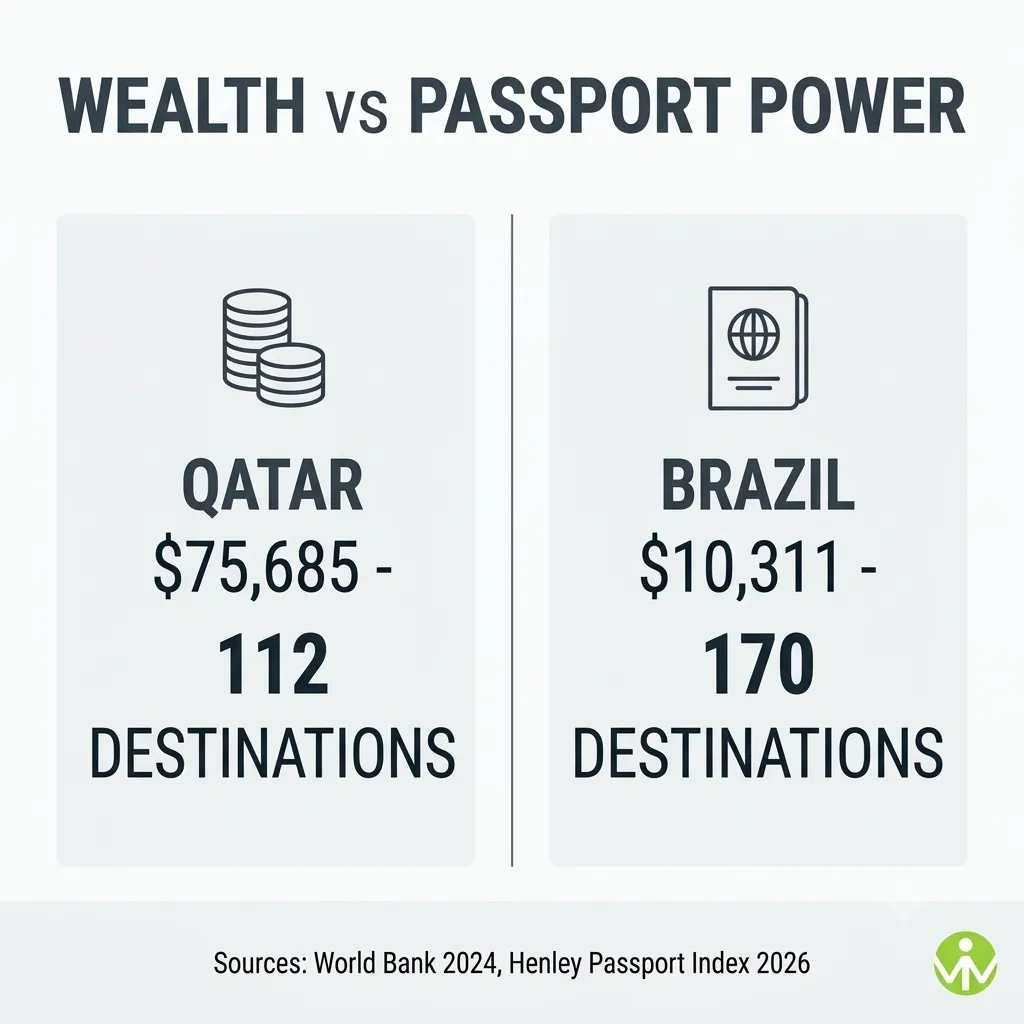
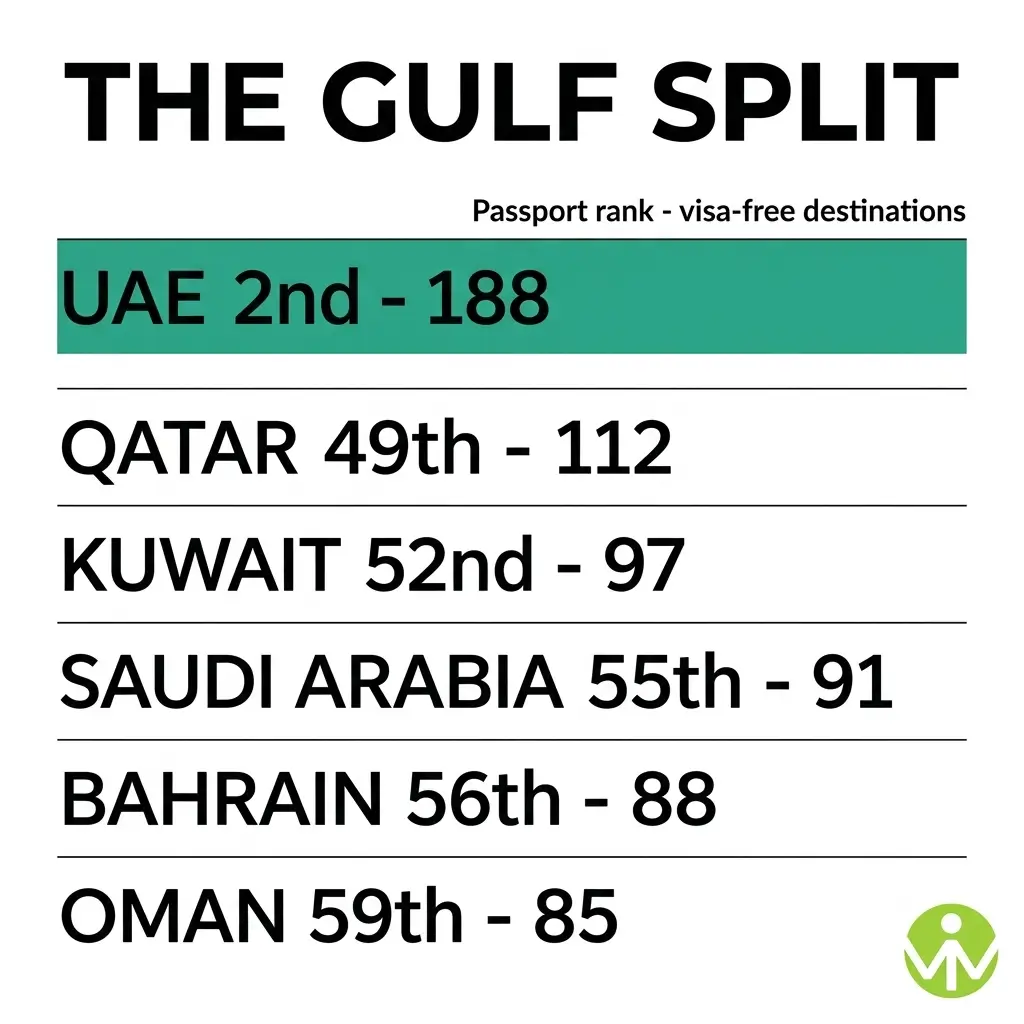
Table 3: The Gulf States: Wealth, Passport Power and Openness
If wealth explained passport power, the Gulf states would cluster together. They do not, and the one that breaks away is not the richest.
The UAE ranks second in the world on 188 destinations, level with Japan and South Korea, despite a GDP per capita of $50,274 that is a third below Qatar’s. It climbed three places in the July 2026 update, the largest single move of any passport that cycle, and over twenty years it has added 153 visa-free destinations, the biggest improvement in the history of the index. Our guide to UAE visa types covers the inbound side of that.
The table also shows why. The fifth column is the Henley Openness Index, which counts how many of the world’s 198 nationalities each country admits without a prior visa. The UAE admits 91 and ranks 48th for openness. Kuwait admits 58 and ranks 70th, and holds 97 destinations. Oman admits 81, ranks 56th, and holds 85.
The correlation is not perfect, and Qatar is the interesting anomaly in the other direction: it is the most open Gulf state on this measure, admitting 95 nationalities, while holding the weakest reciprocal position of the six on 112 destinations. Openness is necessary but not sufficient, because the agreements have to be negotiated individually and that takes years.
The broader lesson is the one the UAE demonstrates: passport power responds to sustained diplomatic effort, on a timescale of decades rather than budget cycles. No Gulf state has been short of money. Only one has converted that into mobility, and it did so through agreements rather than spending.
What this means if you are planning to move
For anyone weighing a second passport, the practical implication is that price and passport power are not related in the way the marketing suggests.
A Caribbean passport obtained through investment will usually deliver more visa-free access than a Gulf residence ever could, because the Caribbean states have spent decades building waiver networks and residence is not citizenship in any case. St Kitts and Nevis, on this table, opens 157 destinations from an economy a fraction of Qatar’s size.
If mobility is the actual goal, compare destination counts directly rather than reasoning from a country’s wealth or its cost of entry. Our breakdown of residence and golden visa programmes separates the routes that lead to a passport from the ones that only lead to residence, which is the distinction that matters most here.
It is also worth being clear that a strong passport is not the same as a right to live anywhere. Visa-free access is for short visits, usually capped at 30 or 90 days, and regional systems have their own arithmetic, as anyone counting days against a Schengen visa allowance discovers. Work, study and settlement run on separate rules entirely, which is why permanent residence routes are assessed on qualifications and sponsorship rather than on nationality.
One practical note before that: these figures move. The index is recompiled quarterly, in January, April, July and October, and a single bilateral agreement taking effect can shift a country several places at once. The UAE’s three-place climb happened between two consecutive editions. If you are making a decision with a long lead time, check the current table rather than a figure quoted in any article, including this one.
Finally, the direction of travel is not fixed. The United States has fallen from first place in 2006 to tenth today while remaining among the wealthiest countries in the world, which is part of what has driven the recent surge in demand for second passports among Americans. Wealth did not hold its position, and wealth will not restore it.
Frequently asked questions about wealth and passport power
Which rich country has the weakest passport?
Of the high-income countries, Qatar has the widest gap between wealth and mobility. It has a GDP per capita of $75,685 and ranks 49th on the Henley Passport Index with 112 visa-free destinations. Kuwait, Bahrain, Saudi Arabia and Oman all show a similar pattern on a smaller scale.
Why is the Chinese passport weak when China is so large an economy?
A passport’s score tracks bilateral visa-waiver agreements, not economic size. China ranks 61st with 83 destinations. Serbia, with almost identical GDP per capita, ranks 34th with 135. The difference is the number of governments that have signed waivers, not the size of the economy behind the passport.
Can a country buy its way up the passport rankings?
No. Every destination on a passport’s score is there because another government agreed to admit its citizens without prior screening, usually on a reciprocal basis. That is a negotiation, and it typically takes years per agreement. The UAE’s rise of 153 destinations in twenty years is the fastest on record and still took twenty years.
Does buying citizenship give you a strong passport?
It depends entirely on which citizenship. Caribbean programmes deliver access in the 140 to 160 range because those states have built wide waiver networks. Cost is not a proxy for access, so compare the destination count for the specific passport rather than the price of the programme.
What is the Henley Openness Index?
It measures the reverse of passport power: how many of the world’s 198 nationalities a country admits without a prior visa. Read alongside the passport rankings it shows how reciprocal a country’s position is. The UAE admits 91 nationalities and ranks 2nd; Kuwait admits 58 and ranks 52nd.
Is the Gulf pattern changing?
Slowly and unevenly. The UAE’s climb to second place shows what sustained negotiation achieves, and several of its neighbours have expanded their own inbound visa regimes in recent years, which is usually the precondition for reciprocal waivers. But agreements are concluded one at a time, and the lag between opening your own borders and having others open theirs is measured in years rather than quarters.
Does a weak passport mean I cannot emigrate?
No. A passport’s ranking affects short-term travel only. Work permits, student visas, family routes and permanent residence are assessed on qualifications, sponsorship, funds and compliance with the destination’s immigration rules. A weak passport makes visiting harder, not settling.
Sources
- Henley & Partners, Global Passport Ranking – passport ranks and visa-free destination counts, verified 20 September 2026.
- Henley & Partners, Henley Openness Index – nationalities admitted without a prior visa, verified 20 September 2026.
- Henley & Partners, Passport Power Doubles as Global Peace Declines, 21 July 2026 – the 20th anniversary edition.
- World Bank, GDP per capita, current US$ – 2024 figures, the most recent complete year.