
Before you apply for a visa, the most important thing to understand is that visa categories are not interchangeable. A tourist visa does not allow you to work. A student visa does not allow long-term employment in most countries. A work visa issued for one employer may not transfer to another. Choosing the wrong visa type is the most expensive mistake an applicant can make — not just in terms of the non-refundable fee, but in the delays and complications it creates for future applications.
This guide gives you a practical overview of how to apply for a visa — covering the different types, the documents needed, the steps in the process, how long it takes, what it costs, and the most common reasons applications fail. Whether you are planning to travel, work, study, or reunite with family, the principles here apply across most destination countries. [Passport rankings]
Visa Types: Choosing the Right Category
Before you apply for a visa, you need to select the right category. Most countries organise visas by purpose of travel. Here are the main types and when each applies:
| Visa Type | Purpose | Typical Duration |
|---|---|---|
| Tourist / Visitor Visa | Leisure travel, visiting family or friends, medical treatment | Short stay — usually 30 to 90 days per entry |
| Business Visa | Meetings, conferences, negotiations — not employment | Short stay — usually 30 to 90 days |
| Student Visa | Full-time study at an accredited institution | Duration of course, with possible extensions |
| Work Visa / Work Permit | Employment with an employer in the destination country | Tied to employment contract — typically 1 to 5 years, renewable |
| Transit Visa | Passing through a country to reach a third destination | Short — typically 24 to 96 hours |
| Family / Spouse Visa | Joining a family member who is a citizen or legal resident | Initially temporary; may lead to PR |
| Permanent Residency Visa | Long-term or indefinite residence and work rights | Indefinite once granted, may require renewal of card |
| Digital Nomad / Remote Work Visa | Living in a country while working remotely for a foreign employer | Typically 6 to 24 months |
When deciding how to apply for a visa, always confirm the correct category for your situation on the official government or consulate website of your destination country. Using a private visa agency’s category descriptions without cross-referencing the official source is a common source of error.
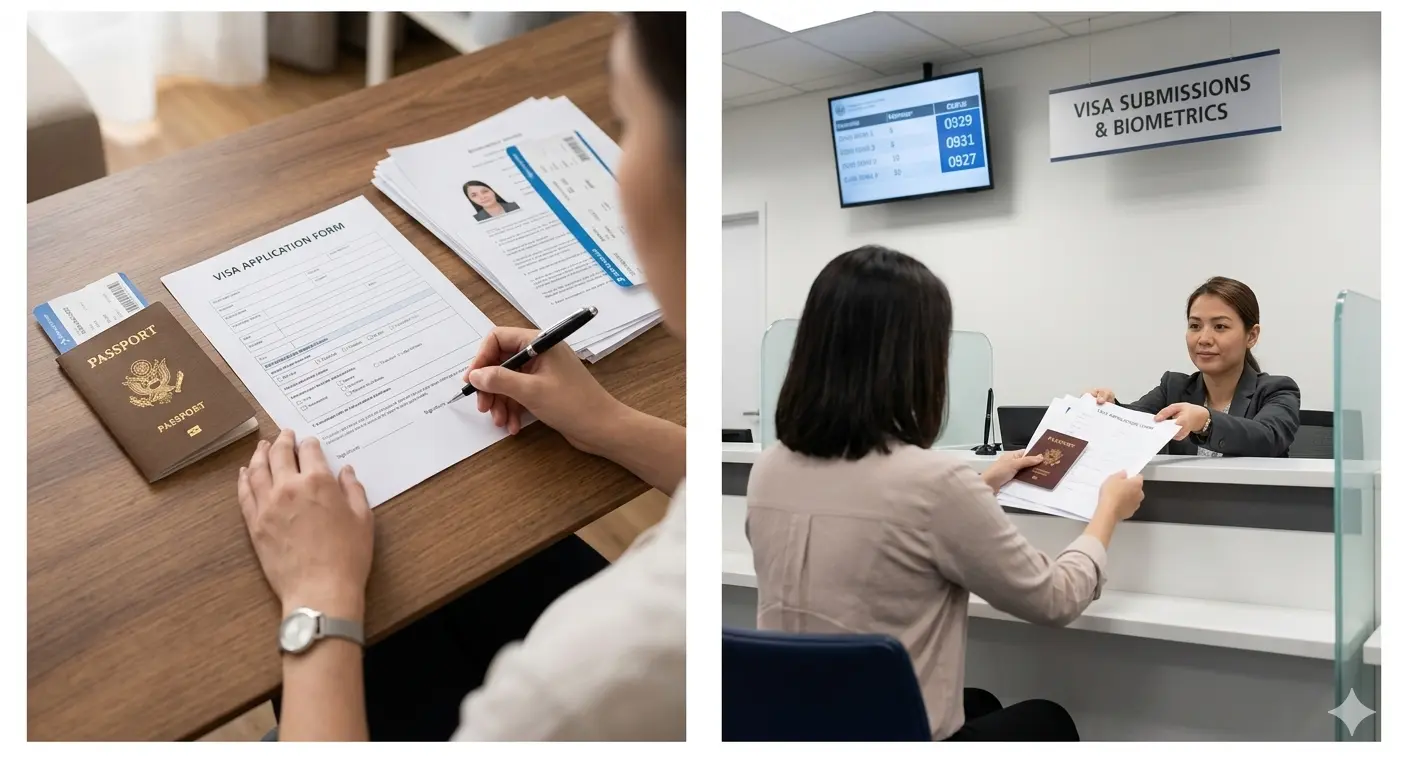
Do You Need a Visa? Checking Before You Apply
Not everyone needs to apply for a visa for every destination. Whether you need one depends on your passport nationality and the destination country. Citizens of high-ranking passports — Singapore, Japan, and most EU member states — can enter a large proportion of countries visa-free. Citizens of lower-ranked passports will typically need a visa for most Western destinations. [Passport rankings]
The most reliable way to check visa requirements is through the IATA Travel Centre (timaticweb2.com) or the official consulate website of your destination country. Requirements can change at short notice when diplomatic or political relations shift, so always verify close to your travel date even if you have visited the same country before.
How to Apply for a Visa: Documents You Will Need
The exact document list varies by visa type and destination, but the following are standard across most applications:
Core Documents Required for Most Visa Types
- Valid passport: A minimum of 6 months’ validity beyond your intended departure date is the standard requirement. Check for blank pages — many countries require at least 2.
- Completed application form: Available online or at the consulate. Complete every field — blank answers are a common cause of rejection.
- Passport-size photographs: Each country specifies the exact size, background colour, and recency. Photographs from 3+ years ago are typically rejected.
- Proof of purpose: For tourists — hotel bookings and itinerary. For workers — job offer letter. For students — university acceptance letter. For families — sponsor’s documents and proof of relationship.
- Proof of funds: Bank statements for the past 3–6 months demonstrating you can support your stay. The required amount varies by destination and visa type.
- Proof of ties to home country: Employment letter, property ownership documents, family responsibilities — evidence you have a reason to return.
- Travel insurance: Mandatory for Schengen visas (minimum EUR 30,000 coverage). Strongly recommended for all applications.
- Visa fee: Paid through official channels before or at the time of application. Non-refundable in nearly all cases.
Additional Documents by Visa Type
- Work visas: Job offer or employment contract, skills assessment results, language test scores, police clearance certificate, medical examination results. [How to apply for a work visa]
- Student visas: Acceptance letter from accredited institution, proof of tuition fee payment or scholarship, language proficiency test scores.
- Family visas: Sponsor’s proof of legal status in destination country, proof of relationship (marriage certificate, birth certificate), financial sponsorship declaration.
- Tourist visas: Return flight booking confirmation, proof of accommodation, itinerary, travel insurance. [How to apply for a tourist visa]
How to Apply for a Visa: The Process Step by Step
Step 1: Determine the correct visa type and authority
Identify which specific visa subtype applies to your situation and which authority handles it — whether that is the country’s consulate, an authorised Visa Application Centre (VFS Global, BLS International, TLScontact), or an online government portal. For Schengen visas, submit the application to the consulate of the country where you will spend the most time, or your first point of entry if time is equal across countries.
Step 2: Gather all required documents before booking an appointment
Do not book your appointment until you have assembled — or have a clear plan to assemble — all required documents. Arriving at an appointment with an incomplete file wastes your slot and, at high-demand consulates, could mean waiting weeks or months for a new one. For time-sensitive visa types such as work and student visas, start gathering documents 2–3 months in advance.
Step 3: Book your appointment
Appointments at major consulates are frequently booked out weeks or months in advance. For Schengen visas from South Asian cities, Middle Eastern cities, or major African capitals, slots during peak travel seasons (June–August, December) may be unavailable for 8–10 weeks. Book as soon as your travel is confirmed — even before all documents are ready.
Step 4: Attend your appointment and submit
Arrive with a complete, well-organised file. Bring originals and photocopies of every document. Most consulates will keep the originals and return copies, or vice versa — know which before you go. Most major destination countries collect biometrics (fingerprints and a photograph) at this stage.
Step 5: Track your application and respond to requests
Most modern consulates and visa centres provide a tracking number. Check regularly. If the consulate requests additional documents — known as an additional documentation request or ADR — respond promptly. Delays in responding can result in your application being closed.
Step 6: Collect your visa or passport
Once a decision is made, your passport will be returned — either by courier, collection at the VAC, or in some cases at the consulate. Check the visa details immediately on receipt: name spelling, dates, number of entries, and any conditions. Errors are rare but must be flagged immediately.
How Long Does It Take to Apply for a Visa?
Processing times vary significantly by destination, visa type, nationality, and time of year. Here are indicative timelines for the most common destinations:
| Destination | Tourist Visa | Work Visa | Student Visa |
|---|---|---|---|
| Schengen Area (EU) | 10–15 working days | Varies by country: 1–3 months | 2–4 weeks (national visa) |
| United Kingdom | 3 weeks | 3–8 weeks | 3 weeks |
| United States | 4–12 weeks (post-interview) | 3–6 months (H-1B) | 2–3 months (F-1) |
| Canada | 4–8 weeks | 2–6 months | 4–12 weeks |
| Australia | 20–40 working days | 1–4 months | 4–6 weeks |
| UAE | 3–5 working days | 2–6 weeks | 2–4 weeks |
These are indicative figures. Processing times fluctuate and official government websites publish current estimates. Always verify before planning.
Visa Fees: What to Budget When You Apply for a Visa
Visa fees are set by each government and are non-refundable regardless of the outcome. They represent only a portion of the total cost — translation fees, skills assessment fees, medical examination fees, and courier fees can add substantially to the total.
| Destination | Tourist Visa Fee | Work Visa Fee (approx.) |
|---|---|---|
| Schengen Area | EUR 90 | EUR 75 (national visa) + employer costs |
| United Kingdom | GBP 127 | GBP 719–1,420 + Immigration Health Surcharge |
| United States | USD 185 | USD 730+ (H-1B, plus employer petition fees) |
| Canada | CAD 100 | CAD 155 (work permit) |
| Australia | AUD 190 | AUD 3,115 (TSS subclass 482) |
| UAE | AED 250–600 | AED 200–300 |
Why Visa Applications Are Refused — and How to Avoid It
Most Common Refusal Reasons Across All Visa Types
- Insufficient proof of ties to home country: The consular officer is not satisfied you will return after your visa expires. This is the leading cause of tourist visa refusals.
- Inconsistent or incomplete documents: Any mismatch between your application form and supporting documents — dates, addresses, employment details — creates doubt.
- Insufficient funds: Bank statements that do not clearly demonstrate you can support yourself (or in some cases, your sponsor cannot support you).
- Poor travel history: First-time applicants with no prior visa record are viewed more cautiously. A history of visa-free travel or prior visas to other countries strengthens an application.
- Previous overstays or violations: Any previous visa violation — even in a third country — will be scrutinised.
- Application submitted too early or too late: Schengen rules prohibit applications more than 3 months before travel. Applying too late leaves insufficient processing time.
How to Strengthen Any Visa Application
- Submit 6 months of bank statements with clear, regular income — not a single large deposit.
- Include a concise cover letter explaining your travel purpose, itinerary, and confirmation that you will return.
- Document all ties to your home country: job letter with return date confirmed, property ownership, family members you are responsible for.
- Start early — a well-prepared, unhurried application is significantly more credible than a rushed one.
Frequently Asked Questions: How to Apply for a Visa
Can I apply for a visa if I have been refused before?
Yes. A prior refusal does not permanently disqualify you, but it must be declared on future applications. Address the specific reason for the refusal in your new application. Repeating the same application with the same documents after a refusal rarely succeeds.
Can I apply for a visa on behalf of someone else?
The applicant must generally be present for biometrics, but a family member or authorised representative can submit documents on their behalf in many countries. Check the specific rules for your destination.
What is the difference between a visa and a residence permit?
A visa is permission to enter a country. A residence permit allows you to live there long-term. In many countries, you enter on a visa and then convert to a residence permit once inside. [Portugal PR]
Can I work on a tourist visa?
No. Working on a tourist visa is a serious violation in virtually every country. It can result in deportation, bans, and significant complications for future immigration applications. If you intend to work, apply for the appropriate work visa. [How to apply for a work visa]
What is a multiple entry visa?
A multiple entry visa allows you to enter and exit the destination country more than once within the visa’s validity period. These are generally issued to applicants with an established travel history and strong financial standing. First-time applicants are more likely to receive a single entry visa.
Does my passport ranking affect my ability to get a visa?
Your passport determines whether you need a visa at all. Citizens of strong passports need visas for far fewer destinations. However, once a visa is required, the assessment is based on your individual circumstances — finances, travel history, employment — not your passport strength alone. [Passport rankings]
Final Note
Knowing how to apply for a visa correctly reduces stress, saves money in non-refundable fees, and significantly improves your success rate. The process is straightforward when you choose the right category, prepare a complete file, and give the consulate a clear picture of who you are and why you are travelling. For destination-specific guidance, explore the country sections on immigrationworld.com. [How to apply for a tourist visa]
Sources