
The 2026 passport rankings mark the twentieth year of the Henley Passport Index, and the anniversary edition tells a story no single table can. The average passport now opens 108 destinations without a visa arranged in advance, almost double the 58 it opened when the index launched in 2006. Yet the distance between the strongest and weakest passports has never been wider. A Singaporean passport reaches 192 destinations. An Afghan passport reaches 22. That 170-destination gap is the largest in the index’s history.
This guide sets out the full 2026 passport rankings: the strongest passports, the weakest, what moved in the most recent update, and what two decades of data show about where global mobility is heading. Every figure below is taken directly from the Henley Passport Index and was verified on 19 September 2026.
| What | Where it stands in the 2026 passport rankings |
|---|---|
| Strongest passport | Singapore, 192 of 227 destinations – a third consecutive year at the top |
| Biggest mover | The UAE, up three places since January to join Japan and South Korea in 2nd on 188 |
| Weakest passport | Afghanistan, 105th with 22 destinations |
| The mobility gap | 170 destinations between top and bottom – the widest in the index’s 20-year history |
| The average passport | 108 destinations, up from 58 in 2006 |
| Only passport to lose ground | Bolivia, down six destinations over twenty years |
| The openness flip side | The US ranks 10th for travel freedom but 73rd for letting others in, admitting 46 nationalities |
| Source: Henley Passport Index, July 2026 edition. Verified 19 September 2026. | |
Table of Contents
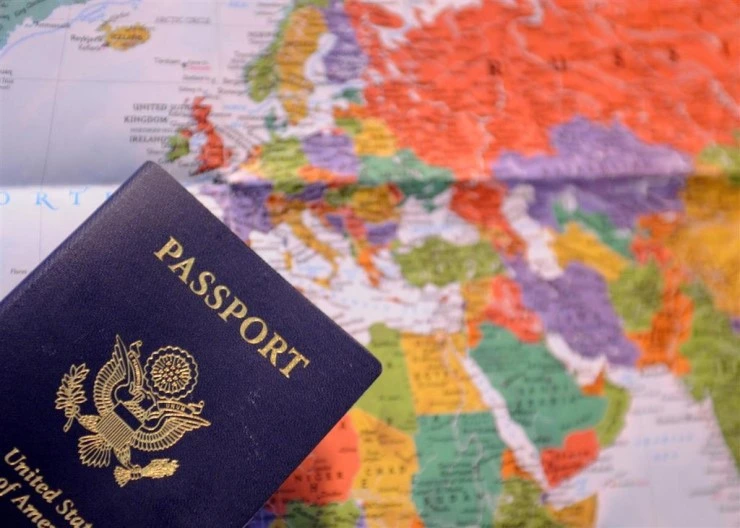
What the passport rankings measure, and what they do not
Henley & Partners compiles the passport rankings from the International Air Transport Association’s Timatic database, the same system airlines use to decide whether a passenger can board. Each of the world’s 199 passports is scored against 227 destinations, and a destination counts if the holder can enter without a visa obtained in advance. That covers three different things: strictly visa-free entry, a visa issued at the border on arrival, and an electronic travel authorisation approved before departure.
What does not count is an e-visa. The distinction sounds technical and is not. An e-visa has to be applied for and approved before you fly, and an airline will refuse boarding without one, which makes it a full visa administered online rather than a form of visa-free access. This is the single most common error in coverage of the index, and it is why some sites quote figures far higher than the ones below.
One feature of the index confuses readers every year, and it is worth explaining before the tables. Henley ranks in tiers rather than assigning 199 unique positions, so a large number of countries share a rank. Eleven countries sit together in fourth place in 2026, all on 186 destinations. A country can therefore gain destinations and keep the same rank, or lose none at all and still slip, purely because the countries around it moved. When a headline says a passport has fallen three places, the underlying score has often barely changed.
It is also worth being clear about what a high position in the passport rankings does not buy. The score measures the right to arrive, not the right to stay. A powerful passport says nothing about your ability to work, study or settle anywhere, and it will not shorten a residence requirement or improve a visa application. Those are governed by each destination’s own immigration rules, which is a separate question from the one this index answers.
Passport rankings 2026: the 10 most powerful passports
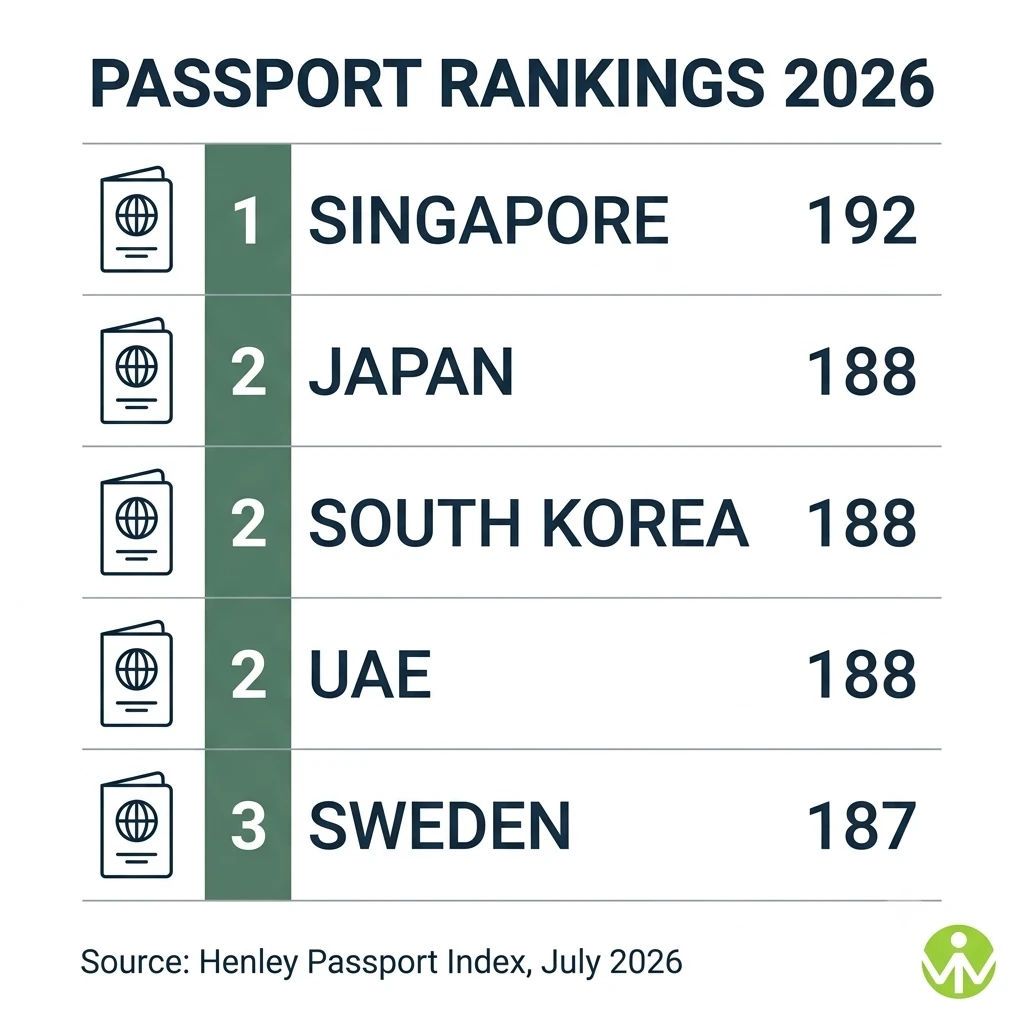
| Rank | Country / Countries | Visa-Free Destinations |
|---|---|---|
| 1 | Singapore | 192 |
| 2 | Japan, South Korea, UAE | 188 |
| 3 | Sweden | 187 |
| 4 | Belgium, Denmark, Finland, France, Germany, Ireland, Italy, Luxembourg, Netherlands, Norway, Spain | 186 |
| 5 | Austria, Greece, Malta, Portugal, Switzerland | 185 |
| 6 | Hungary, Poland, United Kingdom | 184 |
| 7 | Australia, Canada, Czechia, Latvia, Malaysia, New Zealand, Slovakia, Slovenia | 183 |
| 8 | Croatia, Estonia | 182 |
| 9 | Liechtenstein, Lithuania | 181 |
| 10 | Iceland, United States | 180 |
| Source: Henley Passport Index, July 2026 edition. Verified 19 September 2026. | ||
Singapore holds first place for a third consecutive year, with visa-free or visa-on-arrival access to 192 of the 227 destinations tracked. Its lead is the product of decades of bilateral agreement-building across Europe, Asia, the Americas and Africa, and no other passport is currently within four destinations of it.
The most significant change in the 2026 index is in second place. Japan and South Korea, both on 188, are now joined there by the United Arab Emirates, which climbed three places in the most recent update. That is the largest single move of any passport this cycle, and it makes the UAE the highest-ranked Arab passport in the index’s history. Anyone planning travel around it should note that the table measures outbound access only; UAE visa requirements for inbound visitors are a different matter entirely.
Sweden sits alone in third on 187. Below it, the fourth tier is the largest concentration of passport power anywhere on the table, with eleven European countries sharing 186 destinations. The United Kingdom has climbed to sixth on 184, and the United States holds tenth on 180 alongside Iceland.
The European concentration near the top of the passport rankings is not an accident of geography. Schengen membership and the web of EU external agreements deliver a large block of mutual access to every member at once, which is why eleven countries arrive at precisely the same score. It also means European passports tend to move together: an agreement struck at EU level lifts the whole bloc rather than a single country.
One feature of the modern index is how crowded the top has become. The top 10 now contains 38 individual passports, against 26 in 2006. High mobility has spread, and relative advantage within it has become much harder to hold.
Passport rankings 2026: the 10 weakest passports
| Rank | Country | Visa-Free Destinations |
|---|---|---|
| 105 (last) | Afghanistan | 22 |
| 104 | Syria | 25 |
| 103 | Iraq | 28 |
| 102 | Pakistan | 29 |
| 101 | Yemen | 30 |
| 100 | Somalia | 32 |
| 99 | Nepal | 34 |
| 98 | Bangladesh, North Korea | 35 |
| 97 | Iran, Palestinian Territory | 37 |
| 96 | Eritrea | 38 |
| Source: Henley Passport Index, July 2026 edition. Verified 19 September 2026. | ||
Afghanistan holds the weakest passport in the 2026 index, last at 105th, with 22 destinations reachable without a visa arranged in advance. Syria follows on 25 and Iraq on 28. For citizens of the countries at this end of the table, almost every international journey begins with an embassy appointment, supporting documentation, a fee that is rarely refunded, and a meaningful chance of refusal.
What the bottom of the table has in common is not poverty. It is conflict, sanctions and diplomatic isolation. The relationship between national wealth and passport strength is much weaker than people assume, and several wealthy countries hold notably weak passports while some modest economies hold strong ones. Passport power tracks the diplomatic relationships a country has built far more closely than it tracks GDP.
An important caveat belongs here, because these tables are often read as a verdict on a person’s prospects. They are not. A weak passport constrains short-term travel. It does not determine whether someone can study, work or emigrate. Student visas, employer-sponsored work permits, family routes and permanent residence pathways all operate on criteria that have nothing to do with a passport’s visa-free score.
What changed in the July 2026 update
The index is revised quarterly, and four movements in the most recent edition are worth noting.
The UAE was the biggest mover, climbing three places into joint second. Over twenty years it has added 153 visa-free destinations, the largest improvement any passport has recorded in the history of the index.
The United Kingdom rose one place to sixth after securing visa-free access to China and Malawi. Canada also gained, moving to seventh.
The United States held steady at tenth. It is now one of the very few top-ranked passports whose holders still require a visa for China, a reversal of the pattern that held for most of the index’s first decade. Americans looking at what their passport opens today will find the current picture in our guide to the destinations US citizens can enter without a visa, and it is worth remembering that a valid US visa is itself a travel document that unlocks entry to around thirty other countries.
China, meanwhile, ranks 61st on 83 destinations. Its own inbound policy has expanded considerably faster than its outbound score, which is covered in our China immigration guide.
The next revision is due in October 2026. Because the passport rankings are recompiled four times a year, a country’s position is a snapshot rather than a standing, and a single bilateral agreement taking effect can move a passport several places at once.
Table 3: Twenty Years of the Passport Rankings
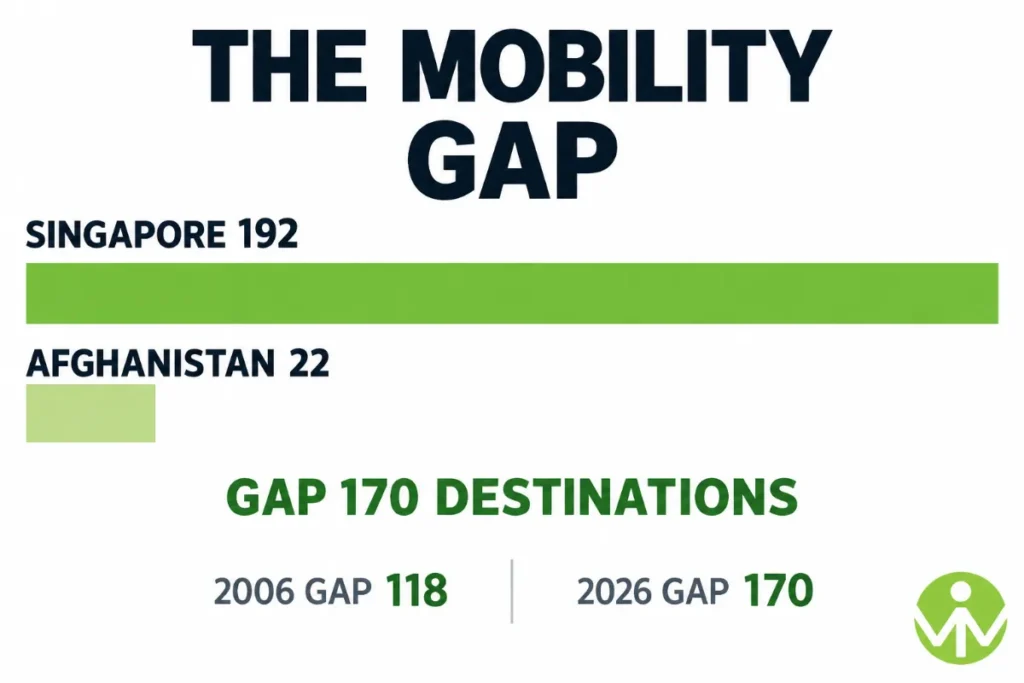
| Measure | 2006 | 2026 |
|---|---|---|
| Strongest passport | USA, Denmark, Finland – 130 destinations | Singapore – 192 destinations |
| Weakest passport | Afghanistan – 12 destinations | Afghanistan – 22 destinations |
| Mobility gap | 118 destinations | 170 destinations |
| Average passport | 58 destinations | 108 destinations |
| United States | 1st | 10th |
| United Kingdom | 3rd | 6th |
| Singapore | 8th | 1st |
| Passports inside the top 10 | 26 | 38 |
| Source: Henley & Partners, Henley Passport Index 20th anniversary edition, 21 July 2026. | ||
The anniversary edition is the first to set two decades side by side, and the comparison is more revealing than any single year’s table.
In 2006 the strongest passports in the world, held by the United States, Denmark and Finland, opened 130 destinations. Singapore now opens 192. Over the same period Afghanistan moved from 12 destinations to 22, so the bottom of the table improved in absolute terms while falling much further behind in relative ones. The gap widened from 118 destinations to 170.
The shift in the composition of the elite is just as striking. The United States ranked first in 2006 and ranks tenth now. The United Kingdom ranked third and now ranks sixth. Singapore ranked eighth and now ranks first. Asia’s rise at the top of the passport rankings over twenty years is the clearest single trend in the data.
One country stands alone. Bolivia is the only passport in the world to have recorded a net loss of visa-free access over the past two decades, down six destinations. Every other passport on the index has become more powerful than it was in 2006.
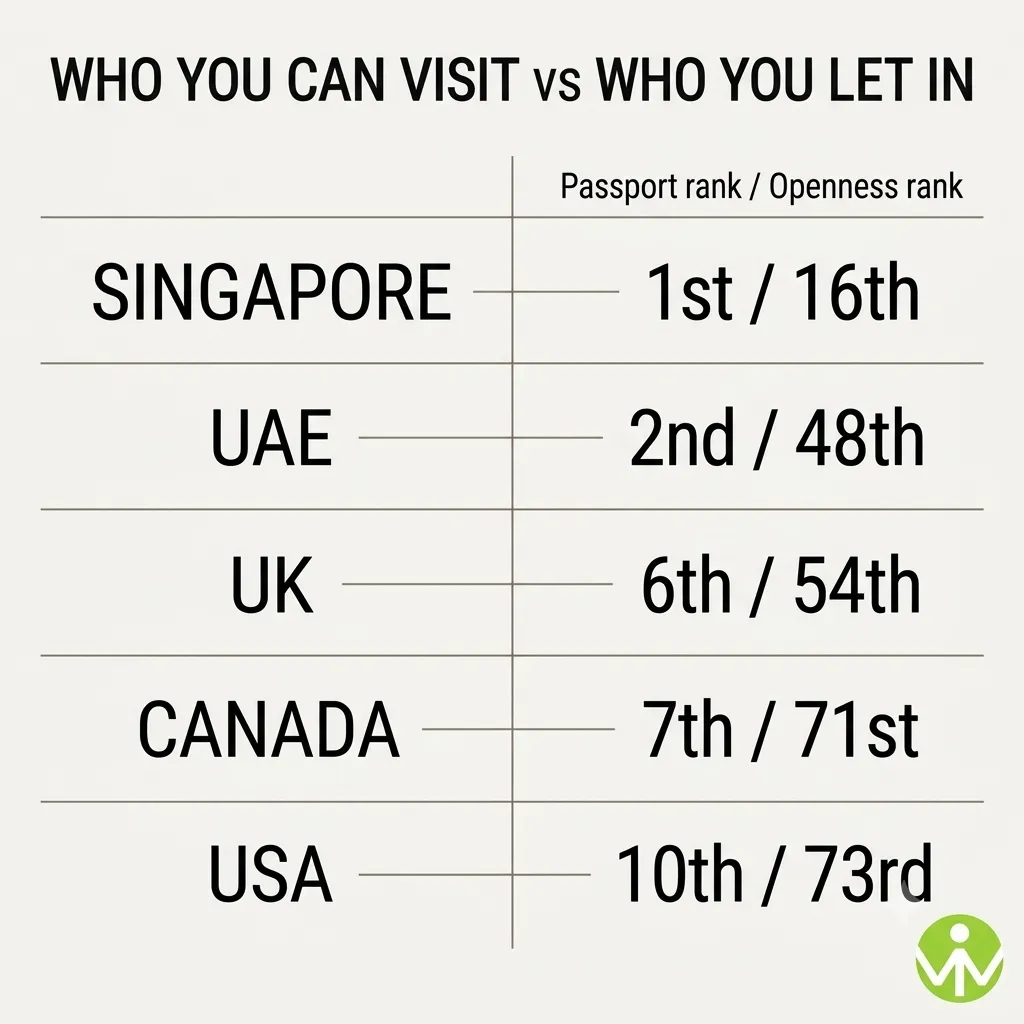
Table 4: The Openness Gap 2026
| Country | Passport Rank | Openness Rank | Nationalities Admitted Visa-Free |
|---|---|---|---|
| Singapore | 1st | 16th | 164 |
| UAE | 2nd | 48th | 91 |
| United Kingdom | 6th | 54th | 84 |
| China | 61st | 58th | 79 |
| Japan | 2nd | 60th | 74 |
| Canada | 7th | 71st | 54 |
| United States | 10th | 73rd | 46 |
| Source: Henley Openness Index. Openness scores are out of 198. Verified 19 September 2026. | |||
The passport rankings measure outbound mobility. A second and much less discussed index measures the reverse: how many nationalities a country admits without a prior visa. Henley publishes this as the Henley Openness Index, scored out of 198.
Read together, the two indices expose a gap the headline table hides. The United States ranks tenth in the world for where its citizens can go, and 73rd for who it lets in, admitting 46 nationalities visa-free. Canada shows the same asymmetry at 71st. At the other extreme, twelve countries admit every one of the 198 nationalities measured without a prior visa, among them Burundi, Cambodia, Kenya, Rwanda, Dominica and Timor-Leste, none of which holds a strong passport of its own.
For anyone planning a trip rather than reading a league table, this is the more useful of the two indices. If you hold a passport in the lower half of the table, the openness data is what tells you which doors are actually open to you.
What the passport rankings mean for your plans
Where you sit in the passport rankings changes what planning a journey looks like, but not in the same way for every kind of traveller.
For short-term travel, a top-20 passport means most trips require nothing beyond a ticket and a document with enough remaining validity, usually six months. Below roughly 60th, advance visas become the norm for popular destinations, and the practical constraints are lead time and documentation rather than eligibility. Either way, check the specific rule rather than the ranking. Visa-free access is frequently capped at 30 or 90 days, and regional systems have their own arithmetic, as anyone who has counted days against a Schengen visa allowance will know.
For work, passport strength is close to irrelevant. Work authorisation turns on qualifications, an employer willing to sponsor, and the destination’s own labour rules. Nationality can affect processing times and which specific routes are open, and some countries operate bilateral labour agreements that favour particular nationalities, but no position on this index will move an application forward.
For study, the position is much the same as for work. Admission and a student visa turn on the institution’s offer, proof of funds and language requirements. Where the table does matter to a student is afterwards: a degree that leads to a work permit, then residence, then eventually citizenship in a top-tier country is one of the more reliable long routes to a stronger passport.
For permanent residence and second citizenship, the passport rankings are genuinely useful, because they quantify what a change of status would be worth. Moving from a passport in the 80s to one in the top 10 is a difference of well over a hundred destinations. That is the arithmetic behind sustained interest in citizenship by investment and in residence-by-investment and golden visa programmes, and behind the rise in demand for second passports among citizens of countries that were until recently at the very top of the index.
Two cautions are worth stating plainly. Standard naturalisation after a residence period typically takes five to ten years, and the faster investment routes carry substantial financial thresholds and due diligence requirements. The index is a planning input, not a shortcut.
If you want to see how a specific passport performs rather than where it sits on the table, our country guides break the picture down destination by destination, including detailed lists for US citizens and Indian passport holders.
Frequently Asked Questions: Passport Rankings 2026
Which country has the most powerful passport in 2026?
Singapore. Singaporean passport holders can enter 192 of the 227 destinations tracked by the Henley Passport Index without arranging a visa in advance, a position Singapore has now held for three consecutive years.
Which passport is the weakest in 2026?
Afghanistan, ranked 105th with visa-free or visa-on-arrival access to 22 destinations. Syria at 104th and Iraq at 103rd complete the bottom three.
Where does the US passport rank in 2026?
The United States ranks 10th, sharing that position with Iceland, with access to 180 destinations. It ranked 1st when the index launched in 2006. It is also now one of the few top-ranked passports whose holders still need a visa to enter China.
What is the difference between the Henley Passport Index and the Openness Index?
The Passport Index measures how many destinations a country’s citizens can enter without a prior visa. The Openness Index measures the reverse, how many nationalities that country admits without a prior visa. They often diverge sharply. The US ranks 10th on the first and 73rd on the second.
How often are passport rankings updated?
Quarterly, in January, April, July and October. A single new bilateral agreement can move a country’s position at any update, and the figures on this page reflect the most recent edition.
Do e-visa destinations count toward a passport’s score?
No. An e-visa must be applied for and approved before departure, and airlines will not board a passenger without one, so Henley excludes e-visa-only destinations. Visa-on-arrival and electronic travel authorisation destinations are included, because in both cases the traveller can depart without an approved visa in hand.
Why do several countries share the same rank?
Henley ranks in tiers rather than assigning 199 unique positions, so every country with the same visa-free score shares a rank. Eleven countries share fourth place in 2026, all on 186 destinations. A passport can therefore change rank without its own score changing at all, simply because the countries around it moved.
Does a passport ranking affect whether I can get a work visa or permanent residency?
Not directly. Work visas and residence applications are assessed on qualifications, sponsorship, financial standing and compliance with the destination’s immigration rules. Passport strength can influence processing times and the range of routes available, but it is not an eligibility criterion.
Final Note
The passport rankings 2026 reflect the current state of global diplomatic relationships and visa policy — both of which can change. The Henley Passport Index updates quarterly, and a single new bilateral agreement can shift a country’s position. The figures in this article are based on the January 2026 edition of the index.
For destination-specific immigration guidance — visa types, eligibility requirements, processing times, and application steps — use the country guides on immigrationworld.com. The passport rankings show where you stand globally; the country guides show what you can do about it.
If you are researching immigration options for a specific country, use the country guides on immigrationworld.com for detailed, destination-specific information on visa types, eligibility requirements, and application processes.
Sources
- Henley & Partners, Passport Power Doubles as Global Peace Declines, 21 July 2026 – the 20th anniversary edition press release.
- Henley & Partners, Global Passport Ranking – the live index, from which all figures on this page were taken.
- Henley & Partners, Henley Openness Index – inbound visa-free access by nationality.
- International Air Transport Association, Timatic database – the underlying travel documentation data.
- All figures verified on 19 September 2026.
Related Readings