
The move from an O-1 visa to green card status is one of the more forgiving transitions in US employment-based immigration, because the evidence that won the O-1 petition usually maps onto the immigrant category that follows. No O-1 visa-to-green-card conversion happens automatically; a separate immigrant petition must be filed and approved. But starting one does not put your existing status at risk. This guide covers the four categories open to an O-1 holder, what each demands, what filing costs, and where the queue stood on the September 2026 Visa Bulletin. It sits under our wider guide to the US green card.
Key Takeaways
- An O-1 visa to green card move needs a separate immigrant petition. O-1 status does not convert into permanent residence on its own.
- Four O-1 visa to green card routes are realistic: EB-1A, EB-1B, EB-1C, and EB-2 with a national interest waiver.
- EB-1A and EB-2 NIW can be self-petitioned. EB-1B needs a permanent job offer, and EB-1C cannot be self-petitioned at all.
- No O-1 visa to green card route requires a PERM labor certification.
- The national interest waiver is decided under the three-prong Matter of Dhanasar test adopted in December 2016, not the older "substantial intrinsic merit" standard.
- Filing or approving an immigrant petition cannot be used as a reason to deny an O-1 extension or change of status.
- On the September 2026 Visa Bulletin, EB-1 is current worldwide but backlogged for India and China, and EB-2 India is unavailable.
Table of Contents
The move from an O-1 visa to green card status is one of the more forgiving transitions in US employment-based immigration, because the evidence that won the O-1 petition usually maps onto the immigrant category that follows. No O-1 visa-to-green-card conversion happens automatically; a separate immigrant petition must be filed and approved. But starting one does not put your existing status at risk. This guide covers the four categories open to an O-1 holder, what each requires, what the filing costs are, and where the queue stood on the September 2026 Visa Bulletin. It sits under our wider guide to the US green card.
Why an O-1 visa to green card move starts from a strong position
USCIS admits an O-1 beneficiary for a period long enough to complete the event or activity, capped at three years, then authorises extensions in increments of up to one year for the same work. There is no lifetime ceiling, which is why some people hold O-1 status for a decade. That open-ended renewability turns the O-1 visa to green card decision into a question of timing rather than a race against an expiry date.
The second advantage is legal. Under 8 CFR 214.2(o)(13), USCIS should not deny an extension of stay or a change of status “on the basis of the approval of a permanent labor certification or the filing of a preference petition for the O-1 beneficiary”. Starting an immigrant case cannot, by itself, cost you the status you are standing on. One caveat: the O-1 is not formally dual intent the way the H-1B and L-1 are, so a consular officer can still probe your intentions abroad. Our guide to alternatives to the H-1B visa sets the classifications side by side. A TN visa holder has less room still: TN requires temporary intent and has no equivalent regulatory safeguard.
Four O-1 visa to green card routes to choose between
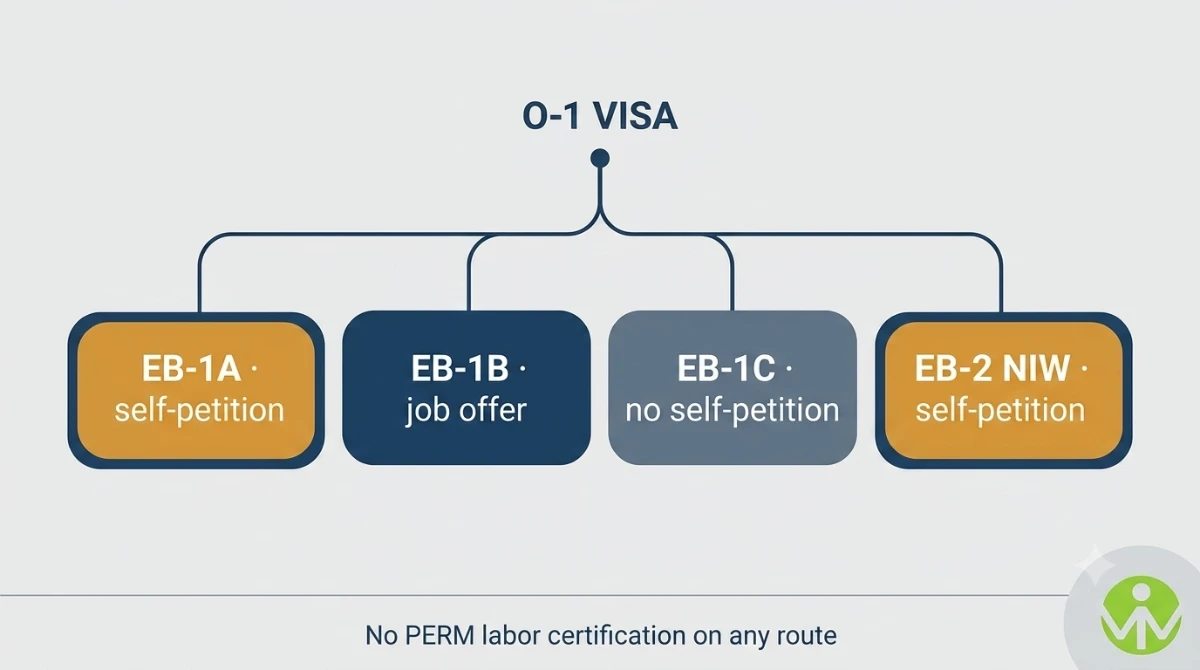
There is no O-1-specific green card. Every O-1 visa-to-green-card case runs through one of the standard employment-based preference categories, and four are realistic. They differ on who may file, whether an employer must be involved at all, and how long the wait will be. Choosing wrong costs a filing fee and, more painfully, a priority date.
Table 1 — The four O-1 visa to green card routes compared
| Route | Best fit | Self-petition? | Job offer? | Labor cert? | Premium clock |
|---|---|---|---|---|---|
| EB-1A — extraordinary ability | The profile that won the O-1A or O-1B petition | Yes | No | No | 15 business days |
| EB-1B — outstanding professor or researcher | Academics, 3+ years teaching or research | No | Yes — tenured, tenure-track or permanent research post | No | 15 business days |
| EB-1C — multinational manager or executive | Managers moved to a US entity by a related foreign employer | No — not permitted | Yes | No | 45 business days |
| EB-2 with national interest waiver | Advanced-degree or exceptional-ability workers with a nationally important endeavor | Yes | No | No — waived | 45 business days |
| Source: USCIS Policy Manual, Volume 6, Part F, Chapters 2-5. Verified 23 August 2026. | |||||
EB-1A — extraordinary ability
The natural destination for most O-1A and O-1B holders. It uses a similar vocabulary to the O-1 and, critically, you may file for yourself: no employer, no job offer, no sponsor who can withdraw the petition if you change roles.
EB-1B — outstanding professor or researcher
For academics with at least three years of teaching or research experience who meet two of six criteria. It requires an offer from a qualifying US employer for a tenured post, a tenure-track post or a permanent research position, so it is not a self-petition route.
EB-1C — multinational manager or executive
For people employed abroad by a qualifying organisation for one year out of the previous three, then moved to a related US entity in a managerial or executive role. The year abroad need not be continuous. Self-petitioning is expressly not permitted.
EB-2 with a national interest waiver
The fallback when the EB-1A evidence is thin. You must first qualify for EB-2 as an advanced-degree professional or by exceptional ability, then separately persuade USCIS to waive the job offer. Our EB-1A vs EB-2 NIW comparison examines the trade-off.
EB-1A: the default O-1 visa to green card route
Both classifications ask you to show extraordinary ability through a checklist of evidence, which is the strongest argument for treating EB-1A as the default. USCIS assesses it in two steps, following Kazarian v. USCIS. First it checks whether your evidence objectively meets the ten regulatory criteria — at least three, unless you hold a one-time major international award. Then it weighs the record as a whole to decide whether you are “one of that small percentage who have risen to the very top of the field of endeavor”.
Table 2 — The ten EB-1A criteria at 8 CFR 204.5(h)(3)
| # | Criterion |
|---|---|
| 1 | Lesser nationally or internationally recognised prizes or awards for excellence |
| 2 | Membership in associations requiring outstanding achievement, judged by recognised experts |
| 3 | Published material about you in professional publications or major media |
| 4 | Judging the work of others in the same or an allied field |
| 5 | Original contributions of major significance to the field |
| 6 | Authorship of scholarly articles in professional publications or major media |
| 7 | Display of your work at artistic exhibitions or showcases |
| 8 | A leading or critical role for organisations with a distinguished reputation |
| 9 | High salary or remuneration relative to others in the field |
| 10 | Commercial success in the performing arts |
| At least three are needed, unless you hold a one-time major international award such as a Nobel Prize or Olympic medal. Source: USCIS Policy Manual, Volume 6, Part F, Chapter 2. | |
The second step is where an O-1 visa to green card petition is most often lost. Meeting three criteria clears the first gate only, and petitions are regularly denied at final merits on evidence that satisfied three boxes comfortably. EB-1A also asks for something the O-1 does not: you must intend to continue working in the area of extraordinary ability, and your entry must prospectively benefit the United States.
The national interest waiver and the Dhanasar test
The national interest waiver removes the job offer and labor certification requirements from an EB-2 petition. It is the other self-petition route, and the one where outdated guidance does the most damage to an O-1 visa to green card plan. The governing standard is Matter of Dhanasar, 26 I&N Dec. 884 (AAO 2016), decided on 27 December 2016. According to the USCIS Policy Manual, a waiver may be granted where the proposed endeavor has both substantial merit and national importance, the person is well positioned to advance it, and on balance it would benefit the United States to waive the job offer and labor certification requirements.
Table 3 — The national interest waiver standard: what changed in 2016
| Superseded standard (Matter of NYSDOT, 1998) | Current standard (Matter of Dhanasar, 2016) | |
|---|---|---|
| Prong 1 | The endeavor had to be of “substantial intrinsic merit” | The proposed endeavor has both substantial merit and national importance |
| Prong 2 | The benefit had to be national in scope | The person is well positioned to advance the proposed endeavor |
| Prong 3 | The applicant had to show a US worker would be harmed by requiring labor certification | On balance, it benefits the United States to waive the job offer and labor certification requirements |
| Matter of Dhanasar, 26 I&N Dec. 884 (AAO 2016) vacated Matter of New York State Department of Transportation. Any guidance still citing “substantial intrinsic merit” is out of date. | ||
“Substantial merit” alone is no longer enough. National importance is a separate hurdle inside the same prong, and it is where most weak petitions fail. Dhanasar also lowered the barrier facing entrepreneurs and self-employed researchers, who struggled under the old framework to show that requiring labor certification would harm a US worker when there was no US employer in the picture.
Two points guidance often skips. The waiver is not a category of its own — an O-1 visa to green card applicant must still qualify for EB-2 first, and the waiver only excuses the job offer. USCIS also tightened its NIW guidance in January 2025, sharpening how it weighs the evidence behind the second prong.
No O-1 visa to green card route needs a labor certification
This deserves stating plainly, because it is the most common error in circulation on the subject. A PERM labor certification — the Department of Labor process in which an employer tests the US labour market for qualified American workers — is required for none of the four routes above.
USCIS says so separately for each EB-1 subcategory: not required for extraordinary ability, not for outstanding professors and researchers, not for multinational managers and executives. For EB-2 it would normally apply, and the national interest waiver is the mechanism that removes it. Anyone telling an O-1 holder that their employer must first run a PERM recruitment is describing the EB-2 or EB-3 route, not the O-1-to-green-card route. The five employment-based preference categories differ sharply here.
Filing an O-1 visa to green card petition: forms and fees
Every O-1 visa to green card filing begins with Form I-140, the Immigrant Petition for Alien Worker. For EB-1A and NIW, you sign it yourself; for EB-1B and EB-1C, the employer signs. The base fee set by 8 CFR 106.2 is $715 on all four routes, so cost is not a reason to choose between them.
An Asylum Program Fee is charged on top: $600 as standard, $300 for a small employer of 25 or fewer full-time-equivalent staff, nothing for a qualifying nonprofit. Premium processing is optional and was adjusted on 1 March 2026 to $2,965. That fee is identical across categories; the guaranteed clock is not. EB-1A and EB-1B are decided within 15 business days, EB-1C and NIW within 45.
Adjustment of status: finishing an O-1 visa to green card case inside the US
You file Form I-485 with USCIS — $1,440 for an applicant aged 14 or over — and remain in the country while it is decided. It can be filed alongside the I-140, but only when a visa number is immediately available. That caveat is routinely dropped from advice aimed at O-1 holders, and it excludes most Indian and Chinese nationals in the backlogged categories. USCIS decides monthly whether applicants use the Final Action Dates chart or the more generous Dates for Filing chart.
Consular processing abroad
If you are outside the United States, the approved petition goes to the National Visa Center, you complete Form DS-260, and you attend an immigrant visa interview at a US embassy or consulate. You enter as a permanent resident and the card follows. The two routes are alternatives, not sequential steps.
Where the O-1 visa to green card queue stands right now
Approval of the I-140 is not the finish line. Your priority date is the day the petition was filed, and you wait until it becomes current for your category and country of chargeability. For most nationalities EB-1 carries no wait. For Indian and Chinese nationals it carries a substantial one, and this is where an O-1 visa to green card decision stops being about evidence and becomes arithmetic.
Table 4 — The O-1 visa to green card queue: final action dates, September 2026
| Category | All other countries | China (mainland-born) | India |
|---|---|---|---|
| EB-1 | Current | 1 July 2023 | 15 October 2022 |
| EB-2 (including NIW) | Current | 1 September 2021 | Unavailable |
| EB-3 | 1 September 2024 | 1 January 2022 | 1 January 2014 |
| Table A, Visa Bulletin Number 18, Volume XI, September 2026 (US Department of State). Dates move monthly and can retrogress. | |||
Two warnings in the September 2026 Visa Bulletin bear on any filing planned this year. On EB-1 India, the State Department warns that high demand “may necessitate making the category unavailable in the coming weeks”. On EB-2, it warns that demand “may make it necessary to retrogress the final action date or make the category unavailable before the end of the fiscal year”. EB-2 India is already unavailable. Categories that close at fiscal year end normally reopen when new annual limits take effect on 1 October, but reopening dates are neither guaranteed nor published in advance.
How long an O-1 visa to green card case takes
The honest answer separates two clocks that are frequently added together as though they were one. The adjudication clock covers how long USCIS takes to decide the I-140: months without premium processing, 15 or 45 business days with it. The queue clock covers the wait for a visa number, which depends entirely on category and country.
For a worldwide EB-1A applicant using premium processing and adjustment of status, an O-1 visa to green card transition can realistically finish inside a year. For an Indian national in the same category, adjudication may take three weeks and the queue several years. Both filed identical petitions; only the chargeability differs. Any single figure quoted for this process without naming a country should be treated with suspicion. Applicants unsure which categories they qualify for should start with US green card eligibility.
Once an O-1 visa to green card case completes, the extension filings stop, you are free to change employer, and naturalisation becomes available after five years as a permanent resident. Our summary of the benefits of a US green card covers what changes on approval. O-1 holders with a US citizen or permanent resident spouse should also weigh the family-based green card route, which is unrelated to the categories above and sometimes faster.
Frequently asked questions
Can I apply for a green card while holding O-1 status?
Yes. USCIS may not deny an O-1 extension or change of status merely because a labor certification has been approved or a preference petition filed for you. The O-1 is not formally dual intent in the way the H-1B is, so intent can still be questioned at a consulate abroad, but a pending petition is not by itself a problem.
Does an O-1 visa to green card transition require an employer?
Not necessarily. EB-1A and EB-2 with a national interest waiver can both be self-petitioned, so no employer need be involved. EB-1B requires a permanent job offer from a qualifying US institution, and EB-1C cannot be self-petitioned at all.
Is a labor certification needed to convert an O-1 visa to green card status?
No. USCIS confirms separately that a permanent labor certification is not required for EB-1A, EB-1B or EB-1C. For EB-2 it would normally apply, and the national interest waiver exists specifically to remove it.
What test does USCIS use for a national interest waiver?
The three-prong test from Matter of Dhanasar, 26 I&N Dec. 884 (AAO 2016): the endeavor must have substantial merit and national importance, the person must be well positioned to advance it, and waiving the job offer must on balance benefit the United States. The earlier “substantial intrinsic merit” standard was vacated in December 2016.
Does holding an O-1 visa guarantee EB-1A approval?
No. The categories use similar language but are judged separately. EB-1A additionally requires that you intend to continue working in your field of extraordinary ability, and it applies a final merits test that many petitions meeting three criteria still fail.
Can I file Form I-140 and Form I-485 at the same time?
Only when an immigrant visa number is immediately available for your category and country on the chart USCIS is using that month. Applicants chargeable to India or mainland China in backlogged categories generally cannot file concurrently.
What does an O-1 visa to green card filing cost?
Form I-140 costs $715, plus an Asylum Program Fee of $600, $300 or nothing depending on the filer. Form I-485 is $1,440 for an applicant aged 14 or over. Premium processing is optional at $2,965 and buys a decision in 15 business days for EB-1A and EB-1B, or 45 for EB-1C and NIW cases.