
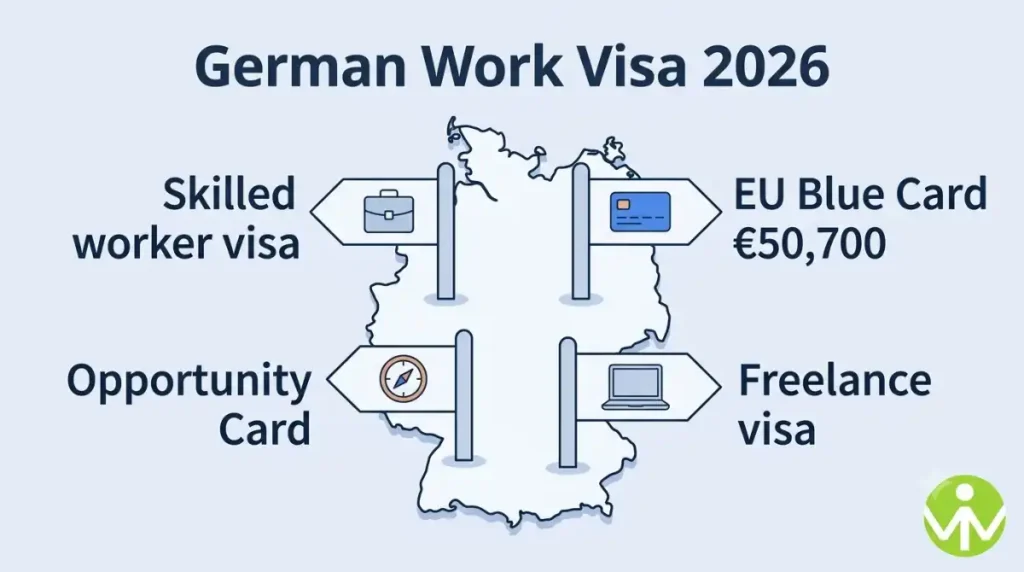
A German work visa is the national long-stay visa (Type D) that lets a non-EU citizen enter Germany to work, and the right German work visa in 2026 depends on three things: whether you already hold a job offer, whether you have a degree, and what the job pays. Germany has no single permit for everyone. The main routes are the skilled worker visa, the EU Blue Card, the Opportunity Card for people who are looking for a job, and the freelance or self-employment visa.
This guide explains each German work visa route, the 2026 EU Blue Card salary thresholds, the requirements and documents, the €75 fee, how the application works at a German embassy or consulate, and how a work permit can lead to permanent residency. It replaces older advice that still mentions a six-month Job Seeker visa, which no longer exists as a separate visa. For the full map of short-stay and long-stay options, see our guide to the types of Germany visa.
Key Takeaways
- Four main routes: the skilled worker visa, the EU Blue Card, the Opportunity Card (job search without an offer) and the freelance or self-employment visa.
- EU Blue Card in 2026: €50,700 gross a year, or €45,934.20 for shortage occupations and young professionals.
- The Opportunity Card lasts up to one year, allows up to 20 hours of work a week and needs €1,091 a month in proof of funds. The six-month Job Seeker visa no longer exists as a separate visa.
- The national visa fee is €75 for adults and €37.50 for minors under 18.
- Settlement: Blue Card holders can apply after 21 months (B1 German) or 27 months (A1 German); skilled workers after at least three years.
Table of contents
Who needs a German work visa?
Citizens of EU and EEA countries and Switzerland do not need a German work visa. They can live and work in Germany without one. Citizens of Australia, Canada, Israel, Japan, New Zealand, South Korea, the United Kingdom and the United States may enter without a visa and apply for a residence permit after arrival. Everyone else who plans to work in Germany normally applies for a national visa at a German embassy, consulate or authorised visa centre before travelling.
A national visa is usually an entry visa. After you arrive, the local foreigners authority (Ausländerbehörde) issues the residence permit that matches your job. A Schengen visa is not a German work visa, because it covers short visits only, as our German tourist visa guide explains.
Types of German work visa in 2026
Germany has four main routes for work, compared in the table below. The best German work visa for you depends on your qualification, your salary and whether you already have an employer.
Table 1: German work visa routes compared (2026)
| Route | Best for | Job offer needed | Key 2026 requirement | Initial validity | Route to settlement |
|---|---|---|---|---|---|
| Skilled worker visa | A qualified job with a recognised qualification | Yes | Recognised qualification; over-45s need €55,770 a year or pension proof | Up to 4 years, or contract plus 6 months if shorter | After at least 3 years |
| EU Blue Card | Graduates in higher-paid jobs | Yes | €50,700 gross a year (€45,934.20 for shortage occupations and young professionals) | Contract length plus a short margin, maximum 4 years | After 21 months (B1 German) or 27 months (A1 German) |
| Opportunity Card | Job search without an offer | No | Recognised qualification, or 6 or more points plus A1 German or B2 English; €1,091 a month in funds | Up to 1 year | Not directly; switch to a work permit |
| Freelance and self-employment visa | Founders and freelancers | No | Economic interest, financing and any professional licence; pension proof if over 45 | Up to 3 years | After 3 years of successful operation |
| National visa fee for every route: €75 for adults, €37.50 for minors. Figures as of 1 October 2026 from the Federal Foreign Office, Make it in Germany and the Federal Employment Agency. | |||||
Skilled worker visa (employment visa)
The skilled worker visa is the broadest German work visa. It is for people with a job offer in a qualified position, meaning a role that normally needs a university degree or vocational training. Your qualification must be recognised in Germany or comparable to a German academic qualification, and regulated professions such as healthcare also need a licence to practise. The Federal Employment Agency checks the salary and working hours against those of comparable workers in Germany, as Make it in Germany explains.
Applicants over 45 who are new to the German labour market need a gross annual salary of at least €55,770 in 2026, or proof of adequate pension provision. The residence permit runs for up to four years or the length of the contract plus six months, whichever is shorter. After at least three years on an employment-based permit, you may qualify for a settlement permit.
EU Blue Card Germany
The EU Blue Card is the German work visa route for graduates with a higher-paid job. You need a German degree or a comparable foreign qualification, or a tertiary qualification of at least three years, plus a job paying at least €50,700 gross a year in 2026. The lower threshold of €45,934.20 applies to shortage occupations and to young professionals whose degree was obtained within the last three years. The Federal Employment Agency publishes both figures, and they are reviewed every year.
IT specialists without a degree can still qualify if they have worked in IT roles for at least three of the past seven years at university-equivalent level, hold a job offer of at least six months and meet the €45,934.20 threshold. The card is issued for the length of the employment contract plus a short additional period, up to a maximum of four years, and family reunification is possible. During the first year, a change of job must be notified to the local authority, which checks that the conditions are still met. Blue Card holders can apply for a settlement permit after 21 months with B1 German or 27 months with A1 German. For how the scheme works across EU member states, see our EU Blue Card guide; the figures in this article are the German ones, and the official Make it in Germany Blue Card page has the application details.
Opportunity Card (Chancenkarte)
The Opportunity Card is the only German work visa that lets qualified people come to Germany to look for work without a job offer. It is issued for up to one year. There are two ways to qualify. The first is a foreign vocational or academic qualification that is fully recognised in Germany, or a qualification earned in Germany. The second is a completed vocational training of at least two years, or an academic qualification, plus at least six points on the points system, together with German at A1 level or English at B2 level.
The points route is cumulative, with a maximum of 16 points, as the table below shows. The official self-check gives your own score.
Table 2: Opportunity Card points route (2026)
| Criterion | Points |
|---|---|
| Partial recognition of a foreign qualification | 4 |
| Qualification in a shortage occupation | 1 |
| Professional experience: at least 2 of the last 5 years | 2 |
| Professional experience: at least 5 of the last 7 years | 3 |
| German language skills: A2 / B1 / B2 or higher | 1 / 2 / 3 |
| English language skills: C1 or higher | 1 |
| Age: under 35 / 35 to 39 | 2 / 1 |
| Legal residence in Germany of at least 6 months in the last 5 years | 1 |
| Partner who also meets the Opportunity Card requirements | 1 |
| Maximum 16 points; at least 6 are needed. Experience points are not cumulative. Source: Make it in Germany, 2026. Use the official self-check to work out your own score. | |
Holders can work up to 20 hours a week in a part-time job and do trial work of up to two weeks per employer. Applicants must show they can support themselves, with at least €1,091 a month (€13,092 for a year) in a blocked account, a part-time job contract or a formal obligation from a sponsor. Once you find a qualified job, you apply for the matching residence permit, such as a skilled worker permit or an EU Blue Card. Make it in Germany also mentions an extension of the card of up to two years.
Freelance and self-employment visa
Germany has no dedicated start-up visa, so founders and freelancers use the self-employment residence permit. Business founders must show an economic interest in, or regional demand for, their product or service, a foreseeable positive effect on the economy, and evidence that the plan can be financed through personal capital or a secured loan. Freelancers must show funds for their projects and any professional licence their field requires. Applicants over 45 must show adequate pension provision. The first permit is issued for up to three years, and a settlement permit becomes possible after three years of successful operation, according to Make it in Germany.
What happened to the Job Seeker visa?
Older guides, including earlier versions of this one, describe a six-month Job Seeker visa. That route was replaced by the Opportunity Card from June 2024, and the Make it in Germany portal states that no separate job-seeker visa exists. If another website still describes a six-month job-search permit as a current German work visa, check it against the official portals before relying on it.
German work visa requirements
Requirements differ by route, but most German work visa applications rest on the same core conditions:
- Recognised qualification: your degree or vocational training must be recognised in Germany or comparable to a German qualification, and regulated professions need a licence to practise.
- Qualified job offer: the skilled worker visa and the EU Blue Card need a concrete offer from a German employer. The Opportunity Card and the self-employment visa do not.
- Salary: the Blue Card thresholds are €50,700 and €45,934.20 in 2026, and applicants over 45 on the skilled worker route need €55,770 or pension proof.
- Language: the official pages for the skilled worker visa and the EU Blue Card list no general German-language requirement, although the Opportunity Card points route needs A1 German or B2 English.
- Funds and insurance: Opportunity Card applicants must prove €1,091 a month, and every applicant should expect to show valid health insurance cover.
Documents for a German work visa
Each embassy or consulate publishes its own checklist, and the Federal Foreign Office advises applicants to read the requirements well before the planned date of travel. Use the checklist of the mission that covers your place of residence. Typical documents for a German work visa include:
- A valid passport and the completed national visa application form, printed and signed.
- Biometric photographs that meet the mission’s photo requirements.
- A signed employment contract or binding job offer (not needed for the Opportunity Card).
- Proof of your qualification and its recognition in Germany, and a CV.
- Proof of health insurance, and proof of funds for the Opportunity Card.
- An employer declaration on the employment relationship, where the mission asks for it.
Some missions also ask for proof of accommodation or a police clearance certificate, so confirm the list before you book your appointment.
How to apply for a German work visa
The steps to apply for a German work visa are the same for applicants of any nationality. Only the mission, the visa centre and the appointment system differ.
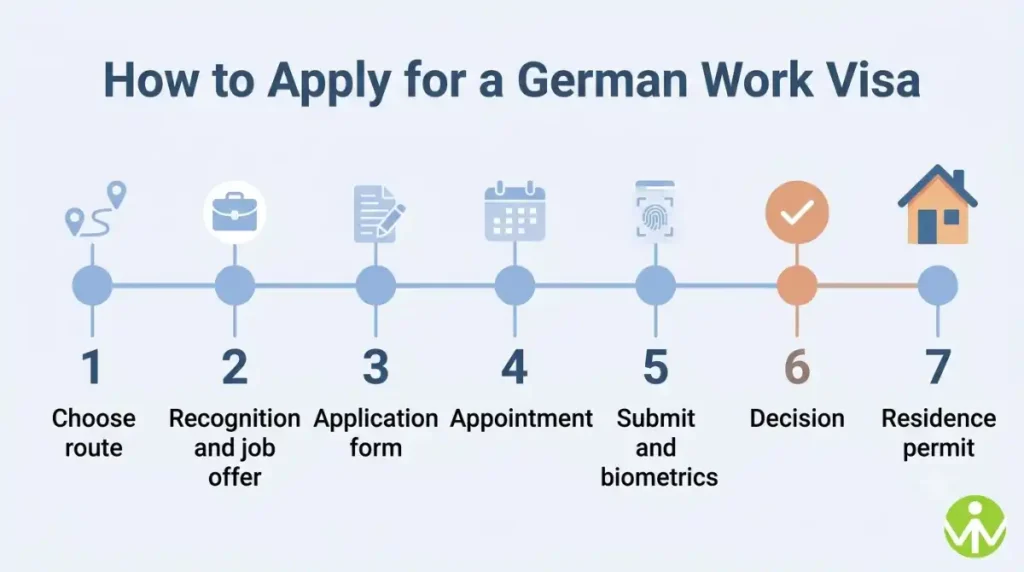
- Choose your route and check its requirements on the official Make it in Germany pages.
- Get your qualification recognised if your profession requires it, and secure a job offer unless you are applying for the Opportunity Card.
- Complete the national visa application form online at videx.diplo.de, or collect it from the mission. For employment visas, the Consular Services Portal also lets skilled workers, and German employers or agencies on their behalf, apply online.
- Book an appointment with the German embassy, consulate or authorised visa application centre responsible for your place of residence.
- Attend the appointment in person to hand in original documents, give fingerprints and a photo, and pay the fee.
- Wait for the decision. The Federal Foreign Office says applications may take several months depending on the purpose of the stay, so apply as early as you can.
- Travel to Germany and contact the local foreigners authority, which issues the residence permit that matches your job.
German work visa cost and processing time
The national visa fee for a German work visa is €75 for adults and €37.50 for minors under 18. The Federal Foreign Office applies reductions or waivers in specific cases, such as scholarship holders and family members of German or EU citizens. The residence permit issued by the local foreigners authority after arrival carries a separate fee set locally, so confirm the current amounts with your mission before you pay.
Other costs add up: translations of documents, recognition of your qualification, health insurance and, for the Opportunity Card, proof of funds of €13,092 for a year. The Federal Foreign Office says processing can take several months. Many guides quote four to twelve weeks for an employment visa, but that range is not confirmed by an official source, so treat any timeline as indicative.
From a German work visa to permanent residency
A German work visa is not permanent, but several routes lead to a settlement permit. EU Blue Card holders can apply after 21 months with B1 German or 27 months with A1 German, not the 33 months quoted in some older guides. Skilled workers on an employment-based permit may qualify after at least three years, and self-employed people after three years of successful operation. Conditions such as pension contributions, income and housing apply, and our guide to permanent residency in Germany covers the documents and the process.
Family members have their own route. Spouses and children usually apply through family reunification, which depends on the sponsor’s permit, income and housing, as our Germany dependent visa guide explains.
Choosing the right German work visa
Start with your situation. If you hold a job offer, a degree and a salary above the threshold, the EU Blue Card is the fastest route to settlement. If you have an offer for a qualified role but a lower salary or no degree, the skilled worker visa fits. If you have no offer yet but hold a recognised qualification or enough points, the Opportunity Card lets you search in Germany. Founders and freelancers use the self-employment visa. Graduates of German universities can also stay for up to 18 months to look for qualified work, which our German student visa guide covers. Whichever German work visa you choose, confirm the figures with the official portals, because thresholds change every year.
German work visa FAQs
How much does a German work visa cost?
The national visa fee is €75 for adults and €37.50 for minors under 18, with reductions or waivers in specific cases. Translations, recognition of qualifications, health insurance and the local residence permit fee after arrival are extra.
Can I get a German work visa without a job offer?
Yes, with the Opportunity Card, if you hold a fully recognised qualification or score at least six points on the points system, with A1 German or B2 English for the points route. You must also prove €1,091 a month in funds. The card is valid for up to one year. The other routes require a job offer or a business plan.
Is there still a Job Seeker visa for Germany?
No. The six-month Job Seeker visa was replaced by the Opportunity Card in June 2024, and Make it in Germany states that no separate job-seeker visa exists.
What is the EU Blue Card salary requirement in 2026?
The general threshold is €50,700 gross a year. A lower threshold of €45,934.20 applies to shortage occupations, young professionals whose degree was obtained within the last three years, and IT specialists without a degree.
How long until permanent residency on a German work visa?
EU Blue Card holders can apply for a settlement permit after 21 months with B1 German or 27 months with A1 German. Skilled workers on an employment-based permit may qualify after at least three years.
Can my family join me on a German work visa?
Usually yes. Family reunification is possible for EU Blue Card holders and under other work permits, subject to conditions such as income and housing. Spouses normally need A1 German unless an exemption applies, and Blue Card holders’ spouses are among those exempt. Our dependent visa guide has the details.