
The US visa interview waiver is now open to far fewer applicants than at any point in the past decade, and most people renewing a visa in 2026 will sit across a desk from a consular officer. For years, routine renewals were handled by courier: you dropped your passport at a collection centre, waited a week or two, and it came back with a new visa. That route closed for almost everyone on 1 October 2025. This guide sets out who still qualifies, who no longer does, and what the process looks like now that an in-person appointment is the default rather than the exception.
Key takeaways
- The US visa interview waiver now covers only diplomatic and official categories, plus B-1/B-2, Border Crossing Card and H-2A renewals within 12 months of expiry.
- H-1B, L, F, M, J, O, P, E and R applicants are no longer eligible and should plan for an in-person interview.
- Age-based exemptions ended on 1 October 2025. Applicants under 14 and over 79 are now interviewed like everyone else.
- The renewal window is 12 months, not the 48 months that older guidance describes.
- Since 15 July 2026 you are expected to apply in your country of nationality or usual residence, and fees paid elsewhere are not refunded.
- Eligibility is not a guarantee: a consular officer can require an interview for any reason.
- Budget for a $185 or $205 application fee plus the $250 visa integrity fee where the post is collecting it.

Table of Contents
What the US visa interview waiver is
Every applicant for a nonimmigrant visa is required by law to appear before a consular officer. The US visa interview waiver is the exception to that rule: a decision by the Department of State that a particular class of applicant does not need to appear, usually because they have held the same visa before and nothing about the case invites a second look.
The US visa interview waiver has no single public-facing name, which is why it travels under several. Consulates call it the Interview Waiver Program. Applicants and agents in India call it dropbox, after the courier centres where passports are handed in. Elsewhere you will see “visa renewal by mail” or simply “no-interview renewal.” They all describe the same thing, and the eligibility rules described below apply identically whatever the local term.
What has changed is the scope. Between 2020 and 2024 the US visa interview waiver was stretched to keep visa services moving through a backlog, at one point covering applicants whose previous visa had expired up to 48 months earlier across most working, student and visitor categories. That expansion has been unwound in stages, and what remains is narrower than the pre-pandemic baseline.
Who still qualifies for a US visa interview waiver
Under the guidance the Department of State issued on 18 September 2025, effective 1 October 2025, only two groups remain eligible for a US visa interview waiver.
The first is diplomatic and official travel: applicants for A-1, A-2, C-3 visas (excluding attendants, servants and personal employees of accredited officials), G-1 through G-4, NATO-1 through NATO-6, and TECRO E-1, together with anyone applying for a diplomatic- or official-type visa.
The second is a narrow band of renewals. B-1, B-2 and combined B-1/B-2 visitor visas of the kind covered in our US tourist visa guide, Border Crossing Cards, and H-2A agricultural worker visas can be renewed without an interview, provided every one of the following is true.
| Condition | What it requires |
|---|---|
| Same classification | The new application is in the same visa classification as the visa previously held (B-1/B-2, Border Crossing Card or H-2A) |
| Expiry window | The previous visa expired less than 12 months before the new application |
| Age | The applicant is 18 or over |
| Where you apply | The application is made in the applicant’s country of nationality or usual residence |
| Refusal history | The applicant has never been refused a visa, unless that refusal was overcome or waived |
| Ineligibility | There is no apparent or potential ground of ineligibility |
| Source: US Department of State, Interview Waiver Update, 18 September 2025, effective 1 October 2025. Every condition must be met; they are cumulative, not alternatives. | |
The conditions are cumulative, not alternatives. An applicant who meets five of the six is interviewed. The 12-month window is the one that catches most people out, because it replaced a 48-month window in February 2025 and a great deal of advice published before that date is still circulating.
One further point applies to every category on the list. Consular officers may require an in-person interview on a case-by-case basis for any reason, so a US visa interview waiver is never a guarantee. Eligibility means the post may decide not to interview you; it does not oblige it to skip the appointment.
Who no longer qualifies
Everyone else. The change is easiest to understand by listing what is absent from the US visa interview waiver categories, because the absences are the whole story.
H-1B and H-4 applicants are not eligible. Neither are L-1 and L-2 intracompany transferees, F-1 and M-1 students, J-1 exchange visitors, O-1 and P classifications, E treaty traders and investors, or R-1 religious workers. Mexican citizens renewing a TN visa are also interviewed, because the waiver does not cover TN or TD visas. First-time applicants in every category are interviewed. So are people renewing a visa they have held continuously for twenty years.
The age exemptions are also gone. Under the previous rules, children under 14 and adults over 79 were routinely spared an appointment. As of 1 October 2025, all nonimmigrant visa applicants, including those under 14 and over 79, generally require an in-person interview. A family of four renewing visitor visas now books four appointments rather than two, and a page on any site that still promises otherwise is out of date.
For H-1B holders in particular this is the most directly felt of the recent changes. A renewal that used to mean a courier drop now means an appointment slot at a post where demand rose sharply the moment the waiver categories shrank. If you are tracking the wider set of rules affecting the category, our guide to the H-1B visa rules covers the cap, the fees and the petition process, and the H-1B visa changes article sets this alongside the fee and lottery changes of the same period.
How the US visa interview waiver narrowed, step by step
The current position is the endpoint of four separate announcements in under two years. Reading them in sequence explains why so much conflicting advice about the US visa interview waiver is still in circulation: each version was accurate on the day it was written.
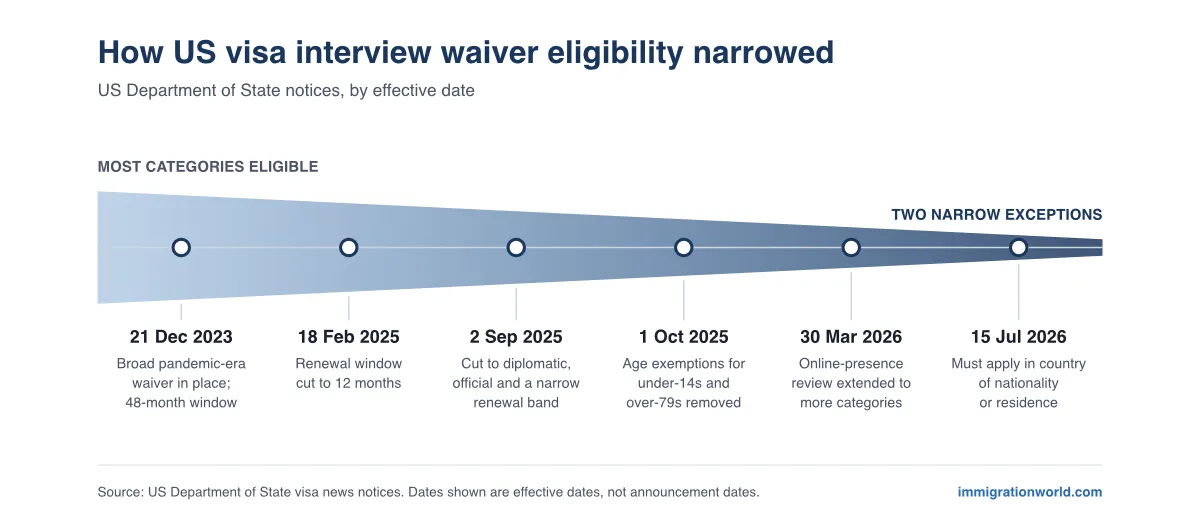
| Effective date | What changed | Renewal window |
|---|---|---|
| 21 December 2023 | Broad pandemic-era waiver in place across most working, student and visitor categories | 48 months |
| 18 February 2025 | Eligibility narrowed; first-time H-2 applicants lose waiver eligibility | 12 months |
| 2 September 2025 | Waiver cut back to diplomatic and official categories plus a narrow band of renewals | 12 months |
| 1 October 2025 | Age-based exemptions for applicants under 14 and over 79 removed | 12 months |
| 30 March 2026 | Online-presence review extended to further visa classifications | 12 months |
| 15 July 2026 | Applicants directed to apply in their country of nationality or usual residence | 12 months |
| Source: US Department of State visa news notices. Dates shown are effective dates, not announcement dates. | ||
Two things follow from that sequence. First, any guidance that mentions a 48-month renewal window predates February 2025 and should be discarded. Second, a widely circulated claim that the narrowing took effect on 1 October 2026 is simply a mistyped year; the Department of State notice is dated 18 September 2025 and takes effect on 1 October 2025.
Where you must apply
Since 15 July 2026, there is a second constraint that interacts with the US visa interview waiver rules. Under a Department of State notice of 15 July 2026, applicants for US nonimmigrant visas should schedule their visa interview appointments at the US embassy or consulate in their country of nationality or residence. Where residence is the basis, you must be able to show that you actually live there.
Applying elsewhere is not forbidden outright, but the Department of State is explicit about the consequences: fees paid for such applications are not refunded and cannot be transferred, wait times will be significantly longer, and applicants may find it harder to qualify for the visa at all. Holders of A, G, C-2, C-3 and NATO visas are outside the rule, as are diplomats, UN-related travellers, and cases granted an exception for humanitarian, medical or foreign policy reasons.
The practical effect is that the third-country workaround has closed. Booking an appointment in a neighbouring country because slots at home were months away used to be ordinary practice. It is now an application made in the wrong place, with a non-refundable fee attached.
What a renewal costs in 2026
Losing the US visa interview waiver changes the shape of a renewal, and a second set of changes has altered its cost.
| Charge | Amount | Who it applies to |
|---|---|---|
| Visa application (MRV) fee, non-petition-based | $185 | B, F, M, J, TN/TD and similar categories |
| Visa application (MRV) fee, petition-based | $205 | H, L, O, P, Q and R categories |
| Treaty trader or investor visa | $315 | E-1 and E-2 applicants |
| Fiance(e) visa | $265 | K applicants |
| Visa integrity fee | $250 | Most nonimmigrant visa issuances, including dependants; collection is uneven between posts |
| Paid expedite pilot (optional) | $750 | B visa applicants only, at selected posts, until 31 December 2026 |
| Fees as published by the US Department of State, August 2026. The visa integrity fee is adjusted annually for inflation and is refundable in principle, but no refund process has been published. | ||
Two entries on that table need care. The visa integrity fee was created by Public Law 119-21, signed on 4 July 2025, with a statutory start of 1 October 2025, but collection has been uneven between posts, and some are still bringing payment systems online. It is in principle refundable to applicants who fully comply with their visa terms, though no refund mechanism has been published. It sits on top of the petition-stage costs, which for working visas have moved sharply in the same period — see our timeline of the $100,000 H-1B fee. The expedited appointment pilot is limited to B visas at a handful of posts in Canada, Mexico and Central America, and runs only to 31 December 2026.
Expanded screening is worth budgeting time for even though it carries no fee. From 30 March 2026 the Department of State extended online-presence review to further categories, and applicants in the affected classifications are asked to set the privacy settings on all of their social media profiles to public. This is one reason interview capacity has tightened: each appointment takes longer than it used to.
What to do when you cannot get a US visa interview waiver
The process for an interviewed renewal is the same as for a first application, and the sequence matters more than it used to because appointment inventory is the bottleneck.
Complete the DS-160 online application form first and keep the confirmation barcode, because you cannot book without it. Pay the visa fee for your category. Then book the earliest appointment your post offers, before you finalise travel dates rather than after; at busy posts the gap between booking and the first available slot can run to months, and the Department of State publishes current wait times by location. Take the interview appointment letter, the DS-160 confirmation, your passport, your previous visa, and the petition or programme documents for your category, such as an I-797 approval notice for a working visa or an I-20 for a student visa.
If your plans are genuinely urgent, check whether your post offers an expedited appointment on grounds such as a medical emergency or a funeral. That is a separate process from the paid pilot described above, and it is granted at the post’s discretion.
One last piece of planning advice. Because a US visa interview waiver can no longer be assumed, the safest approach is to treat every renewal as an interview from the outset, and to be pleasantly surprised if the post decides otherwise. Applicants who plan around the waiver and discover late that they do not qualify are the ones who end up rebooking flights.
Frequently asked questions
Is the US visa interview waiver programme still running?
Yes, but the US visa interview waiver now applies only to diplomatic and official categories and to B-1/B-2, Border Crossing Card and H-2A renewals within 12 months of expiry. Every other applicant should expect an in-person interview.
Can H-1B holders still renew by dropbox?
No. H-1B is not among the categories that kept US visa interview waiver eligibility after 1 October 2025, so H-1B and H-4 applicants renewing abroad attend an interview.
Do children under 14 still skip the interview?
No. The age-based exemptions for applicants under 14 and over 79 were removed on 1 October 2025, and those applicants are now generally interviewed like everyone else.
My visa expired two years ago. Can I renew without an interview?
No. The renewal window is 12 months from the expiry of the previous visa. The 48-month window that many older guides describe was withdrawn in February 2025.
Can I apply in a different country to get an earlier appointment?
You should not. Since 15 July 2026 applicants are expected to apply in their country of nationality or usual residence. Fees for applications made elsewhere are not refunded or transferred, and wait times are longer.
If I qualify for a US visa interview waiver, am I guaranteed not to be interviewed?
No. Consular officers may require an interview on a case-by-case basis for any reason, whatever your eligibility.
Also See
- US Visa Renewal in India – Everything You Should Know
- 3 USA Green Card Replacements For EB 5 Visa
- Types of US Visa: The Complete 2026 Guide
- An Introduction to the Types of Business Visa to USA
- Types of USA Student Visa and How to Apply for them
- Everything You Need to Know Before Applying for a US Tourist Visa
- List Of Countries Indians Can Visit With A US Visa