
France visas fall into two groups: short-stay visas for visits of up to 90 days, and long-stay visas for anyone planning to live, work, study, or join family in France for longer. Within those groups sit more than a dozen categories, from the Schengen visa used by tourists to the Talent residence permit for skilled workers, founders, and researchers.
The right category depends on why you are going, how long you will stay, and your nationality. This guide explains the main types of France visas, what each allows, what each costs after the tax rises in May 2026, and how each connects to permanent residence and citizenship. Apply for every type through France-Visas, the French government’s official visa portal.
Key Takeaways
- The types of France visas fall into two groups: the short-stay Schengen visa for up to 90 days in any 180-day period, and the long-stay visa (type D) for stays of more than three months.
- The most common long-stay visa is the VLS-TS, which acts as a residence permit for its first year once you validate it online within three months of arrival.
- A Schengen visa costs €90 and a long-stay visa €99. Since 1 May 2026, validating a VLS-TS costs €300 at the standard rate or €100 at the reduced rate, up from €200 and €50.
- Skilled workers, EU Blue Card holders, founders, investors, and researchers use the Talent residence permit, valid for up to four years.
- Since 1 January 2026, a first multi-year card requires French at A2, a resident card at B1, and naturalisation at B2, each with a civic exam.
- Young people from 16 partner countries and territories can use the working holiday visa to live and work in France for up to a year.
Table of Contents
Types of France visa at a glance
The table below compares the main types of France visa by purpose, length, and whether they lead to a residence card.
Main types of France visa compared
| Visa type | Purpose | Length | Leads to residence? |
|---|---|---|---|
| Schengen short-stay visa (type C) | Tourism, business, family visits, short courses, medical treatment | Up to 90 days in any 180-day period | No |
| Airport transit visa (type A) | Changing planes at a French airport without entering France | Transit zone only | No |
| VLS-TS (long-stay visa valid as a residence permit) | Study, salaried work, Talent permit, spouse of a French citizen, au pair, visitor | 4 to 12 months | Yes, through a residence card requested before it expires |
| VLS-T (temporary long-stay visa) | One stay that will not be extended, such as a semester or a long family visit | More than 3 months, up to 12 months | No |
| Long-stay visa with a residence card to request | Stays that need a prefecture card from the start | Card requested within 2 months of arrival | Yes |
| Working holiday visa | Travel with the right to work, for nationals of partner countries | Up to 12 months (up to 24 months for Canadians) | No, except a switch to a Talent permit |
| Talent residence permit (talent passport) | Qualified employees, EU Blue Card, founders, investors, researchers, artists | Up to 4 years, renewable | Yes |
| Sources: France-Visas and Service-Public, checked 21 November 2026. | |||
Short-stay types of France visa
Short-stay types of France visa cover trips of up to 90 days in any 180-day period. Nationals of visa-exempt countries, including the United States, Canada, Australia, Japan, and the UK, need no visa for these trips; everyone else applies for a Schengen visa.
Schengen visa (type C)
The uniform Schengen visa covers tourism, business meetings, family visits, short courses, and medical treatment. It is valid across the Schengen area unless the sticker says otherwise, but France must be your main destination, or your first point of entry if your days are split evenly. Frequent travellers with a good visa history can receive multiple-entry visas valid for up to five years. Our France tourist visa guide covers documents, proof of funds, and processing times, and our Schengen visa guide explains how the area works.
Airport transit visa (type A)
Nationals of some countries need an airport transit visa to change planes at a French airport without leaving the international zone. It costs the same as a Schengen visa and does not allow entry into France.
EES and ETIAS
The Entry/Exit System (EES), which records fingerprints and a facial image at the Schengen external border, has applied in full since 10 April 2026. ETIAS, the travel authorisation for visa-exempt visitors, still has no start date; our ETIAS guide tracks its status. Neither system replaces the types of France visa described here for travellers who need one.
Long-stay types of France visa
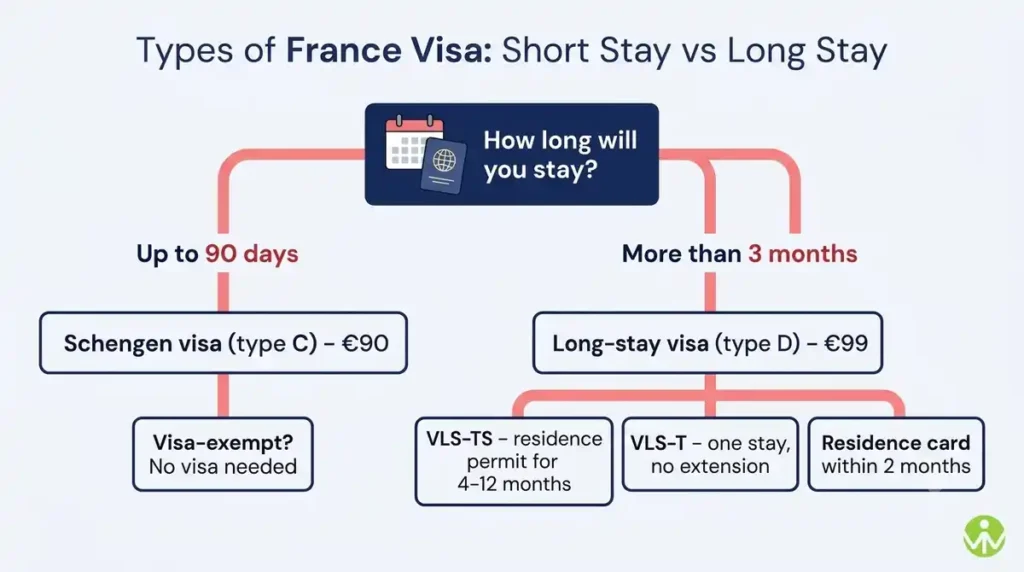
Long-stay types of France visa, known as type D visas, are for stays of more than three months. Apply from your country of residence, usually no earlier than three months before departure. While it is valid, a long-stay visa also lets you visit other Schengen countries for up to 90 days in any 180-day period. Service-Public and France-Visas describe three forms of long-stay visa.
VLS-TS: long-stay visa valid as a residence permit
The VLS-TS is the standard long-stay visa for stays of 4 to 12 months. It replaces a residence card for its first year, provided you validate it on the ANEF portal, run by the Ministry of the Interior, within three months of arrival and pay the validation tax. Service-Public lists students, employees on permanent contracts, spouses of French citizens, and Talent permit holders among its main users. To stay longer, apply to the prefecture for a residence card in the two months before the VLS-TS expires.
VLS-T: temporary long-stay visa
The VLS-T covers one stay of more than three months that you will not extend, such as a single semester, a sabbatical, or a long visit to family. It needs no validation and no residence card, but it does not allow work and cannot be renewed in France.
Long-stay visa with a residence card to request
Some long-stay visas state that you must request a residence card within two months of arrival. Holders apply to the prefecture in that window to receive their first card.
Types of France visa for work
Most types of France work visas require the employer to obtain work authorisation through the ANEF portal before you apply for the visa. The Talent residence permit is the main exception: qualifying profiles skip that step.
Salaried employee and temporary worker visas
The salarié visa is for a permanent contract, and the travailleur temporaire visa is for a fixed-term contract. Your employer applies for work authorisation first; once it is granted, apply for the long-stay visa. A first-year VLS-TS leads to a residence card if the job continues.
Talent residence permit (talent passport)
The Talent residence permit, still widely called the talent passport, is a multi-year card valid for up to four years and renewable. It covers qualified employees, employees of innovative companies, employees on assignment, researchers, founders, investors, artists, and people with an international reputation. Under a ministerial order of 21 August 2025, the qualified employee category requires a gross salary of at least €39,582 a year. Spouses and children receive a Talent – family card that allows them to work.
EU Blue Card
France issues the EU Blue Card as a Talent category for highly qualified employees with a contract of at least six months. The 2026 salary floor is €59,373 gross a year, 1.5 times the reference salary. Our EU Blue Card guide compares the scheme across EU countries.
French Tech Visa for founders and investors
Founders selected by a partner incubator or accelerator apply under the Talent founder category, marketed as the French Tech Visa. Investors who place at least €300,000 in a French business qualify under the investor category. Our startup visa by country comparison shows how the French route compares with other countries, and our French start-up visa article covers its background.
Seasonal work and intra-company transfers
Seasonal workers receive a multi-year seasonal worker card valid for up to three years, allowing up to six months’ work a year. Employees transferred within a group use the ICT (intra-corporate transfer) permit, also valid for up to three years.
Types of France visa for study
Students choose between several types of France visa, depending on course length. Courses of up to 90 days use a Schengen visa. Candidates invited to sit an entrance exam apply for the student-competition visa, which converts into a residence card once they are admitted. Longer programmes use the VLS-TS étudiant, which allows up to 964 hours of part-time work a year.
Applicants in countries covered by the Études en France procedure apply through Campus France and pay a reduced visa fee of €50. Minors enrolled in a French school receive a visa valid for up to 11 months. Our France student visa guide covers the steps.
Job search after graduation
Graduates with a master’s-level degree or equivalent from a French institution can apply for a one-year job-search or company-creation card. It lets them work while looking for a job or setting up a business, then switch to a work or Talent permit.
Au pair visa
Non-EU nationals aged 18 to 30 can spend up to a year with a French host family under the jeune au pair route, extendable to two years. Au pairs work up to 25 hours a week on family tasks and must have time to attend language or other courses.
Family types of France visa
Family types of France visa depend on who you are joining: a French citizen, a non-EU resident of France, or a Talent permit holder.
Spouse of a French citizen
Foreign spouses of French citizens receive a VLS-TS for private and family life and may work from arrival. France-Visas lists them among applicants exempt from the long-stay visa fee. After the first year, they apply for a multi-year card.
Family reunification
A non-EU resident who has lived in France legally for at least 18 months can apply for family reunification for a spouse aged 18 or over and children under 18. The application goes to the French Office for Immigration and Integration (OFII), and the resident must show stable, sufficient income and suitable housing. Once the prefecture approves it, family members apply for their long-stay visas. Algerian nationals follow a separate bilateral agreement with a 12-month residence requirement.
Families of Talent permit holders and EU citizens
Spouses and children of Talent permit holders receive a Talent – family card without going through family reunification. Non-EU family members of EU, EEA, and Swiss citizens receive a free Schengen visa when needed, then a residence card as family members of an EU citizen.
Visitor visa: living in France without working
The visitor (visiteur) visa suits retirees and others who can support themselves without working in France. Applicants show stable resources, usually at least the French minimum wage, along with health insurance and accommodation, and sign a commitment not to take paid work. Visitors staying more than six months normally receive a VLS-TS visiteur and can then apply for a visitor residence card; a shorter stay may receive a VLS-T. Of all France visas, the visitor visa is the one most often confused with a tourist visa, but it is a long-stay visa.
Working holiday visa
Among the types of France visa, the working holiday visa depends most on nationality. France has working holiday agreements with Argentina, Australia, Brazil, Canada, Chile, Colombia, Ecuador, Hong Kong, Japan, Mexico, New Zealand, Peru, Russia, South Korea, Taiwan, and Uruguay. Applicants are usually aged 18 to 30; the upper limit is 35 for some nationalities, including Argentina, Australia, and Canada. The visa lasts up to 12 months, or up to 24 months for Canadians, allows paid work to fund the trip, and can be used only once. Holders cannot switch to another residence card, except by requesting a Talent permit three months before the visa ends.
Other types of France visa
Several less common types of France visa cover interns with an internship agreement, volunteers, professional athletes, ministers of religion, children adopted by French citizens, and patients who need treatment lasting more than three months. A child adopted by a French citizen pays a reduced visa fee of €15.
From visa to residence: permits after arrival
Most long-term stays move from a VLS-TS to a residence card issued by the prefecture. The usual path is a one-year temporary card, then a multi-year card valid for up to four years, then a 10-year resident card after five years of legal residence. Only some types of France visa start this path: the VLS-T, short-stay visas, and the working holiday visa do not.
New language and civic requirements from 2026
From 1 January 2026, applicants under 65 must prove French at A2 for a first multi-year card and B1 for a first residence card, and pass a 40-question civic exam. Naturalisation requires B2, spoken and written, and the same civic exam.
French language levels required for residence and citizenship
| Application | French level | Civic exam |
|---|---|---|
| First multi-year residence card | A2 | Yes |
| First 10-year resident card | B1 | Yes |
| Naturalisation by decree or declaration | B2, spoken and written | Yes |
| In force since 1 January 2026. Applicants aged 65 and over are exempt from the residence card language requirement. Source: Service-Public. | ||
French citizenship after residence
Several types of France visa lead, through residence cards, to citizenship. Naturalisation by decree generally requires five years of regular residence in France, reduced to two years for people who completed two years of higher education in France and obtained a degree there. Applicants need French at B2, a pass in the civic exam, stable resources, and an interview at the prefecture. Spouses of French citizens can apply by declaration after four years of marriage. France allows dual citizenship; our guide to countries that allow dual citizenship explains how other countries treat it.
Fees for the types of France visa
France-Visas sets visa fees, and you pay them when you apply; service providers such as TLScontact and VFS Global add their own charges. Long-stay visa holders then pay a validation tax or a residence card tax in France by electronic tax stamp. The Finance Act for 2026 raised these taxes from 1 May 2026, as Service-Public reports. Convert the €90 Schengen visa fee, the €99 long-stay visa fee, and the €300 validation tax into your currency before you budget.
Fees and taxes for the types of France visa
| Item | Standard rate | Reduced rate or exemption |
|---|---|---|
| Schengen short-stay visa | €90 | €45 for children aged 6 to 12; free for children under 6 |
| Airport transit visa | €90 | €45 for children aged 6 to 12; free for children under 6 |
| Short-stay visa for Guadeloupe, French Guiana, Martinique, Réunion, Saint Martin, or Saint-Barthélemy | €60 | €35 for children aged 6 to 12 |
| Long-stay visa | €99 | €50 for students processed by Campus France; spouses of French citizens exempt |
| Long-stay visa for a child adopted by a French citizen | €15 | Not applicable |
| VLS-TS validation tax | €300 (€200 before 1 May 2026) | €100 (€50 before 1 May 2026) for students, seasonal workers, family reunification, and other listed cases |
| First residence card | €350 (€225 before 1 May 2026) | €150 (€75 before 1 May 2026) |
| Residence card renewal | €250 (€225 before 1 May 2026) | €100 (€75 before 1 May 2026) |
| Naturalisation stamp | €255 (€55 before 1 May 2026) | Not applicable |
| Taxes in force from 1 May 2026. Visa service providers charge their own fees on top. Sources: France-Visas fee table and Service-Public, checked 21 November 2026. | ||
How to choose between the types of France visa
Start with the length of your stay. Up to 90 days means a Schengen visa, or no visa for visa-exempt nationals. Longer stays need a long-stay visa, and your purpose then decides the category: a job offer points to the salarié or Talent routes, an enrolment letter to the student visa, a French spouse or resident relative to the family routes, and independent means without work to the visitor visa. If you are 18 to 30 and from a partner country, the working holiday visa is the simplest way to try living in France.
For a broader look at settling permanently, see our guide on how to migrate to France, and for the general steps that apply to all types of France visas, our guide on how to apply for a visa.
FAQ: types of France visa
How many types of France visas are there?
France has two main groups: short-stay visas for up to 90 days and long-stay visas for longer stays. Within those groups, France-Visas lists more than a dozen types of France visas for tourism, business, study, work, family, au pair stays, working holidays, and other purposes.
What is the difference between a VLS-TS and a VLS-T?
A VLS-TS acts as a residence permit for up to 12 months once validated online, and it can lead to a residence card. A VLS-T covers one stay you will not extend, needs no validation, and does not allow work.
How much does a France visa cost?
A Schengen visa costs €90 and a long-stay visa €99. Since 1 May 2026, validating a VLS-TS costs €300, or €100 at the reduced rate for students and some other categories.
Can I work in France on a student visa?
Yes. The VLS-TS étudiant allows up to 964 hours of part-time work per year, about 60% of full-time working hours.
Which types of France visas lead to permanent residence?
Long-stay visas for work, Talent, family, and study can lead to a 10-year resident card after five years of legal residence, with French at B1 and a pass in the civic exam. Short-stay visas, the VLS-T, and the working holiday visa do not.
Do I need ETIAS to visit France?
Not yet. ETIAS has no confirmed start date, and it will not replace the types of France visas that require an application. Visa-exempt visitors enter France with a valid passport and are registered in the EES at the border.
Is the France visitor visa the same as a tourist visa?
No. The visitor visa is a long-stay visa for people who live in France without working. Tourists visiting for up to 90 days need a Schengen visa, or no visa if their nationality is exempt.