
The types of UAE visa fall into four broad groups: short visits, work, long-term residence, and sponsorship for study or family. The right choice depends on why you are travelling, how long you plan to stay, and whether an employer, a relative, or nobody at all will sponsor you.
This guide covers all seven emirates, not only Dubai. The UAE is a federation, so most rules are set federally, but Dubai runs its own immigration authority and occasionally applies different figures. Where the two differ, the guide says which applies. Every figure below comes from the UAE Government’s official visa portal and the issuing authorities, checked in November 2026.
Key Takeaways
- The types of UAE visa split into visits, work, long-term residence, and sponsorship for study or family.
- ICP issues visas for Abu Dhabi and the Northern Emirates; GDRFA issues them in Dubai, sometimes with different figures.
- The Golden, Green, Blue, and retirement visas need no sponsor; standard work and family visas do.
- The Green Visa needs AED 15,000 a month for skilled employees or AED 360,000 a year for freelancers.
- Retirees aged 55 or over qualify with AED 1 million in property plus AED 1 million in savings, or a set annual income.
- Residents who stay outside the UAE for more than 180 days lose their residence visa unless an exception applies.
Table of Contents
Who Issues the Types of UAE Visa
Two authorities issue the types of UAE visa covered in this guide, along with the residence permits that follow. The Federal Authority for Identity, Citizenship, Customs and Port Security (ICP) covers Abu Dhabi, Sharjah, Ajman, Umm Al Quwain, Ras Al Khaimah, and Fujairah. The General Directorate of Residency and Foreigners Affairs in Dubai (GDRFA) handles Dubai. Work permits sit with a third body, the Ministry of Human Resources and Emiratisation (MoHRE), which classifies jobs by skill level.
UAE embassies abroad do not issue tourist visas. Apply online through ICP or GDRFA, or through a UAE-based airline, a licensed travel agent, or a hotel, all of which apply to the same authorities on your behalf. Passports must be valid for at least six months from the date of entry.
Types of UAE Visa at a Glance
The table below compares the main types of UAE visa by validity, sponsorship, and the headline requirement. The sections that follow explain each route in more detail.
Table 1: Types of UAE visa at a glance
| Visa | Validity | Sponsor needed | Main requirement | Renewable or extendable |
|---|---|---|---|---|
| Tourist visa (30 or 60 days) | 30 or 60 days | No (apply directly or via airline, agent, or hotel) | Return ticket and UAE-valid insurance | Extendable |
| Five-year multiple-entry tourist visa | 5 years, 90 days per visit | No | US$4,000 balance for 6 months, insurance, return ticket | Each stay extendable by 90 days |
| Visa on arrival | 14 to 180 days, by nationality | No | Eligible passport or approved third-country document | Depends on nationality |
| GCC resident eVisa | 30 days | No | GCC residence valid for 1 year, approved profession | Once, by 30 days |
| Transit visa | 48 or 96 hours | Airline, agency, or airport hotel | Onward ticket | No |
| Job-seeker visit visa | 60, 90, or 120 days | No | MoHRE skill level 1 to 3 or top-500 graduate, bachelor’s degree | No (single trip) |
| Investment exploration visit visa | 60, 90, or 120 days | No | Financial solvency or high qualification, financial guarantee | No (single trip) |
| Medical treatment visa | 90 or 180 days (Dubai) | Licensed UAE hospital | Medical report, deposit, insurance | Companion visa once |
| Standard employment visa | 2 years | Employer | Job offer and MoHRE work permit | Yes |
| Virtual work visa | 1 year | No | US$3,500 monthly salary from an employer abroad | Yes |
| Green Visa | 5 years | No | AED 15,000 monthly salary or AED 360,000 annual freelance income | Yes |
| Golden Visa | 5 or 10 years | No | Depends on category | Yes |
| Blue Visa | 10 years | No | Exceptional environmental contribution | Yes |
| Retirement visa | 5 years | No | Age 55 or over, assets or income | Yes |
| Student visa | Linked to the course | University or resident parent | Enrolment certificate | Yes |
| Family residence visa | Linked to the sponsor’s visa | Resident relative | Sponsor earns AED 4,000, or AED 3,000 plus housing | Yes |
| Source: UAE Government portal (u.ae) and ICP, checked 18 November 2026. Fees and thresholds change; confirm on the ICP or GDRFA service card before applying. | ||||
Visit and Tourist Types of UAE Visa
Visit visas are the largest group among the types of UAE visa. Most allow tourism, family visits, or business meetings, but not paid work.
30-Day and 60-Day Tourist Visas
Single-entry tourist visas run for 30 or 60 days. GDRFA lists the 30-day visa at AED 252 and the 60-day visa at AED 352 (about US$69 and US$96), plus VAT and small service charges. Visitors need a return or onward ticket and medical insurance valid in the UAE. Our Dubai tourist visa guide covers fees, extensions, and the application steps in full.
Five-Year Multiple-Entry Tourist Visa
The five-year tourist visa is open to all nationalities and needs no sponsor. Each visit can last 90 days and can be extended once by another 90 days. Applicants must show a bank balance of US$4,000 or its equivalent over the previous six months, health insurance valid in the UAE for 180 days, and a return or onward ticket.
Visa on Arrival
Many nationalities need none of the visit types of UAE visa in advance and receive a visa on arrival instead. The length of stay varies by passport, typically 30 or 90 days. Others qualify only on a conditional basis. Indian passport holders, for example, get a 14-day visa on arrival if they hold a valid US visa or Green Card, or a residence permit from an approved list of countries. Our guide to the countries Indians can travel to without a visa explains why the UAE sits outside that list. ICP has announced that a UK residence visa alone will stop qualifying for Indian nationals; check its current status with ICP before travelling.
Since 25 June 2026, nationals of Indonesia, Vietnam, Thailand, the Philippines, Kenya, and South Africa who hold a valid residence permit from the US, an EU state, the UK, Singapore, Japan, South Korea, Australia, New Zealand, or Canada can also get a visa on arrival: AED 100 for 14 days, extendable once, or AED 250 for 60 days. The country lists change often, so confirm eligibility on the official portal. The global passport rankings show how far the UAE’s own passport has climbed in the same period.
GCC Resident eVisa
Residents of other Gulf Cooperation Council countries apply online before arrival. The eVisa is valid for 30 days from issue, allows a 30-day stay, and can be extended once by 30 days. The GCC residence permit must be valid for at least a year, and the applicant’s profession must appear on the approved list.
Transit Visa
Travellers who are not eligible for visa-free entry or a visa on arrival need a transit visa to leave the airport. It is issued for 48 or 96 hours, allows a single entry, and cannot be extended. Apply through the UAE-based airline you are flying with, a travel agency, or an airport hotel.
Purpose-Led Visit Visas
Several visit visas target a specific purpose and need no host in the country. The job-seeker visa allows a single trip of 60, 90, or 120 days for applicants in MoHRE skill levels 1 to 3, or for graduates of the world’s top 500 universities who graduated within the past two years. A bachelor’s degree and a financial guarantee are required. The visit visa to explore investment opportunities has the same 60, 90, or 120-day options for investors and entrepreneurs.
In 2025, the UAE added visit visas for artificial intelligence specialists, entertainment professionals, event and exhibition visitors, and cruise or leisure-boat tourists, each backed by a licensed sponsor. Residents can also sponsor relatives or friends on a visit visa if they meet a minimum monthly salary: AED 4,000 for first-degree relatives, AED 8,000 for second- and third-degree relatives, and AED 15,000 for friends.
Medical Treatment Visa
The medical treatment visa is the most specialised of the visit types of UAE visa. Foreign patients can enter for treatment under the sponsorship of a licensed UAE hospital, which processes the entry permit and requires a financial deposit. In Dubai, GDRFA grants single- or multiple-entry medical visas for 90 or 180 days. A companion can enter on the same type of visa as the patient, and the companion’s visa can be extended only once, on medical grounds.
Work Types of UAE Visa
Work routes are the second large group among the types of UAE visa. Most foreign workers enter on an employer-sponsored visa, but self-sponsored and remote-work options now sit alongside it.
Standard Employment Visa
A standard employment visa runs for two years and is renewable. The employer applies, after obtaining a MoHRE work permit for the role. The worker then completes a medical fitness test and registers for an Emirates ID. The visa ends with the job, so changing employers means a new permit and visa. Our guide on how to migrate to Dubai walks through the move itself, from documents to the first weeks after arrival.
Freelance and Self-Employed Work
Freelancers and self-employed professionals can sponsor themselves through the Green Visa, covered below, provided they hold a MoHRE freelance or self-employment permit. Our Dubai freelance visa guide explains the permit, the cost, and eligibility.
Remote Work: The Virtual Work Visa
Remote work is the newest addition to the work types of UAE visa. The virtual work visa lets foreign employees live in the UAE while working for a company outside it. Applicants need a salary certificate showing at least US$3,500 a month (about AED 12,850), proof of employment abroad, health insurance, and a medical fitness result. Apply to ICP or GDRFA. Our overview of digital nomad visas compares the UAE route with those in other countries.
Long-Term Residence Types of UAE Visa
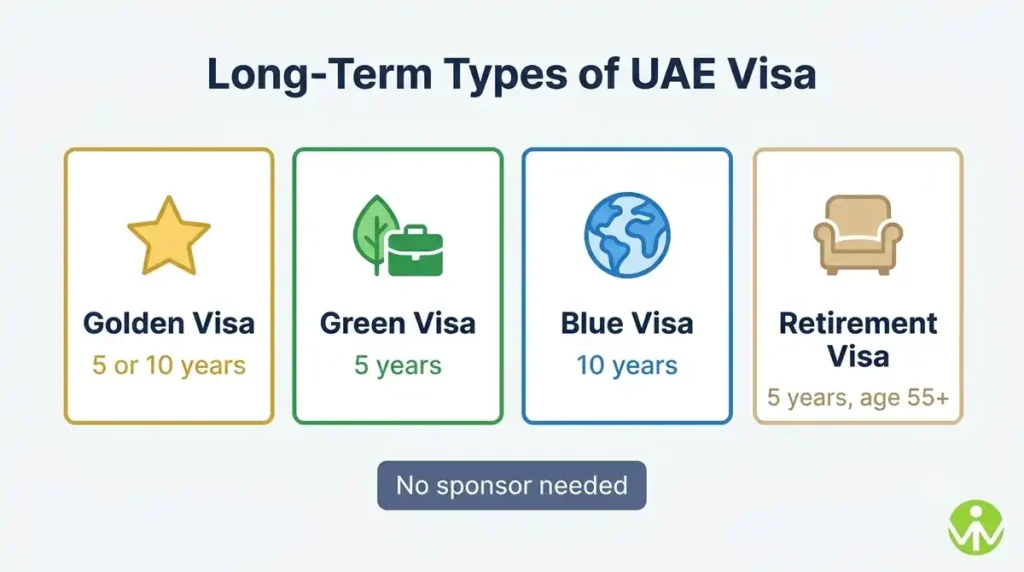
The long-term types of UAE visa share one feature that matters more than duration: none needs an employer or relative as sponsor. Holders sponsor themselves and their families.
Table 2: Long-term types of UAE visa and their thresholds
| Route | Duration | Main threshold | Sponsor needed |
|---|---|---|---|
| Golden Visa: public investment | 10 years | AED 2 million capital | No |
| Golden Visa: real estate | 5 years (federal portal) | AED 2 million in property | No |
| Golden Visa: entrepreneurs | 5 years | Approved innovative project and incubator letter | No |
| Golden Visa: exceptional talent | 10 years | Recommendation or qualification; no financial threshold | No |
| Golden Visa: outstanding students | 5 years (school), 10 years (university) | Academic excellence; no financial threshold | No |
| Golden Visa: humanitarian pioneers and frontline heroes | 10 years | Documented service; no financial threshold | No |
| Green Visa: skilled employee | 5 years | Bachelor’s degree, AED 15,000 a month, MoHRE skill level 1 to 3 | No |
| Green Visa: freelancer or self-employed | 5 years | AED 360,000 a year over 2 years, or financial solvency | No |
| Green Visa: investor or partner | 5 years | ICP-approved investment | No |
| Blue Visa | 10 years | Exceptional environmental contribution | No |
| Retirement visa | 5 years | Age 55 or over and 15 years of work; AED 1 million property plus AED 1 million savings, or AED 180,000 a year (AED 240,000 in Dubai) | No |
| Dubai property investor visa | 2 years | Completed property; no minimum for sole owners, AED 400,000 per co-owner | No |
| Source: u.ae, ICP, and Dubai Land Department, checked 18 November 2026. Some Dubai sources describe a 10-year Golden Visa for real estate; confirm the term with ICP or GDRFA. | |||
Golden Visa
The Golden Visa is the most flexible of the long-term types of UAE visa: a 5- or 10-year renewable residence permit. Holders can sponsor family members, need no sponsor themselves, and can stay outside the UAE for longer than the usual six months without losing residence. The AED 2 million figure often quoted applies to investors only: 10 years for public investments, and 5 years for real estate according to the federal portal (about US$545,000). Entrepreneurs receive 5 years. People with exceptional talent, outstanding students, humanitarian pioneers, and frontline heroes qualify with no financial threshold at all.
Our comparison of golden visas by country sets the UAE scheme against residence-by-investment programmes elsewhere, and our look at why millionaires move to Dubai explains the wider appeal.
Green Visa
The Green Visa is a five-year, self-sponsored residence visa for three groups. Skilled employees need a bachelor’s degree and a monthly salary of at least AED 15,000. Freelancers and self-employed workers need annual income of at least AED 360,000 over the previous two years, or proof of financial solvency. Investors and business partners qualify through an ICP-approved investment. Holders can sponsor first-degree relatives.
Blue Visa
The Blue Visa is a 10-year residence visa for people who have made an exceptional contribution to environmental protection and sustainability, inside or outside the UAE. Members of international organisations, award winners, activists, and researchers can apply to ICP directly or be nominated by a UAE authority.
Retirement Visa
The retirement visa runs for five years. Applicants must be at least 55 and have worked for at least 15 years, inside or outside the UAE. They must also own property worth at least AED 1 million and hold savings of at least AED 1 million, or earn an annual income of at least AED 180,000. Dubai sets that income figure at AED 240,000 (about US$65,300).
Dubai Property Investor Visa
Dubai also offers a two-year residence visa linked to property ownership. Since April 2026, the Dubai Land Department has applied no minimum property value to sole owners, while each co-owner of a jointly held property must own a share worth at least AED 400,000.
Study and Family Types of UAE Visa
The remaining types of UAE visa depend on a sponsor already in the country: a university, a parent, or a resident spouse.
Student Visa
Students can live in the UAE under the sponsorship of an accredited university or of a parent resident in the UAE. Universities usually handle the application, which needs a certificate stating the length of study. Resident parents can sponsor sons up to 25, or older while they attend higher education, and daughters until they marry. Families of foreign university students can also stay if they can afford suitable housing, and top students can apply for a Golden Visa.
Family Residence Visa
Residents can sponsor a spouse, unmarried daughters, sons under 25, and children with special needs if they earn at least AED 4,000 a month, or AED 3,000 plus accommodation. Family members aged 18 or over must pass a medical test. Dependants’ visas cannot outlast the sponsor’s and are cancelled with it, followed by a grace period of up to six months to find a new permit.
A foreign spouse, parent, or child of a UAE citizen can receive a five-year residence visa with the citizen as sponsor. A woman who is divorced or widowed while on her husband’s visa receives a one-year extension for herself and her children, renewable once.
Rules That Apply to Every UAE Residence Visa
Whatever the route, the types of UAE visa that lead to residence share the same core rules. Applicants aged 18 or over pass a medical fitness test and a security check, then receive an Emirates ID, which expires with the visa. A residence visa lapses automatically after more than 180 consecutive days outside the UAE, although Golden and Green visa holders, students abroad, and several other groups are exempt. Overstaying any visit, tourist, or residence visa costs AED 50 a day under ICP’s standard rate.
How Dubai and the Other Emirates Differ
Much of the conflicting advice about the types of UAE visa online comes from the split between federal and Dubai rules. The table shows the differences that most often matter.
Table 3: Federal (ICP) and Dubai (GDRFA) differences
| Requirement | Federal (ICP) | Dubai (GDRFA) |
|---|---|---|
| Emirates covered | Abu Dhabi, Sharjah, Ajman, Umm Al Quwain, Ras Al Khaimah, Fujairah | Dubai |
| Retirement visa, income route | AED 180,000 a year | AED 240,000 a year |
| Retirement visa, assets route | AED 1 million property plus AED 1 million savings | AED 1 million property plus AED 1 million savings |
| Medical treatment visa | Single or multiple entry | Single or multiple entry, 90 or 180 days |
| Re-entry after more than 6 months abroad | Apply to ICP from abroad; AED 100 per 30 days outside | ICP service not available to Dubai residents; contact GDRFA |
| Overstay fine | AED 50 a day | AED 50 a day (some GDRFA pages still show AED 100 plus an AED 200 out-pass) |
| Source: UAE Government portal (u.ae), checked 18 November 2026. | ||
How to Choose Between the Types of UAE Visa
Start with the purpose of the trip. A holiday or family visit points to a tourist visa, a visa on arrival, or a sponsored visit visa. A job offer points to the standard employment visa, while a high salary or freelance income may justify the self-sponsored Green Visa instead. Remote employees of foreign companies fit the virtual work visa, retirees the retirement visa, and investors, specialists, and top students the Golden Visa.
Most types of UAE visa also hinge on the sponsor. Check who will sponsor you, and which emirate you will live in, since Dubai’s figures can differ. Confirm current requirements on the ICP or GDRFA service card before applying, as fees and thresholds change without much notice.
Types of UAE Visa: Frequently Asked Questions
How many types of UAE visa are there?
The UAE Government groups the types of UAE visa into about ten families: Golden, Blue, visit, work, residence, student, investor, tourist, transit, and medical. Each family contains several individual visas, so the total number of permits runs well above ten.
Which types of UAE visa do not need a sponsor?
The Golden, Green, Blue, retirement, and virtual work visas are self-sponsored, as are the five-year tourist visa, the job-seeker visit visa, and the visit visa to explore investment opportunities.
Do UAE embassies issue tourist visas?
No. Tourist visas come from ICP or GDRFA, either directly online or through a UAE-based airline, a licensed travel agent, or a hotel.
Is the UAE Golden Visa valid for 5 or 10 years?
It depends on the category. Public investors, exceptional talents, top university students, and humanitarian and frontline categories receive 10 years. Entrepreneurs and outstanding school students receive 5 years, and the federal portal lists 5 years for the real estate route.
Why do Dubai’s visa figures differ from those of other emirates?
Dubai runs its own immigration authority, GDRFA, while ICP covers the other six emirates. Most rules match, but some thresholds differ. The retirement visa income route, for example, needs AED 180,000 a year federally and AED 240,000 a year in Dubai.
Can Indian passport holders get a UAE visa on arrival?
Only on a conditional basis. Indian nationals qualify for a 14-day visa on arrival if they hold a valid US visa or Green Card, or a residence permit from an approved country. ICP has announced that a UK residence visa alone will no longer qualify, so check the current list before travelling.
How long can a UAE resident stay outside the country?
A residence visa lapses after more than 180 consecutive days abroad. Golden and Green visa holders are exempt, and other residents can apply for a re-entry permit if they were away for study, work, or treatment.
What is the fine for overstaying a UAE visa?
ICP has standardised the overstay fine at AED 50 a day for visit, tourist, and residence visas. Some older GDRFA pages still quote higher figures, so check the exact amount with the authority that issued the visa.