
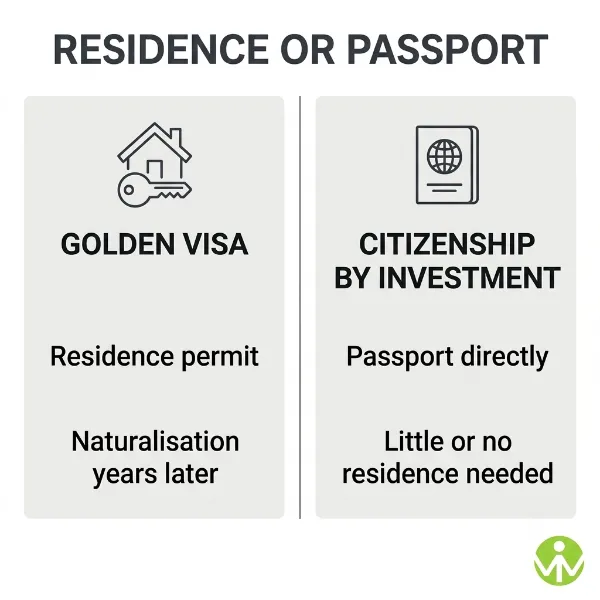
A golden visa grants residence in exchange for investment, and that single sentence contains the thing most guides on this subject get wrong. It does not grant citizenship. It does not grant a passport. It grants the right to live somewhere, and whether that ever becomes a nationality depends on a completely separate body of law that the programme does not control and can change while you are waiting.
This guide sets out every programme still open in 2026, what each one costs, and the four significant programmes that have closed since 2022. Figures were compiled on 21 September 2026, and every closure is sourced to the government that ordered it.
| Question | Answer |
|---|---|
| What does a golden visa give you? | Residence, not citizenship. Any passport comes later through that country’s ordinary naturalisation rules. |
| Cheapest in Europe | Latvia, from EUR 50,000 for a business investment. |
| Most popular in Europe | Portugal, from EUR 250,000 – but naturalisation now takes 10 years, not 5. |
| Biggest change since 2022 | Four programmes closed: the UK, Ireland, Australia and Spain. |
| Outside Europe | The UAE Golden Visa at AED 2 million for 10 years, with no sponsor required. |
| The most expensive | New Zealand, at NZD 10 million for the Balanced category. |
| What to check first | The naturalisation law, not the programme. Portugal’s programme did not change; its citizenship law did. |
| Compiled 21 September 2026. Sources listed in the article. | |
Table of Contents

What a golden visa actually is
The term has no legal meaning. It is a market label for residence-by-investment schemes, and the countries that operate them call them by other names: investor visa, residence permit for investment, Active Investor Plus, Golden Visa in the UAE’s case because the UAE adopted the marketing term officially.
What these schemes share is the structure. You make a qualifying investment, usually in property, funds, government bonds or a business. You receive a residence permit, typically renewable while the investment is maintained. Physical presence requirements are usually light, sometimes as little as a few days a year. And the permit is residence only.
The route that does grant a passport directly is a different product entirely, covered in our guide to citizenship by investment. Confusing the two is the most expensive mistake available in this area, because the timelines differ by years and the risks differ in kind. A direct citizenship programme has a published price and a published process. A golden visa depends on a naturalisation law that can be rewritten around you.
Portugal is the live demonstration. Its programme is open and unchanged, but Organic Law 1/2026 came into force on 19 May 2026 and extended the residence period required before naturalisation from five years to ten, or seven for citizens of EU and CPLP states. Nobody touched the golden visa. They changed the law at the other end of it.
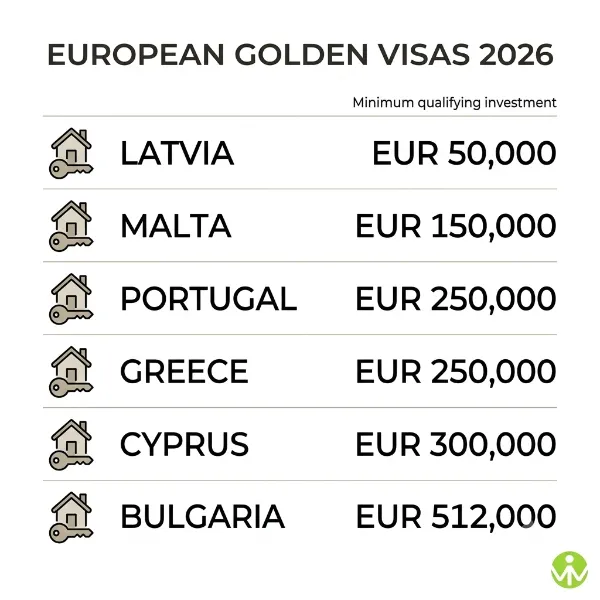
European golden visa programmes open in 2026
| Country | Minimum investment | Routes available |
|---|---|---|
| Latvia | EUR 50,000 | Business investment. Property from EUR 250,000, bank deposit from EUR 280,000 |
| Malta | About EUR 150,000 | Permanent Residence Programme: government contribution, property and donation combined |
| Portugal | EUR 250,000 | Cultural or artistic investment. Qualifying investment funds from EUR 500,000 |
| Greece | EUR 250,000 | Commercial-to-residential conversion. EUR 400,000 regional property, EUR 800,000 in major cities and islands |
| Hungary | EUR 250,000 | Real estate fund. Higher education donation from EUR 1,000,000 |
| Cyprus | EUR 300,000 | Residential or commercial property, or collective investments |
| Bulgaria | EUR 512,000 | Alternative investment funds and ETFs |
| Italy | EUR 250,000 | Innovative startups. EUR 500,000 companies, EUR 1,000,000 philanthropy, EUR 2,000,000 government bonds |
| Minimums are the published entry point for a single applicant and exclude government, legal and due diligence fees. Figures compiled from published programme terms, 21 September 2026. Confirm with the national authority before any decision. | ||
Eight European countries still operate a residence-by-investment route. The spread is wider than most comparisons suggest, from EUR 50,000 to EUR 2,000,000 depending on country and route.
Latvia is the cheapest entry point in Europe at EUR 50,000 for a business investment, with property and bank deposit routes at EUR 250,000 and EUR 280,000. Portugal remains the best-known programme at EUR 250,000 for cultural or artistic investment, or EUR 500,000 into qualifying funds. The real estate route that made Portugal famous is no longer part of it.
Greece has moved upmarket and now prices by location and property type: EUR 250,000 for a commercial-to-residential conversion, EUR 400,000 for regional property, and EUR 800,000 in Athens, Thessaloniki and the high-demand islands. Italy runs the widest tier structure of any European programme, from EUR 250,000 for innovative startups through EUR 500,000 for established companies and EUR 1,000,000 for philanthropy up to EUR 2,000,000 in government bonds.
Cyprus sits at EUR 300,000, Hungary at EUR 250,000 into a real estate fund, and Bulgaria at EUR 512,000 through alternative investment funds. Malta’s Permanent Residence Programme is the structural outlier at roughly EUR 150,000, because it combines a government contribution, a property requirement and a donation rather than a single investment.
One point about Malta needs stating clearly, because it is widely misreported. Malta’s residence programme is open. Malta’s citizenship-by-investment programme is not: the Court of Justice of the European Union ruled it unlawful on 29 April 2025. Any page describing a EUR 650,000 contribution that delivers an EU passport is describing a programme that no longer exists.
The golden visa programmes that have closed
| Programme | Closed to new applications | Authority |
|---|---|---|
| United Kingdom, Tier 1 (Investor) | 17 February 2022 | UK Home Office |
| Ireland, Immigrant Investor Programme | 15 February 2023 | Irish Government |
| Australia, Business Innovation and Investment Programme (subclass 188) | 31 July 2024 | Department of Home Affairs |
| Spain, investor residence | 3 April 2025 | Organic Law 1/2025 of 2 January |
| Sources: UK Parliament written statement HCWS492; Irish Immigration Service; Australian Department of Home Affairs; Organic Law 1/2025 (Spain). All verified 21 September 2026. | ||
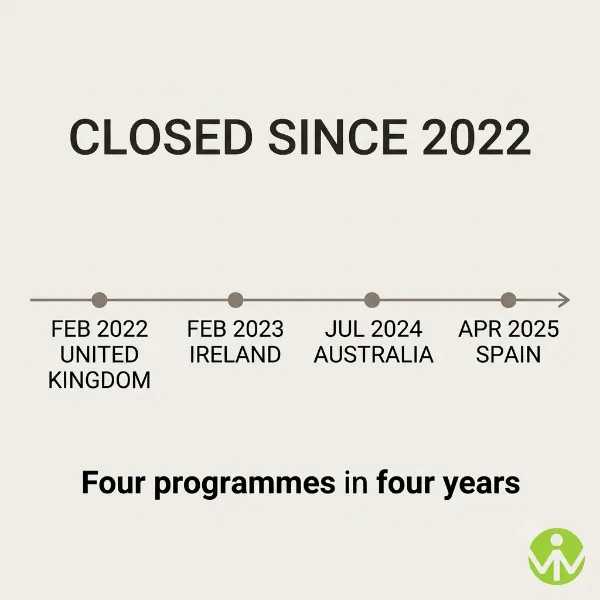
Four major programmes have shut in four years, and lists still carrying them are not merely out of date but actively misleading.
The United Kingdom closed the Tier 1 (Investor) route on 17 February 2022, and a government review of how it had operated followed the next January. Ireland closed its Immigrant Investor Programme on 15 February 2023, with approved investors keeping their status and a backlog the department expects to take years.
Australia closed the Business Innovation and Investment Programme, the subclass 188, permanently to new applications on 31 July 2024. Unlike the others it has a successor of sorts: the National Innovation Visa replaced the talent and investment streams, though it is a merit route rather than a capital one and should not be described as one of these schemes.
Spain abolished its investor residence route through Organic Law 1/2025 of 2 January, with no new applications accepted from 3 April 2025. Existing permits stay valid to expiry and renewals are decided under the rules in force when they were granted.
Golden visa routes outside Europe
| Country | Programme | Minimum investment | What it grants |
|---|---|---|---|
| United Arab Emirates | Golden Visa, public investment | AED 2,000,000 | 10-year renewable residence, no sponsor |
| United Arab Emirates | Green Visa | No capital threshold; skills and self-employment based | 5-year renewable residence, no sponsor |
| New Zealand | Active Investor Plus, Growth | NZD 5,000,000 held for 3 years | Residence |
| New Zealand | Active Investor Plus, Balanced | NZD 10,000,000 held for 5 years | Residence |
| United States | EB-5 Immigrant Investor | US$800,000 in a targeted employment area, otherwise US$1,050,000 | Conditional permanent residence |
| Sources: u.ae (UAE), Immigration New Zealand, and the EB-5 Reform and Integrity Act 2022 (United States). Verified 21 September 2026. | |||
Europe dominates the coverage, but three of the most substantial programmes are elsewhere, and two of them changed significantly in the past eighteen months.
The UAE operates the only scheme that officially uses the name. Its scheme grants ten years of renewable residence with no sponsor at AED 2,000,000 in public investments, and several of its categories require no investment at all. The Green Visa sits below it at five years for skilled professionals and the self-employed, also without a sponsor. Both are covered in our guide to UAE visa types.
New Zealand reopened as a serious option on 1 April 2025. The Active Investor Plus visa now runs two categories: Growth at NZD 5,000,000 held for three years, and Balanced at NZD 10,000,000 held for five. The previous threshold was NZD 15,000,000, and the English language requirement has been removed entirely, which is an unusual liberalisation at a time when most countries are tightening.
The United States EB-5 programme is frequently listed alongside golden visas and belongs in a slightly different category, since it is an employment-creation route granting conditional permanent residence rather than a renewable permit. The current thresholds are US$800,000 in a targeted employment area and US$1,050,000 elsewhere, under the EB-5 Reform and Integrity Act 2022. Our EB-5 guide covers the detail.
Programmes also operate in Malaysia, Thailand, Singapore, Mauritius and several Caribbean and Central American states. Their current terms could not be verified against a primary source for this edition and have deliberately been left out rather than reproduced from secondary listings.
What these programmes cost beyond the headline figure
The published minimum is the entry ticket, not the price. Four further categories of cost apply almost everywhere, and together they routinely add a fifth to a third on top.
Government and application fees are charged per person and are rarely refundable if an application fails. Legal and agent fees are commercial and vary enormously; in several countries an application cannot practically be filed without local representation. Dependants are charged separately, on brackets that differ by age and relationship, and a family of four frequently costs substantially more than twice a single applicant. Renewal fees recur for as long as the permit is held, which on a ten-year horizon is a real number rather than a rounding error.
Then there is the investment itself, which is not a cost but is not a neutral asset either. Property bought to satisfy a residence threshold sits in a market shaped by that threshold: the buyers are other applicants, the price floor is set by the programme, and both can move when the rules do. Portugal’s removal of the real estate route in 2023 is the clearest illustration of what happens to a programme-driven market when the programme changes.
Tax is a separate question, and usually the bigger one
Holding a residence permit is not the same as being tax resident, and the two are decided by different rules. Most countries determine tax residence by days of physical presence, by where your permanent home or centre of vital interests sits, or by a combination. A permit that requires seven days a year will not usually make you tax resident. Actually moving will.
That cuts both ways. People who buy residence expecting a tax outcome frequently do not get one, because they never establish the presence that would trigger it. And people who do relocate sometimes acquire tax obligations they had not modelled, including on worldwide income, while remaining liable in their country of origin. United States citizens are taxed on worldwide income wherever they live, so for them no residence route changes anything at all on this front.
Take advice from a tax professional in your own jurisdiction before taking it from anyone whose income depends on the application proceeding.
How to compare a golden visa properly
Price is the least useful comparator, and it is the one every listicle leads with. Four questions matter more.
What is the path to citizenship, and is it stable? This is the Portugal lesson. Read the country’s nationality law, not the programme brochure, and note when it was last amended.
What does the permit actually let you do? Some grant access to work, some do not. Some allow family inclusion as of right, some charge per dependant. Schengen residence permits allow short-stay travel across the area but are not equivalent to citizenship of it.
What are the physical presence requirements? These vary from a few days a year to substantial residence, and they interact with the naturalisation clock: a programme with light presence requirements may be pleasant to hold and useless as a path to a passport, because naturalisation usually demands real residence.
And what is the exit? Most routes require the investment to be maintained for the duration. Property in a programme-driven market can be difficult to sell at the price paid, and fund investments carry ordinary market risk. This is a migration decision with an investment attached, not the reverse.
If the underlying goal is mobility rather than relocation, check what the eventual passport would actually open before committing. Our passport rankings give the current figures, and the piece on wealth and passport power explains why cost and access correlate so poorly. If the goal is simply the right to live somewhere, compare against the ordinary routes in our guide to permanent residency and the countries where PR is easiest to obtain, which are cheaper in almost every case.
Frequently asked questions about golden visas
Does a golden visa give you citizenship?
No. It grants residence. Citizenship, if it comes at all, comes later through that country’s ordinary naturalisation process, which typically requires a qualifying period of residence, a language test and a good-character assessment. The two are separate legal processes with separate rules.
Which is the cheapest golden visa?
Latvia, from EUR 50,000 for a business investment, is the cheapest in Europe. Malta’s Permanent Residence Programme is around EUR 150,000 but combines several components rather than a single investment. Cost is a poor guide to value here, because the countries differ enormously in what the permit leads to.
Which golden visa programmes have closed?
Four since 2022: the United Kingdom’s Tier 1 (Investor) in February 2022, Ireland’s Immigrant Investor Programme in February 2023, Australia’s Business Innovation and Investment Programme in July 2024, and Spain’s investor residence route in April 2025.
Can I still get a golden visa in Portugal?
Yes. The programme is open at EUR 250,000 for cultural investment or EUR 500,000 for qualifying funds, and the real estate option was removed earlier. What changed is naturalisation: since 19 May 2026, it requires ten years of residence, or seven for EU and CPLP nationals, rather than five.
Do I have to live in the country?
For the permit, usually very little – some programmes require only a few days a year. For citizenship, usually a great deal. This is the gap that catches people out: minimal presence keeps the residence permit alive but does not accumulate the real residence most naturalisation laws require.
Is a golden visa the same as citizenship by investment?
No, and the distinction is the most important one in this subject. Citizenship by investment grants a passport directly, usually within months. A golden visa grants a residence permit, and any passport depends on later satisfying that country’s naturalisation rules.
Can my family be included?
Almost always, but not on the same terms. Spouses and minor children are normally included as of right, while adult children, parents and grandparents depend on the country and usually attract an additional contribution. Check the age brackets carefully: several programmes cut off dependency at 18, others at 25, and a child who ages out mid-application can fall outside the grant entirely.
Will this affect my current nationality?
A residence permit does not, because you are not acquiring a new nationality. If you eventually naturalise, it depends entirely on whether your own country permits dual nationality. Our list of countries that allow dual citizenship is the place to check before planning that far ahead.
Sources
- Immigration New Zealand, investor category – Active Investor Plus settings from 1 April 2025.
- UAE Government, Golden Visa – categories, validity and thresholds.
- UK Parliament, Tier 1 (Investor) route: review of operation, written statement HCWS492.
- Irish Immigration Service, closure of the Immigrant Investor Programme.
- Government of Spain, abolition of the investor visa – Organic Law 1/2025 of 2 January.
- Australian Department of Home Affairs, Business Innovation and Investment programme – closed 31 July 2024.