
For eighteen months, US citizenship by birth was the most contested question in American immigration law. On 30 June 2026, the Supreme Court settled it. In Trump v. Barbara, the justices ruled 6–3 that a child born on American soil is a citizen at birth, whatever the immigration status of that child’s parents.
This guide explains US citizenship by birth as it now stands, how the challenge to it unfolded, and what could still change.
Key takeaways
- The Supreme Court upheld US citizenship by birth on 30 June 2026 in Trump v. Barbara, by a vote of 6–3.
- Executive Order 14160, signed on 20 January 2025, tried to end birthright citizenship for children of undocumented and temporary-visa parents. It never took effect.
- Children born in the United States to parents on H-1B, F-1, B-2 or any other temporary visa are US citizens.
- The 2020 visa rule aimed at “birth tourism” is a separate measure and remains in force.
- Congress is considering bills to restrict birthright citizenship by statute. None has passed.
Table of Contents
What US citizenship by birth means
US citizenship by birth comes from the Citizenship Clause of the Fourteenth Amendment, ratified on 9 July 1868:
“All persons born or naturalized in the United States, and subject to the jurisdiction thereof, are citizens of the United States and of the State wherein they reside.”
The amendment was adopted to overturn the Supreme Court’s 1857 decision in Dred Scott v. Sandford, which had held that Black Americans could not be citizens. Thirty years later, in United States v. Wong Kim Ark (1898), the Court applied the clause to the American-born son of Chinese parents who were themselves barred from naturalising. That case has governed US citizenship by birth ever since.
US citizenship by birth is one of four routes to becoming an American. The others are birth abroad to US-citizen parents, naturalisation, and derivative citizenship through a parent’s naturalisation.
Who qualifies for US citizenship by birth in 2026
Birth on US soil
A child born anywhere in the fifty states or the District of Columbia acquires US citizenship by birth. The parents’ visa status, or lack of one, is irrelevant. This covers births to tourists, students, temporary workers, asylum seekers and people with no lawful status at all.
Births in US territorial waters and US airspace count as well.
The territories, and the American Samoa exception
US citizenship by birth extends by statute to Puerto Rico, Guam, the US Virgin Islands and the Northern Mariana Islands.
American Samoa is the exception, and it is one that most guides get wrong. People born in American Samoa and Swains Island are US nationals, not US citizens. They hold US passports and may live and work anywhere in the country, but they cannot vote in federal elections and must naturalise to become citizens. Litigation over this status is ongoing.
The narrow exclusions
The phrase “subject to the jurisdiction thereof” carves out a very small group: children born to accredited foreign diplomats, and children born to hostile forces occupying US territory. In practice, only the diplomatic exception has any modern application. It has never been read to exclude the children of ordinary immigrants.
The challenge to US citizenship by birth: Executive Order 14160
What the order tried to do
On 20 January 2025, his first day back in office, President Trump signed Executive Order 14160, “Protecting the Meaning and Value of American Citizenship.” It directed federal agencies to withhold recognition of US citizenship by birth from any child born after 19 February 2025 whose mother was unlawfully present or lawfully present only on a temporary basis, unless the father was a citizen or lawful permanent resident.
The practical reach was wide. Children of H-1B and L-1 workers, F-1 students, and B-2 visitors would all have been excluded, alongside children of undocumented parents.
How the lower courts responded
The order was scheduled to take effect 30 days after signing. It never did. Federal judges across several districts blocked it, with one describing it as blatantly unconstitutional.
The administration’s first move was procedural rather than substantive. Instead of defending the order’s merits, it asked the Supreme Court to curtail the power of district judges to issue nationwide injunctions. On 27 June 2025, in Trump v. CASA, the Court agreed 6–3 that universal injunctions exceed the equitable authority Congress gave the federal courts.
That was a real win for the executive branch, but it did not save the order. Challengers refiled as class actions. On 10 July 2025, Judge Joseph Laplante of the District of New Hampshire certified a nationwide class of affected babies and enjoined the order as to all of them, finding it likely contradicted both the Fourteenth Amendment and a century of untouched precedent.
What the Supreme Court held
The administration appealed directly, bypassing the First Circuit. The justices granted review on 5 December 2025 and heard argument on 1 April 2026.
Chief Justice John Roberts wrote for the majority. Children born to parents unlawfully or temporarily present, he held, satisfy both elements of the Citizenship Clause: they are born in the United States, and they are subject to its jurisdiction. “Under the Constitution, they are citizens at birth.”
Roberts traced the rule from English common law through the Revolution to the Fourteenth Amendment, which he said was written to “permanently enshrine” an understanding of citizenship the country already held. He rejected the government’s argument that the clause turns on the parents’ domicile or primary allegiance, calling the evidence for that reading scant. His closing line: “Citizenship, then and now, was the right to have rights.”
Justice Brett Kavanaugh concurred in the judgment only. In his view the order did not violate the Fourteenth Amendment but did violate the federal statute codifying birthright citizenship — a distinction that matters, because it implies Congress could legislate differently.
Justice Clarence Thomas dissented at length, joined by Justice Neil Gorsuch. Justice Samuel Alito, dissenting separately, called the decision “a serious mistake.” Gorsuch wrote briefly and separately to question how the government’s domicile theory could apply to undocumented parents who intend to remain permanently.
The administration did not seek rehearing.
What the ruling did not change
Two things survive untouched.
The 2020 birth tourism visa rule. In January 2020, the State Department amended 22 CFR 41.31 so that travelling to the United States primarily to obtain citizenship for a child is not a permissible purpose for a B visa. Consular officers who believe that is an applicant’s main reason for travel may refuse the visa. The rule is still in force. Trump v. Barbara concerned who is a citizen once born, not who gets a visa to travel.
Pregnancy alone is not a ground for refusal, and consular officers cannot require a pregnancy test. But an applicant who appears to be travelling to give birth faces a presumption she must rebut.
Sponsorship timelines. A US citizen can petition for parents only at age 21, and the process takes years. US citizenship by birth has never been a fast route to status for the parents.
Could Congress still end US citizenship by birth?
This is now the live question, and Kavanaugh’s concurrence is why.
Within three weeks of the decision, Republican members introduced at least three measures: the Citizenship Act of 2026 from Senator Jim Banks, the Birthright Citizenship Clarification Act of 2026 (H.R. 9633), and a proposed constitutional amendment. The President has pushed for the statutory route rather than an amendment.
Most constitutional and immigration scholars think the statutory route fails. Roberts’s opinion rests on the Constitution, not on the statute, and a majority of the Court reached that ground. A law narrowing US citizenship by birth would face immediate challenge and, on the reasoning in Barbara, would likely lose.
A constitutional amendment would work, but the arithmetic is forbidding: two-thirds of both chambers and ratification by 38 states.
For now, nothing has passed, and the rule is unchanged.
US citizenship by birth and Indian parents
This question comes up constantly, and the usual answer given online is wrong.
A child born in the United States to Indian parents is a US citizen from birth. That is automatic and requires no application.
India does not permit dual citizenship. Under the Citizenship Act, 1955, a person who voluntarily acquires another nationality loses Indian citizenship — but a child who acquires US citizenship automatically at birth has not done so voluntarily. In practice, parents choose: register the birth with the Indian consulate and claim Indian citizenship for the child, or leave the child a US citizen alone. On the US side, there is no conflict: US law lets a child hold US citizenship alongside another nationality, as our guide to US dual citizenship explains.
If the family keeps US citizenship, the child can hold an Overseas Citizen of India (OCI) card, which gives lifelong visa-free entry to India and most residence rights short of voting and public office. This is the route most families take. The child does not “get back” US citizenship later — a US citizen at birth remains one unless they formally renounce as an adult.
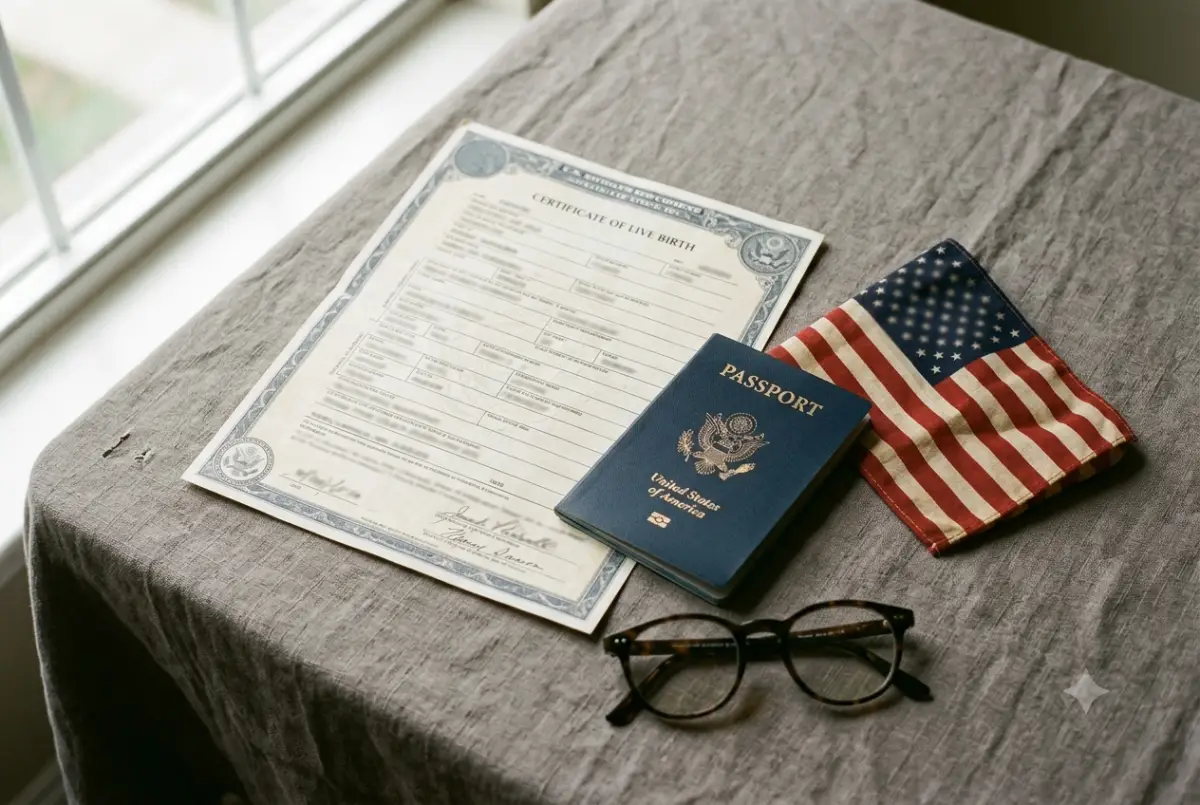
How to prove US citizenship by birth
Three documents matter:
- The state-issued birth certificate. Order certified copies from the vital records office of the state of birth, not the hospital.
- The US passport. Apply on Form DS-11 with the birth certificate. For a child under 16, both parents must consent.
- The Consular Report of Birth Abroad (CRBA). This applies only to children born outside the United States to citizen parents, and is not needed for a birth on US soil.
Keep the certified birth certificate. It is the primary evidence of US citizenship by birth, and replacing it later from overseas is slow.
Frequently asked questions
Is US citizenship by birth still law in 2026?
Yes. The Supreme Court confirmed it on 30 June 2026 in Trump v. Barbara.
Did Executive Order 14160 ever take effect?
No. Courts blocked it before its 19 February 2025 start date, and the Supreme Court struck it down in June 2026.
Is a baby born to H-1B parents a US citizen?
Yes. Children of temporary visa holders qualify for US citizenship by birth, exactly as before the order.
Can a pregnant woman travel to the United States on a tourist visa?
Travel is not prohibited, but the 2020 rule lets consular officers refuse a B visa if they conclude the primary purpose is to give birth in the US.
Can Congress end US citizenship by birth by statute?
It can try, and bills have been introduced. Most scholars expect a statute to be struck down, because the ruling rests on the Constitution.
Are people born in American Samoa US citizens?
No. They are US nationals. They hold US passports but must naturalise to become citizens.
Sources
- Trump v. Barbara, No. 25-365 (US Supreme Court, 30 June 2026)
- Trump v. CASA, Inc. (US Supreme Court, 27 June 2025)
- Executive Order 14160, “Protecting the Meaning and Value of American Citizenship,” 20 January 2025
- United States v. Wong Kim Ark, 169 US 649 (1898)
- 22 CFR 41.31, as amended 24 January 2020
- Congressional Research Service, “Birthright Citizenship: Litigation Status Update” (LSB11414)
This article is general information, not legal advice. For a decision that affects your family’s status, consult a licensed US immigration attorney.