
Grenada citizenship by investment is one of five programmes in the Eastern Caribbean that grant a passport in return for an economic contribution, and Grenada is the only one of the five whose country holds a United States investor treaty. That treaty is why the programme is marketed as a route to America. It is also the point at which most of what is written about Grenada citizenship stops being accurate.
This guide sets out what Grenada citizenship costs in 2026, who qualifies, what the passport opens, and what the E-2 treaty does and does not do — along with two developments that will matter more than any single fee: a new regional regulator headquartered in Grenada, and a European Union request that all five Caribbean programmes close by 2028.
Key takeaways
- Grenada citizenship starts at US$235,000 through the National Transformation Fund, or US$270,000 through approved real estate plus a US$50,000 government fee.
- Every applicant aged 17 and over attends a mandatory interview and gives biometric data.
- Official guidance puts processing at three to four months, and applications must go through an Authorised Local Agent.
- The passport reaches 147 destinations visa-free or visa-on-arrival, and is one of only five that reach China, Russia, the Schengen Area and the United Kingdom.
- Grenada is the only Caribbean programme whose country holds a US E-2 treaty — but since December 2022 an investor-citizen needs three years of domicile in Grenada before applying for one.
- The European Union has asked all five Caribbean programmes to close by 1 June 2028. Nothing has been suspended, and negotiations are open.
Table of Contents
What Grenada citizenship by investment is
Grenada citizenship by investment is a statutory programme established under the Grenada Citizenship by Investment Act 2013 and administered by the Investment Migration Agency, which has run it since February 2014. An applicant makes a qualifying economic contribution, passes due diligence, and is granted full citizenship — not residence, and not a visa.
Two features separate it from a residence-by-investment scheme of the kind covered in our guide to the most popular golden visa programmes. The grant is citizenship with a passport rather than a permit to live somewhere, and there is no requirement to set foot in Grenada at any stage. There is no language test, education requirement, or minimum stay. You must file applications through an Authorised Local Agent.
Grenada permits dual citizenship, so Grenada citizenship does not require giving up an existing nationality. Whether an existing nationality survives the acquisition of a second one is a question for the other country — the United States permits dual citizenship, while India, China and several others do not.
What Grenada citizenship costs in 2026
There are two qualifying routes. The figures below are the published minimums from the Investment Migration Agency, and they are the floor rather than the total cost: government, due diligence, processing and interview fees sit on top, and are set out in the next section.
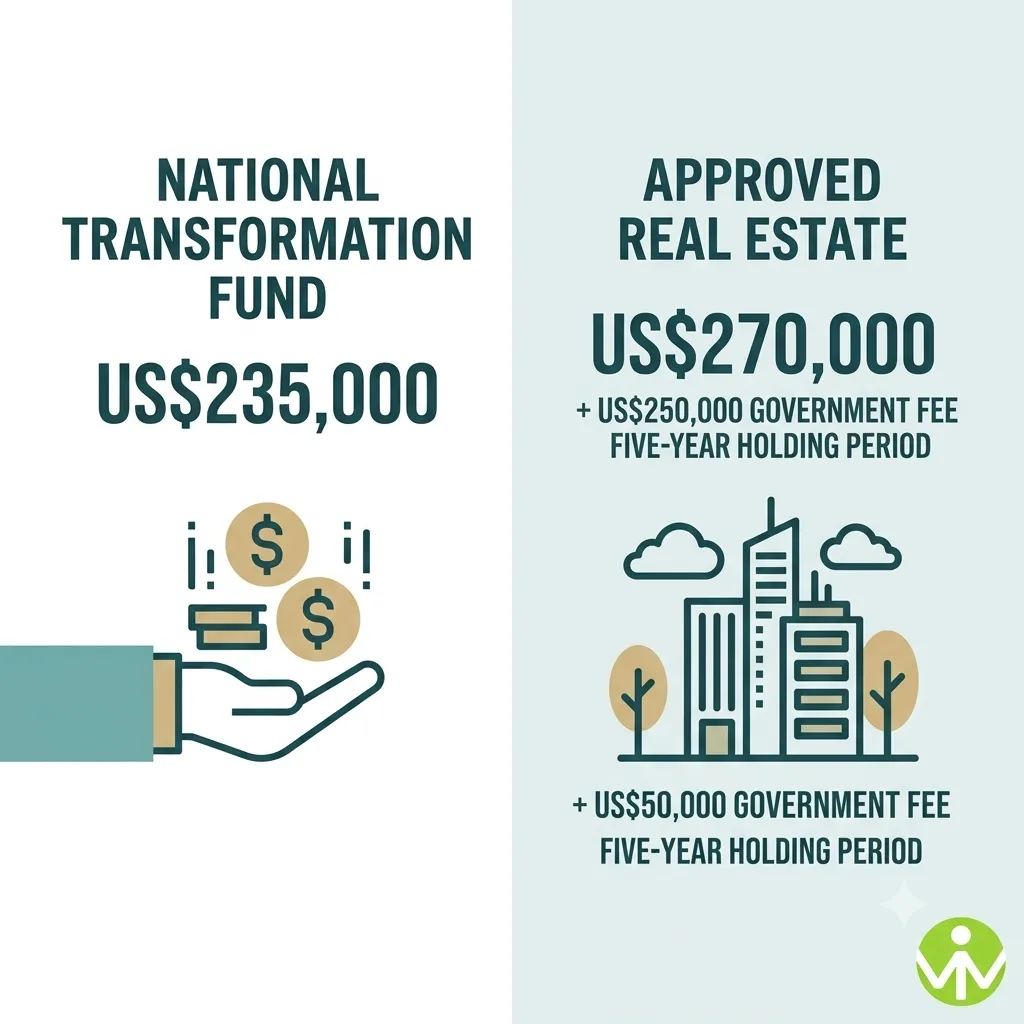
Table 1: Grenada citizenship by investment routes and minimums (2026)
| Route | Minimum investment | Government fee | Key condition |
|---|---|---|---|
| National Transformation Fund, single applicant | US$235,000 | None | Non-refundable contribution |
| National Transformation Fund, family of up to four | US$235,000 | None | Same figure as a single applicant |
| Approved real estate, qualifying share | US$270,000 | US$50,000 | Five-year holding period |
| Approved real estate, full unit | US$350,000 | US$50,000 | Five-year holding period |
| Source: Investment Migration Agency, Grenada. Figures current at 18 September 2026. | |||
The National Transformation Fund route
The National Transformation Fund is a government fund that finances public projects. A contribution to it is non-refundable and buys no asset. At US$235,000 it is the cheaper entry point in almost every family configuration, because the same figure covers a single applicant, a couple, or a family of up to four. Beyond four, the published schedule adds US$25,000 or US$50,000 per additional dependant after the third, and US$75,000 for an additional sibling.
The floor of US$235,000 is not a Grenada-specific number. It reflects a minimum agreed across the five Eastern Caribbean programmes to end the price competition between them, and it applies whichever of the five a reader is comparing — including St Kitts and Nevis.
The real estate route
The real estate route requires the purchase of an interest in a government-approved project, almost always a hotel, resort or villa development. A qualifying share costs US$270,000, raised from US$220,000 on 1 July 2024; a full unit costs US$350,000. Either way a government fee of US$50,000 applies, which the fund route does not carry.
The property must be held for five years. Citizenship is retained after a compliant sale, so the holding period is a condition of the investment rather than of the status. Since 2024 the regulations also prohibit discounting, rebates and guaranteed buy-back arrangements across all routes, which removes the structures that previously allowed the headline price to be quietly reduced.
The sticker price understates the gap. With the US$50,000 government fee added, the real estate route starts roughly US$85,000 above the fund route — against the prospect of recovering some capital after five years in a small and illiquid property market.
Fees, due diligence and the interview
These fees are charged per person and are separate from the investment itself.
Table 2: Grenada citizenship application fees per person (2026)
| Fee | Main applicant | Spouse | Dependant aged 17+ | Dependant aged 0-16 |
|---|---|---|---|---|
| Application fee | US$1,500 | US$1,500 | US$1,500 | US$1,500 |
| Due diligence fee | US$5,000 | US$5,000 | US$5,000 | Nil |
| Processing fee | US$1,500 | US$1,500 | US$1,500 | US$500 |
| Interview fee | US$1,000 | US$1,000 | US$1,000 | Not applicable |
| Source: Investment Migration Agency, Grenada. Charged per person and separate from the investment. Current at 18 September 2026. | ||||
The interview fee is the newest line. It exists because the interview is now compulsory rather than discretionary, and it applies to every applicant aged 17 and over, including the spouse.
Who qualifies for Grenada citizenship
The published requirements are that an applicant is at least 18 years old, holds no criminal record, is in good health, and makes the required contribution. There is no minimum net worth test and no requirement to demonstrate business experience.
Who is refused
The agency lists the disqualifying grounds plainly. An application fails if the applicant provides false information on the form, has a previous conviction carrying a custodial penalty of more than six months, is the subject of a criminal investigation, is judged a national security risk to Grenada or to any other country, has been involved in activity likely to bring Grenada into disrepute, or has been denied a visa by a country with which Grenada has visa-free arrangements and has not subsequently obtained one.
The last of those catches more applicants than it appears to. A refused Schengen, UK or Canadian visa never followed by a successful application is disclosable, and non-disclosure is itself a ground for refusal under the first limb.
Family members you can include
A single application can carry the main applicant, a spouse, dependent children, and dependent parents, grandparents and siblings. Age thresholds vary by relationship: the fee schedule treats dependants aged 16 and under differently from those aged 17 and over, and sets separate terms for siblings, parents and grandparents aged 55 and under. Because those brackets do not map neatly onto the fee tiers, confirm a specific family’s eligibility with an Authorised Local Agent before any money moves.
How to apply for Grenada citizenship, step by step
The sequence is fixed and there is no way to shorten it by dealing with the agency directly.
An applicant appoints an Authorised Local Agent, the only party permitted to file. The agent assembles the file: forms, passport copies, birth and marriage certificates, a police certificate, a medical examination for everyone included, and evidence of the source of the invested funds. It is submitted with the application and due diligence fees paid up front. Due diligence runs on every applicant aged 17 and over, the interview follows, and on approval in principle the investment is made and the remaining fees paid. The certificate of registration and the passport are issued once the funds clear.
The mandatory interview and biometrics
The interview is the substantive change to Grenada citizenship applications in recent years and it is not a formality. It is compulsory for every applicant aged 17 and over, carries its own US$1,000 fee, and comes with biometric capture. The requirement came out of the same regional agreement that set the price floor, and it is being extended to existing passport holders at renewal.
How long Grenada citizenship takes
Official guidance puts processing at three to four months from a complete submission. That figure predates the compulsory interview, so treat it as a floor rather than an expectation. The clock also starts only when the file is complete, and assembling police certificates, medical reports and source-of-funds evidence across several jurisdictions routinely takes longer than the processing itself.
What a Grenada passport actually gets you
A Grenada passport reaches 147 countries and territories visa-free or with a visa on arrival. The raw number matters less than which doors it opens: Grenada is one of only five nationalities — with Brunei, Mauritius, Peru and the Seychelles — whose citizens can enter China, Russia, the Schengen Area and the United Kingdom without a visa. No other Caribbean programme offers that combination, and it is the most defensible thing anyone can say about the passport. Our passport rankings for 2026 set the wider context.
Table 3: Grenada passport access to major destinations (2026)
| Destination | Access | Permitted stay |
|---|---|---|
| Schengen Area | Visa-free | 90 days in any 180 |
| United Kingdom | Visa-free | Up to 6 months |
| China | Visa-free | 30 days |
| Russia | Visa-free | 90 days in any 180 |
| United States | Visa required | No visa waiver; apply for a visa |
| Access terms as at 18 September 2026. Schengen visa-free status is under formal review by the European Commission – see “The EU deadline and what it means”. | ||
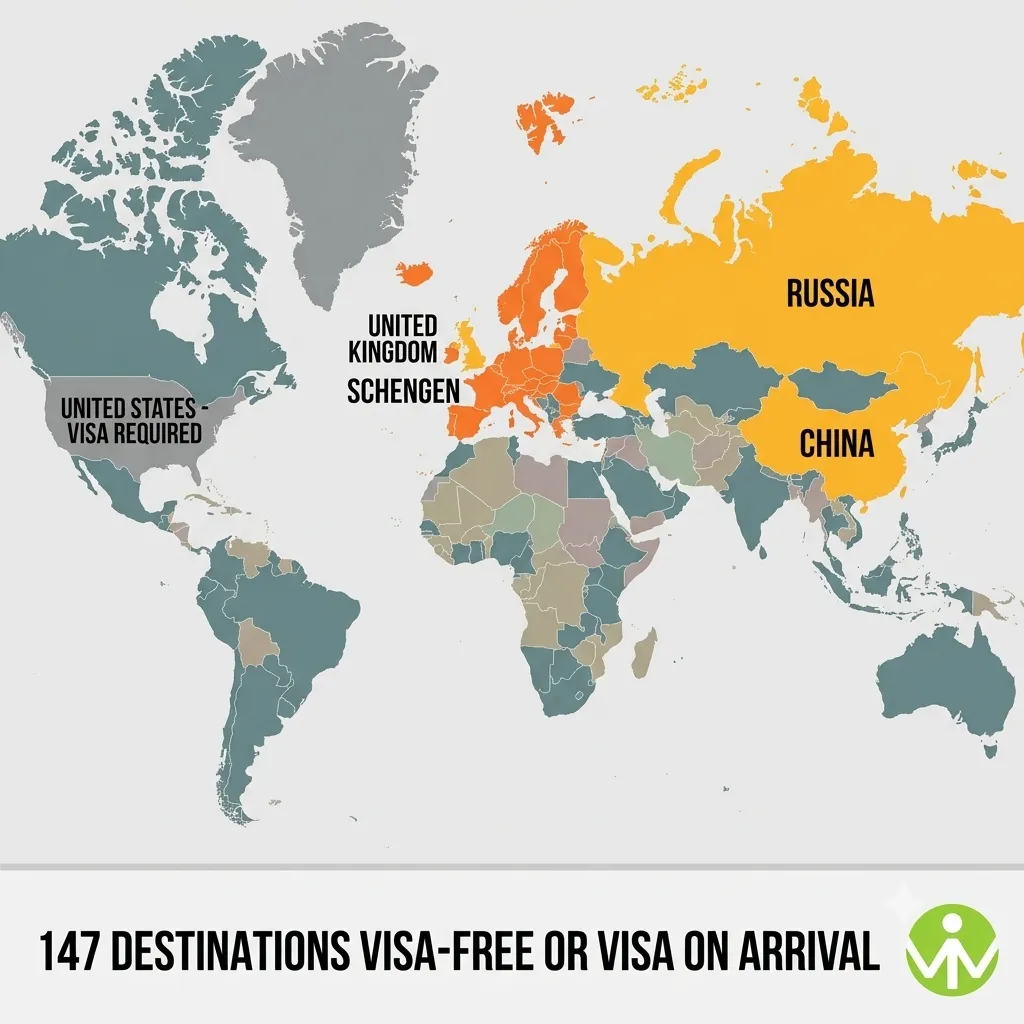
The United States is the conspicuous absence. Grenada is not in the US Visa Waiver Program, so Grenada citizenship does not permit visa-free travel to the United States. A Grenadian passport holder applies for a visa like anyone else, whether that is a B-1 business visa or something longer-term.
The E-2 visa question
This is the reason most people arrive at the subject of Grenada citizenship, and it needs to be stated precisely, because the marketing around it is systematically misleading.
The true part: Grenada holds a treaty with the United States that has been in force since 3 March 1989, and it is listed on the US Department of State’s treaty countries table for E-2 only, with no E-1. Under the reciprocity schedule for Grenada, an E-2 visa is issued for 60 months, multiple entry, with no reciprocity fee. Grenada is the only one of the five Caribbean citizenship programmes attached to an E-2 treaty; Antigua and Barbuda, Dominica, St Kitts and Nevis and St Lucia have none.
The three-year domicile rule
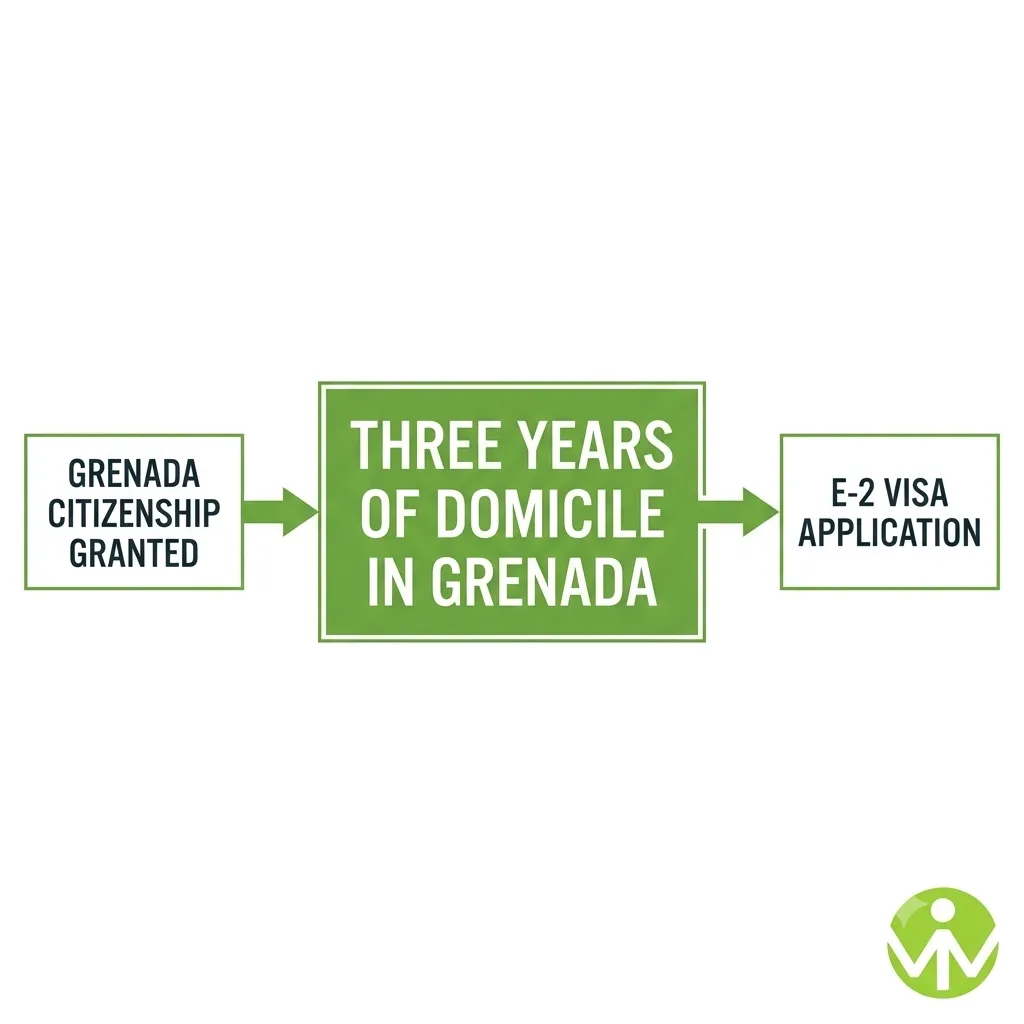
The part that is usually left out: since the James M. Inhofe National Defense Authorization Act for Fiscal Year 2023 became law in December 2022, an applicant who acquired the nationality of a treaty country through financial investment must have been domiciled in that country for a continuous period of not less than three years at some point before applying for an E-1 or E-2 visa.
That provision was written for exactly this situation. Buying Grenada citizenship and applying for an E-2 visa shortly afterwards does not work, and has not worked since 2022. Once three years of domicile have been accumulated the requirement is satisfied permanently, and the applicant does not have to remain in Grenada to apply — but the three years have to happen. For an investor who has no intention of living in Grenada, the E-2 treaty is not a benefit of Grenada citizenship in any practical sense.
Two further corrections follow, both routine in material about Grenada citizenship. The E-2 is a non-immigrant visa: it confers no permanent residence and no path to US citizenship, however often it is renewed. And there is no statutory or regulatory minimum investment for an E-2 — USCIS applies a proportionality test in which the lower the cost of the enterprise, the higher the proportion of it the investment must represent. Figures such as US$100,000 or US$150,000 are conventions of practice, not thresholds in law. Our guide to the E-2 treaty investor visa covers the requirements in full.
Where that leaves the comparison
Stripped of the E-2 claim, Grenada citizenship competes with the other four Caribbean programmes on due diligence, passport strength and price, and it holds a real advantage on the second. It does not offer faster access to the United States than its neighbours, unless the applicant will live in Grenada for three years.
Grenada citizenship by investment compared with the US EB-5
The two are frequently presented as alternatives. They are not comparable products, and the table makes the difference clearer than prose does.
Table 4: Grenada citizenship by investment compared with the US EB-5
| Grenada citizenship by investment | US EB-5 | |
|---|---|---|
| What is granted | Citizenship and a passport | Conditional permanent residence |
| Minimum investment | US$235,000 (fund route) | US$800,000 in a targeted employment area; US$1,050,000 otherwise |
| Capital at risk | No – the fund contribution is a donation | Yes – capital must remain at risk |
| Residence required | None | Yes, to maintain the status |
| Stated timeline | Three to four months | Years, with country-specific backlogs |
| Route to citizenship | Immediate, in Grenada | Naturalisation after five years as a permanent resident |
| EB-5 amounts are those set by the EB-5 Reform and Integrity Act of 2022; the first inflation adjustment is due on 1 January 2027. | ||
The EB-5 figures are those set by the EB-5 Reform and Integrity Act of 2022 – the US$800,000 targeted-employment-area threshold among them – with the first inflation adjustment due on 1 January 2027. Older material still quotes US$900,000 and US$1.8 million; those came from a 2019 rule vacated by a federal court in June 2021 and have not been the law since. Our EB-5 immigrant investor guide covers the programme, and the route to a US passport is set out in our guide to US citizenship.
The EU deadline and what it means
This is the development most likely to change the value of Grenada citizenship, and it is moving now.
On 26 November 2025 the European Union adopted Regulation (EU) 2025/2441, which came into force on 30 December 2025 and revised the mechanism for suspending visa-free travel. The Council’s own summary confirms what changed: operating an investor citizenship scheme that grants citizenship to people with no genuine link to the country is now a ground for suspension in its own right. The Court of Justice of the European Union applied the same reasoning inside the bloc when it struck down Malta’s investor citizenship scheme in April 2025. The initial suspension period rose from nine to twelve months, and the extension from eighteen to twenty-four.
On 25 June 2026 the European Commissioner for Internal Affairs and Migration, Magnus Brunner, wrote to all five Eastern Caribbean states asking them to phase their programmes out by 1 June 2028, with interim vetting and sanctions-screening measures due by September 2026. The letters were made public on 7 July. On 10 July the five heads of government met in Roseau and issued a joint statement proposing a mission to Brussels and arguing that any transition must come with replacement development financing. It did not accept the 2028 date, or mention it.
Nothing has been suspended. Grenada citizenship carries Schengen visa-free access today and negotiations are open. The point for a prospective applicant is that the access which makes the passport attractive rests on a political arrangement now formally under review, on a timetable running to mid-2028.
ECCIRA and the new regional oversight
In September 2025, after roughly two years of negotiation, the five programme states signed an agreement creating the Eastern Caribbean Citizenship by Investment Regulatory Authority. It will maintain regional registers of applicants, licensees and developers, publish annual compliance reports, levy fines and revoke licences, and it underpins the mandatory biometric collection now applied at application and at renewal.
Its headquarters will be in Grenada. For an applicant this is a mild positive and a practical inconvenience in equal measure: a shared regulator able to revoke licences is the strongest answer the region has to the European Commission’s objections, and it is also why the interview, the biometrics and the extra fees now exist. Expect the five programmes to converge on process and vetting rather than diverge. The OECS standards for the programmes set out the intent.
Holding your status: what happens after approval
Grenada citizenship, once granted, is citizenship: no renewal of status, no residence obligation, no minimum stay. Passports are issued for a fixed term, and renewal now involves giving biometric data if it was not captured at application.
Citizenship obtained through investment can be revoked where it was obtained by fraud, false representation or concealment of a material fact — the standard provision in this kind of legislation, and the reason the disclosure requirements are worth taking seriously. On the real estate route, selling inside five years breaches the terms of the investment; after five years the property can be sold and the citizenship is retained.
Frequently asked questions
How much does Grenada citizenship cost in total?
For a single applicant on the fund route, US$235,000 plus roughly US$9,000 in application, due diligence, processing and interview fees, before agent and legal costs. On the real estate route, US$270,000 plus the US$50,000 government fee and the same per-person fees.
Do I have to live in Grenada?
No. There is no residence requirement before or after the grant, and no minimum stay. The only context in which living in Grenada matters is the three-year domicile rule for a US E-2 visa.
Does Grenada citizenship give me an E-2 visa to the United States?
Not on its own, and not quickly. Grenada holds an E-2 treaty, but an applicant who acquired Grenada citizenship through investment must first have been domiciled in Grenada for three continuous years. The passport alone does not open the E-2.
How long does Grenada citizenship take?
Official guidance is three to four months from a complete application. Gathering the supporting documents and scheduling the compulsory interview for every adult applicant often takes longer than the processing.
Can I include my parents and children?
Yes. A single application can include a spouse, dependent children, and dependent parents, grandparents and siblings, subject to age thresholds and additional contributions beyond the fourth family member.
Will Grenada citizenship still give visa-free access to Europe?
It does today. The European Union has asked the five Caribbean programme states to close their schemes by 1 June 2028 and has made running such a scheme a standalone ground for suspending visa-free access, but no suspension has been imposed and talks are continuing.
Is the investment refundable?
The National Transformation Fund contribution is not — it is a donation and buys no asset. Real estate is an asset that can be sold after five years, but resale values in a small market are uncertain and should not be assumed to return the purchase price.