
The Malta investor program is not what it was two years ago. The route that sold Maltese citizenship for a EUR 650,000 contribution was ruled unlawful by the European Union’s highest court in April 2025, and Malta closed it three months later. What remains is a residence programme, a startup permit, a remote-work permit, and a discretionary citizenship route that no amount of money can buy.
That distinction matters more than any figure on this page. A great deal of material still online describes the Malta investor program as a way to buy an EU passport in twelve months. It is not, and has not been since April 2025. One page on Malta’s own government website still describes the old route, which is covered below.
This guide sets out what closed, what replaced it, what the open Malta investor route costs in 2026, and what it does and does not give you. Every figure comes from the Maltese government or the Court of Justice of the European Union rather than from an agency listing.
Key Takeaways
- The citizenship route is closed. The Court of Justice of the European Union ruled Malta’s investor citizenship scheme unlawful on 29 April 2025. Malta discontinued it in July 2025.
- Citizenship by merit cannot be bought. The Community Malta Agency describes it as “neither a programme nor a scheme, pathway, continuation, or alternative” to the former investor framework.
- The open route grants residence, not a passport. The Malta Permanent Residence Programme (MPRP) is the Malta investor program that still operates in 2026.
- Government charges are EUR 99,500 for a single applicant. A EUR 60,000 administration fee, a EUR 37,000 contribution, a EUR 2,000 donation and a EUR 500 residence card.
- Property is EUR 375,000 to buy or EUR 14,000 a year to rent. Held for five years. The reduced South Malta and Gozo thresholds were removed on 1 January 2025.
- Residence does not include the right to work. An MPRP certificate carries no employment licence, and allows 90 days of Schengen travel in any 180.
- Naturalisation takes five years and stays discretionary. Twelve months’ continuous residence plus four years in the preceding six, adequate Maltese or English, and a ministerial decision.
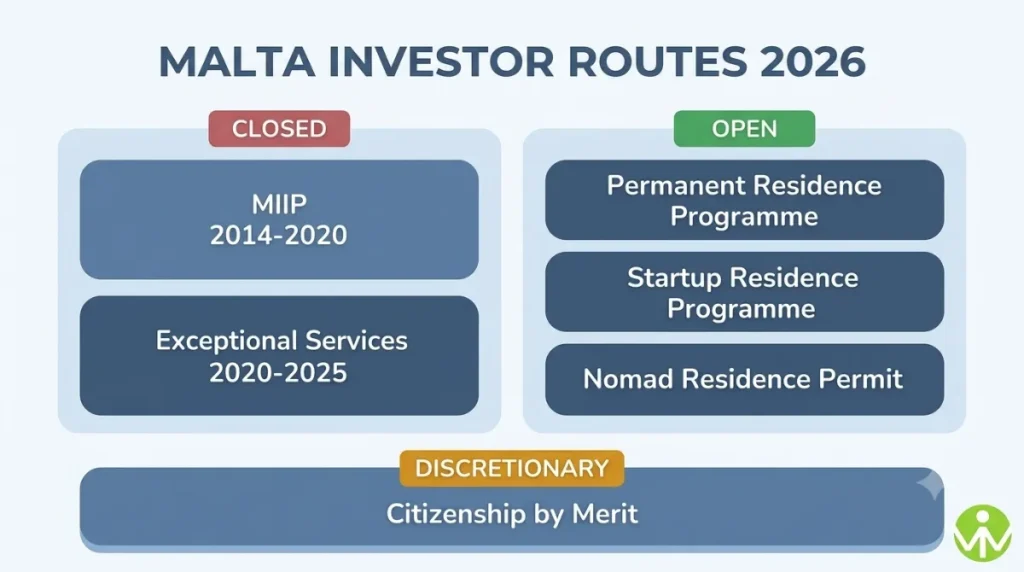
Table of Contents
What the Malta investor program means in 2026
Malta has never run a single scheme called the Malta investor program. The phrase covers a family of routes, and in 2026 they divide cleanly in two: routes that lead to residence, which are open and priced, and routes that lead to citizenship, which are open only on merit and are not for sale.
Malta investor routes: what is open and what is closed in 2026
| Route | Status in 2026 | What it leads to |
|---|---|---|
| Malta Individual Investor Programme (MIIP), 2014-2020 | Closed | Citizenship |
| Granting of Citizenship for Exceptional Services by Direct Investment, 2020-2025 | Closed. Discontinued July 2025 | Citizenship |
| Citizenship by Naturalisation on the Basis of Merit (S.L. 188.06) | Open, but not purchasable | Citizenship, at the Minister’s discretion |
| Malta Permanent Residence Programme (MPRP) | Open | Permanent residence |
| Malta Startup Residence Programme | Open | Three-year residence, extendable |
| Nomad Residence Permit | Open | One-year residence, renewable |
| Sources: Court of Justice of the European Union, Case C-181/23, 29 April 2025; Community Malta Agency; Residency Malta Agency. Position as at 23 September 2026. | ||
The rest of this guide follows that division, because almost every error in circulation about the Malta investor program comes from collapsing the two halves into one. Residence by investment and citizenship by investment are different products with different prices and different rights, a distinction our guide to golden visa programmes by country sets out in more detail.
Malta’s citizenship by investment route is closed
What the Court of Justice actually ruled
On 29 April 2025 the Grand Chamber of the Court of Justice of the European Union gave judgment in Commission v Malta, Case C-181/23. It held that granting nationality in exchange for predetermined payments or investments breaches Article 20 of the Treaty on the Functioning of the European Union and the duty of sincere cooperation in Article 4(3) of the Treaty on European Union.
The Court’s reasoning was blunt. The acquisition of Union citizenship, it said, cannot result from a commercial transaction. Selling nationality jeopardises the mutual trust between member states and undermines the solidarity that Union citizenship rests on. Member states keep the power to decide who their nationals are, but must exercise it consistently with EU law.
Malta complied. The Maltese Citizenship (Amendment) Act, XXI of 2025, was published on 24 July 2025. The Community Malta Agency stated that the amendments aligned Maltese law with the judgment by removing non-conforming aspects and discontinuing the Granting of Citizenship for Exceptional Services programme. That ended the last citizenship-by-investment route in the European Union, as our pillar guide to citizenship by investment records.
Why citizenship by merit is not a replacement
Legal Notice 159 of 2025, published on 29 July 2025, rewrote the subsidiary legislation that had carried the investment route. S.L. 188.06 is now the Granting of Citizenship by Naturalisation on the Basis of Merit Regulations, and the ministerial board that oversees it has been renamed accordingly.
Merit means a documented contribution in science and research, technology, sport, entrepreneurship including job creation, culture and the arts, or philanthropy. An applicant needs at least eight months of residence in Malta and title to adequate residential property there. There is no set contribution and no published price. The Minister takes the final decision and is not obliged to give reasons.
The Community Malta Agency has been unusually direct about what this is not. Citizenship by merit, it says on its own website, is neither a programme nor a scheme, pathway, continuation, or alternative to Malta’s former citizenship by investment framework, and decisions are discretionary and assessed case by case. Anyone marketing merit naturalisation as the new Malta investor program is contradicting the agency that administers it.
One official page still describes the old route
This is worth flagging because it is the likeliest source of fresh confusion. The Community Malta Agency’s own Acquisition of Citizenship page still sets out a route called Granting of Citizenship by Naturalisation for Exceptional Services by Direct Investment, with a 36-month residence period reducible to 12 months for a direct investment of EUR 600,000 to EUR 750,000, plus property, investment and a EUR 10,000 charitable donation.
That text predates the July 2025 amendments. The Act, the Legal Notice, the agency’s own press release and the judgment itself all say otherwise, and they are the current position. A stale page on a government site is still a stale page.
The Malta investor program that is open: permanent residence
The Malta Permanent Residence Programme, usually shortened to MPRP, is the Malta investor route that still operates. It is governed by S.L. 217.26 and administered by the Residency Malta Agency. It grants permanent residence in Malta to a non-EU applicant and qualifying family members in return for a fixed set of payments and a property commitment.
It was amended twice in fourteen months, which is why so many published figures are wrong. Legal Notice 310 of 2024 took effect on 1 January 2025 and Legal Notice 146 of 2025 followed in July. Between them they raised the administration fee, replaced the two-tier contribution with a single figure, raised the dependant fee, and deleted the reduced property thresholds for South Malta and Gozo.
Who can apply for the Malta investor program
The main applicant must be at least 18 and a third-country national, meaning not a citizen of an EU or EEA state or of Switzerland. Applications must go through a licensed agent, who now pays an annual licence fee of EUR 5,000 to the agency.
The regulations define a dependant in five categories: a spouse or partner in an equivalent relationship; a child of either partner under 18; an unmarried child of either partner aged 18 to 28; a parent or grandparent of either partner who is not in full-time employment and is principally dependent on the main applicant; and an adult child of either partner certified as having a disability. The agency describes the effect as including up to four generations in one Malta investor application.
The Malta investor program property requirement
Every Malta investor applicant under this route must hold a qualifying property for five years, either by purchase at a minimum of EUR 375,000 or by lease at a minimum of EUR 14,000 a year. The property may be anywhere in Malta or Gozo.
That single figure is the change most guides have missed. Before 1 January 2025 a property in South Malta or Gozo qualified at a lower threshold, and a great many pages still quote EUR 300,000 or EUR 10,000 a year on that basis. Legal Notice 310 of 2024 deleted the differential outright: the regulation now reads simply for a property situated in Malta or Gozo. After the five years the specific property may be released, but the beneficiary must continue to maintain a residential property in Malta.
What the Malta investor program costs
The payments are fixed rather than negotiable, and the regulations attach each one to a milestone rather than to a date.
What the Malta investor program costs in 2026
| Item | Amount | When it is paid |
|---|---|---|
| Administration fee, main applicant | EUR 60,000 | EUR 15,000 within one month of submission; EUR 45,000 within two months of approval in principle |
| Administration fee, each adult dependant | EUR 7,500 | With the balance. Spouse, children under 18 and adult children with a certified disability are exempt |
| Government contribution | EUR 37,000 | The same figure whether the property is bought or leased |
| Donation to a registered NGO | EUR 2,000 | Before the certificate is issued |
| Residence card | EUR 500 per person | Five-year card |
| Qualifying property, purchase | EUR 375,000 minimum | Held for five years, Malta or Gozo |
| Qualifying property, lease | EUR 14,000 per year minimum | Held for five years, Malta or Gozo |
| Agent annual licence fee | EUR 5,000 | Paid by the licensed agent, not the applicant |
| Source: Residency Malta Agency; S.L. 217.26 as amended by L.N. 310 of 2024 (in force 1 January 2025) and L.N. 146 of 2025. Figures as at 23 September 2026. | ||
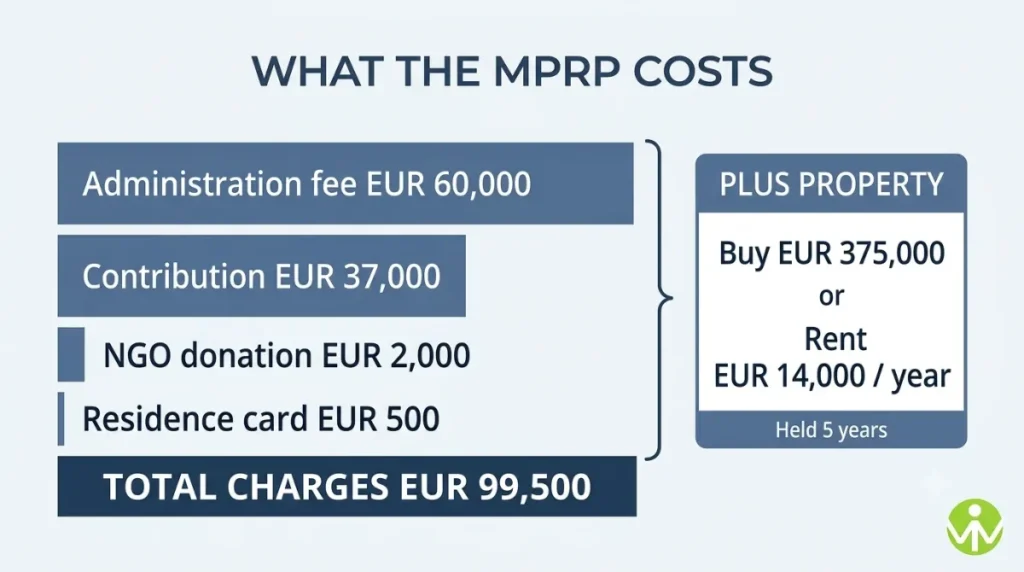
For a single applicant with no dependants the government charges come to EUR 99,500: a EUR 60,000 administration fee, a EUR 37,000 contribution, the EUR 2,000 donation and the EUR 500 residence card. Property sits on top of that, and the two routes behave differently: rent is an expense, at a minimum of EUR 70,000 across the five years, while a purchase is an asset the applicant continues to own.
Three points are easy to miss. The contribution is now the same whether the property is bought or leased, where it was once EUR 30,000 against EUR 60,000. The dependant administration fee rose to EUR 7,500 but three categories were made exempt, so in practice only adult children aged 18 to 28 and dependent parents or grandparents attract it. And the Malta investor program carries no bonds-or-shares component at all, despite a persistent claim that EUR 150,000 must be placed in government-approved securities. That was a condition of the old citizenship route.
Proof of assets under the Malta investor program
An applicant must show either EUR 500,000 in assets, of which at least EUR 150,000 must be financial, or EUR 650,000 in assets, of which at least EUR 75,000 must be financial. The agency states that the asset position is monitored annually for the first five years, so this is a standing requirement rather than a one-off test. It is the standing condition of the Malta investor program.
What the Malta investor program does not give you
This is the section most guides leave out, and it is the one that decides whether the Malta investor program suits a particular reader at all.
Maltese permanent residence set against Maltese citizenship
| Right | MPRP permanent residence | Maltese citizenship |
|---|---|---|
| Live in Malta indefinitely | Yes, while programme obligations are met | Yes |
| Work in Malta | No. A work permit must be obtained separately | Yes |
| Travel in the Schengen Area | 90 days in any 180-day period | Freely, as an EU citizen |
| Live and work in other EU states | No | Yes |
| Vote in Maltese elections | No | Yes |
| Pass the status to children automatically | No | Yes |
| Obtainable by investment | Yes | No, not since 29 April 2025 |
| Sources: Residency Malta Agency programme FAQs; Maltese Citizenship Act, Cap. 188; Court of Justice of the European Union, Case C-181/23. As at 23 September 2026. | ||
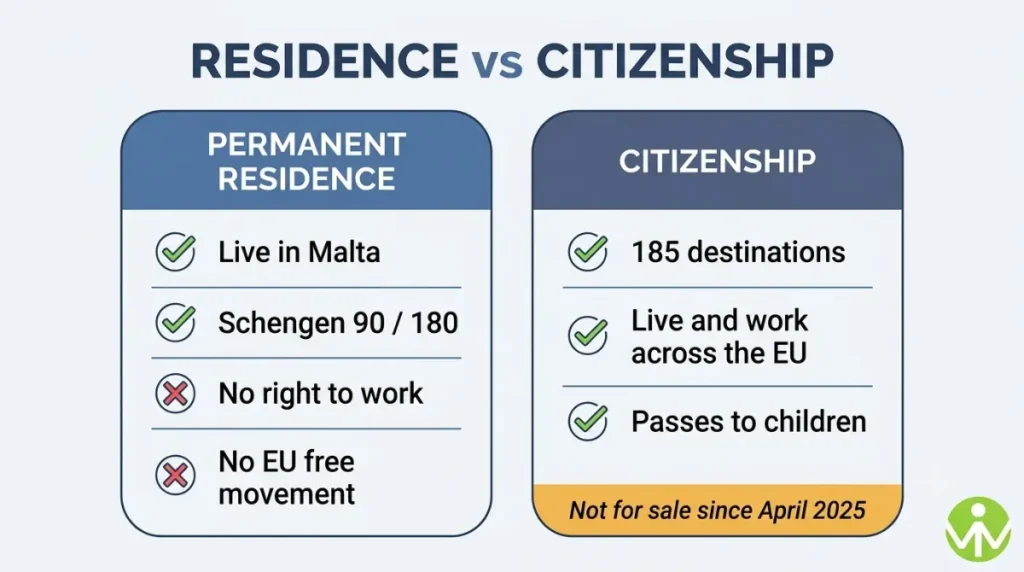
Two limits deserve stating in full. First, permanent residence does not carry the right to work. The Residency Malta Agency is explicit that a certificate of residency under the programme does not entitle the beneficiary to any employment licence and that a work permit must still be obtained through the normal procedures. Second, the residence card gives visa-free Schengen travel for a maximum of 90 days in any 180-day period. It is not EU free movement, and it does not allow the holder to settle in another member state.
Readers weighing the Malta investor program against routes elsewhere can compare our guides to the United States EB-5 investor programme and to Grenada’s citizenship by investment programme: one is an immigrant visa, the other a citizenship route that is still open.
How to apply for the Malta investor program
The sequence is set by the regulations and runs through a licensed agent from start to finish.
Step 1. Appoint a licensed agent. Applications are not accepted directly from individuals.
Step 2. Submit the application with supporting documents, and pay EUR 15,000 of the administration fee within one month of submission.
Step 3. Due diligence and vetting are carried out by the Residency Malta Agency.
Step 4. On a letter of approval in principle, pay the EUR 45,000 balance of the administration fee and the dependant fees within two months.
Step 5. Complete the qualifying property purchase or lease, and pay the EUR 37,000 contribution and the EUR 2,000 donation to a registered NGO.
Step 6. Submit evidence of all obligations, after which the certificate of residency and residence cards are issued.
The Malta investor program has no language test, no interview published as a mandatory step, and no minimum physical presence requirement in Malta during the five years.
The Malta investor program timeline: what is fixed and what is not
The regulations fix the payment deadlines but not the decision itself. EUR 15,000 falls due within one month of submission; the balance within two months of approval in principle. How long the agency takes to reach that approval is not published as a service standard, and any single figure quoted elsewhere should be treated as an estimate rather than a commitment.
Two periods are fixed and both run for five years: the property must be held for five years, and the asset position is monitored annually for five years. The certificate of residency itself does not expire, provided the programme obligations continue to be met.
Other Malta investor routes: founders and remote workers
Two further routes sit alongside the permanent residence programme. Neither is a Malta investor programme in the passive sense, but both come up often enough to belong here.
The Malta Startup Residence Programme targets founders in manufacturing, software development, industrial services, health and life sciences, sustainable industries, and other innovative activity. It requires EUR 25,000 in capital, plus EUR 10,000 for each additional co-founder, and admits up to six. Core employees must earn at least EUR 30,000 a year. Permits run for three years and extend by five for founders.
The Nomad Residence Permit is not an investment route, but it is the one readers most often confuse it with. It requires a minimum gross annual income of EUR 42,000 and is open to third-country nationals working remotely for a foreign employer, their own foreign company, or foreign clients. It runs for a year and is renewable.
The three open Malta residence routes compared
| Permanent Residence Programme | Startup Residence Programme | Nomad Residence Permit | |
|---|---|---|---|
| Who it is for | Passive investors and their families | Founders in eligible sectors | Remote workers |
| Financial test | EUR 500,000 in assets including EUR 150,000 financial, or EUR 650,000 including EUR 75,000 financial | EUR 25,000 capital, plus EUR 10,000 per additional co-founder | EUR 42,000 gross annual income |
| Property | Buy at EUR 375,000 or rent at EUR 14,000 a year | Not specified | Rental or purchase agreement required |
| Duration | Permanent, subject to obligations | Three years, then five more for founders | One year, renewable |
| Right to work in Malta | No, a separate work permit is needed | Yes, within the startup | No, work is for foreign clients or employers |
| Leads automatically to citizenship | No | No | No |
| Sources: Residency Malta Agency; Malta Startup Residence Programme eligibility document V4.2, August 2025; Nomad Residence Permit eligibility page. As at 23 September 2026. | |||
From Malta investor residence to a Maltese passport
Permanent residence does not convert into citizenship on its own, and the Malta investor program does not shorten the path. Ordinary naturalisation under the Maltese Citizenship Act requires residence in Malta throughout the twelve months immediately before the application, and an aggregate of at least four years within the six years before that twelve-month period. Five years in total, and the applicant must also show adequate knowledge of Maltese or English, be of good character, and be considered a suitable citizen.
The decision remains discretionary. Malta permits dual citizenship, so a successful applicant is not required to renounce an existing nationality, a point our guide to dual citizenship covers in more detail. But the honest summary is that the Malta investor program buys time in Malta, not a Maltese passport.
What the Malta investor program used to sell
Worth stating, because it is what the closed route was really selling. Malta shares fifth place on the Henley Passport Index with Austria, Greece, Portugal and Switzerland, with visa-free or visa-on-arrival access to 185 destinations in the July 2026 edition, as our own passport rankings guide records. A Maltese passport is also an EU passport, which carries the right to live and work in any member state.
That passport strength is what the closed Malta investor route was really selling, and it is no longer for sale. Caribbean programmes such as St Kitts and Nevis are still open and are genuine citizenship routes, but they deliver a different passport with different reach and face their own pressure from Brussels.
Malta investor program: frequently asked questions
Can I still buy Maltese citizenship in 2026?
No. The Malta investor program no longer includes a route that grants citizenship in exchange for money. The Court of Justice of the European Union ruled Malta’s investor citizenship scheme unlawful on 29 April 2025, and Malta discontinued it through the Maltese Citizenship (Amendment) Act published on 24 July 2025. Any site still quoting a EUR 650,000 contribution for a Maltese passport is describing a programme that no longer exists.
What is the cheapest way into the Malta investor program?
Renting rather than buying. A single applicant who leases a qualifying property pays EUR 99,500 in government charges, plus a minimum of EUR 14,000 a year in rent for five years. Buying instead means the same EUR 99,500 plus a qualifying property of at least EUR 375,000, which is an asset rather than a fee.
Does Malta permanent residence let me work in Malta?
No. The Residency Malta Agency states that a certificate of residency under the programme does not entitle the beneficiary to any employment licence, and that a work permit must still be applied for through the normal procedures. This is one of the most common misunderstandings about the Malta investor program.
How long must I hold the property?
Five years. After that the beneficiary must continue to maintain a residential property in Malta, but the specific qualifying property may be released. The asset test is also monitored annually for the first five years.
Is the South Malta and Gozo discount still available?
No. Legal Notice 310 of 2024, in force on 1 January 2025, deleted the reduced property values for South Malta and Gozo. A single figure now applies across the islands: EUR 375,000 to buy or EUR 14,000 a year to rent.
Can Malta permanent residence lead to a Maltese passport?
Only through ordinary naturalisation, and not automatically. The Maltese Citizenship Act requires twelve months’ residence immediately before the application and four further years within the preceding six, adequate knowledge of Maltese or English, and good character. The decision is discretionary.
What is citizenship by merit, and can I apply for it?
It is a discretionary naturalisation route covering science and research, technology, sport, entrepreneurship including job creation, culture and the arts, and philanthropy. It requires at least eight months of residence in Malta and title to adequate residential property. There is no set contribution, the Minister makes the final decision, and the Community Malta Agency states it is not a continuation of or alternative to the former investor route.
How strong is the Maltese passport?
Malta shares fifth place on the Henley Passport Index with Austria, Greece, Portugal and Switzerland, with visa-free or visa-on-arrival access to 185 destinations in the July 2026 edition. That strength belongs to citizenship, not to residence, and is no longer obtainable through the Malta investor program.