
The E-2 visa lets a national of a treaty country move to the United States to run a business they have put substantial capital into, and stay for as long as that business keeps trading. Two things about it surprise almost everyone: the law has no minimum investment, and no amount of time on an E-2 visa brings you any closer to a green card.
This guide explains who qualifies, which countries have a treaty, what an E-2 visa costs in 2026, how long it lasts, what a spouse can do, and how the category compares with the EB-5 immigrant investor programme. It sits inside our guide to the types of US visa. We checked every figure against the US Department of State and USCIS on 18 September 2026.
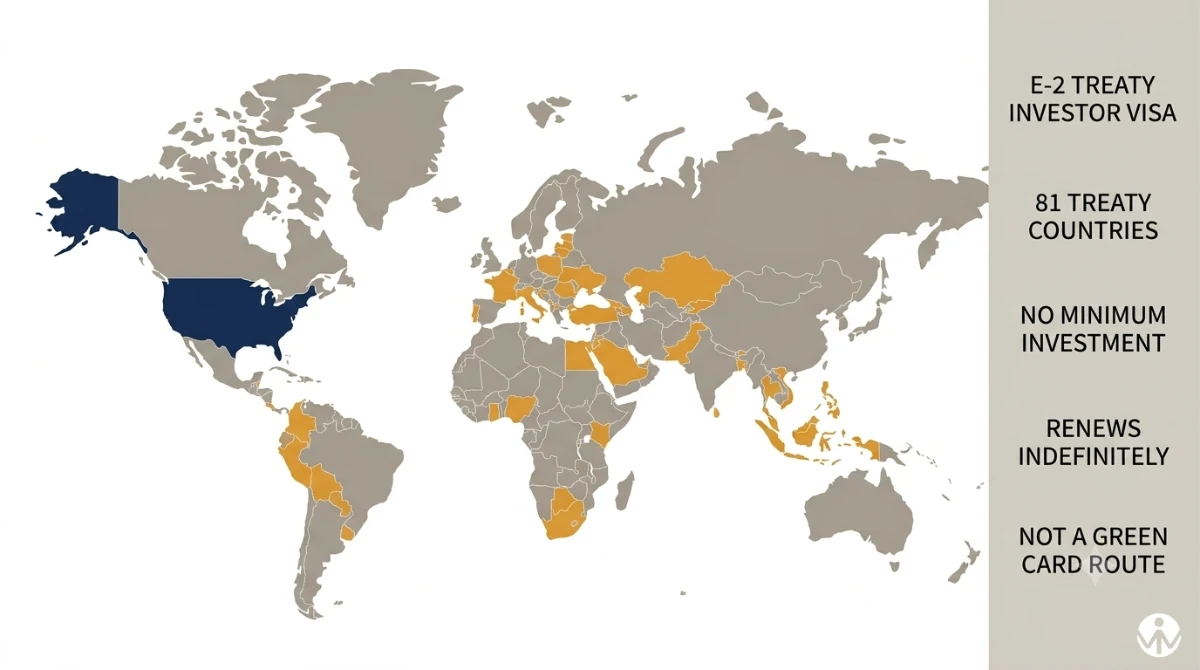
Key Takeaways
- The E-2 visa is open only to nationals of countries that hold a qualifying treaty with the United States. 81 countries and jurisdictions do; 79 of those are open to new investors.
- India, mainland China, Brazil, Russia, Saudi Arabia, Nigeria, Indonesia, Vietnam and South Africa are not on the list.
- There is no minimum investment in the law. USCIS applies a proportionality test, so the cheaper the business, the larger the share of its cost you must put in.
- An E-2 visa can be renewed indefinitely, but it never leads to a green card on its own. Time spent on one brings you no closer to permanent residence.
- Spouses are employment authorised incident to status. No separate work permit is required.
- Budget 315 USD for the visa application. Applying from inside the United States instead costs 1,015 USD plus an Asylum Program Fee.
Table of Contents
What the E-2 visa is
The E-2 classification allows a national of a treaty country to enter the United States by investing a substantial amount of capital in a U.S. business. A treaty country means one with which the United States maintains a treaty of commerce and navigation, or a qualifying international agreement, or which has been deemed a qualifying country by legislation. Certain employees of that investor, or of a qualifying organisation, can come on the same basis.
Two features define the category. It renews without limit: there is no cap on the number of two-year extensions an E-2 visa holder may be granted, so a business that keeps running can support a stay of decades. And itis tied to the enterprise. You are approved for one specific activity, and if that business closes, is sold or changes fundamentally, the status goes with it.
E-2 is the investor half of a pair. E-1 covers treaty traders, meaning people carrying on substantial trade principally between the United States and their own country. Some countries hold both treaties, some only one. Greece and Brunei have an E-1 treaty but no E-2, so their nationals cannot use this route. A separate E-2 CNMI category exists for long-term investors in the Northern Mariana Islands; it follows its own rules, and spouses there must apply for a work permit.
Who qualifies for an E-2 visa?
USCIS sets three requirements for the investor: be a national of a treaty country; have invested, or be actively in the process of investing, a substantial amount of capital in a bona fide US enterprise; and be seeking to enter solely to develop and direct it. The detail sits in 8 CFR 214.2(e).
Treaty nationality
Nationality is the gate, and it is absolute. What counts is your citizenship, not where you live, where you hold your money, or where the business trades. A permanent resident of a treaty country who holds some other citizenship does not qualify; a citizen of a treaty country who has never lived there does. Where a company is the investor, at least half of it must be owned by nationals of the treaty country who either hold E-2 status in the United States or would qualify for it if they applied.
A substantial investment
Capital must be at risk in the commercial sense, placed with the object of making a profit, and subject to partial or total loss if the business fails. Money sitting in an account is not an investment; money irrevocably committed to the enterprise is. You must also show the funds were not obtained, directly or indirectly, from criminal activity, which in practice means documenting where every part of the investment came from. Substantial is defined by proportion rather than by amount, which is important enough to have a section of its own below.
More than a marginal enterprise
A marginal enterprise does not qualify. USCIS defines one as a business with no present or future capacity to generate more than a minimal living for the investor and their family. A consultancy that will only ever pay the investor’s own salary is the classic refusal. A new business can still qualify while below that line, provided it can cross it within five years of the E-2 visa being granted, which is why a credible five-year projection does real work in an application.
Intent to develop and direct
You must be coming to run the business, shown either by owning at least 50% of it or by holding operational control through a managerial position or another corporate device. A passive stake, however large, will not support an E-2 visa. You must also intend to leave when your status ends, although unlike a visitor visa, an E-2 visa does not require you to keep a residence abroad to return to.
E-2 visa treaty countries in 2026
The State publishes the treaty list, and it is the first thing to check, because nothing else matters if your country isn’t on it. As at 18 September 2026, the treaty countries table names 81 countries and jurisdictions with an E-2 treaty. Two of those are closed in practice, so 79 are open to a new investor.
Table 1 — E-2 visa treaty countries in 2026
| Country or jurisdiction | Treaty classification | Treaty effective date | Notes |
|---|---|---|---|
| Albania | E-2 | 4 January 1998 | |
| Argentina | E-1 and E-2 | 20 December 1854 | |
| Armenia | E-2 | 29 March 1996 | |
| Australia | E-1 and E-2 | 16 December 1991 | Also holds the separate E-3 category |
| Austria | E-1 and E-2 | 27 May 1931 | |
| Azerbaijan | E-2 | 2 August 2001 | |
| Bahrain | E-2 | 30 May 2001 | |
| Bangladesh | E-2 | 25 July 1989 | |
| Belgium | E-1 and E-2 | 3 October 1963 | |
| Bolivia | E-1 and E-2 | 9 November 1862 / 6 June 2001 | E-2 closed: grandfathering ended 10 June 2022 |
| Bosnia and Herzegovina | E-1 and E-2 | 15 November 1982 | Successor to the Yugoslavia treaty |
| Brunei | E-1 only | 11 July 1853 | No E-2 treaty |
| Bulgaria | E-2 | 2 June 1954 | |
| Cameroon | E-2 | 6 April 1989 | |
| Canada | E-1 and E-2 | 1 January 1994 | |
| Chile | E-1 and E-2 | 1 January 2004 | |
| China (Taiwan) | E-1 and E-2 | 30 November 1948 | Taiwan only. Mainland China has no treaty |
| Colombia | E-1 and E-2 | 10 June 1948 | |
| Congo (Brazzaville) | E-2 | 13 August 1994 | |
| Congo (Kinshasa) | E-2 | 28 July 1989 | |
| Costa Rica | E-1 and E-2 | 26 May 1852 | |
| Croatia | E-1 and E-2 | 15 November 1982 | Successor to the Yugoslavia treaty |
| Czech Republic | E-2 | 1 January 1993 | |
| Denmark | E-1 and E-2 | 30 July 1961 / 10 December 2008 | |
| Ecuador | E-2 | 11 May 1997 | Closed to new investors; investments predating 18 May 2018 qualify to 18 May 2028 |
| Egypt | E-2 | 27 June 1992 | |
| Estonia | E-1 and E-2 | 22 May 1926 / 16 February 1997 | |
| Ethiopia | E-1 and E-2 | 8 October 1953 | |
| Finland | E-1 and E-2 | 10 August 1934 / 1 December 1992 | |
| France | E-1 and E-2 | 21 December 1960 | |
| Georgia | E-2 | 17 August 1997 | |
| Germany | E-1 and E-2 | 14 July 1956 | |
| Greece | E-1 only | 13 October 1954 | No E-2 treaty |
| Grenada | E-2 | 3 March 1989 | |
| Honduras | E-1 and E-2 | 19 July 1928 | |
| Ireland | E-1 and E-2 | 14 September 1950 / 18 November 1992 | |
| Israel | E-1 and E-2 | 3 April 1954 / 1 May 2019 | |
| Italy | E-1 and E-2 | 26 July 1949 | |
| Jamaica | E-2 | 7 March 1997 | |
| Japan | E-1 and E-2 | 30 October 1953 | |
| Jordan | E-1 and E-2 | 17 December 2001 | |
| Kazakhstan | E-2 | 12 January 1994 | |
| Korea (South) | E-1 and E-2 | 7 November 1957 | |
| Kosovo | E-1 and E-2 | 15 November 1882 | Successor to the Yugoslavia treaty |
| Kyrgyzstan | E-2 | 12 January 1994 | |
| Latvia | E-1 and E-2 | 25 July 1928 / 26 December 1996 | |
| Liberia | E-1 and E-2 | 21 November 1939 | |
| Lithuania | E-2 | 22 November 2001 | |
| Luxembourg | E-1 and E-2 | 28 March 1963 | |
| Macedonia | E-1 and E-2 | 15 November 1982 | Successor to the Yugoslavia treaty |
| Mexico | E-1 and E-2 | 1 January 1994 | |
| Moldova | E-2 | 25 November 1994 | |
| Mongolia | E-2 | 1 January 1997 | |
| Montenegro | E-1 and E-2 | 15 November 1882 | Successor to the Yugoslavia treaty |
| Morocco | E-2 | 29 May 1991 | |
| Netherlands | E-1 and E-2 | 5 December 1957 | |
| New Zealand | E-1 and E-2 | 10 June 2019 | |
| Norway | E-1 and E-2 | 18 January 1928 | |
| Oman | E-1 and E-2 | 11 June 1960 | |
| Pakistan | E-1 and E-2 | 12 February 1961 | |
| Panama | E-2 | 30 May 1991 | |
| Paraguay | E-1 and E-2 | 7 March 1860 | |
| Philippines | E-1 and E-2 | 6 September 1955 | |
| Poland | E-1 and E-2 | 6 August 1994 | |
| Portugal | E-1 and E-2 | 15 March 2024 | |
| Romania | E-2 | 15 January 1994 | |
| Senegal | E-2 | 25 October 1990 | |
| Serbia | E-1 and E-2 | 15 November 1882 | Successor to the Yugoslavia treaty |
| Singapore | E-1 and E-2 | 1 January 2004 | |
| Slovak Republic | E-2 | 1 January 1993 | |
| Slovenia | E-1 and E-2 | 15 November 1982 | Successor to the Yugoslavia treaty |
| Spain | E-1 and E-2 | 14 April 1903 | |
| Sri Lanka | E-2 | 1 May 1993 | |
| Suriname | E-1 and E-2 | 10 February 1963 | |
| Sweden | E-1 and E-2 | 20 February 1992 | |
| Switzerland | E-1 and E-2 | 8 November 1855 | |
| Thailand | E-1 and E-2 | 8 June 1968 | |
| Togo | E-1 and E-2 | 5 February 1967 | |
| Trinidad and Tobago | E-2 | 26 December 1996 | |
| Tunisia | E-2 | 7 February 1993 | |
| Turkey | E-1 and E-2 | 15 February 1933 / 18 May 1990 | |
| Ukraine | E-2 | 16 November 1996 | |
| United Kingdom | E-1 and E-2 | 3 July 1815 | |
| Compiled from the US Department of State’s treaty countries table, retrieved 18 September 2026. State does not publish a total, and the list changes when treaties are signed or terminated. A legacy ‘Yugoslavia’ entry also appears on State’s table; its obligations pass to the seven successor states listed above. Check the source before relying on an omission. | |||
Countries with no E-2 treaty
Several of the largest sources of migration to the United States hold no E-2 treaty at all. India, mainland China, Brazil, Russia, Saudi Arabia, Nigeria, Indonesia, Vietnam, South Africa and the United Arab Emirates are all absent from the list, and no amount of investment changes that. Note also that the entry reading China (Taiwan) means Taiwan; it does not extend to the People’s Republic. The misconception is widespread and expensive, because applicants from non-treaty countries routinely pay for company formation before discovering the treaty requirement. The last section of this guide sets out what is actually available instead.
Bolivia and Ecuador: closed to new investors
Two countries on State’s table are shut in practice. Bolivia’s E-2 arrangement ended, and the grandfathering that protected investments made before 10 June 2012 expired on 10 June 2022, so there is no live route. Ecuador’s treaty was terminated for new investors from 18 May 2018, and those holding a qualifying investment from before that date remain eligible only until 18 May 2028. A Bolivian or Ecuadorian national starting fresh in 2026 cannot use the E-2 visa.
How much you need to invest for an E-2 visa
There is no figure in the statute, the regulations or the USCIS guidance. What exists is a proportionality test. The investment must be substantial in relation to the total cost of buying an established business or setting up a new one, sufficient to show your financial commitment to making it work, and large enough to support the likelihood that you will succeed. USCIS states the consequence directly: the lower the cost of the enterprise, the higher, proportionately, the investment must be.
So 100,000 USD put into a business that costs 120,000 USD to establish stands on far stronger ground than the same sum put into a venture needing a million. The figures circulated online as E-2 visa minimums, usually 100,000 USD or 150,000 USD, have no legal basis at all. They are rules of thumb drawn from approved cases, and quoting one at a consular officer will not help. The practical floor is set by the other requirements instead: the investment has to be large enough that the business is not marginal and that you plausibly control and run it.
E-2 visa fees and costs in 2026
E-2 visa government fees depend on where you apply from. From outside the United States, it is a single visa fee. From inside, it is a petition, and it costs several times more.
Table 2 — E-2 visa fees and costs in 2026
| Cost | Amount (USD) | When it applies |
|---|---|---|
| Visa application (MRV) fee, E-1 and E-2 | 315 | Every applicant at a consulate. Paid before the interview and not refundable if refused. The highest of State’s four non-immigrant tiers. |
| Form I-129, change of status inside the US | 1,015 on paper, 965 online | 510 for a small employer or a nonprofit, whichever way it is filed. Not needed if you apply at a consulate. |
| Asylum Program Fee, filed with Form I-129 | 600 | 300 for a small employer, 0 for a nonprofit. Payable separately from the filing fee. |
| Form I-907, premium processing (optional) | 2,965 | Buys adjudicative action on the I-129 within 15 business days. Available only with an I-129, never with a consular application. |
| Form I-539, for dependants already in the US | 470 on paper, 420 online | One application covers a spouse and children filing together. |
| Visa issuance and reciprocity fee | Varies by nationality | Set country by country; many nationalities pay nothing. Check the reciprocity schedule for your country. |
| Visa Integrity Fee | 250, conditional | Legislated but not on State’s published fee schedule as at 18 September 2026. Confirm before budgeting for it. |
| Filing fees from USCIS Form G-1055, edition 09/09/26; visa fees from the Department of State’s fee schedule. Both checked 18 September 2026. Business costs such as legal fees, the investment itself and company formation are not included. The 9-11 Response and Biometric Entry-Exit Fee that took effect on 9 September 2026 applies to H-1B and L-1 petitions only, not to E-2. | ||
The 315 USD visa application fee (about that in euros) is the highest of the Department of State’s four non-immigrant tiers, above the 205 USD petition-based band that covers H, L and O visas. The consular route carries no petition fee at all, which is one reason most first-time applicants go through a consulate even when they could file from inside the country.
How to apply for an E-2 visa
There are two routes and they are not interchangeable.
Applying at a US consulate
- Complete Form DS-160 online and pay the 315 USD application fee.
- Assemble the evidence: proof of nationality, proof that the funds are yours and lawfully sourced, proof they are irrevocably committed, a business plan with five-year projections, and evidence of your ownership or operational control.
- Book an interview. E treaty traders and investors are not eligible for an interview waiver, so expect to attend in person, however many US visas you have held before.
- Attend the interview, and if approved, seek admission at a port of entry as an E-2 non-immigrant.
Changing status inside the United States
If you are already in the United States in a lawful non-immigrant status, Form I-129 can be filed to change your status to E-2 instead. You cannot use it from abroad. The trade-off is cost, 1,015 USD (about that in euros) plus the Asylum Program Fee against 315 USD, and the fact that a change of status gives you E-2 status but not an E-2 visa, so you will still need a visa from a consulate the first time you travel. Premium processing is available on the I-129 for 2,965 USD (in euros), which buys adjudicative action within 15 business days. It does nothing whatever for a consular application, a point a lot of guides get wrong.
How long an E-2 visa lasts
Three different periods get confused with one another here, and the distinction matters.
- Visa validity. How long the visa in your passport can be used for travel. This is set by the reciprocity schedule for your nationality and runs from a few months to five years, so check your country’s schedule rather than assuming.
- Period of admission. How long you may stay after each entry. This is two years, whatever the visa says.
- Readmission. An E-2 visa holder who travels abroad is generally granted a fresh two-year period upon return, at the discretion of the border officer.
Extensions from inside the country are granted in increments of up to two years, and there is no limit to how many you may be granted, so an E-2 visa can support an indefinite stay. However, it cannot lead to permanent residency.
E-2 visa rules for spouses and children
A spouse and unmarried children under 21 may accompany or follow the investor, and their nationality does not have to match the investor’s, which the category is unusually relaxed about. They are granted the same period of stay. If they are already in the United States, one Form I-539 at 470 USD (in euros) covers the family filing together.
The important change came in 2021. Spouses in valid E-2 or E-2S status are employment authorised incident to status, so no work permit is needed before starting a job. An unexpired Form I-94 showing E-2S is acceptable evidence for Form I-9. A spouse may still choose to file for an Employment Authorization Document, which some employers find easier to process, but it is optional rather than required. Children may study but not work.
One trap is worth knowing. The automatic two-year readmission attaches to the investor. Family members get the benefit only if they are travelling with the investor at the time, or travel and return within the new period themselves. Otherwise, they keep their original expiry date and have to apply to extend separately.
E-2 visa employees
The category is not only for the investor. An employee of a treaty investor can also hold an E-2 visa on three conditions: they must share the nationality of the principal employer, meet the legal definition of an employee, and either carry out executive or supervisory duties or, in a lesser role, have special qualifications.
Special qualifications means skills that make the person essential to the efficient operation of the business. USCIS weighs proven expertise, whether others hold the same skills, what those skills command in salary, and whether they are readily available in the United States. Knowledge of a foreign language and culture is not enough on its own. A skill that is essential today can also become commonplace and stop qualifying later.
One 2026 addition is easy to miss. Following Executive Order 14286, an E-2 application for a job involving the operation of a commercial motor vehicle must be supported by evidence of English language proficiency, and the Department of State has increased screening for those applicants. USCIS will generally accept visas issued after 15 June 2026 for such positions as proof.
E-2 visa vs EB-5: the green card question
This is the decision most investors are actually making, and the familiar framing, that an E-2 visa is the faster and cheaper version of an EB-5, understates the difference. The two do different jobs.
Table 3 — E-2 visa vs EB-5
| E-2 treaty investor visa | EB-5 immigrant investor programme | |
|---|---|---|
| What you get | Non-immigrant status, renewable without limit | Permanent residence: conditional for two years, then unconditional |
| Who can apply | Nationals of treaty countries only | Any nationality |
| Minimum investment | None set in law. Must be substantial relative to the cost of the business | 1,050,000 USD, or 800,000 USD in a targeted employment area or infrastructure project |
| Job creation | No job count. The business must not be marginal | At least ten full-time jobs for qualifying US workers |
| Your role | At least 50% ownership, or operational control through a managerial position | No management role required; a passive stake qualifies |
| Leads to a green card | No, not by itself | Yes, that is the route |
| Initial period | Two years, extendable in two-year increments, no limit | Two-year conditional green card |
| Spouse can work | Yes, authorised incident to status, no separate permit needed | Yes, as a permanent resident |
| How you file | DS-160 at a consulate, or Form I-129 from inside the US | Form I-526E, then Form I-485 or consular processing |
| E-2 requirements from USCIS and 8 CFR 214.2(e); EB-5 amounts as set by the EB-5 Reform and Integrity Act of 2022. Checked 18 September 2026. | ||
An E-2 visa does not bar you from permanent residence; it simply does not deliver it. Plenty of holders later qualify under a different category, whether EB-5, the EB-1C route for multinational managers, or an employment-based green card through an employer. What does not happen is an E-2 visa maturing into a US green card through the passage of time, and the claim that it can is the most common error in circulation about this category.
Why E-2 visa applications get refused
- Marginality. The business will not support more than a minimal living, and the five-year projection does not credibly show otherwise.
- Funds not at risk. The money is still in a bank account, or in escrow with a route back, rather than irrevocably committed.
- Source of funds undocumented. Gifts, loans secured on foreign property and business proceeds all need a clean paper trail.
- A passive investment. Property bought to appreciate, or a stake with no operating role, fails the develop-and-direct test.
- An investment too small in proportion to the cost of the business, whatever its absolute size.
- Nationality. The applicant’s country holds no treaty, or holds an E-1 treaty only.
If your country has no E-2 treaty
For nationals of the larger non-treaty countries, three routes do real work in place of an E-2 visa.
- The L-1 visa, for someone transferring into a US office of a company they already work for abroad. It does not depend on nationality, and the L-1A manager route pairs with the EB-1C green card.
- The EB-5 programme, expensive at 800,000 to 1,050,000 USD, but open to every nationality, and it delivers permanent residence rather than a renewable stay.
- A second citizenship in a treaty country. Grenada’s citizenship by investment programme is the best-known version, because Grenada has held an E-2 treaty since 1989. It is a legitimate route, but it is two processes with two sets of costs and requirements, and it grants no fast track to US citizenship.
If what you want is to work in the United States rather than run a business, our guide to H-1B visa alternatives covers the employment-based options, and the B-1 visa is what you travel on to scout an opportunity before committing to any of them.
Frequently asked questions
Is there a minimum investment for an E-2 visa?
No. Neither the statute nor the regulations set a figure. USCIS applies a proportionality test against the total cost of the business, so the smaller the venture, the larger the share of its cost your investment has to represent.
Can an E-2 visa lead to a green card?
Not by itself, and no length of time on one improves your position. E-2 holders who obtain permanent residence do so by qualifying separately under another category, most often EB-5 or EB-1C.
Does India have an E-2 treaty with the United States?
No. India does not appear on the Department of State’s treaty list, so Indian citizens cannot apply in this category. The L-1 visa and the EB-5 programme are the routes that are actually available.
How long does an E-2 visa take?
A consular application depends on interview availability at the post, which varies widely from country to country. A change of status on Form I-129 runs to USCIS processing times, or 15 business days if premium processing is paid for. Premium processing is not available for consular cases.
Can my spouse work on an E-2 visa?
Yes. A spouse in valid E-2 or E-2S status is employment authorised incident to status and can start work without applying for a permit first. Children under 21 may study but not work.
Can I buy property as my E-2 investment?
Not as a passive holding. Real estate bought in the expectation that it will rise in value is not an active enterprise and fails the develop-and-direct requirement. A property business you actively operate is a different matter.
What happens if the business fails?
The status depends on the enterprise, so if the business ceases to operate the basis for E-2 status goes with it, and you are expected to depart or change to another status. A substantive change such as a merger, an acquisition or the sale of the division you work in requires a new Form I-129 for the status to continue.