
A US green card is the document that makes someone a lawful permanent resident of the United States — free to live and work anywhere in the country, indefinitely, with no employer sponsorship to maintain and no expiry date on the status itself. It is what most temporary visa holders ultimately aim for, and the last step before citizenship.
There is no single application for one. A US green card is reached through one of five broad routes — family, employment, the diversity lottery, investment, or humanitarian protection — and each route has its own petition form, its own annual allocation of visa numbers, and its own queue. Which route you qualify for determines nearly everything else: what you file, what it costs, and whether you wait eighteen months or two decades.
This guide covers all five as they stand in October 2026, with the numerical limits for the new fiscal year, the wait times from the latest Visa Bulletin, what the process costs, and the policy changes that landed this year.
Key takeaways — the US green card in brief
- A US green card grants lawful permanent residence — the right to live and work anywhere in the United States indefinitely, with no employer sponsorship to maintain and no expiry on the status itself.
- There are five routes to it: family sponsorship, employment, the diversity visa lottery, investment through EB-5, and humanitarian protection. Each has its own petition, its own annual allocation and its own queue.
- For fiscal year 2027, which began on 1 October 2026, the United States has 226,000 family-preference numbers, at least 140,000 employment-based numbers and up to 55,000 diversity visas, with a 7% per-country ceiling of 25,620.
- That per-country ceiling, not processing speed, is what creates multi-decade waits. In the October 2026 Visa Bulletin, EB-2 India reopened with a final action date of 1 November 2013, while EB-2 for most other countries retrogressed from current to 1 January 2025.
- EB-5 minimums are $800,000 in a targeted employment area and $1,050,000 elsewhere. Both adjust for inflation on 1 January 2027 — the widely quoted $500,000 figure has been obsolete since 2022.
- Diversity visa entry now carries a $1 registration fee. As of early October 2026, DV-2027 registration had never opened and no DV-2027 selectees had been announced, even though the DV-2027 visa year began on 1 October 2026.
- A US green card is not a travel document for other countries and confers no visa-free travel of its own.
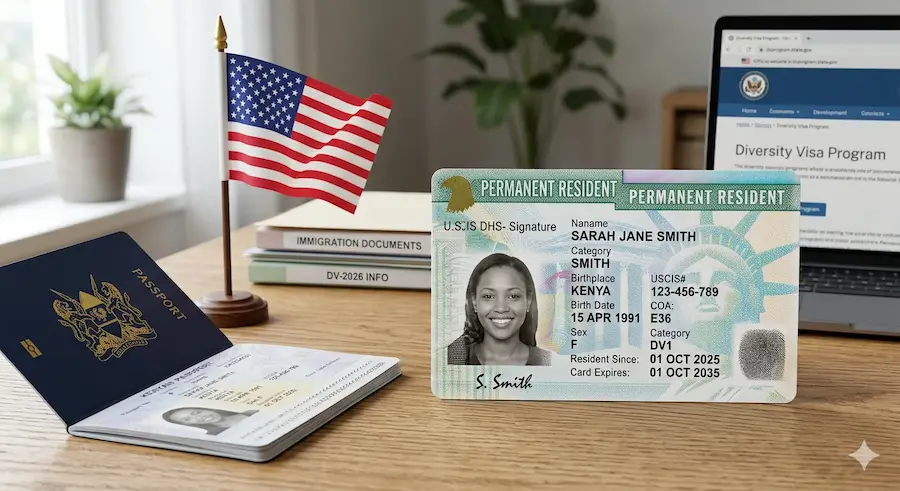
Table of Contents
What a US green card is — and what it is not
The card is a physical document, valid for ten years and renewable, or two years in the conditional cases described further down. The status behind it does not expire when the card does. Lawful permanent residence continues until it is abandoned, rescinded or revoked.
A US green card is an immigrant status, and that is the essential distinction from a visa. A nonimmigrant visa — H-1B, F-1, B-2 — admits you for a stated purpose and a stated period, and then it ends. Permanent residence carries no purpose test and no end date. Our guide to US green card eligibility walks through the qualifying tests category by category.
What the status gives you: the right to live and work anywhere in the United States in almost any job, without separate work authorisation; the right to leave and re-enter; the ability to petition for certain family members; in-state tuition rates in many states; and eligibility to naturalise after five years of permanent residence, or three if you are married to and living with a US citizen. The full set of US green card benefits goes further into each.
What it does not give you: the right to vote in federal elections, eligibility for most federal government jobs, or immunity from removal. A permanent resident convicted of certain offences can still be deported.
One misconception is worth correcting head-on, because it circulates widely. A US green card is not a travel document for third countries and confers no visa-free travel of its own. A number of countries do have entry rules that reference US permanent residence — usually waiving their own visa requirement, or easing transit — but those are individual national policies that change without notice, not a benefit attached to the card. Check the destination’s rules for your nationality every time.
The five US green card routes at a glance
Before going route by route, the shape of the whole system in one view.
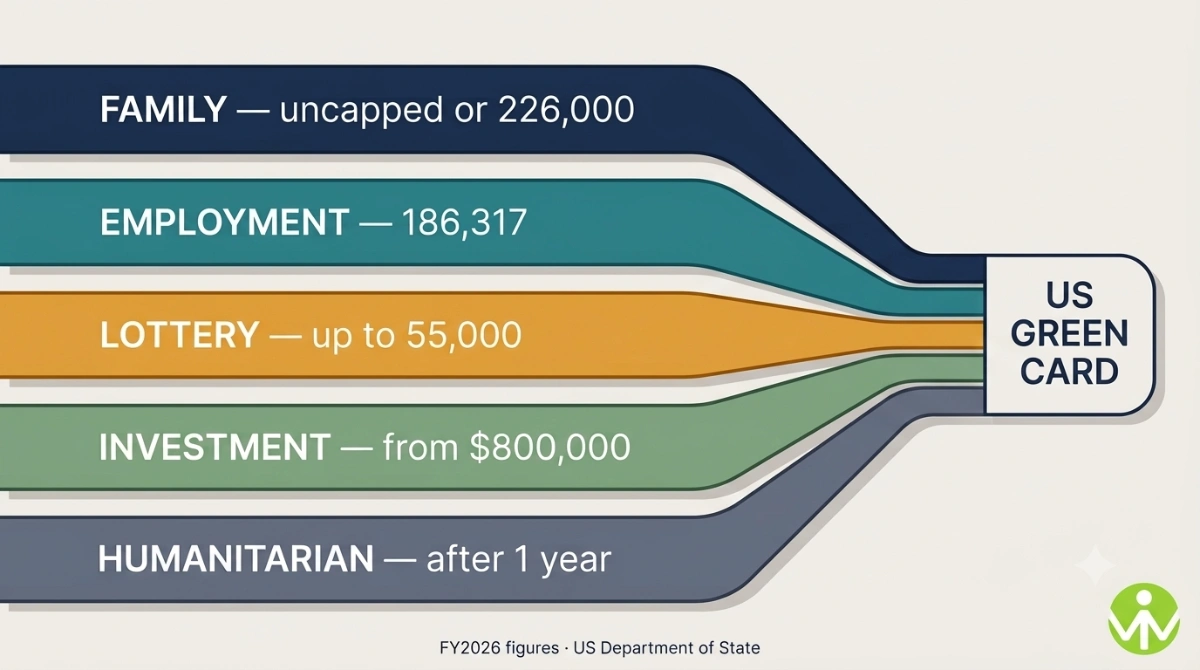
Table 1: The five US green card routes compared
| Route | Who it is for | Petition filed | FY2027 supply | Typical wait |
|---|---|---|---|---|
| Family — immediate relative | Spouses, unmarried children under 21 and parents of US citizens | Form I-130 by the citizen | Uncapped | Roughly 1–2 years, processing-driven |
| Family — preference | Other relatives of citizens; spouses and children of permanent residents | Form I-130 by the sponsor | 226,000 | 1 year to 25+ years by category and country |
| Employment | Workers sponsored by a US employer, plus self-petitioners of extraordinary ability or national interest | Form I-140 | At least 140,000 | Current to 13+ years by category and country |
| Diversity visa lottery | Nationals of countries with low recent immigration to the US | Online entry, then Form DS-260 | Up to 55,000 | One fixed annual cycle |
| Humanitarian | Refugees, asylees, and certain trafficking, crime and abuse victims | Form I-485 after one year, or Form I-360 | Category-specific | Varies widely |
| Annual figures are the fiscal year 2027 limits published in the US Department of State Visa Bulletin for October 2026. Wait times are indicative and depend on country of chargeability. As of October 2026. | ||||
Family-based US green cards
Family sponsorship is the largest single source of US green cards, and it splits into two halves that behave completely differently.
Immediate relatives — uncapped, but not instant
Spouses of US citizens, unmarried children under 21, and parents of citizens aged 21 or over are classed as immediate relatives. There is no annual cap on this group, so there is no visa number queue at all. The wait is purely administrative — adjudication of the Form I-130, then either adjustment of status or consular processing — which in practice commonly runs one to two years end to end.
Fiancé(e)s of US citizens are a special case: they enter on a K-1 visa and adjust status after marrying within 90 days.
Family preference categories — capped and queued
Everyone else in the family route falls into one of four preference categories sharing 226,000 numbers a year, subject to the 7% per-country ceiling. That ceiling is why the wait varies so sharply by country of birth. In the October 2026 bulletin, F4 — siblings of adult US citizens — has a final action date of 22 October 2011 worldwide, but 22 April 2001 for Mexico. Same category, same rules, more than a decade apart.
F2A, covering spouses and minor children of permanent residents, is the fastest preference category and sits close to current for most of the world. Our detailed family-based green card guide covers the documentary requirements in full.
One rule catches families out repeatedly: a child who turns 21 while the petition is pending can “age out” of a category. The Child Status Protection Act freezes age in some circumstances, and a 2025 policy change tightened how it is applied.
Employment-based US green cards
The employment route runs on five preference categories, EB-1 through EB-5. The statutory baseline is 140,000 numbers a year across all of them, and it is a floor: unused family-preference numbers from the previous year fall across into the employment total, which lifted fiscal year 2026 to 186,317. The October 2026 Visa Bulletin gives the fiscal year 2027 level only as “at least 140,000”, and calculates its per-country limit on that baseline, so treat any higher FY2027 figure as provisional until the State Department publishes it.
The five employment preference categories
- EB-1 — extraordinary ability, outstanding professors and researchers, and multinational managers and executives. No labour certification required.
- EB-2 — advanced degrees or exceptional ability. Labour certification required, unless the applicant obtains a national interest waiver and self-petitions.
- EB-3 — skilled workers, professionals and other workers. Labour certification required.
- EB-4 — certain special immigrants, including some religious workers and special immigrant juveniles.
- EB-5 — immigrant investors, covered in its own section below.
The five employment-based preference categories are set out in more detail separately. Holders of other work visas often move across: an O-1 visa can be converted to EB-1A, and the H-1B visa is the most common starting point.
Read: EB-1A and EB-2 NIW compared
Where the employment backlog actually bites
The per-country cap does most of the damage. In fiscal year 2026, India reached its per-country limit in EB-2 on 22 May and in the EB-5 unreserved category on 10 June, and both categories stayed unavailable for India until the year ended. They reopened on 1 October 2026, when fiscal year 2027 began: the October 2026 bulletin gives India a final action date of 1 November 2013 in EB-2 and 1 December 2023 in EB-5 unreserved. EB-3 India stands at 1 January 2014.
Applicants chargeable to most other countries face far shorter queues, though not none: EB-1 and EB-5 unreserved are current for them, while EB-2 retrogressed in October 2026 from current to 1 January 2025 and EB-3 moved back to 15 May 2024. Legislative attempts to remove the country cap, most prominently the S.386 bill, have repeatedly stalled. For anyone already in that queue, the question is procedural rather than legislative — what moving from H-1B to a green card actually involves, stage by stage.
The green card lottery: the diversity visa route
The Diversity Visa programme makes up to 55,000 US green cards available each year to nationals of countries with historically low rates of immigration to the United States. Entry is online, once a year, and selection among qualifying entries is random. It is the only US green card route open to applicants with no relative, no employer and no capital.
Two eligibility conditions apply. You must be a native of an eligible country — or claim eligibility through a spouse or a parent — and you must have either a high school education or its equivalent, or two years of qualifying work experience in the past five years. Our list of green card lottery eligible countries sets out who is excluded, and the green card lottery guide covers the entry mechanics.
Two things have changed, and older guides do not reflect them. Entry is no longer free: a $1 registration fee now applies per entrant and cannot be waived. And the DV-2027 entry period never opened. In November 2025 the State Department announced changes to the entry process and said registration dates would be announced “as soon as practicable”. As of early October 2026 no entry period had been published and no DV-2027 selectees had been announced, even though the DV-2027 visa year began on 1 October 2026. Check travel.state.gov directly before relying on any date for DV-2027 or DV-2028.
Selection is checked only through the official Entrant Status Check on the State Department’s E-DV site. The department does not notify selectees by email, post or telephone — anything that does is a scam.
Investing your way to a US green card: EB-5
EB-5 grants permanent residence to investors who invest capital in a US commercial enterprise and create at least 10 full-time jobs for US workers.
The current minimums are $800,000 for a project in a targeted employment area — rural, or high unemployment — and $1,050,000 elsewhere. Those replaced the old $500,000 and $1,000,000 thresholds under the EB-5 Reform and Integrity Act of 2022. Any guide still quoting $500,000 is describing a rule that ended more than four years ago.
The amounts are due to change again. The statute requires both to adjust on 1 January 2027 for cumulative CPI-U inflation measured from 1 January 2022, rounded down to the nearest $50,000. Industry projections put the new thresholds at roughly $900,000 for a targeted employment area and around $1.2 million elsewhere, though the exact figures depend on inflation data not yet published.
The 2022 Act also reserved a share of annual EB-5 numbers: 20% for rural projects, 10% for high-unemployment areas and 2% for infrastructure. Those set-asides are current for every country in the October 2026 bulletin, including India and China, while the unreserved category has a final action date of 1 December 2016 for China and 1 December 2023 for India — which is the main reason set-aside projects now dominate the market. The EB-5 investor programme guide covers project selection and the filing sequence.
Refugee, asylee and humanitarian routes
Refugees admitted to the United States, and people granted asylum, may apply for a US green card after one year in that status using Form I-485. There is no visa number queue for these applications, although adjudication itself can take a long time.
These are the only US green card routes that do not depend on a sponsor, an employer or a lottery draw. Separate humanitarian routes exist for victims of trafficking holding T status, victims of certain crimes holding U status, abused spouses and children self-petitioning under the Violence Against Women Act, and special immigrant juveniles. Each has its own petition form and its own eligibility test, and none of them requires a sponsor.
How many US green cards are available each year
Table 2: Fiscal year 2027 US green card numerical limits
| Category | FY2027 limit | Notes |
|---|---|---|
| Immediate relatives of US citizens | No limit | Spouses, unmarried children under 21, parents of adult citizens |
| Family-sponsored preference | 226,000 | F1, F2A, F2B, F3 and F4 combined |
| Employment-based preference | At least 140,000 | EB-1 to EB-5; statutory floor. FY2026 was 186,317 after fall-across from unused family numbers |
| Diversity visa | Up to 55,000 | Allocated by region, subject to a per-country limit |
| Per-country ceiling | 25,620 | 7% of the combined family and employment total |
| Dependent area ceiling | 7,320 | 2% of the same combined total |
| Source: US Department of State, Visa Bulletin for October 2026. Fiscal year 2027 runs 1 October 2026 to 30 September 2027. | ||
The per-country ceiling is the single most consequential rule in the whole system, and it is widely misunderstood. It is not a guaranteed share for each country — it is a ceiling, applied identically to every country regardless of population or demand. A country of 1.4 billion people and a country of 300,000 are both held to the same 25,620 numbers. That arithmetic, not slow processing, is what produces multi-decade backlogs for a handful of nationalities and none at all for the rest of the world.
How long the US green card wait actually is
The Visa Bulletin publishes a final action date for each capped category each month. If your priority date — the date your petition was filed — is earlier than the date shown for your category and country, a visa number is available to you now.
Table 3: Final action dates, October 2026 Visa Bulletin
| Category | All other areas | China (mainland) | India | Mexico | Philippines |
|---|---|---|---|---|---|
| F1 — unmarried adult children of citizens | 22 Jan 2020 | 22 Jan 2020 | 22 Jan 2020 | 8 Sep 2008 | 1 Nov 2013 |
| F2A — spouses and minor children of residents | 22 Sep 2026 | 22 Sep 2026 | 22 Sep 2026 | 22 Mar 2026 | 22 Sep 2026 |
| F2B — unmarried adult children of residents | 22 Aug 2019 | 22 Aug 2019 | 22 Aug 2019 | 15 May 2010 | 1 Oct 2013 |
| F3 — married children of citizens | 22 Oct 2014 | 22 Oct 2014 | 22 Oct 2014 | 1 Jul 2001 | 22 Jul 2006 |
| F4 — siblings of adult citizens | 22 Oct 2011 | 22 Oct 2011 | 15 Dec 2006 | 22 Apr 2001 | 15 May 2008 |
| EB-1 | Current | 1 Jul 2023 | 1 Feb 2023 | Current | Current |
| EB-2 | 1 Jan 2025 | 1 Oct 2021 | 1 Nov 2013 | 1 Jan 2025 | 1 Jan 2025 |
| EB-3 — skilled and professional | 15 May 2024 | 8 Jan 2022 | 1 Jan 2014 | 15 May 2024 | 15 Aug 2023 |
| EB-3 — other workers | 1 Jan 2022 | 1 Oct 2019 | 1 Jan 2014 | 1 Jan 2022 | 1 Jan 2022 |
| EB-4 | 15 Dec 2022 | 15 Dec 2022 | 15 Dec 2022 | 15 Dec 2022 | 15 Dec 2022 |
| EB-5 — unreserved | Current | 1 Dec 2016 | 1 Dec 2023 | Current | Current |
| EB-5 — set-asides | Current | Current | Current | Current | Current |
| Source: US Department of State, Visa Bulletin for October 2026. “Current” means numbers are available to all applicants in the category. Dates are published monthly and can retrogress. | |||||
Read the US green card wait times by finding your category and your country of chargeability, which is normally your country of birth rather than your citizenship. A spouse can sometimes claim the other spouse’s country of chargeability, which occasionally moves a case out of a backlogged column entirely.
How to apply for a US green card, step by step
Almost every US green card follows the same three-stage shape, whichever route it travels.
- 1. The petition. Someone establishes that you fit a category. A relative files Form I-130; an employer files Form I-140, usually after a labour certification from the Department of Labor; an investor files Form I-526E. Self-petitioners in EB-1A, EB-2 national interest waiver and VAWA cases file for themselves. Diversity visa selectees skip this stage entirely — selection is the qualifying event.
- 2. The wait for a number. Unless you are an immediate relative, or your category is current, you wait until your priority date is reached in the Visa Bulletin.
- 3. The application for status. Either adjustment of status inside the United States, or consular processing abroad.
Adjustment of status or consular processing
If you are lawfully present in the United States when a number becomes available, you can file Form I-485 with USCIS and never leave the country. Adjustment of status also lets you apply for interim work authorisation and travel permission while the application is pending.
If you are outside the United States, the case moves to the National Visa Center and then to a US embassy or consulate, where you complete Form DS-260, submit civil and financial documents including the Affidavit of Support, attend a medical examination and sit an interview. On approval you receive an immigrant visa, and you become a permanent resident at the moment you are admitted to the United States. The physical card follows by post.
Since July 2026, the State Department has directed that immigrant visa applicants be interviewed in their country of residence, ending the previous practice of booking at whichever post had the shortest queue.
What a US green card costs
Table 4: Government fees on the US green card process
| Fee | Amount (USD) | Paid to | When |
|---|---|---|---|
| Form I-130, family petition | $675 paper / $625 online | USCIS | With the petition |
| Form I-140, employment petition | $715 paper / $665 online | USCIS | With the petition |
| Form I-485, adjustment of status | $1,440 | USCIS | With the application, filed inside the US |
| Immigrant visa processing — family | $325 | Department of State | Consular processing, per applicant |
| Immigrant visa processing — employment | $345 | Department of State | Consular processing, per applicant |
| Immigrant visa processing — diversity visa | $330 | Department of State | Per diversity visa selectee applicant |
| Diversity visa registration | $1 | Department of State | Per entrant, at the point of entry |
| Affidavit of Support review | $120 | Department of State | Where the affidavit is reviewed domestically |
| State Department fees verified against travel.state.gov, August 2026. USCIS fees should be confirmed against the USCIS fee calculator before filing. Excludes medical examination, translation, legal and travel costs. | |||
These are government fees only, and for most applicants they are not the largest line. The medical examination, civil-document procurement and translation, and legal representation usually cost more than the filing fees do — though in employment cases the employer normally carries both the legal cost and the $715 petition fee. An adjustment of status applicant filing inside the United States pays $1,440 on Form I-485 alone.
What changed for US green card applicants in 2026
Several changes this year affect applicants directly, and none of them appear in guidance written before 2026.
- Public charge bonds. From August 2026, the State Department is running a pilot under which consular officers may require certain immigrant visa applicants to post a public charge bond with USCIS as a way of overcoming a public charge refusal. The amount is set on a case-by-case basis based on the totality of the circumstances.
- Public benefits screening. A February 2026 policy directs additional scrutiny of applicants assessed as being at higher risk of relying on public benefits, with processing changes for some nationalities.
- Expanded vetting. Since March 2026, visa applicants have been subject to expanded screening and social-media vetting.
- Country-of-residence interviews. From July 2026, immigrant visa applicants are generally adjudicated at the post covering their country of residence.
- Visa bonds and suspensions. A May 2026 measure subjects nationals of certain countries to visa bonds, and Proclamation 10998, in force since 1 January 2026, suspends or restricts visa issuance, including immigrant visas, for nationals of 39 countries. Both lists change; our guide to the US travel ban has the current country list, so check the position before filing.
None of these close a route to a US green card outright, but together they lengthen consular timelines and raise the documentary burden, particularly on the family and diversity visa routes where applicants are more often processing abroad.
After approval: conditions, renewal and citizenship
Some US green cards arrive conditional. If you obtained permanent residence through a marriage that was less than two years old when it was approved, or through EB-5, the initial card is valid for two years. You must file to remove the conditions in the 90 days before it expires — Form I-751 for marriage cases, Form I-829 for EB-5 — or the status terminates.
Otherwise the US green card is valid for ten years and is renewed with Form I-90. Renewal replaces the card; it does not renew the status, which continues regardless.
Permanent residence can be lost by abandonment. Absences of more than six months invite questions at the border about whether you have maintained residence, and absences of more than a year create a presumption of abandonment unless you obtained a re-entry permit before leaving.
After five years as a permanent resident — three if you are married to and living with a US citizen — you may apply to naturalise, subject to physical presence, continuous residence, English, civics and good moral character requirements. Children born in the United States are citizens by birth, a rule that has itself been the subject of litigation in 2026.
Frequently asked questions about the US green card
How long does it take to get a US green card?
It depends entirely on the route and the country of chargeability. An immediate relative of a US citizen commonly completes the process in one to two years. A diversity visa selectee completes it within a single fixed annual cycle. An Indian national in EB-2 or EB-3, by contrast, faces a queue that already runs to more than a decade — the October 2026 final action dates for India are 1 November 2013 in EB-2 and 1 January 2014 in EB-3.
Can I get a US green card without a job offer or a family sponsor?
Yes, through four routes. EB-1A extraordinary ability and EB-2 national interest waiver both allow self-petitioning without an employer. EB-5 requires investment rather than sponsorship. And the diversity visa lottery requires neither — only nationality of an eligible country and the education or work experience threshold.
Does a US green card let me travel visa-free to other countries?
No. A US green card is not a passport substitute and confers no visa-free travel of its own. Some countries do waive their visa requirement or ease transit rules for US permanent residents, but those are national policies that vary by your nationality and change without notice. Always check the destination country’s current rules.
What is the difference between a US green card and a US visa?
A visa is permission to seek admission for a stated purpose and period — study, work, tourism — and it expires. A US green card is permanent resident status, with no purpose test and no end date. The card itself expires and is renewed, but the status behind it does not.
Can a US green card be taken away?
Yes. Permanent residence can be abandoned through prolonged absence from the United States, rescinded if it was obtained improperly, or revoked following certain criminal convictions. Conditional residents who fail to file to remove conditions on time also lose the status automatically.
Is the green card lottery still running, and is it still free?
The Diversity Visa programme remains in law, with up to 55,000 visas a year, but it is not currently taking entries. DV-2027 registration never opened: the State Department announced changes to the entry process in November 2025 and, as of early October 2026, had published no entry period and announced no DV-2027 selectees. Entry is also no longer free: a $1 registration fee applies per entrant and cannot be waived. Check travel.state.gov directly before relying on any date for DV-2027 or DV-2028.
When does the EB-5 investment amount go up, and by how much?
On 1 January 2027. The statute requires both minimums to adjust for cumulative CPI-U inflation measured from 1 January 2022, rounded down to the nearest $50,000. Projections put the new figures at roughly $900,000 for a targeted employment area and around $1.2 million elsewhere, but the official amounts have not been published. Our EB-5 investor programme guide will carry the new figures once they are.
Do I have to be in the United States to apply for a US green card?
No. If you are lawfully present in the United States you can adjust status without leaving, using Form I-485. If you are abroad, you go through consular processing at a US embassy or consulate using Form DS-260. Since July 2026 that interview is generally held at the post covering your country of residence.