
An Italy work visa is a long-stay national (Type D) visa that lets a non-EU citizen enter Italy to take up a job or start self-employed work. It is an entry visa only. Within 8 working days of arrival you must take the next step towards a residence permit (permesso di soggiorno), the document that actually lets you live and work in Italy.
For most salaried jobs, the process starts with your employer, not with you. The employer applies for a work authorisation called the nulla osta, and in most categories that application is only possible within the yearly quota set by the Decreto Flussi, Italy’s flows decree. The current decree covers three years at once: 164,850 places in 2026, 165,850 in 2027 and 166,850 in 2028. The EU Blue Card for highly qualified workers is the main route outside the quota.
This guide explains each type of Italy work visa, what happened in the 2026 click days, the current EU Blue Card salary threshold, and the steps and fees. For the full range of Italian visas, see our guide to the types of Italy visa.
Key Takeaways
- An Italy work visa is an entry visa only: the residence permit process must start within 8 working days of arrival.
- For salaried and seasonal jobs, the employer first obtains a nulla osta, usually within the Decreto Flussi quota of 164,850 places in 2026.
- Demand far exceeds supply: about 194,000 pre-filled applications competed for the 164,850 places in the 2026 click days.
- The EU Blue Card sits outside the quota and requires a gross salary of at least €36,278 a year.
- The national visa fee is €116; residence permit charges are paid separately once you are in Italy.
Table of Contents

Types of Italy work visa
Italy issues several types of work visa. Which Italy work visa fits you depends on whether you will be employed, self-employed or highly qualified, and on how long the work lasts.
Salaried employment visa (lavoro subordinato)
This is the standard Italy work visa for employees on a fixed-term or permanent contract. Your employer applies for the nulla osta at the Sportello Unico per l’Immigrazione, the one-stop immigration desk at the local prefecture. Before applying, the employer must check with the local job centre that no suitable worker already in Italy is available. The residence permit you receive later follows the contract: the first permit can last up to two years and can be renewed as long as the job continues.
Read: Types of Italy Visa: The Complete 2026 Guide
Self-employment visa (lavoro autonomo)
Freelancers, professionals and people setting up a business apply for the self-employment visa. It has its own small quota of 650 places a year for 2026 to 2028. Applicants must show the resources, qualifications, and any licences the activity requires, plus clearance from the local police headquarters (Questura). Founders of innovative startups use a dedicated track, explained in our Italy startup visa guide.
Seasonal work visa (lavoro stagionale)
The seasonal Italy work visa covers jobs in agriculture and tourism. A seasonal permit can last up to nine months in any twelve-month period. Workers who have already done seasonal work in Italy can be hired on a multi-year nulla osta covering up to three years, so the employer does not have to apply each season again.
EU Blue Card for highly qualified workers
The EU Blue Card is the Italy work visa route for highly qualified employees. It is not subject to the Decreto Flussi quota, so the employer can apply at any time of year rather than waiting for a click day. You need a higher-education qualification, or in some cases equivalent professional experience, and a binding job offer of at least six months.
EU Blue Card salary threshold in 2026
The salary must be at least equal to ISTAT’s figure for gross pay per employee, which Italian law uses as the threshold and which is updated periodically. The latest figure is €36,278.51 a year (convert €36,278.51), up from €33,500 in 2024 and €35,500 in mid-2025. The card is issued for two years, or for the length of the contract plus three months if the contract is shorter. Blue Card holders can bring their family on easier terms than most permit holders, and time spent as a Blue Card holder elsewhere in the EU can count towards Italy permanent residency. Our EU Blue Card guide compares how the card works across the EU, and the European Commission’s EU Blue Card Italy page sets out the national rules.
Other routes outside the quota
Some categories are issued outside the quota under Article 27 of Italy’s Immigration Act, including senior executives, university teachers and researchers, intra-company transferees and certain specialised workers. There is also a separate channel of 10,000 out-of-quota places a year for carers of elderly people and babysitters for children up to age six, recruited through authorised agencies and employer associations.
Italy work visa quotas under the Decreto Flussi
Most applications for an Italy work visa depend on the Decreto Flussi. The 2026 to 2028 decree sets the number of work permits for each year and shares them out by sector and, in part, by nationality, with reserved shares for countries that cooperate with Italy on migration.
Table 1: Decreto Flussi work permit quotas, 2026 to 2028
| Year | Seasonal work | Non-seasonal and self-employed work | Total |
|---|---|---|---|
| 2026 | 88,000 | 76,850 | 164,850 |
| 2027 | 89,000 | 76,850 | 165,850 |
| 2028 | 90,000 | 76,850 | 166,850 |
| 2026 to 2028 | 267,000 | 230,550 | 497,550 |
| Source: Decreto Flussi 2026 to 2028 (Prime Ministerial Decree of 2 October 2025), as reported by Italian immigration practitioners; checked 28 September 2026. A further 10,000 out-of-quota places a year apply to elderly carers and babysitters. | |||
The 2026 click days and what happened
Employers submit applications online on fixed click days, after a pre-filling window. In 2026 there were four:
- 12 January: seasonal farm work
- 9 February: seasonal tourism work
- 16 February: non-seasonal employment, with 43,300 places shared out between provinces, according to the Ministry of Labour
- 18 February: domestic and care work, with 13,600 places
Demand was well above supply. Il Sole 24 Ore reported that 194,121 applications had been pre-filled for the 164,850 places available in 2026. The gap was widest for domestic and care work, where 48,877 applications competed for 13,600 places, more than three per place. The Ministry of the Interior has set targets of 20 days to process a seasonal nulla osta and 60 days for a non-seasonal one.
A quota place is not the end of the process. A March 2026 report by the Ero Straniero campaign found that, under the 2023 to 2025 decrees, only about 8 in 100 applicants had completed the full procedure by December 2025. If your Italy work visa depends on the quota, plan for a long timeline and keep your employer closely involved. The Ministry of the Interior announces the 2027 click days and pre-filling window in advance, so check the dates before your employer starts.
Eligibility for an Italy work visa
The core requirements are similar across the employment routes:
- A job offer or contract from an employer in Italy, or for self-employment, a viable activity and the resources to run it
- A nulla osta issued to your employer, or the Questura clearance for self-employment
- A place within the relevant quota, unless your route is outside it, such as the EU Blue Card or an Article 27 category
- The qualifications the role requires, including recognised degrees for the Blue Card and licences for regulated professions
- No grounds for refusing entry, such as a previous expulsion or a Schengen Information System alert
- Somewhere to live in Italy
Documents required for an Italy work visa
Checklists vary slightly between consulates, so always use the list of the office where you apply. A typical Italy work visa application includes:
- A passport valid for at least three months beyond the visa, with two blank pages
- The completed national visa application form and a recent passport photo
- The original nulla osta and a copy
- The signed employment contract or binding job offer
- Proof of accommodation in Italy
- Degree certificates and, where required, professional licences
- The receipt for the visa fee
Consulates may also ask for translations or legalised copies of documents issued abroad.
How to apply for an Italy work visa, step by step
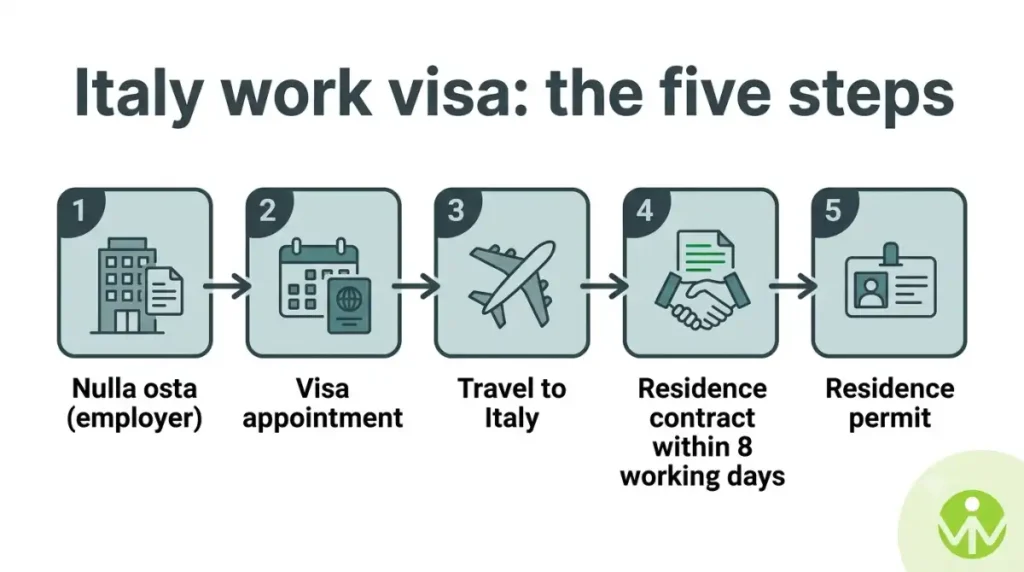
Step 1: Your employer applies for the nulla osta online through the Ministry of the Interior’s portal, on the relevant click day or, for the EU Blue Card, at any time.
Step 2: The Sportello Unico checks the application with the police and the labour office and issues the nulla osta, which is valid for six months. It is sent electronically to the Italian consulate in your country of residence.
Step 3: Complete the questionnaire on the Visto per l’Italia portal and book an appointment through Prenot@Mi or the consulate’s external service provider.
Step 4: Attend your appointment with your documents and pay the fee. The consulate may invite you to an interview.
Step 5: Once your Italy work visa is issued, travel to Italy while the visa is valid.
Step 6: Within 8 working days of arrival, go to the Sportello Unico to sign the residence contract (contratto di soggiorno) and, for permits of a year or more, the integration agreement. You then complete your residence permit application through the post office kit and a fingerprint appointment at the Questura.
After five years of legal residence, you can apply for the EU long-term residence permit, as explained in our Italy permanent residency guide.
Italy work visa processing time and fees
How long an Italy work visa takes depends on the route. On paper, the nulla osta should take 20 days for seasonal work and 60 days for other employment, and the consular stage usually adds a few weeks. In practice the quota routes often take much longer, while the EU Blue Card tends to move faster because there is no click day to wait for.
The national visa fee is €116. It is not refunded if the application is refused. Visa-centre service charges, where they apply, are extra, and once in Italy you pay separately for the residence permit.
Table 2: Italy work visa and residence permit costs in 2026
| Item | Cost | Paid to |
|---|---|---|
| National (Type D) work visa | €116 | Italian consulate |
| Visa-centre service fee | Varies by country | External service provider, where used |
| Residence permit contribution | €40 (permit up to 1 year) or €50 (over 1 year) | Paid at the post office |
| Electronic residence permit card | €30.46 | Paid at the post office |
| Revenue stamp (marca da bollo) | €16 | Bought from a tobacconist |
| Post office handling fee | €30 | Poste Italiane |
| Sources: Italian consular fee tables (Q3 2026) for the visa fee; residence permit charges as published by Poste Italiane and Italian practitioners, checked 28 September 2026. Charges can change, so confirm before paying. | ||
Italy work visa FAQs
How long is an Italy work visa valid?
The visa itself is for entry and is valid for the period printed on it. What matters afterwards is the residence permit, which follows your contract: the first permit can last up to two years and can be renewed while the job continues. There is no five-year limit on renewals, and after five years you can apply for long-term residence.
What is the difference between a nulla osta and an Italy work visa?
The nulla osta is the work authorisation your employer obtains from the Sportello Unico in Italy. The Italy work visa is the entry visa the consulate issues to you on the strength of that nulla osta. You need both, and then a residence permit once you arrive.
Is the EU Blue Card part of the Decreto Flussi quota?
No. The EU Blue Card is issued outside the quota, so the employer can apply at any time. The job must pay at least the ISTAT-based threshold, currently €36,278.51 a year, and last at least six months.
What happens if my employer misses the click day?
The employer must wait for the next click day for that category, unless the job qualifies for an out-of-quota route such as the EU Blue Card or an Article 27 category. Places left unused after the first allocation can be redistributed by the Ministry of Labour later in the year.
Can I switch from a student visa to an Italy work visa?
You do not need a new visa. If you hold an Italian study permit and have a job offer, you can apply to convert it into a work permit from inside Italy. Graduates of Italian degree programmes can also apply for a 12-month permit to look for work, as our Italy student visa guide explains.
Can I work in Italy on a tourist or Schengen visa?
No. A Schengen visa or visa-free entry allows visits and business meetings, not paid work for an Italian employer, and it cannot be turned into a work permit inside Italy. Our Italy tourist visa guide and Schengen visa guide explain what short stays allow.
How much does an Italy work visa cost?
The national visa fee is €116. Once you are in Italy, the residence permit adds roughly €116 to €126 in charges, depending on the length of the permit, plus any visa-centre fees paid before you travel.