
A Japan work visa is permission for a foreign national to take paid employment in Japan, and it always starts with a job offer. Japan does not issue one general work permit. Instead, the Immigration Services Agency (ISA) grants a status of residence that matches the job, and the visa issued by an embassy is only the entry document. This guide covers the main Japan work visa types, what employers and applicants must show, the 2026 rule changes, current fees, and how to apply.
Key Takeaways
- Japan has no single work permit: a Japan work visa means a status of residence matched to the job, sponsored by an employer through a Certificate of Eligibility (COE).
- Engineer/Specialist in Humanities/International Services is the main status for graduate-level jobs, while Specified Skilled Worker covers designated sectors with labour shortages.
- Since 15 April 2026, smaller employers (ISA Categories 3 and 4) file extra documents, and staff in mainly language-based customer roles must prove CEFR B2-level language skills.
- Visa fees rose to about ¥15,000 for a single entry on 1 July 2026, and changes and extensions cost ¥10,000 to ¥75,000 at the counter from 1 October 2026.
- COE processing for Engineer/Specialist status averaged about 47 days for approvals in August 2026.
- Employment for Skill Development replaces Technical Intern Training on 1 April 2027.
Table of Contents
What Is a Japan Work Visa?
Japan separates the visa from the status of residence. The visa, issued by a Japanese embassy or consulate, lets you travel and land. The status of residence, granted on arrival and printed on your residence card, decides what work you may do and for how long. In practice, people say “Japan work visa” to mean any status of residence that permits paid work.
Most work statuses follow the same route. A Japanese employer, or another proxy in Japan, applies to a regional immigration bureau for a Certificate of Eligibility. Once the COE is issued, you apply for the visa abroad. The Ministry of Foreign Affairs of Japan says a COE speeds up both the visa application and the landing examination, although it does not guarantee a visa.
Tourists cannot move into work informally. The Temporary Visitor status used by visa-exempt travellers and holders of a Japan tourist visa does not allow paid work, so a Japan work visa has to be in place before the job begins.
Types of Japan Work Visa
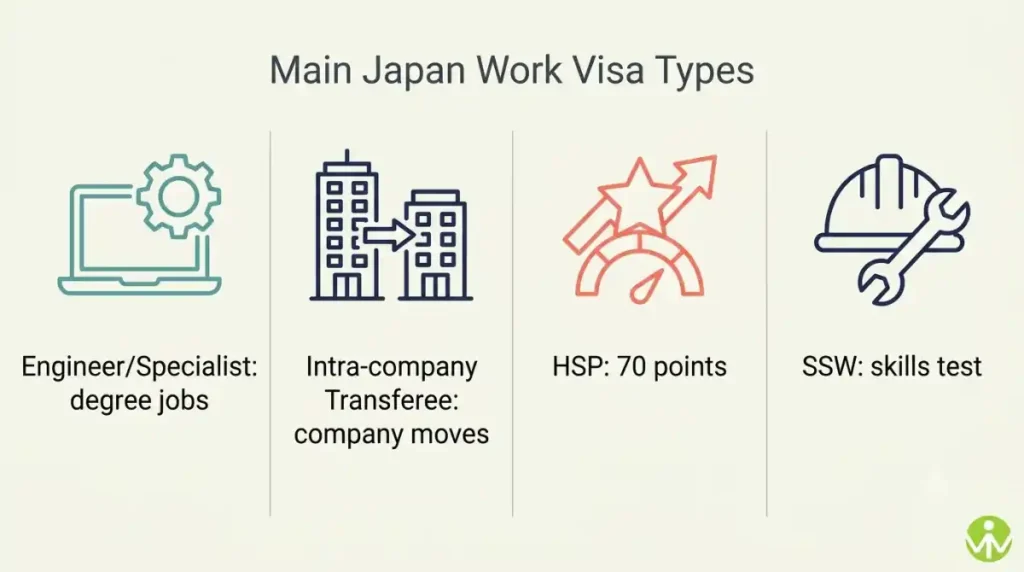
The right Japan work visa depends on the job, your qualifications, and how you are hired. The table compares the statuses most foreign workers use, and our guide to the types of Japan visas covers every other category.
| Status | Typical jobs | Main requirement | Periods of stay | Family can join |
|---|---|---|---|---|
| Engineer/Specialist in Humanities/International Services | IT, engineering, finance, marketing, translation, and language teaching in companies | Related degree, or 10 years’ experience (3 years for some international-services roles) | 5 years, 3 years, 1 year, or 3 months | Yes, on Dependent status |
| Intra-company Transferee | Staff moved from an overseas office | 1 year with the overseas office immediately before the transfer | 5 years, 3 years, 1 year, or 3 months | Yes, on Dependent status |
| Highly Skilled Professional (i) | Researchers, specialists, and executives | 70 points, or J-Skip income and career thresholds | 5 years | Yes, with extra benefits |
| Specified Skilled Worker (i) | Designated labour-shortage sectors | Sector skills test and basic Japanese | Up to 3 years per grant, 5 years in total | No |
| Specified Skilled Worker (ii) | Experienced workers in designated sectors | Higher-level sector skills test | 3 years, 2 years, 1 year, or 6 months, renewable | Yes, spouse and children |
| Business Manager | Founders and company managers | ¥30 million capital, 1 full-time employee, and Japanese ability | 5 years down to 3 months | Yes, on Dependent status |
| Source: Immigration Services Agency of Japan status pages and MOFA. Table as of November 2026. | ||||
Engineer/Specialist in Humanities/International Services
This is the most widely used Japan work visa. It covers jobs that need knowledge of the natural sciences, such as engineering and IT, or the humanities, such as law, economics, and marketing. It also covers work that draws on a foreign culture, such as translation, interpreting, design, or language teaching in a private company. About 475,000 people held the status at the end of 2025, according to ISA figures cited by The Mainichi.
Applicants generally need a degree in a field related to the job or 10 years of relevant experience. International-services roles need three years of related experience instead, although university graduates working in translation, interpreting, or language teaching are exempt from that rule. Pay must be at least equal to what a Japanese employee would receive for the same work. The job must use those skills, so factory-line work, shelf-stacking, and other simple tasks fall outside the status, as the ISA status page explains.
Intra-company Transferee
The Intra-company Transferee status lets a multinational move an employee from an overseas head office, branch, or affiliate to its Japanese office for a fixed period. The employee must have worked for the overseas office for at least one year immediately before the transfer, and the work in Japan must fall within the same fields as the Engineer/Specialist status. It requires no degree and no new contract with a Japanese employer. It does not cover executives running the Japanese business, who need Business Manager status instead.
From 1 April 2026, the ISA changed the documents it requires for this status, and smaller employers now provide more evidence of the transfer and the applicant’s earlier employment.
Highly Skilled Professional and J-Skip
The Highly Skilled Professional (HSP) status awards points for education, career, salary, age, Japanese ability, and other factors. Applicants with 70 points receive HSP (i) for five years, with benefits such as a spouse’s right to work full time and, in some cases, permission to bring a parent or a domestic worker. After three years, holders can move to HSP (ii), which has no time limit. Specialist and business-management applicants currently need an annual salary of at least ¥3 million.
J-Skip replaces the points test for high earners. Researchers and engineers with a master’s degree or 10 years of experience qualify with annual income of at least ¥20 million, and business managers with five years of experience qualify with at least ¥40 million. Both HSP routes shorten the path to permanent residency, covered below.
Specified Skilled Worker
Specified Skilled Worker (SSW) admits workers into sectors with labour shortages, including nursing care, construction, food manufacturing, agriculture, accommodation, and automobile transport. SSW (i) requires a sector skills test and basic Japanese, usually JLPT N4 or the Japan Foundation Test for Basic Japanese. It is granted for up to three years at a time, with a five-year total limit, and family members cannot join the worker. SSW (ii) needs a higher skills test, has no total limit, allows a spouse and children to join, and can lead to permanent residency.
The ISA’s SSW page now names 19 fields after the government added linen supply, logistics warehousing, and resource circulation, with recruitment in those three fields reportedly due to begin in 2027. The government has capped SSW (i) at 805,700 workers until March 2029. In the food service field, the ISA suspended new COEs on 13 April 2026 because the field was nearing its cap, so check a field’s status before applying for this Japan work visa.
Other Japan Work Visa Statuses
Several narrower statuses cover specific professions: Professor, Researcher, Instructor (language teachers at schools), Medical Services, Legal/Accounting Services, Nursing Care, Entertainer, Journalist, Religious Activities, Artist, and Skilled Labor, which covers roles such as chefs specialising in foreign cuisine. Founders need Business Manager status, which since 16 October 2025 requires ¥30 million in capital, at least one full-time employee, and Japanese ability. Our Japan startup visa guide explains those rules.
Japan Work Visa Requirements
Every Japan work visa starts with a job offer or a transfer from an organisation willing to sponsor the COE. The core requirements are a role that matches the status, qualifications or experience that meet its criteria, and pay at least equal to a Japanese worker’s. The employer must also run a viable business, and the ISA judges this partly by sorting employers into four categories.
Employer categories
Category 1 covers listed companies and public bodies. Category 2 covers organisations that withheld at least ¥10 million in employee income tax the previous year, plus those approved for online applications. Category 3 covers other employers that file the annual withholding statement, and Category 4 covers everyone else, including many new companies. Category 1 and 2 employers file few documents, while Category 3 and 4 employers must prove the business is real with registration certificates, business descriptions, and financial statements. Category 3 and 4 employers also carry most of the 2026 changes below.
Documents applicants usually provide
Applicants usually provide a passport, a photo, degree certificates or employment references proving experience, a CV, and the employment contract or notice of working conditions. IT engineers can use certain IT qualification certificates in place of a degree. The employer adds company documents matching its category, and the ISA can ask for more during the review.
2026 Changes to the Japan Work Visa
Japan tightened several work statuses in 2026 while raising fees. The changes mainly target smaller employers and roles at risk of misuse.
New documents and a language rule from 15 April 2026
For applications filed on or after 15 April 2026, Category 3 and 4 employers sponsoring Engineer/Specialist staff must submit a declaration about the company’s representative. If the job mainly involves using language skills with people, such as translation, interpreting, or hotel front-desk work, the applicant must also prove CEFR B2-level ability in the working language. The ISA treats JLPT N2 or higher, a score of at least 400 in the BJT Business Japanese Proficiency Test, and graduation from a Japanese university or vocational college as meeting B2 for Japanese.
The rule applies to COE, change-of-status, and acquisition applications, while extensions are exempt when the holder continues the same duties. Despite some headlines, Japan has not made JLPT N2 a requirement for every Japan work visa. Engineers, IT staff, and other roles that do not mainly rely on language skills are not covered, and neither are Category 1 and 2 employers.
Closer checks on agency staff and transfers
Since March 2026, the ISA has investigated workplaces that take Engineer/Specialist staff through staffing agencies, to stop agencies placing those workers in non-specialist jobs. Agencies dispatching such staff file a pledge, management ledgers, and work-status reports, and the ISA updated this guidance on 13 July 2026. Intra-company Transferee applications have also faced tighter document checks since 1 April 2026.
Higher fees and tougher renewals
Visa fees rose on 1 July 2026 and residence fees on 1 October 2026, as the fees section below shows. The ISA’s guidelines also allow it to use tax and other government records when deciding changes and extensions, so unpaid residence tax, pension, or health insurance can count against a renewal.
How to Apply for a Japan Work Visa
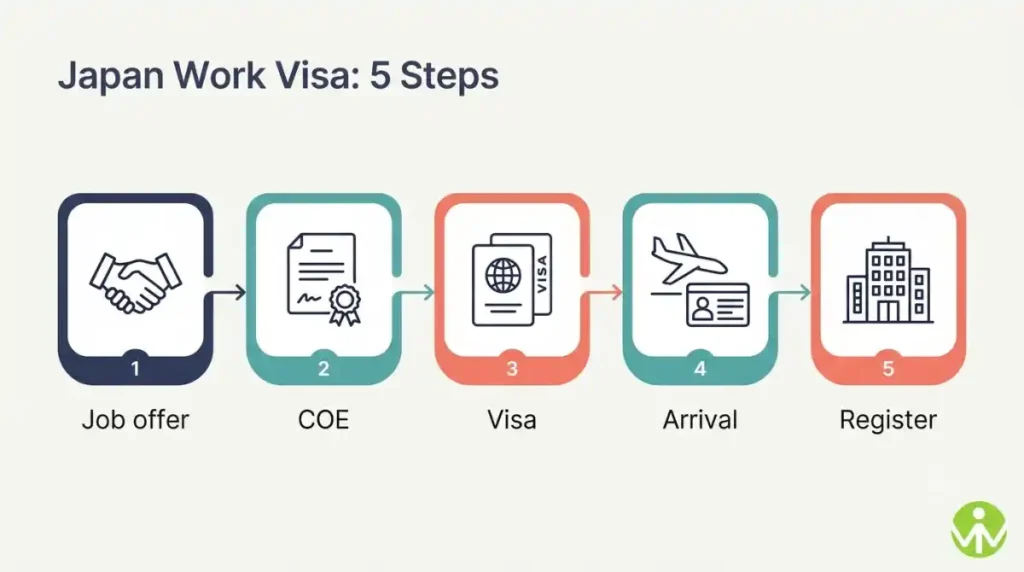
The Japan work visa process has five main steps for applicants abroad.
- Secure a job offer or transfer. The employer confirms the job, pay, and matching status, and gathers its category documents.
- Apply for the COE. The employer or an authorised agent files at the regional immigration bureau covering the workplace, either at the counter or online. COE processing for Engineer/Specialist status averaged 47.1 days for approvals in August 2026, according to ISA processing-time data, and work statuses usually take longer before April hiring.
- Apply for the visa. Take your passport, application form, photo, and COE, either on paper or electronically, to the Japanese embassy or consulate. Some nationalities need extra documents, so check your local embassy’s website.
- Travel within the COE’s validity. A COE is valid for three months from issue, so enter Japan within that window. At major airports, immigration officers issue your residence card on arrival.
- Register locally. Register your address at the municipal office within 14 days of settling, and enrol in health insurance and the pension system through your employer or the municipality.
If you are already in Japan on another status, such as Student, apply for a change of status instead of a COE. Our Japan student visa guide explains the switch after graduation, and our general guide on how to apply for a work visa compares the process with other countries.
Japan Work Visa Fees and Processing Time
The COE itself is free. The visa costs about ¥15,000 for a single entry or ¥30,000 for multiple entries for applications accepted from 1 July 2026, according to the MOFA fee page. Fees vary by nationality, and some nationals pay nothing. Changes and extensions inside Japan use the banded fees introduced on 1 October 2026.
| Item | At the counter | Online |
|---|---|---|
| Visa, single entry (at an embassy) | About ¥15,000 | Not applicable |
| Visa, multiple entry (at an embassy) | About ¥30,000 | Not applicable |
| Certificate of Eligibility | Free | Free |
| Change or extension: 3 months or less | ¥10,000 | ¥10,000 |
| Change or extension: over 3 months, up to 6 months | ¥18,000 | ¥15,000 |
| Change or extension: over 6 months, less than 1 year | ¥25,000 | ¥21,000 |
| Change or extension: 1 year | ¥33,000 | ¥27,000 |
| Change or extension: over 1 year, less than 3 years | ¥48,000 | ¥42,000 |
| Change or extension: 3 years or more, less than 5 years | ¥64,000 | ¥56,000 |
| Change or extension: 5 years or more | ¥75,000 | ¥65,000 |
| Permanent residence | ¥200,000 | Not applicable |
| Sources: MOFA visa fee page (applications accepted from 1 July 2026) and ISA fee leaflet (from 1 October 2026). Visa amounts are approximate and vary by nationality. Online amounts exclude any transaction charge. | ||
The fee depends on the period of stay granted, so a five-year Engineer/Specialist extension costs ¥75,000 at the counter or ¥65,000 online, while a one-year grant costs ¥33,000 at the counter. The ISA fee leaflet lists every band. Average COE processing in August 2026 ranged from about 35 days for Intra-company Transferee to about 63 days for SSW (i).
Changing Jobs, Extending, and Bringing Family
Changing jobs on a Japan work visa
You can change employers on most work statuses without a new Japan work visa, provided the new job fits the same status. Notify the ISA within 14 days of leaving or joining an employer. For certainty before your next extension, apply for a Certificate of Authorized Employment, which confirms the new job fits your status. A move into a different type of work needs a change of status first. HSP (i) holders are an exception: their status names the employer, so any new job needs a change of status.
Extending your stay
Apply to extend before your period of stay expires, and file up to three months in advance. The ISA reviews whether you still do qualifying work and whether you have paid taxes, pension contributions, and health insurance premiums on time.
Bringing your family
Spouses and children of most Japan work visa holders can join on Dependent status, provided the worker can support them. Dependent holders may work up to 28 hours a week with permission. SSW (i) is the main exception: family members cannot accompany the worker unless they qualify for their own status.
From a Japan Work Visa to Permanent Residency
A Japan work visa can lead to permanent residency. The standard route needs 10 years of continuous residence, including at least five years in a work or status-based status. HSP holders can apply after three years with 70 points, or after one year with 80 points; J-Skip holders can apply after one year. Revised guidelines from 1 October 2026 add an income test, and the application fee is now ¥200,000. Our guide to permanent residency in Japan covers the new requirements.
What Changes for the Japan Work Visa in 2027
Two officially scheduled changes take effect on 1 April 2027. First, Employment for Skill Development replaces the Technical Intern Training programme. It is a three-year route designed to bring workers up to SSW (i) level, and it allows a change of employer within the same field under set conditions. The government expects to admit up to 426,200 workers through it by March 2029. Second, new COE applications for SSW (ii) will require Japanese at B1 level or above, according to an ISA notice.
Other changes are not yet final. The ISA has published a draft ordinance adding a five-year period of stay for SSW (ii), reportedly from January 2027, and Jiji Press reported in October 2026 that the ISA plans to raise the ¥3 million minimum salary for HSP. Check the ISA website before applying, as dates and figures can change.
Frequently Asked Questions About the Japan Work Visa
Can I get a Japan work visa without a degree?
Yes. Engineer/Specialist status accepts 10 years of relevant experience instead of a degree, or three years for some international-services roles. Intra-company Transferee status needs no degree, and SSW relies on skills and language tests.
Do I need to speak Japanese for a Japan work visa?
Not for most graduate-level jobs. Japanese is required for SSW, for Business Manager status, and, since 15 April 2026, for language-based customer roles with smaller employers. Japanese ability also earns points toward Highly Skilled Professional status.
How long does it take to get a Japan work visa?
The COE stage takes the longest. ISA data shows average COE processing of about 47 days for Engineer/Specialist status and about 63 days for SSW (i) for approvals in August 2026, followed by the embassy stage.
How much does a Japan work visa cost?
Can I change jobs on a Japan work visa?
Yes, if the new job fits your current status. Notify the ISA within 14 days, and change your status first if the new job falls under a different category. HSP (i) holders need a change of status for any new employer.
Can I work in Japan on a tourist visa?
No. Temporary Visitor status does not allow paid work, and you cannot normally switch from it to a Japan work visa inside Japan. Apply for a COE and enter on the correct status.
Can a Japan work visa lead to permanent residency?
Yes. Most workers qualify after 10 years of residence, including five in a work status, while Highly Skilled Professionals can apply after one or three years, depending on their points.