
Key Takeaways
- There is no single H-1B visa fee: up to seven government charges can apply, depending on the employer’s size, its cap-exempt status and the type of petition.
- For a new cap-subject petition from an employer with 26 or more staff, government fees total $3,595, or $6,560 with premium processing, before legal costs.
- The employer pays almost everything. The ACWIA training fee and the $500 fraud fee can never be passed on to the worker.
- The $100,000 proclamation payment is not being collected: courts in Massachusetts and California have blocked it, and appeals are pending.
- A proposed $103,265 H-1B visa fee on cap-subject petitions is not in force. Comments closed on 24 September 2026 and no final rule has been published.
- The worker’s own costs are small by comparison: the $205 visa application fee, any reciprocity fee and, where collected, a $250 visa integrity fee.
Table of Contents
There is no single H-1B visa fee. A petition can include up to seven separate government charges, and which ones apply depends on who the employer is, how large it is, and what kind of petition it is filing.
For a typical new case, the total runs to a few thousand dollars, almost all of it paid by the employer. This guide sets out every H-1B visa fee in force as of November 2026, the two very large charges that are not in force, who is legally allowed to pay each one, and worked totals for the most common filing scenarios. For eligibility, the annual cap and the wider rules, see our main H-1B visa guide.
H-1B visa fee at a glance
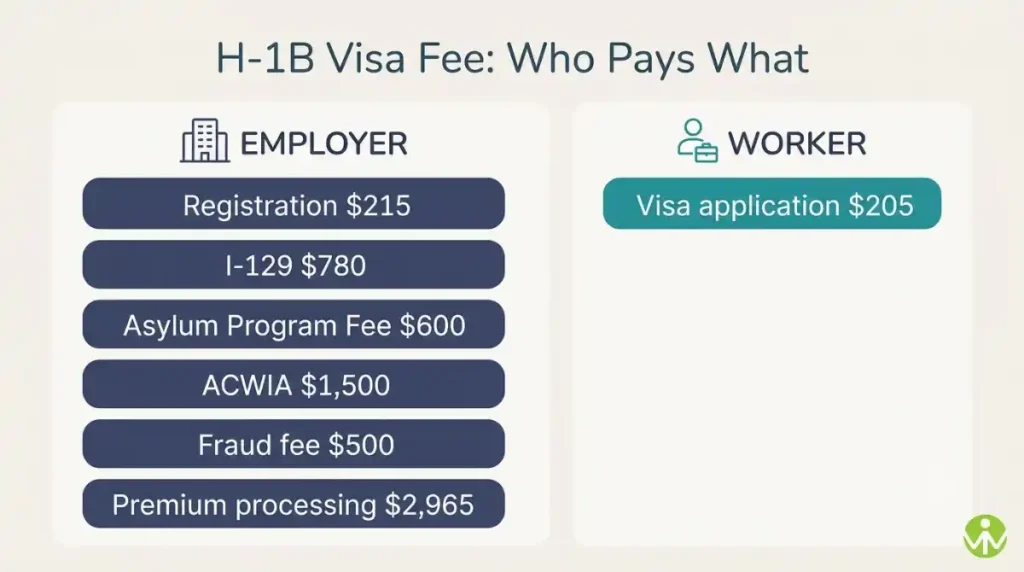
The table lists every H-1B visa fee an employer or worker may meet, in roughly the order they arise, using the amounts on the official USCIS fee schedule and the State Department’s visa fees. Amounts separated by a slash depend on the employer’s size or status.
Table 1: Every H-1B visa fee at a glance
| Fee | Amount (USD) | Paid by | When it applies |
|---|---|---|---|
| H-1B registration | 215 | Employer | Each cap-subject beneficiary entered in the March registration |
| Form I-129 base fee | 780 (460 for employers with 25 or fewer full-time staff, and non-profits) | Employer | Every H-1B petition |
| Asylum Program Fee | 600 / 300 / 0 | Employer | Every I-129: $300 for 25 or fewer full-time staff, nothing for non-profits |
| ACWIA training fee | 1,500 / 750 | Employer only | Initial petitions, first extensions and changes of employer; $750 for 25 or fewer staff; universities and certain research bodies exempt |
| Fraud Prevention and Detection Fee | 500 | Employer only | Initial petitions and changes of employer; not same-employer extensions |
| 9-11 Response and Biometric Entry-Exit Fee | 4,000 | Employer | Employers with 50 or more US staff, over half on H-1B or L-1; covers extensions since 9 September 2026 |
| Premium processing (Form I-907) | 2,965 | Usually the employer | Optional; USCIS must act within 15 business days |
| Visa application (DS-160) | 205 | Worker | Each person applying for an H visa at a US consulate |
| Visa integrity fee | 250 | Worker | Legislated in 2025; collection not confirmed on the State Department fee schedule |
| Proclamation payment | 100,000 | Employer | Blocked by court orders; not being collected |
| Proposed cap-subject fee | 103,265 | Employer | Proposed rule only; not in force |
| USCIS fees from the USCIS fee schedule (Form G-1055) and the final rule at 91 FR 51360; premium processing rate in force since 1 March 2026. Proposed fee from 91 FR 54817. Visa fees from the US Department of State. Checked 8 November 2026. | |||
Not every line applies to every case. The registration fee arises only for cap-subject petitions, the fraud fee only for new petitions and changes of employer, and the $4,000 charge only for a small group of employers. The scenario totals further down show how the pieces combine.
The H-1B visa fee for registration: $215
Every cap-subject case starts with an electronic registration in March, and the H-1B visa fee at this stage is $215 per beneficiary. It rose from $10 for the FY2026 season, a deliberate move to discourage speculative entries. The employer pays it for each person it registers, whether or not that person is selected, and it is not refunded when a registration loses in the wage-weighted H-1B lottery.
Cap-exempt employers skip this stage and the fee altogether. They include universities, their affiliated non-profits and non-profit or government research organisations, along with workers who have already been counted against the cap.
The I-129 petition and the fees that come with it
Once a registration is selected, or for any cap-exempt petition, transfer or extension, the employer files Form I-129. Up to four separate charges attach to it, and each has its own exemptions.
Base filing fee
The I-129 base fee for an H-1B petition is $780. Employers with 25 or fewer full-time-equivalent employees, and non-profits, pay a reduced $460. It is the only H-1B visa fee charged on every petition without exception.
Asylum Program Fee
Introduced in the April 2024 USCIS fee rule, the Asylum Program Fee is $600 for most employers, $300 for those with 25 or fewer full-time-equivalent staff, and nothing for non-profits. It applies to initial petitions and extensions.
ACWIA training fee
The fee created by the American Competitiveness and Workforce Improvement Act funds training and scholarships for US workers. It is $1,500 for employers with 26 or more full-time staff and $750 for smaller ones. Institutions of higher education, their affiliated non-profits and non-profit or government research organisations are exempt. So are second or later extensions with the same employer, and amended petitions that do not extend the worker’s stay.
Fraud Prevention and Detection Fee
This H-1B visa fee is a flat $500. It applies to initial petitions and to petitions for a change of employer, including cap-exempt ones. It does not apply when the same employer extends an existing worker’s status.
The $4,000 fee for H-1B-dependent employers
A much larger H-1B visa fee falls on a narrow group of employers: those with 50 or more US employees, of whom more than half hold H-1B, L-1A or L-1B status. They pay a $4,000 9-11 Response and Biometric Entry-Exit Fee on top of everything else.
Until recently it applied only to initial petitions and changes of employer. A DHS final rule published on 10 August 2026 extended it to extension petitions from 9 September 2026, including extensions with the same employer, where the fraud fee does not apply. Our round-up of H-1B visa changes covers the rule alongside the other 2026 reforms.
Premium processing: the optional H-1B visa fee
Premium processing is optional. Filing Form I-907 with a fee of $2,965 obliges USCIS to act on the petition within 15 business days, where standard processing can take months. The fee rose from $2,805 on 1 March 2026 under an inflation adjustment. If USCIS misses the deadline, it refunds the premium processing fee and keeps the case on the fast track.
It is the one H-1B visa fee a worker may sometimes pay, a point covered under who pays below.
The $100,000 payment: proclaimed but blocked
Proclamation 10973 of 19 September 2025 imposed a one-time $100,000 payment on certain new H-1B petitions for workers outside the United States. It is not being collected.
On 8 June 2026, the District of Massachusetts vacated the policies implementing it as, in substance, an unlawful tax, and the First Circuit refused to pause that ruling on 24 July. The President extended the proclamation to 21 September 2027 through Proclamation 11069, signed on 18 September 2026. On 30 September, a federal judge in the Northern District of California set aside the agency policies implementing both the original proclamation and the extension, and the government has appealed to the Ninth Circuit.
A December 2025 ruling in Washington, D.C., went the other way and is on appeal, so the position could still change. Our page on the $100,000 H-1B fee tracks each case.
The proposed $103,265 H-1B visa fee
Separately from the proclamation, DHS has proposed a new H-1B visa fee of $103,265 on every cap-subject petition. It was published in the Federal Register on 25 August 2026, and would cover petitions counted against both the regular cap and the master’s cap. It would sit on top of every other charge, including any proclamation payment.
Cap-exempt petitions would not pay it. DHS says the amount is set to recover immigration-system costs across several federal agencies that it attributes to the programme. The comment period closed on 24 September 2026. As of 8 November 2026, DHS has not published a final rule, so it cannot charge the fee, and it has not said when it might.
If it is finalised, the cap-exempt route becomes far cheaper than any cap-subject filing, which is why our comparison of H-1B visa alternatives now treats cap-exempt employment as a serious option.
What the worker pays
Most of the H-1B visa fee burden falls on the employer, but the worker pays a few costs directly.
Visa application and integrity fees
A worker outside the United States, or one who travels and needs a new visa stamp, pays the State Department’s $205 application fee for petition-based visas when completing Form DS-160. Some nationalities also pay a reciprocity issuance fee, set country by country.
A $250 visa integrity fee was created by Public Law 119-21 in July 2025 for most nonimmigrant visas. It does not appear on the State Department’s published schedule of visa fees as checked on 8 November 2026, so confirm with the consulate whether it is being collected before you budget for it.
H-4 dependants
A spouse or child under 21 joins the H-1B holder on an H-4 visa, and each pays the same $205 visa fee when applying abroad. Inside the United States, dependants extend or change status on Form I-539, and an eligible spouse applying for H-4 EAD work authorisation files Form I-765. None of the employer-side charges apply to them.
Who is allowed to pay each H-1B visa fee
For most of these charges the law decides who pays, not the employment contract. Under Department of Labor rules, an employer may never pass on the ACWIA training fee or the $500 fraud fee, whether through a payroll deduction, a reimbursement demand or a cut in pay. Other petition costs, including the I-129 fee and the attorney fees for preparing the Labor Condition Application and the petition, are the employer’s business expenses, as the Department’s fact sheet on H-1B pay deductions explains.
Premium processing is the grey area. Where the faster decision serves the employer, it is the employer’s cost. A worker may pay it only where the speed is genuinely for their own benefit, such as needing to travel or to start sooner with a new employer, and only if paying it does not take their pay below the required wage. The visa application fee and costs for family members are normally the worker’s own.
Two further obligations sit outside the fee schedule. An employer that ends the job early must pay the worker’s reasonable cost of return transport home. It also may not charge a penalty for leaving before an agreed date, although a genuine liquidated-damages clause can be lawful under state law.
H-1B visa fee totals by scenario
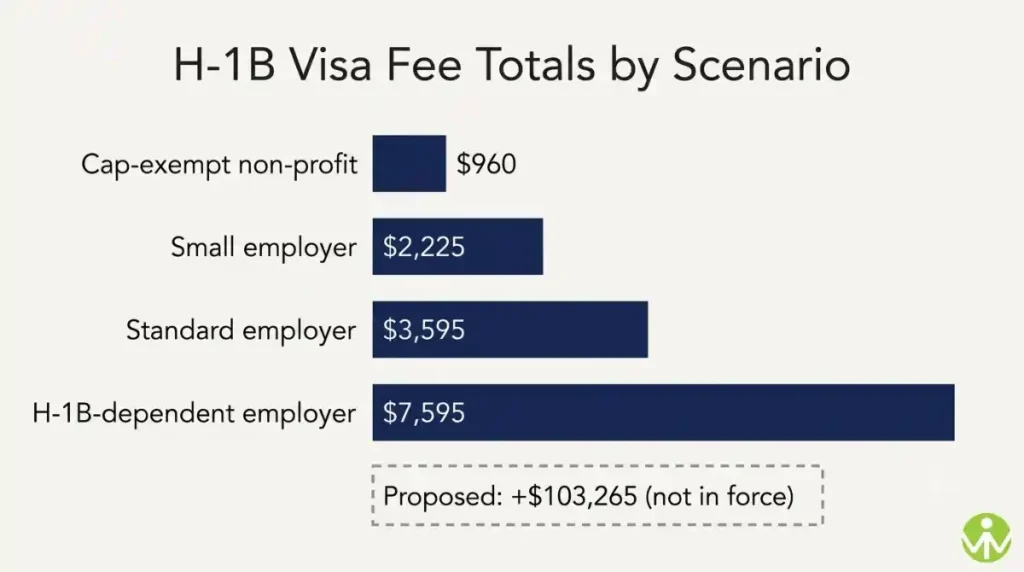
The totals below add up the government charges for the most common cases. They exclude legal fees, which are often larger than the fees themselves, and the proposed $103,265 fee, which is not in force.
Table 2: H-1B visa fee totals by filing scenario
| Scenario | Government fees that apply | Total (USD) | With premium processing (USD) |
|---|---|---|---|
| New cap-subject petition, employer with 26 or more staff | Registration, I-129, Asylum Program Fee, ACWIA, fraud fee | 3,595 | 6,560 |
| New cap-subject petition, H-1B-dependent employer | As above, plus the $4,000 9-11 fee | 7,595 | 10,560 |
| New cap-subject petition, employer with 25 or fewer staff | Registration, reduced I-129, $300 Asylum Program Fee, $750 ACWIA, fraud fee | 2,225 | 5,190 |
| Cap-exempt non-profit university or research body | Reduced I-129 and fraud fee; no registration, Asylum Program Fee or ACWIA | 960 | 3,925 |
| Change of employer, employer with 26 or more staff | I-129, Asylum Program Fee, ACWIA, fraud fee | 3,380 | 6,345 |
| First extension, same employer with 26 or more staff | I-129, Asylum Program Fee, ACWIA | 2,880 | 5,845 |
| Second or later extension, same employer with 26 or more staff | I-129, Asylum Program Fee | 1,380 | 4,345 |
| Government fees only; legal fees and the worker’s own visa costs are extra. H-1B-dependent employers add $4,000 to transfers and extensions as well. The proposed $103,265 fee would apply only to the first three rows, and only if finalised. As of 8 November 2026. | |||
Two patterns stand out. For a larger employer, the H-1B visa fee bill is driven by the ACWIA fee and, for H-1B-dependent firms, the $4,000 charge, rather than by the filing fee itself. And the cap-exempt route is already the cheapest; if the $103,265 proposal is finalised, the gap between a cap-subject and a cap-exempt petition would widen from a few thousand dollars to more than $100,000.
Are H-1B visa fees refundable?
An H-1B visa fee paid to USCIS is generally not refundable, whatever the outcome. A registration that is not selected keeps its $215, and a denied petition keeps the I-129 fee and the charges that come with it.
The exceptions are narrow. Premium processing is refunded if USCIS misses its 15-business-day deadline, and a petition rejected at intake, for example one filed after the cap has been reached, is returned with its fee. No refund mechanism has been set up for employers who paid the $100,000 payment before the courts blocked it.
Frequently asked questions
How much is the H-1B visa fee in 2026?
There is no single amount. For a new cap-subject petition from an employer with 26 or more staff, government fees total $3,595, or $6,560 with premium processing, before legal fees. Smaller employers pay $2,225, and cap-exempt non-profits can pay as little as $960.
Who pays the H-1B visa fee, the employer or the employee?
The employer pays almost all of it, and must pay the ACWIA training fee and the $500 fraud fee itself. Other petition costs are employer business expenses under Department of Labor rules. The worker pays their own visa application fee and costs for dependants, and may pay premium processing only when it benefits them.
Is the $100,000 H-1B fee still being charged?
No. A Massachusetts court vacated the policies implementing it in June 2026, and a California court did the same in September for both the original proclamation and its extension. Appeals are pending, so check its status before filing.
Is the $103,265 H-1B fee in effect?
No. It is a proposed rule published on 25 August 2026. It would apply only to cap-subject petitions, and only once a final rule is published with an effective date.
Do H-1B transfers and extensions pay the same fees as a new petition?
Not quite. A transfer to a new employer pays the full set of fees, except for registration. A same-employer extension skips the fraud fee and, for the second extension, also skips the ACWIA fee. H-1B-dependent employers now pay the $4,000 fee on extensions too.
Are H-1B visa fees refundable?
Generally not. Unselected registrations and denied petitions keep their fees. Premium processing is refunded if USCIS misses the 15-business-day deadline.