
The H-1B lottery is no longer a coin toss. Since 27 February 2026, US Citizenship and Immigration Services has selected cap-subject registrations through a weighted process that gives higher-paid roles more entries in the pool than lower-paid ones, so two people competing for the same visa in the same year can now face selection odds that differ roughly fourfold. One full cycle has already been run this way. Its results, and the mechanics behind them, now govern almost everyone’s odds in the H-1B lottery.
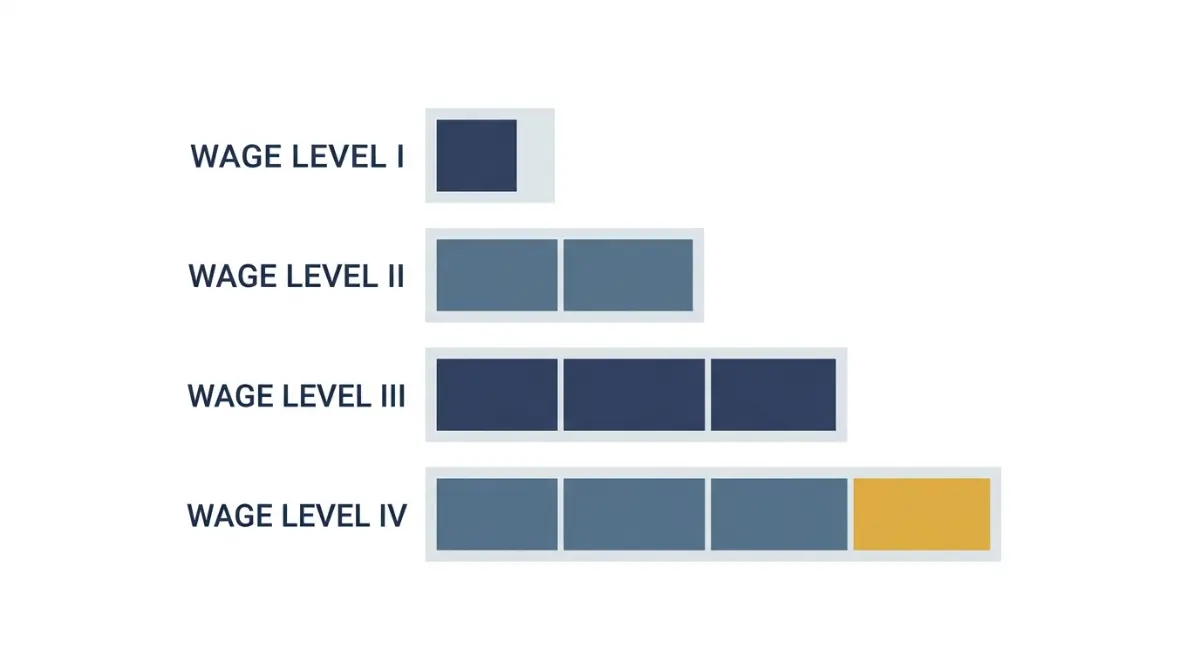
| Key Takeaways – The H-1B lottery has not been random since 27 February 2026. Registrations are now weighted by the Department of Labor wage level attached to the job. – A Level IV role gets four entries in the pool, Level III three, Level II two and Level I one. The same method applies to the 65,000 regular cap and the 20,000 advanced-degree exemption. – A wage level is a percentile within one occupation in one metro area, not a national salary ranking. A modest salary in a low-wage market can outrank a large one in an expensive city. – If several employers register the same person at different wage levels, USCIS applies the lowest of them. Extra registrations cannot raise the entry count, only lower it. – In the FY2027 cycle, the first run under the new rule, registrations fell 38.5% to about 211,600, and 71.5% of selected beneficiaries held a US advanced degree. |
Table of Contents
What changed in the H-1B lottery, and when
The Department of Homeland Security published its final rule on weighted selection on 29 December 2025, under RIN 1615-AD01. It took effect on 27 February 2026, days before the FY2027 registration window opened on 4 March.
Before that, the H-1B lottery treated every properly submitted registration identically. Since the 2024 cycle, selection has also been beneficiary-centric, meaning each person is counted once no matter how many employers register them. The weighted rule leaves that intact. It changes only one thing: how many times a given person’s name is written into the pool before the draw.
Registration itself now asks for more. The employer supplies the Standard Occupational Classification code and the area of intended employment, and certifies the highest wage level under the Occupational Employment and Wage Statistics survey that the offered wage equals or exceeds. The registration fee is unchanged at $215 per beneficiary. Notably, and unlike the $100,000 payment introduced by proclamation in September 2025, no business group filed suit against the weighted H-1B lottery rule before it took effect.
What an OEWS wage level is, and why weighted selection uses it
The four wage levels come from the Department of Labor’s prevailing wage system, which is used for labour condition applications and has nothing to do with immigration selection in its original design. Each level is a percentile of the wage distribution for one occupation in one geographic area, paired with a description of the experience and independence the job requires.
Table 1: What each OEWS wage level means
| Wage level | Current percentile | What the level describes | Proposed percentile (not final) |
|---|---|---|---|
| Level I | 17th | Entry level; basic tasks under close supervision | 34th |
| Level II | 34th | Qualified; some experience, moderate supervision | 52nd |
| Level III | 50th | Experienced; independent judgement on complex work | 70th |
| Level IV | 67th | Fully competent; leads, plans or sets direction | 88th |
| Percentiles are calculated within a single occupation in a single geographic area. Proposed figures are from the Department of Labor’s proposed rule of 27 March 2026, which is not final. | |||
Why a wage level is not the same as a high salary
This is the most common misreading of the new H-1B lottery, and it costs people entries. Because each level is calculated within a single metro area, the salary needed to reach a given level varies enormously by location. Analysis by TRAC at Syracuse University found that a software developer role reaches Level IV at roughly $80,122 a year in Hattiesburg, Mississippi, but requires about $264,514 in San Jose, California. An $85,000 offer in the first market therefore outranks a $150,000 offer in the second for lottery purposes.
The level also reflects the seniority and complexity of the duties described, not simply the number on the offer letter. A generous salary attached to a job written up as entry-level supervised work will still be assigned a low level. Employers who want the higher entry count must be able to defend both the wage and the role description.
Turning that into a decision rule: compare the offer against the OEWS percentile table for that specific SOC code and metro area before comparing it against another offer. The Department of Labor publishes the four levels for every occupation and area, so the check takes minutes and is the only reliable way to know how many entries an offer is worth.
The practical consequence runs against instinct. A candidate choosing between a Bay Area offer and one in a secondary market may be choosing between one entry and three, in the opposite direction of the headline salary. Nothing in the H-1B lottery rewards the higher number on the offer letter; it rewards the higher position within the local distribution. Two candidates in the same occupation earning the same salary in different cities now face materially different odds.
How wage levels become lottery entries
The arithmetic is simple. A registration certified at Level IV is entered four times, Level III three times, Level II twice and Level I once. DHS applies the same method to the 65,000 regular cap and to the 20,000 advanced-degree exemption, so holding a US master’s degree does not exempt anyone from the weighting.
Entries are not the same as places. Each unique beneficiary still counts once toward the numerical cap regardless of how many entries carried their name, so four entries mean four chances of being drawn, not four visas.
Table 2: H-1B lottery entries and projected selection odds by wage level
| Wage level | Entries in the pool | Projected odds (DHS) | Projected odds (TRAC) | Odds under the old random lottery |
|---|---|---|---|---|
| Level IV | 4 | Over 61% | 61.16% | About 29.6% |
| Level III | 3 | Over 45% | 45.87% | About 29.6% |
| Level II | 2 | About 31% | 30.58% | About 29.6% |
| Level I | 1 | About 23% | 15.29% | About 29.6% |
| All figures are projections published with or about the final rule, not observed FY2027 outcomes. DHS and TRAC differ most on Level I. | ||||
The probabilities in the table are projections rather than measured outcomes, and the published estimates do not fully agree. DHS’s own regulatory analysis put Level IV above 61% and Level III above 45%, while implying roughly 23% for Level I. TRAC’s independent modelling produced 15.29% for Level I and 45.87% for Level III on the same rule. The direction is not in dispute; the size of the penalty at the bottom is.
The multiple-registration trap in the H-1B lottery
This is the provision that surprises people most, and it works against the intuition that more offers must be better. Where several employers register the same beneficiary at different wage levels, USCIS uses the lowest wage level among all of those registrations to set the entry count.
A candidate with a Level IV offer from one company and a Level I offer from another does not get four entries. They get one. Accepting a second, lower-level registration can only reduce the entry count that the first registration would have earned on its own, never raise it. Anyone weighing multiple sponsors in a single H-1B lottery cycle needs to know the wage level behind each one before agreeing to be registered.
The older anti-duplication rules still apply on top of this. A single registrant may submit only one registration per beneficiary per fiscal year, and submitting more invalidates all of that registrant’s registrations for that person. Related companies registering the same candidate without a genuine business reason attract scrutiny and can trigger a fraud referral.
A worked example makes the arithmetic concrete. Suppose a candidate holds a Level III offer from an employer in Austin and, as insurance, accepts a second registration from a staffing firm at Level I. Read separately, the first registration is worth three entries and the second is worth one. Read together, as USCIS reads them, the beneficiary is entered once. The insurance policy has cost two of the three entries the candidate already had.
The same logic applies inside a single employer. Where a petition names multiple worksites in different metro areas, the certification is made against the lowest equivalent wage level across those areas, so a role split between San Jose and a lower-cost site is certified at whichever level the cheaper market produces. Candidates and employers therefore need to settle the wage level and the worksite list before the H-1B lottery registration window opens, not after a selection notice arrives.
What the FY2027 H-1B lottery actually produced
FY2027 was the first cycle run under weighting. Registration ran from 4 to 19 March 2026, selection was completed on 31 March, and the filing window closed on 30 June. USCIS confirmed on 17 July 2026 that the cap had been reached, with no second selection round.
Table 3: FY2026 and FY2027 H-1B lottery compared
| Measure | FY2026 (random) | FY2027 (weighted) |
|---|---|---|
| Eligible registrations | 343,981 | About 211,600 |
| Unique beneficiaries | 336,153 | Not published |
| Registrations selected | 120,141 | Not published |
| Selected holding a US advanced degree | About 57% | 71.5% |
| Selected at wage Level I | Not applicable | 17.7% |
| Second selection round | None | None; cap reached 17 July 2026 |
| FY2027 figures are USCIS data reported through secondary sources. USCIS has not published a full four-level wage breakdown for FY2027. | ||
Registrations fell 38.5%, to about 211,600 from 343,981 the year before. Of the beneficiaries selected, 71.5% held a US master’s degree or higher, against roughly 57% in the previous cycle, and only 17.7% of selected registrations sat at Level I. USCIS has not published a full breakdown across all four levels, nor the number of registrations selected, so the widely circulated figures of 85,000 selections and a 40.2% selection rate are derived rather than official and are not used here.
The drop in volume cannot be attributed to the weighted H-1B lottery alone. The same season carried a $100,000 payment on certain new petitions under Proclamation 10973, higher filing fees and a return to mandatory consular interviews. The wage data clearly show a compositional shift: the pool that got through skewed markedly more senior and more highly credentialed than in any recent year.
What the H-1B lottery odds mean at each wage level
Level I and early-career applicants
Level I is where the change bites. Students moving from Optional Practical Training into a first professional job are disproportionately registered at Level I, and their odds have roughly halved on every published estimate. Practical responses are limited but real: an offer in a lower-cost metro area may reach a higher level at the same salary, a role written to reflect genuine independent responsibility may support Level II, and cap-exempt employers such as universities and affiliated non-profits sit outside the H-1B lottery entirely.
Levels III and IV
At the top of the scale, the H-1B lottery has become a materially better bet than it has been for a decade, with projected odds above 45% and 61% respectively. This is why the rule reads as a transfer from early-career candidates to experienced hires, and why its practical effect falls hardest on recent graduates rather than on established professionals changing employers.
What could still change
The weighted rule is settled, but the ground underneath it is not. On 27 March 2026, the Department of Labor proposed raising the four wage-level percentiles to the 34th, 52nd, 70th and 88th. Comments closed on 26 May 2026, and the proposal is not final. If it is adopted, every salary re-maps to a lower level, and H-1B lottery odds shift for large numbers of applicants without a single word of the selection rule changing.
Two other threads are worth watching. The $100,000 payment under Proclamation 10973 remains vacated and the proclamation itself is set to expire on 20 September 2026 unless extended. And the FY2028 season is expected to open around early March 2027, which will be the second H-1B lottery run under weighting and the first with a directly comparable prior year. A fuller account of the year’s other changes is in our guide to the H-1B visa changes in 2026, and the rules governing the wider programme are set out on our H-1B visa page.
For anyone planning around the FY2028 window, three things are worth settling early. The wage level attached to each prospective offer, because it is fixed at registration and cannot be improved afterwards. Whether the employer is cap-subject at all, because cap-exempt institutions sit outside the process entirely. And whether more than one employer intends to register the same person, because a second registration at a lower level reduces the entry count rather than adding to it.
None of that depends on how the pending DOL proposal is resolved. If the percentiles rise, the mapping between salary and level shifts but the mechanics of the H-1B lottery do not, and the same three questions still determine how many times a name appears in the pool.
Frequently Asked Questions
Is the H-1B lottery still a lottery?
Yes. Selection is still random, but it is drawn from a pool in which higher wage levels appear more often. A Level I registration can still be selected and a Level IV registration can still be passed over.
Does a US master’s degree still help?
It does. The 20,000 advanced-degree exemption is unchanged and gives eligible beneficiaries a second selection opportunity. Weighting applies inside that exemption too, so a degree improves the number of draws entered, not the entries held in each.
Can I improve my odds by getting several employers to register me?
No, and it can hurt. Where registrations for one beneficiary carry different wage levels, USCIS applies the lowest of them, so an additional registration at a lower level reduces the entry count rather than adding to it.
Does a higher salary always mean a higher wage level?
No. Wage levels are percentiles within a single occupation in a single metro area, so the salary required for Level IV in an expensive city can be three times the figure required in a low-cost one. The seniority and complexity of the duties described also affect the level assigned.
What happens if the petition is filed at a different wage level from the registration?
USCIS checks that the occupation code, wage level and job details on the petition match the selected registration. Discrepancies that look like an attempt to gain a selection advantage can lead to denial, revocation or a fraud referral.
Are any H-1B jobs outside the lottery altogether?
Yes. Petitions filed by cap-exempt employers, which include higher education institutions, affiliated non-profits and certain research organizations, are not subject to the cap and do not go through the H-1B lottery at any wage level. Citizens of Canada and Mexico working in a listed profession can also avoid the H-1B system entirely through the TN visa, which has no cap and no lottery.