
The H-1B visa alternatives worth taking seriously in 2026 are fewer than most lists suggest, and the reasons for looking have sharpened. A wage-weighted lottery replaced the random draw in February 2026. A proposed rule published on 25 August would add a $103,265 fee to every cap-subject petition. A separate rule that took effect on 9 September now reaches L-1 filings as well as H-1B ones. This guide covers the routes that genuinely substitute for an H-1B and is just as direct about the four that don’t belong on the list at all.
Key Takeaways
- Sponsorship does not go away: Almost all of the H-1B visa alternatives still need an employer to file Form I-129 for you. The O-1 is the only one where an agent may file instead.
- Three ways out of the lottery: Among the H-1B visa alternatives, only the O-1, cap-exempt H-1B employment and the passport-based categories — E-3, H-1B1 and TN — skip the draw entirely.
- A proposed $103,265 fee would spare cap-exempt filings: DHS published the proposal on 25 August 2026. It would reach cap-subject petitions only, and the comment period runs to 24 September 2026.
- Four popular “alternatives” are not work visas: B-1, OPT, EB-2 NIW and EB-5 are not H-1B visa alternatives at all. Two authorise no employment and two are permanent-residence routes.
Table of Contents
Why H-1B visa alternatives matter more in 2026
Nothing has changed about who qualifies for an H-1B. What changed this year is the cost of filing and the odds of selection, and both moved the same way. Since 27 February 2026, USCIS has run a wage-weighted selection giving higher-paid roles more entries in the pool, which pushed early-career registrations down the queue. The cap itself is untouched at 65,000 places plus 20,000 for holders of a US master’s degree, as the full H-1B visa guide sets out.
Cost is the newer pressure, and it is what sends most people looking for H-1B visa alternatives. The $100,000 payment created by Proclamation 10973 is not being collected: a federal court vacated the guidance implementing it on 8 June 2026 and the First Circuit denied the government’s stay request on 24 July 2026. DHS is complying while it considers next steps and says it still intends to collect if that order is lifted — the full timeline has the detail. On top of it sits the proposed $103,265 fee. A petitioner caught by both would owe both.
So this is a structural question, not an effort question. You cannot try harder at a lottery. What you can do is ask whether your nationality, your employer or your track record puts you in a category that never enters the draw — and the H-1B visa alternatives below are grouped in that order. The 2026 changes summary covers what moved on the H-1B itself.
H-1B visa alternatives at a glance
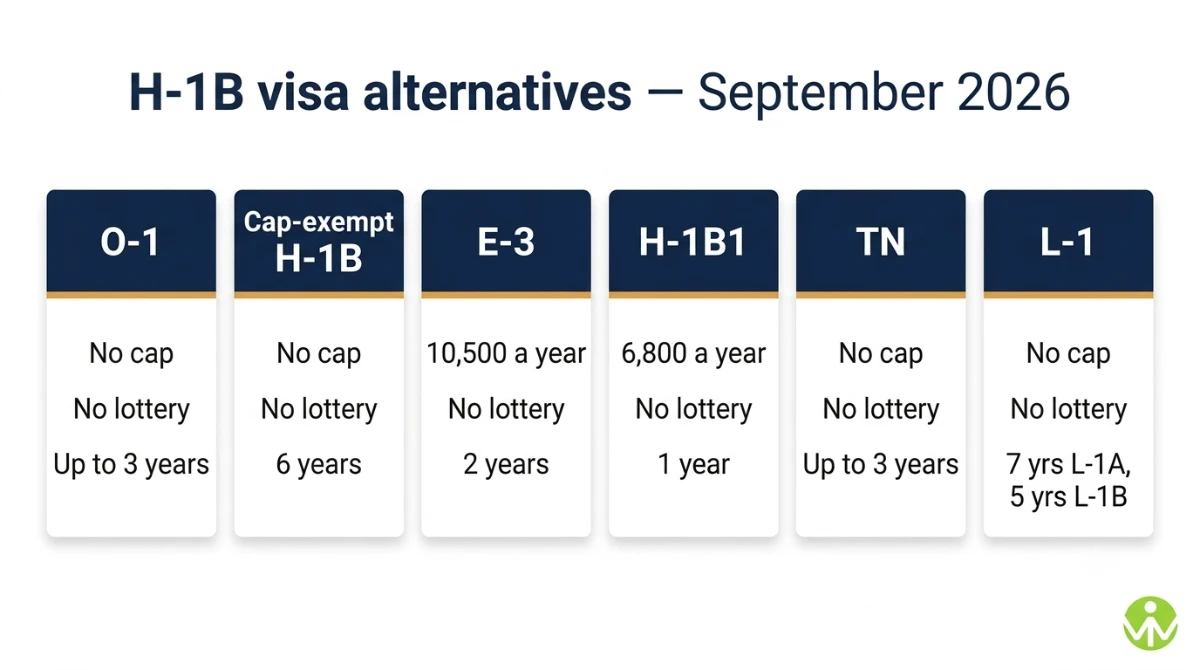
The table compares every route in this guide on the points that decide whether it is open to you: cap, lottery, who petitions, how long you can stay, and whether your spouse can work. Read it as a filter rather than a ranking — for most people only one or two rows are genuinely available. Figures come from the USCIS index of temporary worker classifications and from the statute.
Table 1 — H-1B visa alternatives compared (September 2026)
| Route | Who it fits | Annual cap | Lottery | Employer must petition | Initial stay | Maximum stay | Spouse may work |
|---|---|---|---|---|---|---|---|
| O-1A / O-1B | Proven top-of-field record in science, business, arts or sport | None | No | Yes — employer or agent | Up to 3 years | No fixed ceiling; 1-year extensions | No (O-3) |
| Cap-exempt H-1B | Hired by a university, affiliated non-profit, or non-profit or government research body | None | No | Yes | Up to 3 years | 6 years in H-1B status | Only with an H-4 EAD |
| E-3 | Australian nationals in a speciality occupation | 10,500 | No | LCA required; consular application possible | 2 years | No limit on extensions | Yes — incident to status |
| H-1B1 | Chilean and Singaporean nationals in a speciality occupation | 6,800 (1,400 + 5,400) | No | LCA required | 1 year | 1-year increments; no statutory ceiling | No |
| TN | Canadian and Mexican citizens in a listed USMCA profession | None | No | Job offer required; Canadians may apply at the border | Up to 3 years | Renewable indefinitely | No (TD) |
| L-1A | Managers and executives transferring inside the same corporate group | None | No | Yes | 3 years (1 year for a new office) | 7 years | Yes — incident to status |
| L-1B | Specialised-knowledge staff inside the same corporate group | None | No | Yes | 3 years (1 year for a new office) | 5 years | Yes — incident to status |
| J-1 trainee / intern | Structured training or an internship, not a job | None | No | Designated sponsor issues Form DS-2019 | 18 months / 12 months | Same as initial | Yes — J-2 with an EAD |
| H-2B | Seasonal or peak-load non-agricultural work | 66,000 | Yes — cap already reached | Yes | Up to 1 year | 3 years | No (H-4) |
| As of 14 September 2026. Sources: USCIS temporary worker category pages; 8 U.S.C. 1184(g); 22 CFR 62.22. Stay figures are maximum periods of authorised stay, not visa validity. | |||||||
O-1: the strongest of the H-1B visa alternatives
The O-1 is for people with a demonstrated record of extraordinary ability. O-1A covers science, education, business and athletics; O-1B covers the arts, and film and television on a separate standard. USCIS describes the O-1A bar as being among the small percentage who have risen to the very top of the field.
The evidence is either a one-time major internationally recognised award or, far more often, at least three of the eight criteria at 8 CFR 214.2(o)(3)(iii) — published material about you, original contributions of major significance, judging the work of others, a critical role for a distinguished organisation, high remuneration. Ticking three boxes is not the end of it: USCIS then applies a final merits assessment to the record as a whole, which is where many petitions come unstuck.
What puts the O-1 at the top of the H-1B visa alternatives is the mechanics, not the standard. No cap, no lottery, and you can file a petition in any month. USCIS grants up to three years initially and extends in increments of up to one year with no overall ceiling. You cannot self-petition, but an agent may file on your behalf — which makes the category work for consultants, founders, and anyone with several clients rather than one payroll. The trade-off falls on the family: O-3 dependants may study but may not work.
Alone among the H-1B visa alternatives it also has a clean onward path, because the same evidence usually maps across to EB-1A, EB-1B or a national interest waiver without a labour certification — see the guide to O-1 visa to green card routes. What the O-1 is not is a consolation prize for an unsuccessful lottery: if the record is not there, the category will not manufacture it.
Cap-exempt H-1B: the same visa, outside the lottery
The most overlooked of the H-1B visa alternatives is not another visa at all. It is the H-1B itself, filed by an employer Congress placed outside the numerical limits. Same speciality occupation test, same Labor Condition Application, same form. Only the employer is different.
Under 8 U.S.C. 1184(g)(5), a petition is exempt from the cap where the worker is employed at, or has an offer from, an institution of higher education or a related or affiliated non-profit entity, or a non-profit research organisation or a governmental research organisation. Universities, teaching hospitals, affiliated research institutes and national laboratories are the everyday examples. These petitions never enter the pool, so there is no March registration window and no selection to survive. One feature is worth knowing even if you never use it: a cap-exempt H-1B holder can, in the right circumstances, also work part-time for a cap-subject employer without that second job going through the lottery, for as long as the cap-exempt job continues.
The proposed fee has strengthened this column considerably. DHS states in the 25 August proposal that the $103,265 charge would apply to cap-subject petitions only, including advanced-degree exemption filings, and expressly not to cap-exempt filings. Of all the H-1B visa alternatives on the table, that is the clearest financial argument any of them currently has. Two cautions. Time spent in the United States in H-1B status counts toward the six-year maximum whether the petition was cap-exempt or not. And moving from a cap-exempt employer to an ordinary one puts you straight back into the draw.
Passport-based H-1B visa alternatives: E-3, H-1B1 and TN
For three groups of nationals the decisive fact is the passport rather than the résumé, and none of these H-1B visa alternatives runs a lottery. They share one caveat that rarely reaches the listicles: unlike the H-1B and L-1, none is a dual-intent category. You are expected to show you intend to leave, so pursuing permanent residence alongside them can complicate renewals and re-entry.
E-3 for Australian nationals
The E-3 is open only to nationals of Australia and uses the same speciality occupation standard as the H-1B, with a certified Labor Condition Application behind it. The annual limit is 10,500 under 8 U.S.C. 1184(g)(11)(B) and has never been a practical constraint. USCIS grants two years initially and extends in periods of up to two years with no limit on the number of extensions, subject to some exceptions. Its standout feature, and the reason it beats most H-1B visa alternatives on family terms, is that spouses in valid E-3 or E-3S status are employment authorised incident to status — materially better than the H-4 EAD they would need on the H-1B side. An E-3 can also be applied for directly at a consulate.
H-1B1 for Chilean and Singaporean nationals
The H-1B1 sets aside 6,800 places a year out of the 65,000 — 1,400 for nationals of Chile and 5,400 for nationals of Singapore. Unused numbers fall back into the general pool the following year. The statute fixes the period of authorised admission at one year, extendable only in one-year increments, so the renewal cycle is tighter than anything else here. A certified Labor Condition Application is required, as with the H-1B. Because the category is not dual-intent and does not support the H-4 EAD route, it suits people who are not actively queueing for a green card.
TN for Canadian and Mexican citizens
The TN exists under the United States-Mexico-Canada Agreement, which replaced NAFTA in 2020. It is open to citizens of Canada and Mexico whose profession appears on the agreement’s fixed list, and that list is where most refusals happen — the job has to genuinely be one of the named professions, not merely resemble one. There is no cap. Canadians can present documents to a CBP officer at a designated port of entry without obtaining a visa first; Mexicans apply at a consulate. Admission runs up to three years and is renewable indefinitely, and TD dependants may study but not work. Our guide to TN visa eligibility covers the mechanics.
L-1: the transfer route, and what changed on 9 September 2026
The L-1 is the one route among the H-1B visa alternatives you cannot reach by improving your own profile. It requires that you have already worked for a qualifying related entity abroad — parent, branch, subsidiary or affiliate — for one continuous year within the three years before admission. L-1A covers managers and executives; L-1B covers staff with specialised knowledge of the organisation’s products, services or methods. Employees opening a new US office get one year initially, and everyone else gets three, with extensions of up to two years to a maximum of seven years on an L-1A and five on an L-1B. L-2 spouses are employment authorised incident to status, and the L-1A feeds the EB-1C multinational manager category, which skips labour certification — one of the routes in the employment-based green card guide.
The change worth knowing about is five days old, and it is the reason the L-1 sits lower among the H-1B visa alternatives than it did a year ago. A DHS final rule published on 10 August 2026 (91 FR 51360) took effect on 9 September and requires covered employers to pay the 9-11 Response and Biometric Entry-Exit Fee on all extension-of-status petitions — including extensions filed by the same employer for the same employee, where the fraud prevention and detection fee does not apply. A covered employer has 50 or more US employees, more than half of them in H-1B, L-1A or L-1B status. The fee is $4,500 on an L-1 petition and $4,000 on an H-1B one. For the large IT services employers that treated the L-1 as the cheaper way round the cap, the gap has narrowed.
J-1 and H-2B: the narrower H-1B visa alternatives
The J-1 trainee and intern categories are for structured training rather than employment. A Department of State-designated sponsor issues Form DS-2019 against a training plan on Form DS-7002; you do not simply find an employer. Under 22 CFR 62.22(k) a training programme runs to a maximum of 18 months and an internship to 12, with agriculture and the Hospitality and Tourism category capped at 12 months for training too. Interns must be currently enrolled, or have graduated no more than 12 months before the programme begins. The caveat the lists omit matters more than any of that: some J-1 participants are subject to the two-year home-residency requirement under INA 212(e), and where it applies you cannot change status to H-1B or adjust status until it is satisfied or waived.
The H-2B covers temporary non-agricultural work — seasonal, peak-load or one-off need — capped at 66,000 a year. It is not a professional route, and of all the H-1B visa alternatives it is the one actually shut at the moment: USCIS reached the cap for the first half of FY2027 on 4 September 2026 and is rejecting cap-subject petitions with start dates before 1 April 2027.
Routes that are not H-1B visa alternatives
Four things appear on nearly every list of H-1B visa alternatives and should not. Each is genuinely useful; none substitutes for a sponsored work visa.
- B-1 business visitor. A B-1 authorises no employment and no US payroll. Using it as a short-term work permit is the most common and most consequential misuse in this area — our B-1 visa guide sets out where the line falls.
- OPT and the STEM extension. Optional Practical Training is work authorisation attached to F-1 status — not a visa, and not sponsorship. Twelve months, plus 24 more with the STEM OPT extension, buys time to enter the lottery again across several years. It is a clock, not a destination.
- EB-2 NIW and EB-1A. Green card categories. They appear on these lists because they can be self-petitioned, but an approved Form I-140 is not work authorisation — you still need a status to hold while the queue moves. The comparison of EB-1A and EB-2 NIW covers which suits which record.
- EB-5 and E-2. EB-5 is an investment-based permanent residence route, covered in the US golden visa guide, not an employment one. The E-2 treaty investor category does let essential employees be sponsored, but it turns on your employer being a treaty company and on your own nationality — and there is no US–India E-2 treaty.
For a broader map of the system than this one branch of it, the complete guide to types of US visa covers every category, and H-1B to green card picks up where a temporary work visa leaves off.
Which of the H-1B visa alternatives fits your situation
Most readers arrive with one of a small number of profiles, and that profile narrows the H-1B visa alternatives faster than any feature comparison. This table works backwards from your situation.
Table 2 — Which H-1B visa alternative to look at first
| Your situation | Look at first | Why |
|---|---|---|
| You are an Australian, Chilean, Singaporean, Canadian or Mexican national | E-3, H-1B1 or TN | Citizenship takes you out of the lottery completely |
| You already work for a multinational that has a US entity | L-1A or L-1B | One continuous year abroad in the last three is essentially the whole test |
| You have awards, publications, press coverage or a senior technical record | O-1A | No cap, no lottery, and the same evidence maps onto EB-1A later |
| You would consider a university, research institute or affiliated non-profit | Cap-exempt H-1B | Same visa, filed any month, and outside the proposed $103,265 fee |
| You are on OPT with time still on the clock | Stay on OPT and register again | OPT is a bridge to more lottery attempts, not a destination |
| You want permanent residence and have a strong independent record | EB-1A or EB-2 NIW | A green card route rather than a work visa — you still need a status to hold meanwhile |
| You only need to attend meetings or negotiate a contract in the US | B-1 | A visitor visa: no employment, no US payroll, no substitute for sponsorship |
| Indicative only. Eligibility for every route above turns on facts this table cannot capture — check the relevant USCIS category page before acting. | ||
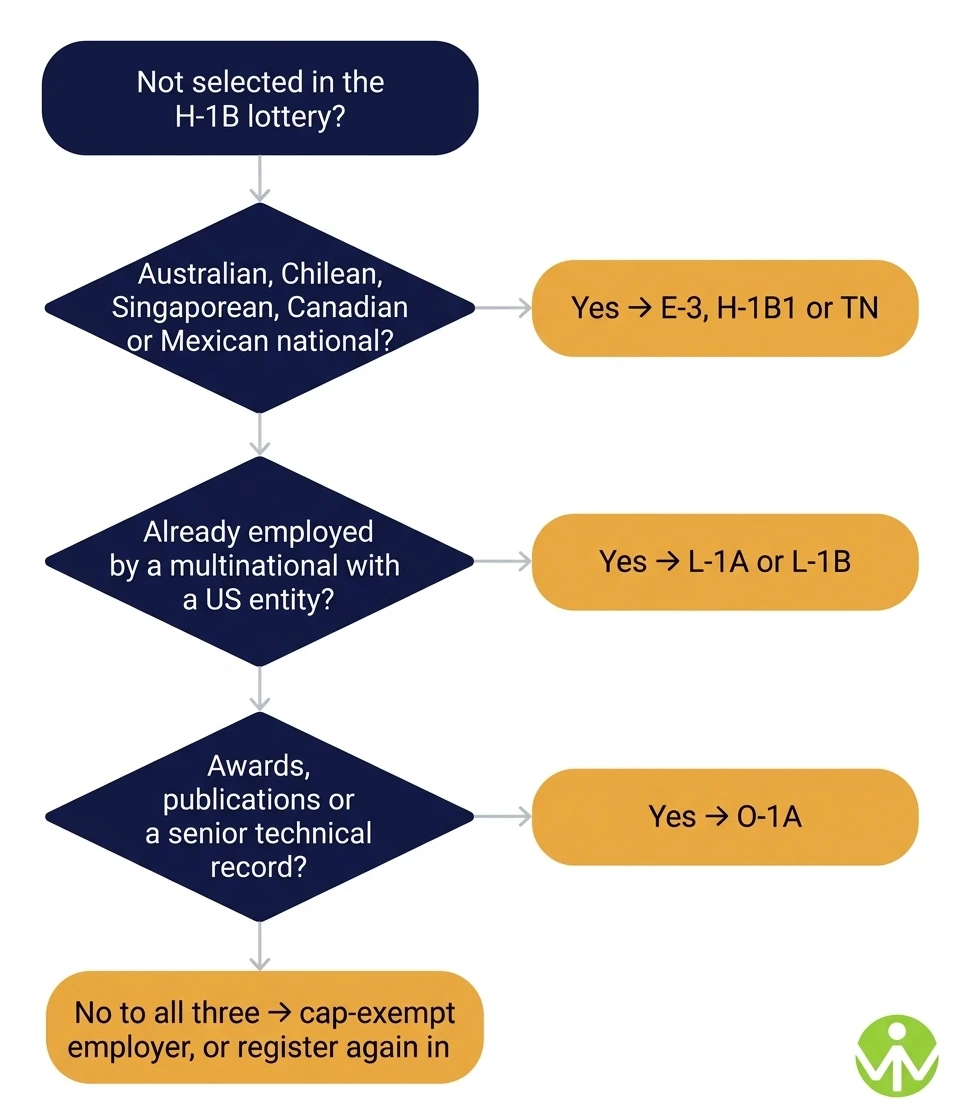
One closing point. If no row describes you, the realistic answer is often to stay in whatever status you hold, get your wage level as high as the role honestly supports, and register again in March. That is not a failure of H-1B visa alternatives — it is a recognition that for many people the H-1B is still the right category, and the only real question is timing.
Frequently asked questions about H-1B visa alternatives
Which H-1B visa alternatives do not require an employer to sponsor you?
None of the temporary work categories. Every route in the comparison table needs someone to file Form I-129 for you. The O-1 comes closest to an exception, because an agent may file in place of an employer. True self-petitioning exists only on the permanent residence side, through EB-1A or a national interest waiver, and an approved petition there does not authorise you to work.
Are there H-1B visa alternatives with no annual cap at all?
Four of the H-1B visa alternatives carry no numerical limit at all: the O-1, the TN, the L-1 and cap-exempt H-1B employment. The E-3 and the H-1B1 have caps, at 10,500 and 6,800 places a year, but neither has been a practical obstacle. The H-2B, at 66,000, is the one category on this page where the cap regularly binds.
Is the $100,000 H-1B payment still being collected?
No. The US District Court for the District of Massachusetts vacated the guidance implementing it on 8 June 2026, and the First Circuit denied the government’s motion for a stay on 24 July 2026. DHS has said it disagrees but will comply while it considers next steps, and that it still plans to collect the payment if the order is later lifted.
Would the proposed $103,265 fee apply to every H-1B petition?
No. As proposed on 25 August 2026 it reaches cap-subject petitions only, including those filed under the advanced degree exemption, and DHS states expressly that it would not apply to cap-exempt filings. It would sit on top of all other fees, including any payment required under a presidential proclamation. It is still a proposed rule, and the comment period runs to 24 September 2026.
Does time on a cap-exempt H-1B count toward the six-year limit?
Yes. Time physically spent in the United States in H-1B status counts toward the six-year maximum whether the petition was cap-exempt or cap-subject. Time spent outside the country during that period can generally be recaptured and added back.
Are the E-3, H-1B1 and TN categories dual-intent?
No, and that difference is what catches people out. The H-1B and the L-1 tolerate an intention to settle permanently; these three H-1B visa alternatives do not. You are expected to show you intend to depart at the end of your authorised stay, which can make renewals and re-entry awkward once a green card process is visibly underway.