
The H-1B to green card route is the path most H-1B workers take toward permanent residence in the United States, and for many of them it is the longest stretch of their immigration journey. The visa is temporary — six years in most cases. The queue it feeds into is not bounded in the same way, and for applicants born in a few specific countries it now runs longer than a working career.
This guide covers the H-1B to green card process stage by stage, what a priority date actually is, where the categories stand in the October 2026 Visa Bulletin, how to hold status while waiting, and which routes genuinely shorten the wait. The route is one part of the wider employment-based green card system; this guide assumes you already hold H-1B status, and if you are earlier than that, start with the H-1B visa guide. For the other four routes to permanent residence, see the US green card overview.
H-1B to green card: key takeaways
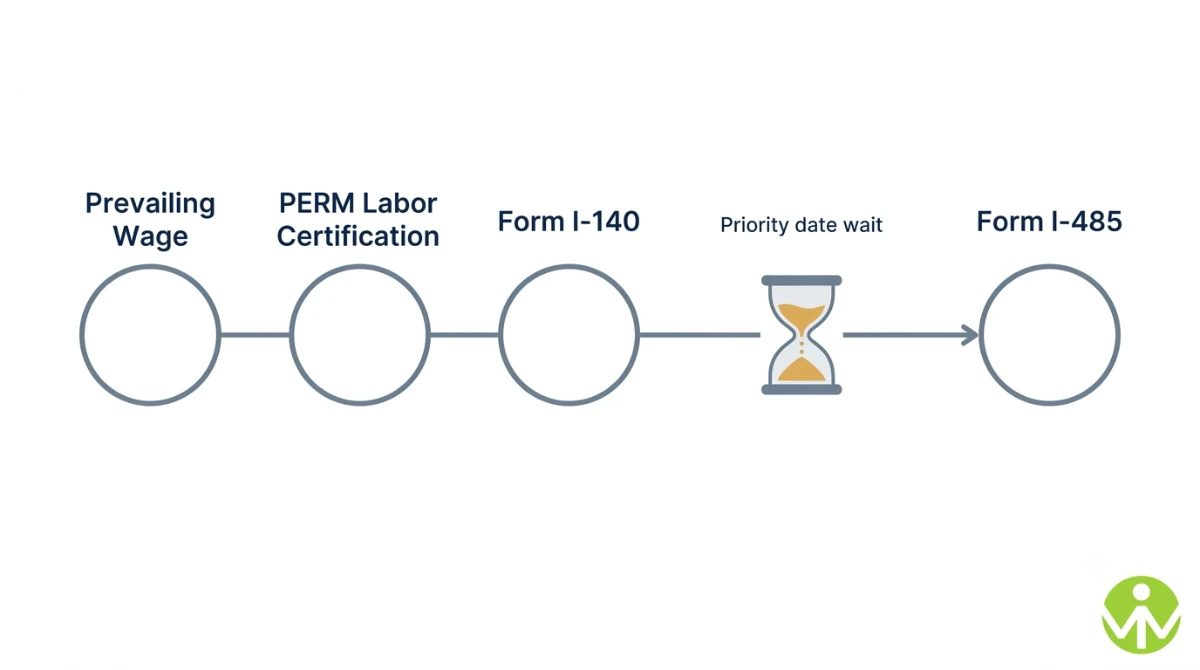
- The H-1B to green card route runs through four stages — prevailing wage, PERM labor certification, Form I-140 and Form I-485 — plus a wait for a visa number that is separate from all of them.
- Those four stages averaged about 3.4 years in the most recent full analysis. The wait for a visa number can add decades, and only for applicants born in a handful of countries.
- A 7% per-country ceiling, not a separate quota, creates that gap. Every country draws on the same allocation — 28,862 visas in the 2026 fiscal year — regardless of size.
- In the October 2026 Visa Bulletin, which opened the 2027 fiscal year, EB-2 India returned at 1 November 2013 and EB-3 India stayed at 1 January 2014. EB-3 is now two months ahead of EB-2 for India on Final Action Dates, and both share a Dates for Filing cutoff, so the gap behind downgrading decisions has almost closed.
- AC21 keeps the H-1B alive past six years — one year at a time with a PERM or I-140 filed 365 days ago, or three years at a time with an approved I-140 and no current priority date.
- Job changes are possible throughout the H-1B to green card process, but the protections differ before I-140 approval, after 180 days of approval, and after 180 days of a pending I-485.
Table of Contents
How the H-1B to green card process works
Most cases run through the employment-based preference system. Two categories make up the bulk: EB-2, for positions requiring an advanced degree or its equivalent, and EB-3, for positions requiring a bachelor’s degree or two years of training or experience. The wider set of employment-based preference categories also includes EB-1, EB-4 and EB-5. In a standard EB-2 or EB-3 case, the employer drives the first three stages, and the worker only files at the end.
Table 1: The four stages of the H-1B to green card process
| Stage | What it establishes | Who files | Typical duration |
|---|---|---|---|
| Prevailing wage determination | The minimum salary the Department of Labor requires for the role | Employer, to DOL | About 187 days |
| Recruitment and PERM labor certification | That no qualified US worker is available for the position | Employer, to DOL | About 141 days of recruitment, then about 483 days of adjudication |
| Form I-140 immigrant petition | The preference category and the priority date | Employer, to USCIS | About 234 days, or 15 business days with premium processing |
| Form I-485 adjustment of status | Permanent residence itself | Worker, to USCIS | About 210 days |
| Averages from a Cato Institute analysis of Department of Labor and USCIS data for the second quarter of FY2025, totalling about 3.4 years. Excludes the wait for a visa number, which is separate and, for backlogged countries, longer than every stage above combined. | |||
Stage one: the prevailing wage determination
The employer asks the Department of Labor to set the prevailing wage for the role in that occupation and location, and the offered salary must meet that rate. As of 7 August 2026, the Department was issuing determinations for requests received in April 2026.
Stage two: PERM labor certification
The employer then runs a prescribed recruitment campaign to test whether a qualified, willing and available US worker exists for the role. If none is found, it files Form ETA-9089 and the Department certifies the position. The date that filing is received becomes the priority date — the queue ticket that governs everything afterwards. Cases entering analyst review in July 2026 had taken an average of 372 calendar days; audited cases take longer.
Stage three: Form I-140
With PERM certified, the employer files Form I-140, which fixes the preference category and confirms the priority date. The fee is $715 on paper or $665 online, and most employers also owe an Asylum Program Fee of $600, which is reduced to $300 for employers with 25 or fewer full-time employees and is waived for non-profits. Premium processing costs $2,965 as of 1 March 2026 and returns a decision on a PERM-based I-140 within 15 business days.
Stage four: adjustment of status
Form I-485 is the application for permanent residence itself — the only stage the worker files personally, and the one that later opens the route to US citizenship. It costs $1,440 on paper or $1,390 online, and can carry Form I-765 for work authorisation and Form I-131 for advance parole. It cannot be filed until a visa number is available under the chart USCIS designates for that month. Applicants outside the United States use consular processing and Form DS-260 instead.
What a priority date means for an H-1B to green card case
A priority date is not an appointment. It is a position in a queue, set by the day the PERM application was filed. Each month the State Department publishes a Visa Bulletin with two charts. Final Action Dates indicate which priority dates are eligible for permanent residence. Dates for Filing say which can submit the application, and usually run further ahead. USCIS states each month which chart employment-based adjustment applicants may use; in October 2026 it was Dates for Filing, after Final Action Dates applied in September.
A category marked “C” is current, meaning no queue at all. A category marked “U” is unavailable, meaning the annual allocation is exhausted and nothing further will be issued until the fiscal year resets on 1 October. Dates can also move backwards, which is called retrogression.
Table 2: H-1B to green card priority dates, September 2026 Visa Bulletin
| Category | All other countries | China | India | India (Dates for Filing) |
|---|---|---|---|---|
| EB-1 | Current | 1 July 2023 | 1 February 2023 | 1 July 2024 |
| EB-2 | 1 January 2025 | 1 October 2021 | 1 November 2013 | 15 January 2015 |
| EB-3 professionals and skilled workers | 15 May 2024 | 8 January 2022 | 1 January 2014 | 15 January 2015 |
| EB-3 other workers | 1 January 2022 | 1 October 2019 | 1 January 2014 | 15 January 2015 |
| EB-5 unreserved | Current | 1 December 2016 | 1 December 2023 | 1 May 2024 |
| Final Action Dates unless the column says otherwise. Source: US Department of State Visa Bulletin for October 2026, the first bulletin of the 2027 fiscal year. USCIS allowed employment-based adjustment applicants to use the Dates for Filing chart in October 2026. EB-2 and EB-3 for all other countries retrogressed from their September positions to keep issuance within FY2027 limits. Dates are republished monthly and can retrogress. | ||||
Why the H-1B to green card wait is uneven across countries
Two people doing the same job at the same company can face wildly different waits, and one statutory rule explains it. No country may take more than 7% of the combined family-sponsored and employment-based preference totals. For the 2026 fiscal year that came to 28,862 visas, set against a worldwide employment-based limit of 186,317 — itself well above the statutory floor of 140,000, because unused family-sponsored numbers fall across into the employment categories. The 7% ceiling is identical for every country, so one sending a hundred applicants and one sending a hundred thousand draw on the same allocation.
Chargeability follows country of birth, not citizenship. Acquiring another passport does not move an applicant out of the queue. India accounts for the great majority of H-1B petitions, so the H-1B to green card queue for India-born applicants absorbs demand many times its allocation. A Cato Institute analysis using March 2023 data put the employment-based backlog at about 1.8 million people, roughly 1.1 million of them born in India. Attempts to remove the country ceiling have repeatedly stalled — the fullest account is the history of the S.386 bill.
Where the H-1B to green card queues stand in October 2026
The October 2026 bulletin opened the 2027 fiscal year with a fresh allocation, and two changes stand out for H-1B workers. EB-2 India, unavailable at the end of the 2026 fiscal year, returned with a Final Action Date of 1 November 2013 — earlier than the 15 July 2014 the August bulletin had projected. EB-3 India stayed at 1 January 2014. For everyone else, EB-2 lost its current status and retrogressed to 1 January 2025, and EB-3 moved back to 15 May 2024; the State Department said these retrogressions were needed to keep issuance within FY2027 quarterly and annual limits.
That reopens the downgrading question. Between 2020 and early 2024 EB-3 India ran ahead of EB-2 India, and thousands filed a second I-140 in EB-3 using the same PERM certification and retained priority date — a manoeuvre known as downgrading. From the April 2026 bulletin, when EB-2 India advanced 303 days in a single month, EB-2 was the more advanced of the two. In October 2026 the order flipped back on Final Action Dates, with EB-3 India two months ahead, while both categories share a Dates for Filing cutoff of 15 January 2015. A margin that small can reverse within a single bulletin, so H-1B to green card advice on downgrading dates quickly.
Holding status when the H-1B to green card wait outlasts six years
H-1B status is capped at six years. Because the queue routinely outlasts that, the American Competitiveness in the Twenty-First Century Act of 2000 — AC21 — provides two ways to keep extending. They are less alternatives than successive stages of one H-1B to green card case: section 106(a) covers the period while the case is being built, section 104(c) the period after the I-140 is approved and the real wait begins.
Table 3: Extending H-1B status during the H-1B to green card wait
| Provision | What it requires | Length granted | Main condition |
|---|---|---|---|
| AC21 section 106(a) | A PERM application or Form I-140 filed at least 365 days earlier. It does not have to be approved — pending is enough. | One year at a time, renewable | Ends if the PERM application or I-140 is denied |
| AC21 section 104(c) | An approved Form I-140 in EB-1, EB-2 or EB-3, and a priority date that is not current because of per-country or worldwide limits | Up to three years at a time, renewable | Once a visa number becomes available, adjustment or an immigrant visa should generally be sought within one year |
| Recapture of time abroad | Documented full days spent physically outside the United States while in H-1B status | Those days added back to the six-year total | Requires travel records; independent of any green card case |
| AC21 is the American Competitiveness in the Twenty-First Century Act of 2000. Extensions under both provisions may be granted repeatedly. Summary only — individual cases turn on their own facts. | |||
Two practical points sit alongside the table. Extensions must be filed before the current I-94 expires, and once a timely extension is pending the worker may generally keep working for the same employer for up to 240 days while it is adjudicated. Separately, any full day spent outside the United States while in H-1B status can be recaptured and added back to the six years, provided the days are documented.
One condition on section 104(c) is easy to miss. Once a visa number does become available, the applicant is generally expected to apply for adjustment of status or an immigrant visa within a year. Letting that year pass without filing can cost eligibility for further extensions under the provision.
Changing jobs during the H-1B to green card process
Three separate protections govern job changes, and they switch on at different moments. Conflating them is a common and expensive error.
H-1B portability is the first: a new employer files a fresh petition, and the worker may generally begin work once USCIS receives it. This protects the visa, not the H-1B to green card case underneath it.
Priority date retention is the second. An I-140 that has been approved for at least 180 days generally survives the sponsoring employer withdrawing it, and the priority date it established can be carried to a new employer’s petition. Leave before that mark and a withdrawal can take the approval — and the queue position — with it. The PERM certification is not portable; the new employer repeats that stage.
AC21 portability under section 106(c) is the third and strongest. Once Form I-485 has been pending 180 days or more, the applicant may move to a new employer or position in the same or a similar occupational classification and keep the pending application, confirming the move on Form I-485 Supplement J. USCIS does not decide “same or similar” by matching occupation codes; it weighs duties, required experience and education, wage level and occupational outlook together, case by case.
What the H-1B to green card wait means for families
Spouses and unmarried children under 21 hold H-4 status. A spouse may apply for work authorisation only once the H-1B worker has an approved I-140 or an AC21 extension beyond six years — so the household’s second income is gated on the H-1B to green card case reaching stage three. The mechanics are in the guide to H-4 EAD work authorisation. Since 30 October 2025 automatic extensions no longer apply to those renewals, which makes filing early a necessity rather than a preference.
Children are the harder problem. A child who turns 21 before the family reaches the front of the queue ages out of the parent’s application. The Child Status Protection Act subtracts the time the I-140 was pending from the child’s age at the moment a visa becomes available, and requires the family to seek permanent residence within a year of that moment. From 15 August 2025, USCIS has calculated the availability date using Final Action Dates rather than the earlier and more generous Dates for Filing chart — a change that narrows CSPA protection for exactly the families whose queues are longest.
Routes that can shorten the H-1B to green card wait
There is no way to buy a better position in an EB-2 or EB-3 queue, but there are ways out of it. Moving to EB-1 is the most direct: EB-1 has its own annual allocation, and for India-chargeable applicants it stood at 1 February 2023 in October 2026 — roughly nine years ahead of EB-3. Two routes let an applicant petition with no employer and no PERM certification at all, extraordinary ability and the national interest waiver, and both are set out in the comparison of EB-1A and EB-2 NIW self-petition routes.
Anyone already holding an O-1 has most of that evidence assembled, which is why the O-1 to green card route runs the same way. Applicants with capital to invest have one more exit that needs no employer and no PERM: the EB-5 visa, whose reserved rural, high-unemployment and infrastructure queues were current for every country in October 2026.
That advantage carries a warning, though. The September 2026 bulletin had cautioned that heavy demand could make EB-1 India unavailable before the 2026 fiscal year ended; the fresh FY2027 allocation moved it forward instead. The nine-year gap is real, but anyone planning an H-1B to green card move around it should check the current month rather than rely on it holding.
Cross-chargeability is the second, and it costs nothing. A married couple may charge the application to either spouse’s country of birth, so where one spouse was born outside the backlogged countries the whole family can use that country’s queue — where the October 2026 cutoffs sat about 21 months behind the calendar in EB-2 and about 29 months behind in EB-3.
The third is administrative discipline. Keeping the I-140 approved, the H-1B extended, the H-4 EAD current and the family’s CSPA position monitored costs nothing and preserves everything; most of the damage done to long-backlogged H-1B to green card cases is procedural rather than substantive.
What could change in the H-1B to green card system
Less than the volume of commentary suggests. The Department of Homeland Security’s “Petition for Immigrant Worker Reforms” rule, which would have rewritten parts of the EB-1, EB-2 and EB-3 regulations, was withdrawn on 12 November 2025 before it was ever published for comment, and has since come off the regulatory agenda. Legislation to remove the per-country ceiling has been introduced repeatedly since S.386 expired in January 2021 and has not passed.
The nearer-term movements are mechanical. Priority dates reset on 1 October each year when a fresh allocation becomes available, which is why categories marked unavailable in August and September often reopen sharply in October — as EB-2 India and EB-5 unreserved India both did in October 2026. On the visa side rather than the green card side, 2026 brought the shift to wage-weighted lottery selection, a wider set of H-1B rule changes, and the $100,000 fee that courts vacated in June 2026, which is not being collected while the appeal proceeds.
Frequently Asked Questions
How long does the H-1B to green card process take?
The employer-side stages — prevailing wage, PERM, I-140 and I-485 — averaged about 3.4 years in the most recent full analysis of Department of Labor and USCIS data, or about 2.8 years where premium processing was used for the I-140. The wait for a visa number sits on top of that and is what actually determines an H-1B to green card timeline. For applicants not subject to a country backlog it is much shorter, though no longer zero in EB-2 after the October 2026 retrogression; for EB-2 and EB-3 applicants born in India, it currently runs into decades.
Can I start the H-1B to green card process in my first year?
Yes, and there is a reason to. Nothing requires a waiting period, and starting early matters because AC21 section 106(a) only allows extensions past six years once a PERM application or I-140 has been on file for 365 days — which in practice means beginning by the fourth or fifth year at the latest.
Does changing employers reset my priority date?
No, provided the I-140 has been approved for at least 180 days. The priority date is retained and can be used by a new employer’s petition. The PERM labor certification does not transfer, so the new employer repeats that stage, but the queue position is preserved. Leaving before the 180-day mark exposes the approval to withdrawal by the former employer.
What happens if my H-1B runs out before the green card arrives?
That is the situation AC21 was written for. With a PERM or I-140 filed at least 365 days earlier, extensions are granted a year at a time. With an approved I-140 and a priority date that is not current, they are granted up to three years at a time and can be renewed repeatedly. Recapturing days spent outside the United States adds further time.
Is it still worth downgrading from EB-2 to EB-3?
It depends on the month, and the margin is now thin. For India-chargeable applicants, EB-2 ran ahead of EB-3 from the April 2026 bulletin until the end of the 2026 fiscal year. The October 2026 bulletin reversed that on Final Action Dates: EB-3 India at 1 January 2014, EB-2 India at 1 November 2013, a two-month difference, with both sharing a Dates for Filing cutoff of 15 January 2015. Downgrading requires a new I-140, the order has flipped twice since 2024, and a gap this small can reverse within one bulletin, so checking the current month matters more than any general rule.
Can my spouse work during the H-1B to green card wait?
An H-4 spouse can apply for an employment authorisation document once the H-1B worker has an approved I-140 or an AC21 extension beyond six years. Once Form I-485 is filed, the spouse can instead apply for an EAD on that basis. Automatic extensions of expiring EADs ended for renewals filed on or after 30 October 2025, so renewals need to go in well ahead of expiry.
Which Visa Bulletin chart applies to my H-1B to green card filing?
USCIS announces each month which chart employment-based adjustment applicants may use — it was Dates for Filing for October 2026, after Final Action Dates in September. Final Action Dates show which priority dates can be approved; Dates for Filing show which can submit the application and usually run further ahead. Separately, since 15 August 2025, USCIS uses Final Action Dates for Child Status Protection Act age calculations regardless of which chart applies to filing.