
A startup visa is a residence permit issued on the strength of a business idea rather than a job offer, and in 2026 roughly twenty countries run one. Which countries those are has changed more in the last three years than in the decade before it. Three well-known schemes have shut, including the one every list used to single out, and one of the most-copied has been replaced by something considerably more expensive.
This guide sets out every scheme open as of August 2026, what each one asks for, what it costs, and which familiar names are no longer available. Where a country’s route has closed or been replaced, that is stated plainly rather than left in a list.
Key Takeaways
- A startup visa is a residence permit granted on the strength of a business idea rather than a job offer. Around twenty countries run one in 2026.
- Europe offers the widest choice. Estonia, Denmark, the Netherlands, France, Ireland, Italy, Spain, Portugal, Austria and Finland all operate an active scheme.
- Two established routes have closed since 2023: the UK’s Start-up visa in July 2023 and New Zealand’s Entrepreneur Work Visa in August 2025.
- Canada’s Start-Up Visa is closed. The final filing deadline of 30 June 2026 has passed, and a replacement entrepreneur pilot has been signalled but not published.
- The United States has never created a startup visa. Founders use the International Entrepreneur Rule, the E-2 treaty investor visa or the O-1A instead.
- Money requirements range from no fixed figure at all in the Netherlands and Estonia to NZD 1 million under New Zealand’s replacement scheme.
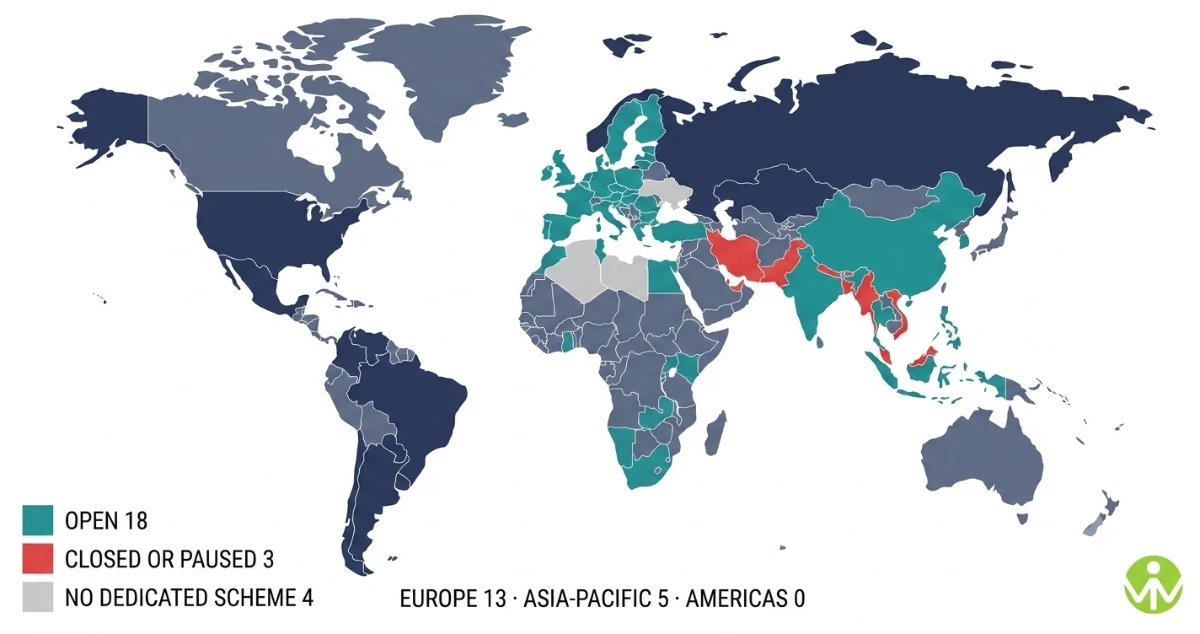
Table of Contents
What a startup visa actually is
The term is used loosely. A startup visa, in the strict sense, is an immigration category in which the qualifying test is the business itself: its novelty, scalability, and plan. That is different from an investor visa, where the test is money, and different again from a talent visa, where the test is the applicant’s track record. The distinction matters because several countries marketed as founder destinations actually run one of the other two.
In practice, open schemes filter founders in one of three ways. Some require endorsement — an incubator, accelerator, expert panel, or designated agency has to vouch for the venture before immigration authorities review the file. Denmark, Estonia, Italy, France, Portugal and the United Kingdom all work this way. Some set a capital threshold, as Austria and Ireland do. A few, notably the Netherlands, do neither and rely on a vetted mentor instead.
Almost all of these schemes are temporary permits. Only Canada designed its scheme to grant permanent residence directly, and that scheme has now closed.
Which countries offer a startup visa in 2026
The table below covers every jurisdiction with a founder-specific route, as well as the significant economies where founders expect to find a startup visa but do not. Status is as of August 2026.
Table 1: Startup visa by country, status August 2026
| Country | Scheme | Status (Aug 2026) | Core requirement | Leads to PR? |
|---|---|---|---|---|
| Estonia | Startup Visa | Open | Startup Committee approval; no capital minimum | Via general residence rules |
| Denmark | Startup Denmark | Open (capped at 75/year) | Expert panel approval of business plan | Via general residence rules |
| Netherlands | Start-up residence permit | Open | Contract with an IND-vetted facilitator | Through self-employed permit |
| France | French Tech Visa (Talent permit) | Open | Selection by a partner incubator or accelerator | Via general residence rules |
| Ireland | Start-up Entrepreneur Programme (STEP) | Open | EUR 50,000 funding available to the business | Via general residence rules |
| Italy | Italia Startup Visa | Open | ISV Committee nulla osta; within Decreto Flussi self-employment quota | Via general residence rules |
| Spain | Entrepreneur visa (Startups Law) | Open | Favourable ENISA innovation report | Via general residence rules |
| Portugal | StartUP Visa / D2 | Open | Certified incubator contract (StartUP Visa) | Via general residence rules |
| Austria | Red-White-Red Card (Start-up Founders) | Open | 50 of 85 points; EUR 30,000 company capital | Card plus after 24 months |
| Finland | Start-up entrepreneur permit | Open | Business Finland eligibility statement | Via general residence rules |
| Latvia | Startup Visa | Open | Startup programme endorsement | Via general residence rules |
| Lithuania | Startup Visa | Open | Expert committee assessment | Via general residence rules |
| United Kingdom | Innovator Founder | Open (replaced Start-up visa) | Endorsement by an approved endorsing body | Settlement after 3 years |
| Germany | None (section 21 self-employment) | No dedicated scheme | Economic interest or regional demand | Settlement permit after 3 years |
| Singapore | EntrePass | Open | 30% shareholding plus one of five qualifying grounds | Separate PR application |
| Japan | Startup Visa to Business Manager | Open (terms tightened) | Municipal certification; JPY 30m capital from Oct 2025 | Via general residence rules |
| South Korea | D-8-4 technology startup visa | Open | Registered IP plus a registered Korean corporation | Via general residence rules |
| Thailand | SMART S visa | Open | THB 600,000 deposit; targeted-industry certification | No direct PR pathway |
| Malaysia | Malaysia Tech Entrepreneur Programme | Open | MDEC endorsement for tech founders | No direct PR pathway |
| Hong Kong | Entry for investment as entrepreneurs | No dedicated scheme | No fixed minimum; economic contribution test | After 7 years’ ordinary residence |
| Canada | Start-Up Visa | Closed to new applicants | Final filing deadline of 30 Jun 2026 has passed | Was direct permanent residence |
| Chile | Start-Up Chile (accelerator) | Open, not a visa category | Acceptance into the Corfo programme | Via general residence rules |
| United States | None (International Entrepreneur Rule) | No startup visa | USD 311,071 qualified investment for IER parole | No; parole is not a PR route |
| Australia | None since BIIP closure | Closed 31 Jul 2024 | National Innovation Visa is a talent route, not a startup visa | NIV grants PR directly |
| New Zealand | Business Investor Work Visa | Entrepreneur Work Visa closed 27 Aug 2025 | NZD 1m or NZD 2m investment | Work-to-residence pathway |
| Status verified against official government sources, August 2026. Schemes marked “no dedicated scheme” have founder routes that are not startup visas in the strict sense. | ||||
Four smaller schemes — Finland, Latvia, Lithuania and Malaysia — appear in the table but are not covered in detail below. All four are active and all four are endorsement-based rather than capital-based.
Startup visa routes in Europe
Europe holds more open schemes than the rest of the world combined, and they differ sharply in what they demand.
Estonia
The Estonian startup visa is assessed by a Startup Committee looking for an innovative, scalable and repeatable business model backed by a working product and early traction. There is no minimum capital requirement, which sets it apart from Estonia’s ordinary business residence permit and its EUR 65,000 threshold. The state fee is EUR 80 for a long-stay visa, valid up to 365 days and extendable by a further 183. Our Estonian startup visa guide covers the application steps.
Denmark
Startup Denmark runs on expert approval rather than money. A panel appointed by the Danish Business Authority must approve the business plan before SIRI will consider the residence application. Teams of up to three people may share one plan, the scheme is capped at 75 permits a year, and the processing fee is DKK 3,060. Applicants show DKK 153,240 in self-support funds for a single person. The first permit runs two years, extendable in three-year blocks. Our Startup Denmark guide has the details.
Netherlands
The Dutch start-up residence permit is built around a facilitator: an experienced mentor vetted by the IND who signs a contract with the founder. There is no fixed investment figure. The permit lasts up to 1 year, after which the founder is expected to transition to the self-employed person permit. It is one of the few routes where the means test can be satisfied by the facilitator financing the stay rather than by the founder’s own savings. Our Netherlands startup visa guide explains the facilitator relationship.
France
France folded its founder route into the Talent residence permit family. The French Tech Visa for Founders requires selection by a partner incubator or accelerator, which validates the project’s innovative character and notifies the Directorate General for Enterprise. Founders show annual means at least equal to the French minimum wage. The permit runs up to four years, is renewable, and spouses receive a Talent – Family permit with full work rights. The French Tech Ticket cash grant that older guides describe no longer exists. Our French startup visa guide predates this restructuring.
Ireland
Ireland’s Start-up Entrepreneur Programme sets the clearest money test in Europe: EUR 50,000 in funding available to the business, plus a EUR 350 non-refundable application fee. An evaluation committee considers proposals quarterly. The business must be innovative, high-potential and capable of creating employment. Ireland no longer accepts applications to the programme from Russian or Belarusian citizens.
Italy
The Italia Startup Visa is handled by a dedicated ISV Committee, which issues a nulla osta within 30 days of a complete application. Unlike Italy’s Investor Visa, it does not sit outside the quota system: startup visas are issued within the Decreto Flussi self-employment quota, which the DPCM of 2 October 2025 sets at 650 places a year for 2026–2028, 500 of them for listed categories that include innovative-startup founders. The first permit is a one-year self-employment visa for startup purposes, convertible into a two-year self-employment residence permit. Applicants document financial resources for the venture and for their own support. Our Italian startup visa guide walks through the committee stage.
Spain
Spain rebuilt its entrepreneur route under the 2022 Startups Law. The decisive step is a favourable report from ENISA confirming the business is genuinely innovative and of economic interest; the Large Companies and Strategic Collectives Unit then issues the permit. There is no headline minimum investment — the innovation assessment does the filtering instead. Any guide that describes Spain as having no assessment stage reflects the pre-2023 position. Our Spanish entrepreneur visa guide needs updating on this point.
Portugal
Portugal runs two adjacent routes. The StartUP Visa requires a contract with an incubator certified under the National Network of Incubators and asks the founder to show roughly EUR 5,147 in personal funds; the business must be capable of reaching EUR 325,000 in turnover or asset value within five years. The D2 visa is the broader entrepreneur route for founders who do not want incubation. Our Portugal D2 guide sets out the difference.
Austria
Austria’s Red-White-Red Card for Start-up Founders is a points scheme requiring 50 of a possible 85 points across qualifications, work experience, language and bonus criteria. It carries a hard money test: EUR 30,000 in company capital with an equity share of at least 50 per cent, with a further EUR 50,000 in committed investment worth 10 bonus points. The card runs up to 24 months, after which holders move to the Red-White-Red Card plus and unrestricted labour market access. Our Red-White-Red Card guide covers the points table.
United Kingdom
The UK closed its Start-up visa on 13 July 2023. Founders now use the Innovator Founder route, which requires endorsement from an approved endorsing body — GBP 1,000 for the endorsement, plus GBP 500 for each of the two mandatory check-in meetings. The visa costs GBP 1,357 from outside the UK, runs three years, sets no minimum investment figure, and can lead to settlement after three years. Our UK Innovator Founder guide is current.
Germany, the large economy without a startup visa
Germany has no dedicated startup visa. Founders use the self-employment residence permit under section 21 of the Residence Act, which asks for economic interest in or regional demand for the product, evidence the concept can be financed, and — for applicants over 45 — proof of pension provision. No minimum investment is specified. The permit is issued for up to three years and can lead to a settlement permit. For the other long-stay routes into Germany, see our guide to the types of Germany visa.
Startup visa routes in Asia and the Pacific
Asia’s schemes are more varied than Europe’s, and two of them changed materially in the last year.
Singapore
The EntrePass requires a private limited company registered with ACRA in which the holder owns at least 30 per cent, plus one of five qualifying grounds: SGD 100,000 raised in a single round from a recognised investor, support from a recognised incubator or accelerator, a prior venture-backed exit, registered intellectual property, or a research collaboration with a Singaporean institution. Food service, entertainment and personal services businesses are excluded. The application fee is SGD 105 with an issuance fee of SGD 225. The first pass and first renewal run one year each; later renewals up to two. Our EntrePass guide covers the qualifying criteria.
Japan
Japan’s startup visa lets designated municipalities and prefectures certify a founder for a preparatory period of residence before the Business Manager status is granted. What changed in October 2025 is the Business Manager test itself: the capital requirement rose from JPY 5 million to JPY 30 million, a sixfold increase, alongside tighter staffing and business-plan scrutiny. Any guide written before late 2025 understates the cost of this route by a wide margin — including our own Japan startup visa guide, which is scheduled for rewrite.
South Korea
Korea’s D-8-4 technology startup visa is built around intellectual property. Applicants need a registered patent, utility model, design, trademark or copyright — or a certificate of application from the Korean Intellectual Property Office with an examination request filed — plus a Korean corporation already registered. A degree from a Korean institution, or a bachelor’s degree from abroad, is the usual academic threshold. The OASIS programme awards points through entrepreneurship education and mentoring, and the D-10-2 preparation visa covers the period before incorporation. Grants run two years.
Thailand
The SMART S visa is Thailand’s startup category. It requires a deposit of at least THB 600,000 held for three months, THB 180,000 for each accompanying family member, health insurance for the full stay, and certification of the business as being in a targeted industry by an agency such as the National Innovation Agency or the Digital Economy Promotion Agency. Holders must own at least 25 per cent of registered capital or hold a directorship. No work permit is required, 90-day reporting is extended to a year, and spouses may work. Our Thailand Smart Visa guide is up to date.
Hong Kong
Hong Kong runs no scheme labelled a startup visa. Founders apply for entry for investment as entrepreneurs under the General Employment Policy, where no fixed minimum investment applies; the Immigration Department assesses whether the amount can support the business and what the venture contributes to the local economy. Applicants arriving through recognised programmes such as the Cyberport Incubation Programme or the Hong Kong Science and Technology Parks incubators are viewed more favourably. Initial stay is up to 36 months, extended on a three-then-two-year pattern. Our Hong Kong startup visa guide covers the incubator route.
Startup visa routes in the Americas and Oceania
This is where the picture has deteriorated most. Four of the five entries below are closed, absent, or replaced by something other than a startup visa.
Canada
Canada’s Start-Up Visa was the scheme every list singled out, because it granted permanent residence directly rather than a temporary permit. It is now closed. Designated organisations had until 31 December 2025 to issue a commitment certificate; final applications had to be filed by 30 June 2026; both dates have passed. The work-permit-while-you-wait stream stopped accepting new applications on 19 December 2025. A replacement entrepreneur pilot has been signalled, but its terms have not been published. The direct-to-permanent-residence design was real, but it never delivered quickly — processing backlogs stretched the process across years. Our Canadian Start-Up Visa guide covers the closure and the alternatives.
Chile
Start-Up Chile is an accelerator run by the government development agency Corfo, not an immigration category. Selected founders receive equity-free funding and support, and use that acceptance to obtain a temporary residence permit. Describing Chile as offering a cash grant with a visa attached — as older guides do — inverts the relationship. The programme comes first; the immigration permission follows from it.
United States
The United States has never created a startup visa. The nearest equivalent is the International Entrepreneur Rule, a parole mechanism rather than a visa, which requires a qualified investment of at least USD 311,071 or a qualified government award of at least USD 124,429, with thresholds set on 1 October 2024. In practice, founders more often use the E-2 treaty investor visa, where nationality determines eligibility, or the O-1A for those with a strong record.
Australia
Australia closed its Business Innovation and Investment Program to new applications on 31 July 2024. The National Innovation Visa that followed is a permanent visa for exceptional talent, awarded by invitation after an expression of interest. It is not a startup visa in any meaningful sense: it rewards an established record rather than a business plan, and founders without that record have no dedicated federal route.
New Zealand
New Zealand closed the Entrepreneur Work Visa to new applications on 27 August 2025 and opened the Business Investor Work Visa on 24 November 2025 in its place. The replacement is an investor product rather than a startup visa: NZD 1 million for a three-year work-to-residence pathway or NZD 2 million for a twelve-month fast track, plus NZD 500,000 in settlement funds, an age limit of 55, and a business employing at least five full-time equivalent staff. The fee is NZD 12,380. This is a fundamental change of character, not a rebrand.
Startup visa schemes that closed or changed
Four of the schemes most often listed as founder options no longer work the way published guides describe. The table below records what changed and when, because the gap between the old descriptions and current practice is wide enough to waste an applicant’s year.
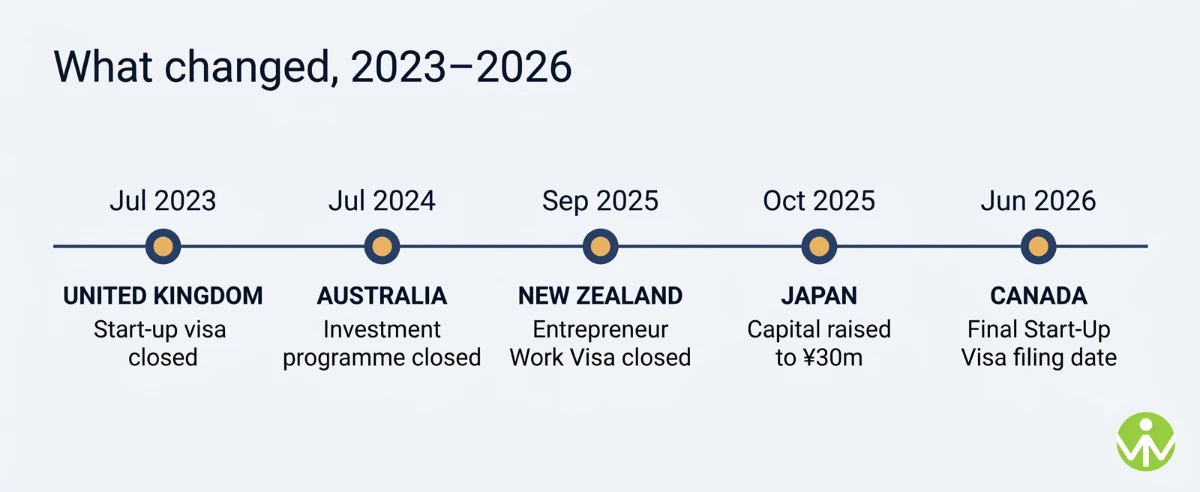
Table 2: Startup visa schemes closed, paused or materially changed
| Country | What changed | Effective | What applies now |
|---|---|---|---|
| United Kingdom | Start-up visa closed to new applications | 13 July 2023 | Innovator Founder visa; endorsement required, no minimum investment |
| Australia | Business Innovation and Investment Program closed | 31 July 2024 | National Innovation Visa, an invitation-only talent route |
| New Zealand | Entrepreneur Work Visa closed to new applications | 27 August 2025 | Business Investor Work Visa from 24 November 2025; NZD 1m or NZD 2m |
| Japan | Business Manager capital requirement raised sixfold | October 2025 | JPY 30 million capital, up from JPY 5 million, plus tighter staffing rules |
| Canada | Start-Up Visa closed to new applicants | Final deadline 30 June 2026 | Closed to all applications; replacement entrepreneur pilot signalled, terms unpublished |
| France | French Tech Ticket cash grant discontinued | Scheme wound down | French Tech Visa under the Talent permit; no grant attached |
| Sources: gov.uk, immi.homeaffairs.gov.au, Immigration New Zealand, Japan Immigration Services Agency, IRCC, welcometofrance.com. Verified August 2026. | |||
What a startup visa costs
Two numbers matter and they are often confused. The first is what you must show — funds in an account, capital in the company, or investment raised. The second is what you pay the government. A scheme with no capital threshold can still be expensive once endorsement and healthcare charges are counted, which is why the United Kingdom sits high on cost despite setting no investment figure at all.
Table 3: What each startup visa costs
| Country | Money you must show | Government fee | Note |
|---|---|---|---|
| Estonia | No capital minimum | EUR 80 (long-stay visa) | Ordinary business permit needs EUR 65,000 |
| Denmark | DKK 153,240 self-support (single) | DKK 3,060 | Higher thresholds with spouse or children |
| Netherlands | No fixed figure | Not published on the IND permit page | Facilitator may finance the stay |
| France | Annual means at the French minimum wage | Standard permit fees apply | Figure moves with SMIC; verify at application |
| Ireland | EUR 50,000 available to the business | EUR 350 (non-refundable) | Quarterly evaluation rounds |
| Italy | Minimum €50,000 in funds (grants and incubator support count) | Standard visa fees apply | Nulla osta within 30 days |
| Spain | No headline minimum | Standard permit fees apply | ENISA innovation report is the real test |
| Portugal | About EUR 5,147 personal funds | Standard visa fees apply | Business must reach EUR 325,000 in 5 years |
| Austria | EUR 30,000 company capital, 50% equity | Standard permit fees apply | Extra EUR 50,000 investment earns 10 points |
| Finland | EUR 1,210 net monthly income | EUR 650 electronic first permit | Income figure varies by region |
| United Kingdom | No minimum investment | GBP 1,357 outside the UK, plus GBP 1,000 endorsement | GBP 500 per check-in meeting, two required |
| Singapore | SGD 100,000 raised, or another qualifying ground | SGD 105 application, SGD 225 issuance | 30% shareholding required |
| Japan | JPY 30,000,000 capital | Standard status fees apply | Raised from JPY 5,000,000 in October 2025 |
| Thailand | THB 600,000 deposit held 3 months | Standard SMART visa fees apply | THB 180,000 per family member |
| New Zealand | NZD 1,000,000 or NZD 2,000,000 | NZD 12,380 including levy | Plus NZD 500,000 settlement funds |
| United States | USD 311,071 qualified investment | Form I-941 filing fee applies | International Entrepreneur Rule parole, not a visa |
| Figures as published by official sources in August 2026 and subject to change. Currency conversions in the article link to xe.com. Fees exclude healthcare surcharges, legal costs and biometrics. | |||
Does a startup visa lead to permanent residency?
Usually, but rarely quickly and almost never automatically. The standard shape is a temporary permit of one to three years, renewable if the business meets whatever benchmark the scheme set, converting to permanent residence after five years of lawful residence under the country’s general rules rather than under the scheme itself.
Canada was the exception that everyone cited, and it is the exception that has now closed. The United Kingdom is now the fastest realistic route among open schemes, with settlement possible after three years on the Innovator Founder visa. Austria’s move from the Red-White-Red Card to the Card plus after 24 months is the next quickest, though that is unrestricted labour market access rather than permanence.
The renewal test is the part founders underestimate. Most schemes ask at the first renewal what the business has actually done — jobs created, revenue booked, further investment raised. A startup visa granted on a plan is renewed on results.
How to choose a startup visa
Start by working out which of the three filters you can pass. If you have money but no endorsement, Austria and Ireland are reachable and Denmark and Italy are not. If you have a credible venture and a network but limited capital, the endorsement-based schemes in Estonia, Denmark, Italy, France and Portugal are the realistic set. If you hold registered intellectual property, Korea’s D-8-4 turns that into a direct qualification.
Then check the renewal test before the entry test. A one-year Dutch permit that expects you to graduate to self-employed status in twelve months is a different commitment from a two-year Danish permit extendable in three-year blocks.
Finally, be honest about whether a startup visa is what you need at all. Founders whose work is genuinely location-independent and who are not raising local capital are often better served by a digital nomad visa, which asks for income rather than a business plan and carries none of the endorsement machinery. Founders from India weighing several destinations may also find our survey of entrepreneur destinations a useful starting point.
Frequently asked questions
Which country has the easiest startup visa to get?
There is no single easiest route, because the schemes filter on different things. Estonia and Denmark set no capital threshold, which makes them the most accessible for founders without money, but both require an expert panel to approve the business first. Austria and Ireland are the most predictable if you have capital, because the test is a published number rather than a judgement call.
Can I get a startup visa without any investment?
Yes. Estonia, Denmark, the Netherlands, Italy, France and Portugal set no minimum investment in the business. You will still need to show you can support yourself, and every one of those schemes substitutes an endorsement or expert assessment for the money test.
Does the United States have a startup visa?
No. It never has. The International Entrepreneur Rule provides parole rather than a visa and requires a qualified investment of at least USD 311,071. Most founders use the E-2 treaty investor visa, which depends on holding the nationality of a treaty country, or the O-1A.
Is Canada’s Start-Up Visa still open?
No. The only route in required a valid 2025 commitment certificate and an application filed by 30 June 2026, and both of those deadlines have passed. A replacement entrepreneur pilot has been signalled but its terms have not been published.
What happened to the UK Start-up visa?
It closed to new applications on 13 July 2023. The Innovator Founder visa replaced it. The main practical differences are that the Innovator Founder route has no minimum investment figure, permits work outside the business, and can lead to settlement after three years.
How long does a startup visa last?
One to three years initially, depending on the country. The Netherlands grants one year, Estonia up to 365 days, Austria and Denmark two years, the United Kingdom and Germany three, and France up to four. Almost all are renewable if the business meets the scheme’s benchmarks.